
uspto-grants-1993_09 · 10.6084/m9.figshare.5104873.v1 · US05246928
查看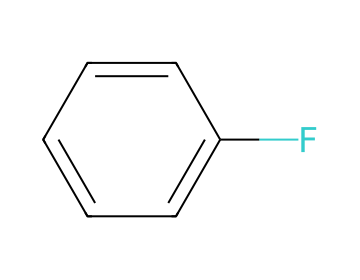
IDENTITY
COMPUTED
PROPERTIES
1.0225 at 68 °F (USCG, 1999) - Denser than water; will sink
1.024 @25 °C
1 to 10 mg/mL at 68 °F (NTP, 1992)
5 °F (NTP, 1992)
185.2 °F at 760 mmHg (NTP, 1992)
85.2 °C @760 [mm Hg]
-42.2 °F (NTP, 1992)
-40 °C
3.31 (NTP, 1992) - Heavier than air; will sink (Relative to Air)
60 mmHg at 67.3 °F ; 100 mmHg at 86.7 °F (NTP, 1992)
77.2 [mmHg]
Fluorobenzene appears as a clear, colorless liquid with a characteristic aromatic odor. About the same density as water. Flash point 5 °F. Vapors heavier than air. May irritate the skin, eyes, and mucous membranes. Used as an insecticide, larvacide and as a reagent for plastic or resin polymers.
Liquid with an odor of benzene; [Merck Index] Colorless liquid with an aromatic odor; [Alfa Aesar MSDS]
659.4;654.4;664;664;663.2;668;671.5;672.6;673.9;671;674;663;659;681;662.5
674;674;664.9;664.1;697.9;664.6;666;680;680;651.3;665.9;643;681;651;684;622
992;996;1003.6
GHS
This chemical does not meet GHS hazard criteria for 0.7% (2 of 300) of reports.
Danger
H225 (99%): Highly Flammable liquid and vapor [Danger Flammable liquids];H318 (67%): Causes serious eye damage [Danger Serious eye damage/eye irritation];H319 (29.3%): Causes serious eye irritation [Warning Serious eye damage/eye irritation];H411 (57.7%): Toxic to aquatic life with long lasting effects [Hazardous to the aquatic environment, long-term hazard];H412 (24.7%): Harmful to aquatic life with long lasting effects [Hazardous to the aquatic environment, long-term hazard]
P210, P233, P240, P241, P242, P243, P264+P265, P273, P280, P303+P361+P353, P305+P351+P338, P305+P354+P338, P317, P337+P317, P370+P378, P391, P403+P235, and P501 (click each P-code to see the statement)
Aggregated GHS information provided per 300 reports by companies from 16 notifications to the ECHA C&L Inventory. Each notification may be associated with multiple companies.;Reported as not meeting GHS hazard criteria per 2 of 300 reports by companies.;There are 15 notifications provided by 298 of 300 reports by companies with hazard statement code(s).;Information may vary between notifications depending on impurities, additives, and other factors. The percentage value in parenthesis indicates the notified classification ratio from companies that provide hazard codes. Only hazard codes with percentage values above 10% are shown. For more detailed information, please visit ECHA C&L website.
HAZARDS
Chemical: Benzene, fluoro-
Status: Active Update: 15-12-2022 https://echa.europa.eu/registration-dossier/-/registered-dossier/22723;Status: Active Update: 02-05-2023 https://echa.europa.eu/registration-dossier/-/registered-dossier/1885
Fluorobenzene: Does not have an individual approval but may be used under an appropriate group standard
The New Jersey Worker and Community Right to Know Act requires public and private employers to provide information about hazardous substances at their workplaces. (N.J.S.A. 34:5A-1 et. seq.)
Flammable Liquid
Special Hazards of Combustion Products: Burning in open flame can form toxic hydrogen fluoride gases.;Behavior in Fire: Heavy vapor can travel a considerable difference to a source of ignition and flash back. (USCG, 1999)
· HIGHLY FLAMMABLE: Will be easily ignited by heat, sparks or flames.;· Vapors may form explosive mixtures with air.;· Vapors may travel to source of ignition and flash back.;· Most vapors are heavier than air. They will spread along the ground and collect in low or confined areas (sewers, basements, tanks, etc.).;· Vapor explosion hazard indoors, outdoors or in sewers.;· Those substances designated with a (P) may polymerize explosively when heated or involved in a fire.;· Runoff to sewer may create fire or explosion hazard.;· Containers may explode when heated.;· Many liquids will float on water.
Irritating to skin, eyes and mucous membranes. Repeated exposure of skin may cause dermatitis due to defatting action. Chronic inhalation of vapors or mist may result to damage to lungs, liver and kidneys. Acute vapor exposures can cause symptoms ranging from coughing to transient anesthesia and central nervous system depression. (USCG, 1999)
· May cause toxic effects if inhaled or absorbed through skin.;· Inhalation or contact with material may irritate or burn skin and eyes.;· Fire will produce irritating, corrosive and/or toxic gases.;· Vapors may cause dizziness or asphyxiation, especially when in closed or confined areas.;· Runoff from fire control or dilution water may cause environmental contamination.
Causes general anesthesia in inhalation lethal-concentration studies of mice; [RTECS] A 28-day inhalation study of rats produced adaptive liver changes (not considered toxicologically significant), and increased fluoride concentrations in bones and teeth; Not likely to cause developmental toxicity or teratogenicity, based on software modeling and a structurally similar compound (chlorobenzene); [EPA ChAMP: Submissions - Submission] May cause smarting and reddening of skin if spilled and allowed to remain on clothes; Vapor exposure may cause coughing, transient anesthesia, and CNS depression; Chronic inhalation exposure may cause lung, liver, and kidney injury; [CHRIS] A skin, eye, nose, and throat irritant; [ToxPlanet: FAHG] An irritant; [NTP] A mild skin and strong eye irritant; Vapors may cause narcotic effects; [Alfa Aesar MSDS] See Chlorobenzene.
2387 130
Aryl Halides
Highly Flammable
Incompatible with strong oxidizing agents. (NTP, 1992)
Fluorobenzene
UN2387
Class 3 Flammable and combustible liquid (49 eCFR § 173.120)
PG II: the degree of danger presented by the material is medium;For more information about the packing group assignment, please visit 49 eCFR § 173
Highly flammable. Slightly soluble in water.
Flam. Liq. 2 (99%);Eye Dam. 1 (67%);Eye Irrit. 2A (29.3%);Aquatic Chronic 2 (57.7%);Aquatic Chronic 3 (24.7%)
Flammable agents - 3rd degree
SAFETY
Excerpt from ERG Guide 130 [Flammable Liquids (Water-Immiscible / Noxious)]:;CAUTION: The majority of these products have a very low flash point. Use of water spray when fighting fire may be inefficient.;SMALL FIRE: Dry chemical, CO2, water spray or regular foam. If regular foam is ineffective or unavailable, use alcohol-resistant foam.;LARGE FIRE: Water spray, fog or regular foam. If regular foam is ineffective or unavailable, use alcohol-resistant foam. Avoid aiming straight or solid streams directly onto the product. If it can be done safely, move undamaged containers away from the area around the fire.;FIRE INVOLVING TANKS, RAIL TANK CARS OR HIGHWAY TANKS: Fight fire from maximum distance or use unmanned master stream devices or monitor nozzles. Cool containers with flooding quantities of water until well after fire is out. Withdraw immediately in case of rising sound from venting safety devices or discoloration of tank. ALWAYS stay away from tanks in direct contact with flames. For massive fire, use unmanned master stream devices or monitor nozzles; if this is impossible, withdraw from area and let fire burn. (ERG, 2024)
· CALL 911. Then call emergency response telephone number on shipping paper. If shipping paper not available or no answer, refer to appropriate telephone number listed on the inside back cover.;· Keep unauthorized personnel away.;· Stay upwind, uphill and/or upstream.;· Ventilate closed spaces before entering, but only if properly trained and equipped.
· ELIMINATE all ignition sources (no smoking, flares, sparks or flames) from immediate area.;· All equipment used when handling the product must be grounded.;· Do not touch or walk through spilled material.;· Stop leak if you can do it without risk.;· Prevent entry into waterways, sewers, basements or confined areas.;· A vapor-suppressing foam may be used to reduce vapors.;· Absorb or cover with dry earth, sand or other non-combustible material and transfer to containers.;· Use clean, non-sparking tools to collect absorbed material.;Large Spill;· Dike far ahead of liquid spill for later disposal.;· Water spray may reduce vapor, but may not prevent ignition in closed spaces.
EYES: First check the victim for contact lenses and remove if present. Flush victim's eyes with water or normal saline solution for 20 to 30 minutes while simultaneously calling a hospital or poison control center. Do not put any ointments, oils, or medication in the victim's eyes without specific instructions from a physician. IMMEDIATELY transport the victim after flushing eyes to a hospital even if no symptoms (such as redness or irritation) develop.;SKIN: IMMEDIATELY flood affected skin with water while removing and isolating all contaminated clothing. Gently wash all affected skin areas thoroughly with soap and water. If symptoms such as redness or irritation develop, IMMEDIATELY call a physician and be prepared to transport the victim to a hospital for treatment.;INHALATION: IMMEDIATELY leave the contaminated area; take deep breaths of fresh air. If symptoms (such as wheezing, coughing, shortness of breath, or burning in the mouth, throat, or chest) develop, call a physician and be prepared to transport the victim to a hospital. Provide proper respiratory protection to rescuers entering an unknown atmosphere. Whenever possible, Self-Contained Breathing Apparatus (SCBA) should be used; if not available, use a level of protection greater than or equal to that advised under Protective Clothing.;INGESTION: DO NOT INDUCE VOMITING. Volatile chemicals have a high risk of being aspirated into the victim's lungs during vomiting which increases the medical problems. If the victim is conscious and not convulsing, give 1 or 2 glasses of water to dilute the chemical and IMMEDIATELY call a hospital or poison control center. IMMEDIATELY transport the victim to a hospital. If the victim is convulsing or unconscious, do not give anything by mouth, ensure that the victim's airway is open and lay the victim on his/her side with the head lower than the body. DO NOT INDUCE VOMITING. IMMEDIATELY transport the victim to a hospital. (NTP, 1992)
General First Aid:;· Call 911 or emergency medical service.;· Ensure that medical personnel are aware of the material(s) involved, take precautions to protect themselves and avoid contamination.;· Move victim to fresh air if it can be done safely.;· Administer oxygen if breathing is difficult.;· If victim is not breathing:;-- DO NOT perform mouth-to-mouth resuscitation; the victim may have ingested or inhaled the substance.;-- If equipped and pulse detected, wash face and mouth, then give artificial respiration using a proper respiratory medical device (bag-valve mask, pocket mask equipped with a one-way valve or other device).;-- If no pulse detected or no respiratory medical device available, provide continuous compressions. Conduct a pulse check every two minutes or monitor for any signs of spontaneous respirations.;· Remove and isolate contaminated clothing and shoes.;· For minor skin contact, avoid spreading material on unaffected skin.;· In case of contact with substance, remove immediately by flushing skin or eyes with running water for at least 20 minutes.;· For severe burns, immediate medical attention is required.;· Effects of exposure (inhalation, ingestion, or skin contact) to substance may be delayed.;· Keep victim calm and warm.;· Keep victim under observation.;· For further assistance, contact your local Poison Control Center.;· Note: Basic Life Support (BLS) and Advanced Life Support (ALS) should be done by trained professionals.;Specific First Aid:;· Wash skin with soap and water.
· Wear positive pressure self-contained breathing apparatus (SCBA).;· Structural firefighters' protective clothing provides thermal protection but only limited chemical protection.
Excerpt from ERG Guide 130 [Flammable Liquids (Water-Immiscible / Noxious)]:;ELIMINATE all ignition sources (no smoking, flares, sparks or flames) from immediate area. All equipment used when handling the product must be grounded. Do not touch or walk through spilled material. Stop leak if you can do it without risk. Prevent entry into waterways, sewers, basements or confined areas. A vapor-suppressing foam may be used to reduce vapors. Absorb or cover with dry earth, sand or other non-combustible material and transfer to containers. Use clean, non-sparking tools to collect absorbed material.;LARGE SPILL: Dike far ahead of liquid spill for later disposal. Water spray may reduce vapor, but may not prevent ignition in closed spaces. (ERG, 2024)
Excerpt from ERG Guide 130 [Flammable Liquids (Water-Immiscible / Noxious)]:;IMMEDIATE PRECAUTIONARY MEASURE: Isolate spill or leak area for at least 50 meters (150 feet) in all directions.;LARGE SPILL: Consider initial downwind evacuation for at least 300 meters (1000 feet).;FIRE: If tank, rail tank car or highway tank is involved in a fire, ISOLATE for 800 meters (1/2 mile) in all directions; also, consider initial evacuation for 800 meters (1/2 mile) in all directions. (ERG, 2024)
Immediate precautionary measure;· Isolate spill or leak area for at least 50 meters (150 feet) in all directions.;Large Spill;· Consider initial downwind evacuation for at least 300 meters (1000 feet).;Fire;· If tank, rail tank car or highway tank is involved in a fire, ISOLATE for 800 meters (1/2 mile) in all directions; also, consider initial evacuation for 800 meters (1/2 mile) in all directions.
24 [mg/m3]
260 [mg/m3]
1600 [mg/m3]
Organic vapor-acid gas respirator where appropriate; neoprene or vinyl gloves; chemical safety spectacles, plus face shield where appropriate; rubber footwear; apron or impervious clothing for splash protection; hard hat. (USCG, 1999)
CAUTION: The majority of these products have a very low flash point. Use of water spray when fighting fire may be inefficient.;Small Fire;· Dry chemical, CO2, water spray or regular foam. If regular foam is ineffective or unavailable, use alcohol-resistant foam.;Large Fire;· Water spray, fog or regular foam. If regular foam is ineffective or unavailable, use alcohol-resistant foam.;· Avoid aiming straight or solid streams directly onto the product.;· If it can be done safely, move undamaged containers away from the area around the fire.;Fire Involving Tanks, Rail Tank Cars or Highway Tanks;· Fight fire from maximum distance or use unmanned master stream devices or monitor nozzles.;· Cool containers with flooding quantities of water until well after fire is out.;· Withdraw immediately in case of rising sound from venting safety devices or discoloration of tank.;· ALWAYS stay away from tanks in direct contact with flames.;· For massive fire, use unmanned master stream devices or monitor nozzles; if this is impossible, withdraw from area and let fire burn.
TOXICITY
Neurotoxin - Acute solvent syndrome
LC50 (rat) = 26,908 mg/m3
0.03
SCREEN Current
Fluorobenzene
PDF Document
Inadequate information to assess carcinogenic potential
2011
REGULATORY
Chemical: Benzene, fluoro-
Status: Active Update: 15-12-2022 https://echa.europa.eu/registration-dossier/-/registered-dossier/22723;Status: Active Update: 02-05-2023 https://echa.europa.eu/registration-dossier/-/registered-dossier/1885
Fluorobenzene: Does not have an individual approval but may be used under an appropriate group standard
The New Jersey Worker and Community Right to Know Act requires public and private employers to provide information about hazardous substances at their workplaces. (N.J.S.A. 34:5A-1 et. seq.)
USES
Used to control carbon content in steel manufacturing, as an identification reagent for plastic and resin polymers, and as an intermediate for insecticides and larvicides; [NTP] Used as an intermediate for pharmaceuticals, pesticides, and other organic compounds; [EPA - PPRTV]
Steel Producing [Category: Industry]
Benzene, fluoro-: ACTIVE
ALIASES
REACTIONS
uspto-grants-1993_09 · 10.6084/m9.figshare.5104873.v1 · US05246928
查看
uspto-grants-1979_04 · 10.6084/m9.figshare.5104873.v1 · US04151285
查看
uspto-grants-1988_08 · 10.6084/m9.figshare.5104873.v1 · US04766125
查看
uspto-grants-1988_08 · 10.6084/m9.figshare.5104873.v1 · US04766125
查看
uspto-grants-1988_08 · 10.6084/m9.figshare.5104873.v1 · US04766125
查看
uspto-grants-1995_05 · 10.6084/m9.figshare.5104873.v1 · US05412066
查看
uspto-grants-2013_09 · 10.6084/m9.figshare.5104873.v1 · US08541431B2
查看
uspto-grants-1986_09 · 10.6084/m9.figshare.5104873.v1 · US04614833
查看