
750 AstraZeneca ELN dataset
查看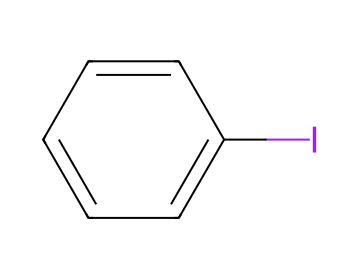
IDENTITY
COMPUTED
PROPERTIES
log Kow = 3.25
1.808 g/cu cm at 20 °C
1.823 @25 °C
Liquid
Soluble in ethanol; slightly soluble in ether, DMSO
Miscible with acetone, benzene, carbon tetrachloride, and ligroin
In water, 340 mg/L at 30 °C
77 °C (171 °F) - closed cup
188.4 °C
188 °C @760 [mm Hg]
Upon decomposition it emits toxic fumes of /iodine/.
-31.3 °C
1.06 [mmHg]
1.06 mm Hg at 25 °C (extrapolated)
Index of refraction = 1.6200 at 20 °C/D
Colorless liquid; [Merck Index]
1033;1075;1050;1038.5;1024.2;1033;1033
1079.6;1088;1088;1081.1;1061;1045
1569;1571.8;1569
GHS
This chemical does not meet GHS hazard criteria for 1.8% (1 of 57) of reports.
Warning
H302 (98.2%): Harmful if swallowed [Warning Acute toxicity, oral];H319 (77.2%): Causes serious eye irritation [Warning Serious eye damage/eye irritation];H332 (12.3%): Harmful if inhaled [Warning Acute toxicity, inhalation]
P261, P264, P264+P265, P270, P271, P280, P301+P317, P304+P340, P305+P351+P338, P317, P330, P337+P317, and P501 (click each P-code to see the statement)
Aggregated GHS information provided per 57 reports by companies from 8 notifications to the ECHA C&L Inventory. Each notification may be associated with multiple companies.;Reported as not meeting GHS hazard criteria per 1 of 57 reports by companies.;There are 7 notifications provided by 56 of 57 reports by companies with hazard statement code(s).;Information may vary between notifications depending on impurities, additives, and other factors. The percentage value in parenthesis indicates the notified classification ratio from companies that provide hazard codes. Only hazard codes with percentage values above 10% are shown. For more detailed information, please visit ECHA C&L website.
HAZARDS
Chemical: Benzene, iodo-
Iodobenzene: Does not have an individual approval but may be used under an appropriate group standard
An irritant; [MSDSonline]
Acute Tox. 4 (98.2%);Eye Irrit. 2 (77.2%);Acute Tox. 4 (12.3%)
Explodes when heated about 200 °C.
Causes respiratory tract irritation. ... Causes skin irritation. Causes eye irritation.
CSL00203
2-(tert-butylsulfonyl)iodosylbenzene + Hydrogen peroxide + Iodobenzene + Peracetic acid
"We are writing to report on an accident that occurred in the chemistry department at Northwestern University on Dec. 3, 2010. Unfortunately, one of our advisees was seriously injured. The accident—a reaction mixture detonation—occurred during an attempt to synthesize 2-(tert-butylsulfonyl)iodosylbenzene, a partially soluble form of iodosylbenzene that is particularly convenient for use as an oxygen source in studies of catalytic chemical oxidations, such as olefin to epoxide reactions. The synthesis had been performed about a dozen times previously at Northwestern without incident. The synthesis procedure was a modified version of a procedure first described by Dainius Macikenas and coworkers (J. Am. Chem. Soc., DOI: 10.1021/ja991094j), which in turn had been adapted from a tested “Organic Syntheses” preparation (Sharefkin, J. G. and H. Saltzman, in “Organic Syntheses”; H. C. Baumgarten, Ed.; New York: John Wiley & Sons, 1973; Collection Vol. 5, page 660). One modification was the use of a higher H2O2/iodobenzene ratio (25 instead of 2.8) while maintaining a similar H2O2 concentration. Likely more relevant was a second modification: the use of 35% by weight (freshly opened) hydrogen peroxide, rather than the 30 wt % solution indicated in the Macikenas procedure and used previously at Northwestern. We do not know with any certainty what caused the explosion. However, the procedure entails combining aqueous H2O2 with acetic anhydride to form peracetic acid. The water component of the aqueous H2O2 solution should serve to remove excess acetic anhydride. We speculate that if some acetic anhydride remained after conversion of the majority to peracetic acid (the desired intermediate compound) or acetic acid (side product), the anhydride could have combined with peracetic acid to form diacetyl peroxide. This organic peroxide is known to be a shock-sensitive explosive. If our reasoning is correct, the amount of diacetyl peroxide that potentially can form is greater in t
Explosive
Not Available
10.1021/cen-v089n002.p002
SAFETY
Suitable extinguishing media: Use water spray, alcohol-resistant foam, dry chemical or carbon dioxide. Special protective equipment for fire-fighters: Wear self contained breathing apparatus for fire fighting if necessary.
Keep container tightly closed in a dry and well-ventilated place. Containers which are opened must be carefully resealed and kept upright to prevent leakage. Light sensitive.
Accidental Release Measures. Personal precautions: Use personal protective equipment. Avoid breathing vapors, mist or gas. Ensure adequate ventilation. Environmental precautions: Do not let product enter drains. Methods for cleaning up: Soak up with inert absorbent material and dispose of as hazardous waste. Keep in suitable, closed containers for disposal.
SRP: The most favorable course of action is to use an alternative chemical product with less inherent propensity for occupational harm/injury/toxicity or environmental contamination. Recycle any unused portion of the material for its approved use or return it to the manufacturer or supplier. Ultimate disposal of the chemical must consider: the material's impact on air quality; potential migration in soil or water; effects on animal and plant life; and conformance with environmental and public health regulations.
Handle with gloves. Choose body protection according to the amount and concentration of the dangerous substance at the work place.
Handle in accordance with good industrial hygiene and safety practice. Wash hands before breaks and at the end of workday.
If inhaled, move person into fresh air. If not breathing give artificial respiration. Consult a physician. In case of skin contact, wash off with soap and plenty of water. Consult a physician. In case of eye contact, rinse thoroughly with plenty of water for at least 15 minutes and consult a physician. If swallowed, never give anything by mouth to an unconscious person. Rinse mouth with water. Consult a physician.
SRP: The scientific literature for the use of contact lenses by industrial workers is inconsistent. The benefits or detrimental effects of wearing contact lenses depend not only upon the substance, but also on factors including the form of the substance, characteristics and duration of the exposure, the uses of other eye protection equipment, and the hygiene of the lenses. However, there may be individual substances whose irritating or corrosive properties are such that the wearing of contact lenses would be harmful to the eye. In those specific cases, contact lenses should not be worn. In any event, the usual eye protection equipment should be worn even when contact lenses are in place.
5.2 [mg/m3]
58 [mg/m3]
350 [mg/m3]
Where risk assessment shows air-purifying respirators are appropriate use a full-face respirator with multipurpose combination (US) or type ABEK (EN 14387) respirator cartridges as a backup to engineering controls. If the respirator is the sole means of protection, use a full-face supplied air respirator. Use respirators and components tested and approved under appropriate government standards such as NIOSH (US) or CEN (EU).
Eye protection: Safety glasses
TOXICITY
Hypothyroidism was produced in weanling albino rats by the oral administration of 2-thiouracil (TU) for 110 days. These animals recorded nearly 50% reduction in mitochondrial oxidation of succinate, protein content and the activity of inner mitochondrial membrane-bound beta-hydroxybutyrate dehydrogenase. Administration of iodobenzene (IB; 0.1 ug/rat/day) and L-thyroxine (T4; 0.6 ug/rat/day) to two sets of hypothyroid rats restored the reduced oxidation rate, enzyme activity and protein content to near normal values. IB was comparable to T4 and may act as a thyroid stimulant.
TERRESTRIAL FATE: Based on a classification scheme(1), a log Koc value of 3.10(2) indicates that iodobenzene is expected to have low mobility in soil(SRC). Volatilization of iodobenzene from moist soil surfaces is expected to be an important fate process(SRC) given an estimated Henry's Law constant of 8.4X10⁻⁴ atm-cu m/mole(SRC), based upon its vapor pressure, 1.06 mm Hg(3), and water solubility, 340 mg/L(4). Iodobenzene is expected to volatilize from dry soil surfaces(SRC) based upon its vapor pressure(3). Iodobenzene has been shown to biodegrade anaerobically in sediment/water slurries with reported half-lives of 13 to 87 days(5-6).
AQUATIC FATE: Based on a classification scheme(1), a log Koc value of 3.10(2) indicates that iodobenzene is expected to adsorb to suspended solids and sediment(SRC). Volatilization from water surfaces is expected(3) based upon an estimated Henry's Law constant of 8.4X10⁻⁴ atm-cu m/mole(SRC), derived from its vapor pressure, 1.06 mm Hg(4), and water solubility, 340 mg/L(5). Using this Henry's Law constant and an estimation method(3), volatilization half-lives for a model river and model lake are 6 hours and 6 days, respectively(SRC). According to a classification scheme(6), an estimated BCF of 65(SRC), from its log Kow of 3.25(7) and a regression-derived equation(8), suggests the potential for bioconcentration in aquatic organisms is moderate(SRC). Iodobenzene is not expected to undergo hydrolysis in the environment due to the lack of functional groups that hydrolyze under environmental conditions(3). Iodobenzene has been shown to biodegrade anaerobically in sediment/water slurries with reported half-lives of 13 to 87 days(9-10).
ATMOSPHERIC FATE: According to a model of gas/particle partitioning of semivolatile organic compounds in the atmosphere(1), iodobenzene, which has a vapor pressure of 1.06 mm Hg at 25 °C(2), is expected to exist solely as a vapor in the ambient atmosphere. Vapor-phase iodobenzene is degraded in the atmosphere by reaction with photochemically-produced hydroxyl radicals(SRC); the half-life for this reaction in air is estimated to be 15 days(SRC), calculated from its rate constant of 1.1X10⁻¹² cu cm/molecule-sec at 25 °C(3). Iodobenzene is not expected to undergo hydrolysis in the environment due to the lack of functional groups that hydrolyze under environmental conditions(2). Iodobenzene does absorb light at wavelengths >290 nm(4) and therefore may be susceptible to direct photolysis by sunlight(SRC).
The log Koc of iodobenzene has been reported as 3.10(1). According to a classification scheme(2), this Koc value suggests that iodobenzene is expected to have low mobility in soil.
/SIGNS AND SYMPTOMS/ Causes respiratory tract irritation. May be harmful if absorbed through skin. Causes skin irritation. Causes eye irritation. Harmful if swallowed.
Iodobenzene's production and use as a chemical reagent(1) may result in its release to the environment through various waste streams(SRC).
ANAEROBIC: Sediment/water from the freshwater stream Loosdrechtse Plassen (sediment/water ratio 0.047g/g, 33% organic carbon, pH 6.5), located in the Netherlands, degraded iodobenzene with reported biodegradation half-lives of 13 to 29 days(1). Sediment/water from the Tsurumi river, Japan was used to determine the biodegradation of iodobenzene; after anaerobic incubation for one year at 25 °C, 98.7% of the added iodobenzene was biodegraded with a half-life of 87 days(2).
An estimated BCF of 65 was calculated in fish for iodobenzene(SRC), using a log Kow of 3.25(1) and a regression-derived equation(2). According to a classification scheme(3), this BCF suggests the potential for bioconcentration in aquatic organisms is moderate(SRC).
The Henry's Law constant for iodobenzene is estimated as 8.4X10⁻⁴ atm-cu m/mole(SRC) derived from its vapor pressure, 1.06 mm Hg(1), and water solubility, 340 mg/L(2). This Henry's Law constant indicates that iodobenzene is expected to volatilize from water surfaces(3). Based on this Henry's Law constant, the volatilization half-life from a model river (1 m deep, flowing 1 m/sec, wind velocity of 3 m/sec)(3) is estimated as 6 hours(SRC). The volatilization half-life from a model lake (1 m deep, flowing 0.05 m/sec, wind velocity of 0.5 m/sec)(3) is estimated as 6 days(SRC). Iodobenzene's estimated Henry's Law constant indicates that volatilization from moist soil surfaces may occur(SRC). The potential for volatilization of iodobenzene from dry soil surfaces may exist(SRC) based upon its vapor pressure(1).
/LABORATORY ANIMALS: Acute Exposure/ NMRI Albino mice, in which the hepatic glutathione (GSH) content was decreased by nearly 50% by either the administration of a pure glucose diet or by starvation, were intoxicated with aryl halides, bromobenzene, and iodobenzene (13 and 9 mmol/kg body weight, respectively, po). After both intoxications, the hepatic glutathione content decreased rapidly to very low values, and liver necrosis, as assessed by serum transaminase levels, occurred in about 45 or 60% of the animals (in the case of bromobenzene or iodobenzene, respectively) after a lag phase of 9 or 6 hr. In both instances liver necrosis was evident only when the hepatic GSH depletion reached a threshold value (3.5-2.5 nmols/mg protein). The same threshold value was evident for the occurrence of lipid peroxidation (measured as both carbonyl functions and conjugated dienes in liver phospholipids). The possibility that the depletion in hepatic GSH level is capable of inducing lipid peroxidation and necrosis could be supported by the fact that similar results were obtained after the administration of diethylmaleate (12 mmol/kg, p.o.), a drug which is expected to conjugate directly with GSH without previous metabolism ...
/LABORATORY ANIMALS: Acute Exposure/ The hepatotoxicity of halogenated aromatic hydrocarbons was investigated in Sprague-Dawley-rats. Male rats received intraperitoneal (ip) injections of 80 mg/kg phenobarbital on 3 successive days. On day 4, animals received ip injections of various doses of organic compounds. Livers were removed after 24 hours and examined ... In rats pretreated with phenobarbital, extensive necrosis was found with treatment of bromobenzene, iodobenzene, chlorobenzene, fluorobenzene, 1,2-dichlorobenzene, 1,3-dichlorobenzene, alpha-chloronaphthalene, beta-chloronaphthalene, and naphthalene. No necrosis was found with 1,4-dichlorobenzene or benzene. Minimal necrosis was seen in rats without phenobarbital pretreatment for bromobenzene, iodobenzene, chlorobenzene, 1,2-dichlorobenzene, and 1,3-dichlorobenzene ...
/ALTERNATIVE and IN VITRO TESTS/ Primary cultures of rat hepatocytes were used to explore the mechanisms of the toxicity of aryl halides. The sensitivity of the hepatocytes to chloro-, bromo-, and iodobenzene was enhanced by inhibition of glutathione reductase with 1,3-bis(2-chloroethyl)-1-nitrosourea (BCNU). In each case, the increased cell killing depended on the metabolism of the toxicant, a result shown by the protective effect of SKF-525A, an inhibitor of mixed function oxidation ...
/OTHER TOXICITY INFORMATION/ The mechanisms of bromobenzene and iodobenzene hepatotoxicity in vivo were studied in mice. Both the intoxications caused a progressive decrease in hepatic glutathione content. In both instances liver necrosis was evident only when the hepatic glutathione depletion reached a threshold value (3.5-2.5 nmol/mg protein). The same threshold value was evident for the occurrence of lipid peroxidation. Similar results were obtained in a group of mice sacrificed 15-20 hr after the administration of diethylmaleate, a drug which is mainly conjugated with hepatic glutathione without previous metabolism. The correlation between lipid peroxidation and liver necrosis was much more significant than that between covalent binding and liver necrosis ...
The rate constant for the vapor-phase reaction of iodobenzene with photochemically-produced hydroxyl radicals has been measured as 1.1X10⁻¹² cu cm/molecule-sec at 25 °C(1). This corresponds to an atmospheric half-life of about 15 days at an atmospheric concentration of 5X10+5 hydroxyl radicals per cu cm(1). Iodobenzene is not expected to undergo hydrolysis in the environment due to the lack of functional groups that hydrolyze under environmental conditions(2). Iodobenzene does absorb light at wavelengths >290 nm(3) and therefore may be susceptible to direct photolysis by sunlight(SRC).
Occupational exposure to iodobenzene may occur through inhalation and dermal contact with this compound at workplaces where iodobenzene is produced or used. (SRC)
Iodobenzene's production and use as a reagent may result in its release to the environment through various waste streams. If released to air, a vapor pressure of 1.06 mm Hg at 25 °C indicates iodobenzene will exist solely as a vapor in the atmosphere. Vapor-phase iodobenzene will be degraded in the atmosphere by reaction with photochemically-produced hydroxyl radicals; the half-life for this reaction in air is estimated to be 15 days. Iodobenzene does absorb light at wavelengths >290 nm and therefore may be susceptible to direct photolysis by sunlight. If released to soil, iodobenzene is expected to have low mobility based upon a log Koc of 3.10. Volatilization from moist soil surfaces is expected to be an important fate process based upon an estimated Henry's Law constant of 8.4X10⁻⁴ atm-cu m/mole. Iodobenzene may volatilize from dry soil surfaces based upon its vapor pressure. Iodobenzene has been shown to biodegrade anaerobically in sediment/water slurries with reported half-lives of 13 to 87 days. If released into water, iodobenzene is expected to adsorb to suspended solids and sediment based upon the Koc. Volatilization from water surfaces is expected to be an important fate process based upon this compound's estimated Henry's Law constant. Estimated volatilization half-lives for a model river and model lake are 6 hours and 6 days, respectively. An estimated BCF of 65 suggests the potential for bioconcentration in aquatic organisms is moderate. Hydrolysis is not expected to be an important environmental fate process since this compound lacks functional groups that hydrolyze under environmental conditions. Occupational exposure to iodobenzene may occur through inhalation and dermal contact with this compound at workplaces where iodobenzene is produced or used. (SRC)
REGULATORY
Chemical: Benzene, iodo-
Iodobenzene: Does not have an individual approval but may be used under an appropriate group standard
PHARMACOLOGY
Iodobenzene has a bimodal effect on the receptor cell tuned to benzoic acid (BA) of the female silk moth Bombyx mori. Exposure to iodobenzene causes an inhibition of the response to BA. With stimulation by iodobenzene alone, a reduction of basic nerve impulse firing during exposure is followed by a transient post-stimulus excitation (rebound). /It was suggested/ that inhibition suppresses excitation during exposure but fades afterwards more rapidly than excitation. Due to the spatial equivalence of the iodine and the acid residue, these effects might indicate opposing interactions of iodobenzene with the specific site for the key compound BA. This is supported by the fact that substitutions by smaller halogens are less effective in both inhibition and rebound ...
The monohydroxylation of halobenzenes by phenobarbital-induced rat liver microsomes was studied. p-Halophenol was the major metabolite from all 4 halobenzenes; o-halophenol formation decreased as the halogen atom size increased. Vmax for total hydroxylation (ortho and para products) correlated well with the sigma + Hammett constant with a negative rho value. This implied a positively charged intermediate in the rate-determining step. Vmax for either ortho or para hydroxylation alone did not correlate with a Hammett constant, implying that the product-determining step occurred after the rate-determining step. Rate-determining formation of a radical cation intermediate probably explained this data. /Halobenzenes/
Detoxification of halogenobenzenes by sulfate, glucuronic-acid, and mercapturic-acid conjugation was studied. Chinchilla-rabbits received oral doses of chlorobenzene, bromobenzene, and iodobenzene equivalent to 150, 210, and 272 mg/kg, respectively ... Ethereal sulfates (E), glucuronides (G), and mercapturic-acids (M) were quantitated in rabbit urine. For chlorobenzene, the percentages of the dose excreted as conjugates were: G, 25.2; E, 26.6; and M, 20.4. For bromobenzene percentages were: G, 40.2; E, 36.8; M, 20.9. For iodobenzene, percentages were: G, 31.3; E, 29.6; M, 22.6 ...
USES
Chemical reagent
Obtained by diazotizing aniline and then treating with an aqueous solution of KI, or by the action of HNO3 on a mixture of C6H6 and iodine.
Benzene, iodo-: ACTIVE
... The aim of this work was the isolation and identification of organic compounds evolved from four commercial resin-modified glass-ionomer cements (resin-based dental materials applied in dentistry) by using an alternative method of volatile compounds analysis-HS-SPME (headspace-solid phase microextraction). Dental materials were heated in closed vial at various temperatures and volatile substances released into the headspace phase above the sample were isolated on a thin polymeric fibre placed in SPME syringe. Identification was performed by using the GC-MS (gas chromatography-mass spectrometry) technique. Almost 50 RMGIC (resin-modified glass-ionomer cement) components (monomers and additives) were identified. The main identified leachables were: iodobenzene (DPICls-diphenyliodonium chloride degradation product), camphorquinone (photo-initiator), tert-butyl-p-hydroxyanisole (inhibitor), 4-(dimethylamino)ethyl benzoate (co-initiator), ethylene glycol dimethacrylate (monomer).
ALIASES
REACTIONS
750 AstraZeneca ELN dataset
查看
750 AstraZeneca ELN dataset
查看
750 AstraZeneca ELN dataset
查看
750 AstraZeneca ELN dataset
查看
750 AstraZeneca ELN dataset
查看
750 AstraZeneca ELN dataset
查看
uspto-grants-1998_03 · 10.6084/m9.figshare.5104873.v1 · US05728500
查看
uspto-grants-1998_03 · 10.6084/m9.figshare.5104873.v1 · US05728500
查看