
uspto-grants-2010_06 · 10.6084/m9.figshare.5104873.v1 · US07732452B2
查看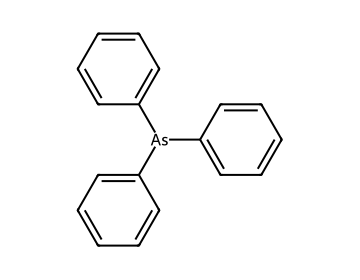
IDENTITY
COMPUTED
PROPERTIES
0.0000496 [mmHg]
White powder; [Alfa Aesar MSDS] Fine colorless crystals; [Aldrich MSDS]
2195
GHS
Danger
H301 (100%): Toxic if swallowed [Danger Acute toxicity, oral];H331 (100%): Toxic if inhaled [Danger Acute toxicity, inhalation];H400 (90.9%): Very toxic to aquatic life [Warning Hazardous to the aquatic environment, acute hazard];H410 (100%): Very toxic to aquatic life with long lasting effects [Warning Hazardous to the aquatic environment, long-term hazard]
P261, P264, P270, P271, P273, P301+P316, P304+P340, P316, P321, P330, P391, P403+P233, P405, and P501 (click each P-code to see the statement)
Aggregated GHS information provided per 44 reports by companies from 4 notifications to the ECHA C&L Inventory. Each notification may be associated with multiple companies.;Information may vary between notifications depending on impurities, additives, and other factors. The percentage value in parenthesis indicates the notified classification ratio from companies that provide hazard codes. Only hazard codes with percentage values above 10% are shown. For more detailed information, please visit ECHA C&L website.
HAZARDS
Restricted substance: Triphenylarsine;EC: 210-032-9;Restriction condition document: PDF link
Triphenylarsine: Does not have an individual approval but may be used under an appropriate group standard
An irritant; Toxic by ingestion and inhalation; [Alfa Aesar MSDS] Almost nothing is known regarding health effects of organic arsenic compounds in humans. Studies in animals show that some simple organic arsenic compounds are less toxic than inorganic forms. Ingestion of methyl and dimethyl compounds can cause diarrhea and damage to the kidneys. [ATSDR ToxProfiles] See Dimethylarsenic acid.
Acute Tox. 3 (100%);Acute Tox. 3 (100%);Aquatic Acute 1 (90.9%);Aquatic Chronic 1 (100%)
SAFETY
Acute Oral: 0.005 mg/kg/day (L134) Chronic Oral: 0.0003 mg/kg/day (L134) Chronic Inhalation: 0.01 mg/m3 (L134)
0.5 [mg/m3], as As
TOXICITY
Arsenic poisoning can be treated by chelation therapy, using chelating agents such as dimercaprol, EDTA or DMSA. Charcoal tablets may also be used for less severe cases. In addition, maintaining a diet high in sulfur helps eliminate arsenic from the body. (L20)
Arsenic poisoning can lead to death from multi-system organ failure, probably from necrotic cell death, not apoptosis. Arsenic is also a known carcinogen, esepcially in skin, liver, bladder and lung cancers. (T1, L20)
Oral (L2) ; inhalation (L2) ; dermal (L2)
Arsenic and its metabolites disrupt ATP production through several mechanisms. At the level of the citric acid cycle, arsenic inhibits pyruvate dehydrogenase and by competing with phosphate it uncouples oxidative phosphorylation, thus inhibiting energy-linked reduction of NAD+, mitochondrial respiration, and ATP synthesis. Hydrogen peroxide production is also increased, which might form reactive oxygen species and oxidative stress. Arsenic's carginogenicity is influenced by the arsenical binding of tubulin, which results in aneuploidy, polyploidy and mitotic arrests. The binding of other arsenic protein targets may also cause altered DNA repair enzyme activity, altered DNA methylation patterns and cell proliferation. (T1, A17)
Exposure to lower levels of arsenic can cause nausea and vomiting, decreased production of red and white blood cells, abnormal heart rhythm, damage to blood vessels, and a sensation of
3, not classifiable as to its carcinogenicity to humans. (L135)
REGULATORY
Restricted substance: Triphenylarsine;EC: 210-032-9;Restriction condition document: PDF link
Triphenylarsine: Does not have an individual approval but may be used under an appropriate group standard
PHARMACOLOGY
Arsenic is absorbed mainly by inhalation or ingestion, as to a lesser extent, dermal exposure. It is then distributed throughout the body, where it is reduced into arsenite if necessary, then methylated into monomethylarsenic (MMA) and dimethylarsenic acid (DMA) by arsenite methyltransferase. Arsenic and its metabolites are primarily excreted in the urine. Arsenic is known to induce the metal-binding protein metallothionein, which decreases the toxic effects of arsenic and other metals by binding them and making them biologically inactive, as well as acting as an antioxidant. (L20)
USES
Triphenylarsine is used as a ligand and a reagent in coordination chemistry and organic synthesis. (L398)
Arsine, triphenyl-: ACTIVE
ALIASES
REACTIONS
uspto-grants-2010_06 · 10.6084/m9.figshare.5104873.v1 · US07732452B2
查看
uspto-grants-2008_09 · 10.6084/m9.figshare.5104873.v1 · US07427636B2
查看
uspto-grants-2008_09 · 10.6084/m9.figshare.5104873.v1 · US07429565B2
查看
uspto-grants-1997_04 · 10.6084/m9.figshare.5104873.v1 · US05618839
查看
uspto-grants-2014_09 · 10.6084/m9.figshare.5104873.v1 · US08822683B2
查看
uspto-grants-2014_09 · 10.6084/m9.figshare.5104873.v1 · US08829012B2
查看
Training data from https://doi.org/10.1039/C8SC04228D (2/10) · 10.1039/C8SC04228D
查看
Training data from https://doi.org/10.1039/C8SC04228D (2/10) · 10.1039/C8SC04228D
查看