
uspto-grants-1979_10 · 10.6084/m9.figshare.5104873.v1 · US04169949
查看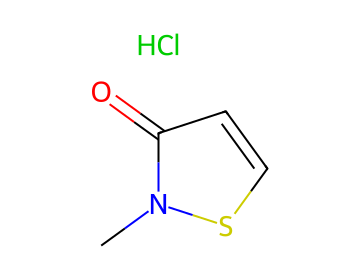
IDENTITY
COMPUTED
PROPERTIES
18.4 [ug/mL] (The mean of the results at pH 7.4)
GHS
Danger
H301 (67.1%): Toxic if swallowed [Danger Acute toxicity, oral];H310+H330 (61.2%): Fatal in contact with skin or if inhaled [Danger Acute toxicity, dermal; acute toxicity, inhalation];H310 (61.2%): Fatal in contact with skin [Danger Acute toxicity, dermal];H314 (100%): Causes severe skin burns and eye damage [Danger Skin corrosion/irritation];H317 (100%): May cause an allergic skin reaction [Warning Sensitization, Skin];H318 (67.1%): Causes serious eye damage [Danger Serious eye damage/eye irritation];H330 (61.2%): Fatal if inhaled [Danger Acute toxicity, inhalation];H334 (32.9%): May cause allergy or asthma symptoms or breathing difficulties if inhaled [Danger Sensitization, respiratory];H400 (66.5%): Very toxic to aquatic life [Warning Hazardous to the aquatic environment, acute hazard];H410 (67.1%): Very toxic to aquatic life with long lasting effects [Warning Hazardous to the aquatic environment, long-term hazard]
P233, P260, P261, P262, P264, P264+P265, P270, P271, P272, P273, P280, P284, P301+P316, P301+P330+P331, P302+P352, P302+P361+P354, P304+P340, P305+P354+P338, P316, P317, P320, P321, P330, P333+P317, P342+P316, P361+P364, P362+P364, P363, P391, P403, P403+P233, P405, and P501 (click each P-code to see the statement)
Aggregated GHS information provided per 170 reports by companies from 6 notifications to the ECHA C&L Inventory. Each notification may be associated with multiple companies.;Information may vary between notifications depending on impurities, additives, and other factors. The percentage value in parenthesis indicates the notified classification ratio from companies that provide hazard codes. Only hazard codes with percentage values above 10% are shown. For more detailed information, please visit ECHA C&L website.
HAZARDS
Chemical: 3(2H)-Isothiazolone, 2-methyl-, hydrochloride
Status: Active Update: 24-02-2022 https://echa.europa.eu/registration-dossier/-/registered-dossier/23630
3(2H)-Isothiazolone, 2-methyl-, hydrochloride: Does not have an individual approval but may be used as a component in a product covered by a group standard. It is not approved for use as a chemical in its own right.
IMAP assessments - 3(2H)-Isothiazolone, 2-methyl-, hydrochloride: Human health tier II assessment;IMAP assessments - Isothiazolinones: Human health tier III assessment;IMAP assessments - Methylisothiazolinone preservatives and industrial biocides: Environment tier II assessment
Acute Tox. 3 (67.1%);Acute Tox. 2 (61.2%);Skin Corr. 1A (100%);Skin Sens. 1 (100%);Eye Dam. 1 (67.1%);Acute Tox. 2 (61.2%);Resp. Sens. 1 (32.9%);Aquatic Acute 1 (66.5%);Aquatic Chronic 1 (67.1%)
Acute toxicity (ingestion) - category 3;Acute toxicity (dermal) - category 3;Acute toxicity (inhalation) - category 2;Skin corrosion - category 1B;Skin sensitisation - category 1A
REGULATORY
Chemical: 3(2H)-Isothiazolone, 2-methyl-, hydrochloride
Status: Active Update: 24-02-2022 https://echa.europa.eu/registration-dossier/-/registered-dossier/23630
3(2H)-Isothiazolone, 2-methyl-, hydrochloride: Does not have an individual approval but may be used as a component in a product covered by a group standard. It is not approved for use as a chemical in its own right.
PHARMACOLOGY
Substances that prevent infectious agents or organisms from spreading or kill infectious agents in order to prevent the spread of infection.
Substances used on inanimate objects that destroy harmful microorganisms or inhibit their activity. Disinfectants are classed as complete, destroying SPORES as well as vegetative forms of microorganisms, or incomplete, destroying only vegetative forms of the organisms. They are distinguished from ANTISEPTICS, which are local anti-infective agents used on humans and other animals. (From Hawley's Condensed Chemical Dictionary, 11th ed)
USES
3(2H)-Isothiazolone, 2-methyl-, hydrochloride (1:1): ACTIVE
ALIASES
REACTIONS

