
uspto-grants-2010_06 · 10.6084/m9.figshare.5104873.v1 · US07728176B2
查看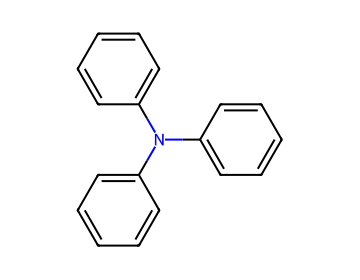
IDENTITY
COMPUTED
PROPERTIES
log Kow= 5.74
5.74
0.774 at 32 °F (NTP, 1992) - Less dense than water; will float
0.774 @ 0 °C/0 °C
0.77 g/cm³
0.77
MONOCLINIC CRYSTALS FROM METHANOL, ETHYL ACETATE, BENZENE
Exist as colorless monoclinic prisms
Colorless solid
less than 1 mg/mL at 68 °F (NTP, 1992)
Insoluble in water, slightly soluble in ethanol, and soluble in ethyl ether and benzene
Solubility in water: very poor
Insoluble
180 °C
180 °C o.c.
657 to 658 °F at 760 mmHg ; 383-401 °F at 10-22 mmHg (NTP, 1992)
365 °C
365 °C
689 °F
When heated to decomposition it emits toxic fumes of /nitrogen oxides/.
261 °F (NTP, 1992)
127 °C
126.5 °C
261 °F
0.000392 [mmHg]
3.92X10⁻⁴ mm Hg @ 25 °C
Index of refraction= 1.353 @ 16 °C/D
7.60 eV
Crystals or off-white lumpy solid. (NTP, 1992)
Colorless solid; [NIOSH]
COLOURLESS-TO-WHITE POWDER WITH CHARACTERISTIC ODOUR.
Colorless solid.
GHS
Warning
H315 (100%): Causes skin irritation [Warning Skin corrosion/irritation];H319 (100%): Causes serious eye irritation [Warning Serious eye damage/eye irritation];H335 (10.2%): May cause respiratory irritation [Warning Specific target organ toxicity, single exposure; Respiratory tract irritation]
P261, P264, P264+P265, P271, P280, P302+P352, P304+P340, P305+P351+P338, P319, P321, P332+P317, P337+P317, P362+P364, P403+P233, P405, and P501 (click each P-code to see the statement)
Aggregated GHS information provided per 49 reports by companies from 4 notifications to the ECHA C&L Inventory. Each notification may be associated with multiple companies.;Information may vary between notifications depending on impurities, additives, and other factors. The percentage value in parenthesis indicates the notified classification ratio from companies that provide hazard codes. Only hazard codes with percentage values above 10% are shown. For more detailed information, please visit ECHA C&L website.
Not Classified
HAZARDS
Chemical: Benzenamine, N,N-diphenyl-
Triphenyl amine: Does not have an individual approval but may be used under an appropriate group standard
The flash point of this chemical has not been determined, but it is probably combustible. (NTP, 1992)
Combustible. Gives off irritating or toxic fumes (or gases) in a fire. Finely dispersed particles form explosive mixtures in air.
Excerpt from NIOSH Pocket Guide for Triphenylamine:;Exposure Routes: Inhalation, ingestion, skin and/or eye contact;Symptoms: In Animals: irritation skin;Target Organs: Skin (NIOSH, 2024)
Eastman Kodak reported no adverse health effects after extensive use of this chemical. [HSDB] A mild skin and eye irritant; [ICSC]
Amines, Phosphines, and Pyridines;Hydrocarbons, Aromatic
ACGIH. Documentation of the threshold limit values and biological exposure indices; 6th Ed: 1658-1659 (1991). TLV-TWA, 5 mg/cu m.
TRIPHENYLAMINE neutralizes acids in exothermic reactions to form salts plus water. May be incompatible with isocyanates, halogenated organics, peroxides, phenols (acidic), epoxides, anhydrides, and acid halides. Flammable gaseous hydrogen may be generated in combination with strong reducing agents, such as hydrides.
Decomposes on burning. This produces toxic fumes including nitrogen oxides. The solution in water is a weak base. Reacts with acids, strong oxidants and halogens.
Dust explosion possible if in powder or granular form, mixed with air.
Insoluble in water.
Recommended Exposure Limit: 10 Hr Time-Weighted Avg: 5 mg/cu m.
Skin Irrit. 2 (100%);Eye Irrit. 2A (100%);STOT SE 3 (10.2%)
Acute toxicity (Oral) - Category 5
SAFETY
Fires involving this material can be controlled with a dry chemical, carbon dioxide, foam or Halon extinguisher. (NTP, 1992)
Use water spray, powder, alcohol-resistant foam, carbon dioxide.
Fresh air, rest.
Rinse and then wash skin with water and soap.
First rinse with plenty of water for several minutes (remove contact lenses if easily possible), then refer for medical attention.
Rinse mouth.
EYES: First check the victim for contact lenses and remove if present. Flush victim's eyes with water or normal saline solution for 20 to 30 minutes while simultaneously calling a hospital or poison control center. Do not put any ointments, oils, or medication in the victim's eyes without specific instructions from a physician. IMMEDIATELY transport the victim after flushing eyes to a hospital even if no symptoms (such as redness or irritation) develop.;SKIN: IMMEDIATELY flood affected skin with water while removing and isolating all contaminated clothing. Gently wash all affected skin areas thoroughly with soap and water. If symptoms such as redness or irritation develop, IMMEDIATELY call a physician and be prepared to transport the victim to a hospital for treatment.;INHALATION: IMMEDIATELY leave the contaminated area; take deep breaths of fresh air. If symptoms (such as wheezing, coughing, shortness of breath, or burning in the mouth, throat, or chest) develop, call a physician and be prepared to transport the victim to a hospital. Provide proper respiratory protection to rescuers entering an unknown atmosphere. Whenever possible, Self-Contained Breathing Apparatus (SCBA) should be used; if not available, use a level of protection greater than or equal to that advised under Protective Clothing.;INGESTION: DO NOT INDUCE VOMITING. If the victim is conscious and not convulsing, give 1 or 2 glasses of water to dilute the chemical and IMMEDIATELY call a hospital or poison control center. Be prepared to transport the victim to a hospital if advised by a physician. If the victim is convulsing or unconscious, do not give anything by mouth, ensure that the victim's airway is open and lay the victim on his/her side with the head lower than the body. DO NOT INDUCE VOMITING. IMMEDIATELY transport the victim to a hospital. (NTP, 1992)
(General first aid procedures);Eye: Irrigate immediately - If this chemical contacts the eyes, immediately wash (irrigate) the eyes with large amounts of water, occasionally lifting the lower and upper lids. Get medical attention immediately.;Skin: Soap wash - If this chemical contacts the skin, wash the contaminated skin with soap and water.;Breathing: Respiratory support;Swallow: Medical attention immediately - If this chemical has been swallowed, get medical attention immediately.
Separated from acids, strong oxidants and halogens.
SMALL SPILLS AND LEAKAGE: If a spill of this chemical occurs, FIRST REMOVE ALL SOURCES OF IGNITION, then you should dampen the solid spill material with acetone and transfer the dampened material to a suitable container. Use absorbent paper dampened with acetone to pick up any remaining material. Seal your contaminated clothing and the absorbent paper in a vapor-tight plastic bag for eventual disposal. Solvent wash all contaminated surfaces with acetone followed by washing with a soap and water solution. Do not reenter the contaminated area until the Safety Officer (or other responsible person) has verified that the area has been properly cleaned.;STORAGE PRECAUTIONS: You should store this material in a refrigerator. (NTP, 1992)
SRP: At the time of review, criteria for land treatment or burial (sanitary landfill) disposal practices are subject to significant revision. Prior to implementing land disposal of waste residue (including waste sludge), consult with environmental regulatory agencies for guidance on acceptable disposal practices.
Personal protection: particulate filter respirator adapted to the airborne concentration of the substance. Sweep spilled substance into covered sealable containers. If appropriate, moisten first to prevent dusting.
The worker should wash daily at the end of each work shift.
Workers whose clothing may have become contaminated should change into uncontaminated clothing before leaving the work premises.
Wear safety goggles.
NO open flames. Closed system, dust explosion-proof electrical equipment and lighting. Prevent deposition of dust.
A harmful concentration of airborne particles can be reached quickly when dispersed, especially if powdered.
Protective gloves.
TOXICITY
Skin
The substance can be absorbed into the body by ingestion.
inhalation, ingestion, skin and/or eye contact
Redness.
Redness.
In Animals: irritation skin
Environmental effects from the substance have not been investigated adequately.
Industrial experience with triphenyl amine ... demonstrated that no injuries occurred as a result of handling of the compound & that no special precautions were necessary for triphenyl amine other than those used for the routine control of organic compounds.
SCREENING TEST IN RATS INDICATED ORAL LD50...TO BE BETWEEN 3200-6400 MG/KG, WHILE IN MICE LD50 VARIED FROM 1600-3200 MG/KG. INTRAPERITONEALLY IN BOTH SPECIES LD50 WAS GREATER THAN 6400 MG/KG. DEATHS OCCURRED IN...ORAL ADMIN IN RATS UP TO 6 DAYS AFTER ADMIN & UP TO 2 DAYS IN...MICE. IP NO DEATHS OCCURRED @ 6400 MG/KG LEVEL.
A 10% SOLN OF COMPD IN MIXT OF 9:1 ACETONE: CORN OIL APPLIED TO DEPILATED SKIN OF GUINEA PIG UNDER OCCLUSIVE COVERING @ CONCN OF 5-20 ML/KG FOR 24 HR PRODUCED ONLY SLIGHT ERYTHEMA WITHOUT EDEMA. CRYSTALS OF SOLID COMPD PLACED IN CONJUNCTIVAL SAC OF RABBIT'S EYE PRODUCED NO EVIDENCE OF DAMAGE AT ANY TIME DURING 2-WEEK PERIOD. ...WAS FOUND NOT TO BE SKIN SENSITIZER IN GUINEA PIG.
INFORMATION MADE AVAILABLE BY EASTMAN KODAK COMPANY REVEALS THAT NO INJURIES HAVE OCCURRED AS RESULT OF HANDLING OF TRIPHENYL AMINE & THAT NO SPECIAL PRECAUTIONS ARE NECESSARY OTHER THAN THOSE USED FOR ROUTINE HANDLING OF ORGANIC COMPD.
Basic treatment: Establish a patent airway. Suction if necessary. Watch for signs of respiratory insufficiency and assist ventilations if necessary. Administer oxygen by nonrebreather mask at 10 to 15 L/min. Monitor for pulmonary edema and treat if necessary ... . Monitor for shock and treat if necessary ... . Anticipate seizures and treat if necessary ... . For eye contamination, flush eyes immediately with water. Irrigate each eye continuously with normal saline during transport ... . Do not use emetics. For ingestion, rinse mouth and administer 5 ml/kg up to 200 ml of water for dilution if the patent can swallow, has a strong gag reflex, and does not drool. Administer activated charcoal ... . Cover skin burns with dry sterile dressings after decontamination ... . /Organic bases/Amines and related compounds/
Advanced treatment: Consider orotracheal or nasotracheal intubation for airway control in the patient who is unconscious or has severe pulmonary edema. Positive-pressure ventilation techniques with a bag-valve-mask device may be beneficial. Monitor cardiac rhythm and treat arrhythmias as necessary ... . Start an IV with D5W /SRP: "To keep open", minimal flow rate/. Use lactated Ringer's if signs of hypovolemia are present. Watch for signs of fluid overload. Administer 1% solution methylene blue if patient is symptomatic with severe hypoxia, cyanosis, and cardiac compromise not responding to oxygen. ... . Consider drug therapy for pulmonary edema ... . For hypotension with signs of hypovolemia, administer fluid cautiously. If patient is unresponsive to these measures, vasopressors may be helpful. Watch for signs of fluid overload ... . Treat seizures with diazepam (Valium) ... . Use proparacaine hydrochloride to assist eye irrigation ... . /Organic bases/Amines and related compounds/
LD50 Mouse Oral 1600-3200 mg/kg Deaths were /SRP: occurred/ up to 2 days after admin.
LD50 Rat Oral 3200-6400 mg/kg Deaths were /SRP: occurred/ up to 11 days after admin.
LD50 Rat & Mouse Intraperitoneal >6400 mg/kg
LD50 Rat oral 3200 mg/kg
LD50 Mouse oral 1600 mg/kg
REGULATORY
Chemical: Benzenamine, N,N-diphenyl-
Triphenyl amine: Does not have an individual approval but may be used under an appropriate group standard
USES
Produced by Eastman Kodak to coat film bases; [HSDB]
Coated on film bases as primary photoconductor
Benzenamine, N,N-diphenyl-: ACTIVE
Industrial experience with triphenylamine at the Eastman Kodak Company demonstrated that no injuries occurred as a result of handling of the compound and that no special precautions were necessary for triphenylamine other than those used for the routine control of organic compounds.
ALIASES
REACTIONS
uspto-grants-2010_06 · 10.6084/m9.figshare.5104873.v1 · US07728176B2
查看
uspto-grants-2010_06 · 10.6084/m9.figshare.5104873.v1 · US07728176B2
查看
uspto-grants-2010_06 · 10.6084/m9.figshare.5104873.v1 · US07728176B2
查看
uspto-grants-2010_06 · 10.6084/m9.figshare.5104873.v1 · US07728176B2
查看
uspto-grants-2010_06 · 10.6084/m9.figshare.5104873.v1 · US07728176B2
查看
uspto-grants-2010_06 · 10.6084/m9.figshare.5104873.v1 · US07728176B2
查看
uspto-grants-1988_08 · 10.6084/m9.figshare.5104873.v1 · US04764625
查看
uspto-grants-1997_04 · 10.6084/m9.figshare.5104873.v1 · US05618980
查看