
uspto-grants-2013_09 · 10.6084/m9.figshare.5104873.v1 · US08541432B2
查看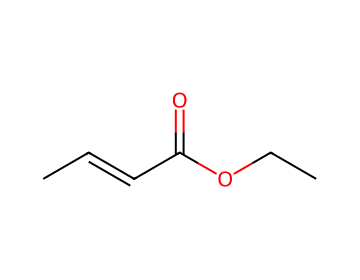
IDENTITY
COMPUTED
PROPERTIES
0.916-0.921
Insoluble in water; soluble in oils
Soluble (in ethanol)
136-137 °C
1.422-1.428
Ethyl crotonate appears as a clear colorless liquid with a pungent odor. Less dense than water and insoluble in water. Vapors heavier than air.
Colorless liquid with a pungent odor; [CAMEO]
Colourless liquid; Powerful sour caramellic-fruity aroma
GHS
Warning
H226 (99.7%): Flammable liquid and vapor [Warning Flammable liquids];H319 (> 99.9%): Causes serious eye irritation [Warning Serious eye damage/eye irritation]
P210, P233, P240, P241, P242, P243, P264+P265, P280, P303+P361+P353, P305+P351+P338, P337+P317, P370+P378, P403+P235, and P501 (click each P-code to see the statement)
Aggregated GHS information provided per 1551 reports by companies from 3 notifications to the ECHA C&L Inventory. Each notification may be associated with multiple companies.;Information may vary between notifications depending on impurities, additives, and other factors. The percentage value in parenthesis indicates the notified classification ratio from companies that provide hazard codes. Only hazard codes with percentage values above 10% are shown. For more detailed information, please visit ECHA C&L website.
HAZARDS
Chemical: 2-Butenoic acid, ethyl ester
2-Butenoic acid, ethyl ester: Does not have an individual approval but may be used under an appropriate group standard
Flammable Liquid
Excerpt from ERG Guide 130 [Flammable Liquids (Water-Immiscible / Noxious)]:;HIGHLY FLAMMABLE: Will be easily ignited by heat, sparks or flames. Vapors may form explosive mixtures with air. Vapors may travel to source of ignition and flash back. Most vapors are heavier than air. They will spread along the ground and collect in low or confined areas (sewers, basements, tanks, etc.). Vapor explosion hazard indoors, outdoors or in sewers. Those substances designated with a (P) may polymerize explosively when heated or involved in a fire. Runoff to sewer may create fire or explosion hazard. Containers may explode when heated. Many liquids will float on water. (ERG, 2024)
Excerpt from ERG Guide 130 [Flammable Liquids (Water-Immiscible / Noxious)]:;May cause toxic effects if inhaled or absorbed through skin. Inhalation or contact with material may irritate or burn skin and eyes. Fire will produce irritating, corrosive and/or toxic gases. Vapors may cause dizziness or asphyxiation, especially when in closed or confined areas. Runoff from fire control or dilution water may cause environmental contamination. (ERG, 2024)
A moderate eye irritant; [RTECS] Safe when used as a flavoring agent in food; [JECFA] An irritant and lachrymator; Ingestion of large quantities may cause CNS depression; Inhalation may cause dizziness or suffocation; [Acros Organics MSDS] See Isopropenyl acetate.
Esters, Sulfate Esters, Phosphate Esters, Thiophosphate Esters, and Borate Esters;Hydrocarbons, Aliphatic Unsaturated
Highly Flammable
ETHYL CROTONATE is an ester. Esters react with acids to liberate heat along with alcohols and acids. Strong oxidizing acids may cause a vigorous reaction that is sufficiently exothermic to ignite the reaction products. Heat is also generated by the interaction of esters with caustic solutions. Flammable hydrogen is generated by mixing esters with alkali metals and hydrides.
Highly flammable. Insoluble in water.
Flam. Liq. 3 (99.7%);Eye Irrit. 2 (> 99.9%)
SAFETY
Excerpt from ERG Guide 130 [Flammable Liquids (Water-Immiscible / Noxious)]:;CAUTION: The majority of these products have a very low flash point. Use of water spray when fighting fire may be inefficient.;SMALL FIRE: Dry chemical, CO2, water spray or regular foam. If regular foam is ineffective or unavailable, use alcohol-resistant foam.;LARGE FIRE: Water spray, fog or regular foam. If regular foam is ineffective or unavailable, use alcohol-resistant foam. Avoid aiming straight or solid streams directly onto the product. If it can be done safely, move undamaged containers away from the area around the fire.;FIRE INVOLVING TANKS, RAIL TANK CARS OR HIGHWAY TANKS: Fight fire from maximum distance or use unmanned master stream devices or monitor nozzles. Cool containers with flooding quantities of water until well after fire is out. Withdraw immediately in case of rising sound from venting safety devices or discoloration of tank. ALWAYS stay away from tanks in direct contact with flames. For massive fire, use unmanned master stream devices or monitor nozzles; if this is impossible, withdraw from area and let fire burn. (ERG, 2024)
Excerpt from ERG Guide 130 [Flammable Liquids (Water-Immiscible / Noxious)]:;Refer to the "General First Aid" section. Specific First Aid: Wash skin with soap and water. In case of burns, immediately cool affected skin for as long as possible with cold water. Do not remove clothing if adhering to skin. (ERG, 2024)
Excerpt from ERG Guide 130 [Flammable Liquids (Water-Immiscible / Noxious)]:;ELIMINATE all ignition sources (no smoking, flares, sparks or flames) from immediate area. All equipment used when handling the product must be grounded. Do not touch or walk through spilled material. Stop leak if you can do it without risk. Prevent entry into waterways, sewers, basements or confined areas. A vapor-suppressing foam may be used to reduce vapors. Absorb or cover with dry earth, sand or other non-combustible material and transfer to containers. Use clean, non-sparking tools to collect absorbed material.;LARGE SPILL: Dike far ahead of liquid spill for later disposal. Water spray may reduce vapor, but may not prevent ignition in closed spaces. (ERG, 2024)
Excerpt from ERG Guide 130 [Flammable Liquids (Water-Immiscible / Noxious)]:;IMMEDIATE PRECAUTIONARY MEASURE: Isolate spill or leak area for at least 50 meters (150 feet) in all directions.;LARGE SPILL: Consider initial downwind evacuation for at least 300 meters (1000 feet).;FIRE: If tank, rail tank car or highway tank is involved in a fire, ISOLATE for 800 meters (1/2 mile) in all directions; also, consider initial evacuation for 800 meters (1/2 mile) in all directions. (ERG, 2024)
Excerpt from ERG Guide 130 [Flammable Liquids (Water-Immiscible / Noxious)]:;Wear positive pressure self-contained breathing apparatus (SCBA). Structural firefighters' protective clothing provides thermal protection but only limited chemical protection. (ERG, 2024)
TOXICITY
Neurotoxin - Acute solvent syndrome;Lacrimator (Lachrymator) - A substance that irritates the eyes and induces the flow of tears.
REGULATORY
Chemical: 2-Butenoic acid, ethyl ester
2-Butenoic acid, ethyl ester: Does not have an individual approval but may be used under an appropriate group standard
USES
Fragrance Ingredients
Flavouring Agent -> FLAVOURING_AGENT -> JECFA Functional Classes
Flavoring Agents -> JECFA Flavorings Index
2-Butenoic acid, ethyl ester: ACTIVE
ALIASES
REACTIONS
uspto-grants-2013_09 · 10.6084/m9.figshare.5104873.v1 · US08541432B2
查看
Training data from https://doi.org/10.1039/C8SC04228D (2/10) · 10.1039/C8SC04228D
查看
Training data from https://doi.org/10.1039/C8SC04228D (9/10) · 10.1039/C8SC04228D
查看
Training data from https://doi.org/10.1039/C8SC04228D (9/10) · 10.1039/C8SC04228D
查看
Training data from https://doi.org/10.1039/C8SC04228D (6/10) · 10.1039/C8SC04228D
查看
Training data from https://doi.org/10.1039/C8SC04228D (6/10) · 10.1039/C8SC04228D
查看
Training data from https://doi.org/10.1039/C8SC04228D (6/10) · 10.1039/C8SC04228D
查看
uspto-grants-2013_07 · 10.6084/m9.figshare.5104873.v1 · US08486954B2
查看