
uspto-grants-1997_04 · 10.6084/m9.figshare.5104873.v1 · US05616762
查看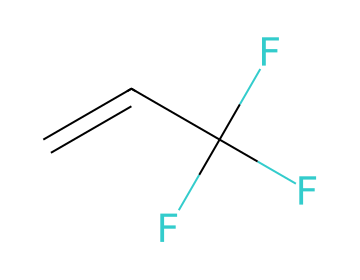
IDENTITY
COMPUTED
PROPERTIES
Very soluble in water, ethanol, and ether; soluble in acetone
-17 °C
When heated to decomposition it emits toxic vapors of ... /hydrogen fluoride/.
4812 mm Hg at 29 °C
Refractive Index: 1.4770 at 20 °C
Gas Vapor
Colorless odorless gas; [MSDSonline] BP = -17 deg C; [HSDB]
315
GHS
This chemical does not meet GHS hazard criteria for 12.2% (6 of 49) of reports.
Warning
H280 (85.7%): Contains gas under pressure; may explode if heated [Warning Gases under pressure]
P410+P403</a, and a href="https://pubchem.ncbi.nlm.nih.gov/ghs/#P410+P403">P410+P403 (click each P-code to see the statement)
Aggregated GHS information provided per 49 reports by companies from 6 notifications to the ECHA C&L Inventory.;Reported as not meeting GHS hazard criteria per 6 of 49 reports by companies.;There are 5 notifications provided by 43 of 49 reports by companies with hazard statement code(s).;Information may vary between notifications depending on impurities, additives, and other factors. The percentage value in parenthesis indicates the notified classification ratio from companies that provide hazard codes. Only hazard codes with percentage values above 10% are shown. For more detailed information, please visit ECHA C&L website.
HAZARDS
Chemical: 1-Propene, 3,3,3-trifluoro-
1-Propene, 3,3,3-trifluoro- is listed on the EPA's Chemical Data Reporting (CDR) system. Manufacturers and importers of 1-Propene, 3,3,3-trifluoro- are required to report information about their production and use of this chemical to the EPA under the Toxic Substances Control Act (TSCA). (40 eCFR Part 711)
TP - indicates a substance that is the subject of a proposed TSCA section 4 test rule.
Status: Active Update: 30-07-2018 https://echa.europa.eu/registration-dossier/-/registered-dossier/16503
In inhalation studies of mice, causes somnolence at >950,000 mg/m3/2H (>250,000 ppm/2H); [RTECS] Evaporating liquid can cause frostbite; Inhalation of high concentrations can cause deprivation of oxygen and cardiac arrhythmias; [MSDSonline]
Pursuant to section 8(d) of TSCA, EPA promulgated a model Health and Safety Data Reporting Rule. The section 8(d) model rule requires manufacturers, importers, and processors of listed chemical substances and mixtures to submit to EPA copies and lists of unpublished health and safety studies. Trifluoromethylethene is included on this list.
Press. Gas (Comp.) (85.7%)
Critical temperature: 105.44 °C; Critical pressure: 3.609X10+6 Pa
Reaction with the lighter divalent metals may give much more reactive materials analogous to Grignard reagents. /Haloalkanes/
TOXICITY
TERRESTRIAL FATE: Based on a recommended classification scheme(1), an estimated Koc value of 97(SRC), determined from a structure estimation method(2), indicates that 3,3,3-trifluoro-1-propene is expected to have high mobility in soil(SRC). Rapid volatilization of 3,3,3-trifluoro-1-propene from moist soil surfaces is expected(SRC) given an estimated Henry's Law constant of 0.76 atm-cu m/mole(SRC), developed using a fragment constant estimation method(3). 3,3,3-Trifluoro-1-propene is expected to volatilize rapidly from dry soil surfaces based on a vapor pressure of 4,393 mm Hg(SRC) at 25 °C(4). Highly chlorinated/fluorinated compounds are not expected to biodegrade rapidly(5).
AQUATIC FATE: Based on a recommended classification scheme(1), an estimated Koc value of 97(SRC), determined from a structure estimation method(2), indicates that 3,3,3-trifluoro-1-propene is not expected to adsorb to suspended solids and sediment in water(SRC). 3,3,3-Trifluoro-1-propene is expected to rapidly volatilize from water surfaces(3,SRC) based on an estimated Henry's Law constant of 0.76 atm-cu m/mole(SRC), developed using a fragment constant estimation method(4). Estimated half-lives for a model river and model lake are 3 and 93 hours, respectively(3,SRC). According to a classification scheme(5), an estimated BCF value of 23(3,SRC), from an estimated log Kow of 2.09(6,SRC), suggests that bioconcentration in aquatic organisms is low(SRC). Highly chlorinated/fluorinated compounds are not expected to biodegrade rapidly(7).
ATMOSPHERIC FATE: According to a model of gas/particle partitioning of semivolatile organic compounds in the atmosphere(1), 3,3,3-trifluoro-1-propene, which has an extrapolated vapor pressure of 4,393 mm Hg at 25 °C(2), is expected to exist solely as a vapor in the ambient atmosphere. Vapor-phase 3,3,3-trifluoro-1-propene is degraded in the atmosphere by reaction with photochemically-produced hydroxyl radicals and ozone molecules(SRC); the half-lives for these reactions in air are estimated to be about 19 and 156 hours respectively(3,SRC).
Other Poison - Simple Asphyxiant
Using a structure estimation method based on molecular connectivity indices(1), the Koc for 3,3,3-trifluoro-1-propene can be estimated to be about 97(SRC). According to a recommended classification scheme(2), this estimated Koc value suggests that 3,3,3-trifluoro-1-propene is expected to have high mobility in soil(SRC).
3,3,3-Trifluoro-1-propene's production and use in the manufacture of fluorine-containing silicones used in hydraulic fluids(1), may result in its release to the environment through various waste streams(SRC).
Highly chlorinated/fluorinated compounds are not expected to biodegrade rapidly(1).
An estimated BCF value of 23 was calculated for 3,3,3-trifluoro-1-propene(SRC), using an estimated log Kow of 2.09(1,SRC) and a recommended regression-derived equation(2). According to a classification scheme(3), this BCF value suggests that bioconcentration in aquatic organisms is low(SRC).
The Henry's Law constant for 3,3,3-trifluoro-1-propene is estimated as 0.76 atm-cu m/mole(SRC) using a fragment constant estimation method(1). This value indicates that 3,3,3-trifluoro-1-propene will volatilize rapidly from water surfaces(2,SRC). Based on this Henry's Law constant, the volatilization half-life from a model river (1 m deep, flowing 1 m/sec, wind velocity of 3 m/sec) is estimated as approximately 3 hours(2,SRC). The volatilization half-life from a model lake (1 m deep, flowing 0.05 m/sec, wind velocity of 0.5 m/sec) is estimated as approximately 96 hours(2,SRC). 3,3,3-Trifluoro-1-propene's Henry's Law constant(1,SRC) indicates that volatilization from moist soil surfaces is expected(SRC). 3,3,3-Trifluoro-1-propene is expected to volatilize rapidly from dry soil surfaces based on an extrapolated vapor pressure of 4,393 mm Hg at 25 °C(3).
The rate constant for the vapor-phase reaction of 3,3,3-trifluoro-1-propene with photochemically-produced hydroxyl radicals has been estimated as 2.0X10⁻¹¹ cu cm/molecule-sec at 25 °C(SRC) using a structure estimation method(1,SRC). This corresponds to an atmospheric half-life of about 19 hours at an atmospheric concentration of 5X10+5 hydroxyl radicals per cu cm(1,SRC). The rate constant for the vapor-phase reaction of 3,3,3-trifluoro-1-propene with ozone has been estimated as 1.8X10⁻¹⁸ cu cm/molecule-sec at 25 °C(SRC) using a structure estimation method(1,SRC). This corresponds to an atmospheric half-life of about 156 hours at an atmospheric concentration of 7X10+11 ozone molecules per cu cm(1,SRC). 3,3,3-Trifluoro-1-propene is not expected to undergo hydrolysis in the environment due to the lack of functional groups to hydrolyze.
Occupational exposure to 3,3,3-trifluoro-1-propene may be through inhalation and dermal contact with this compound at workplaces where this compound is produced or used. (SRC)
3,3,3-Trifluoro-1-propene's production and use in the manufacture of fluorine-containing silicones used in hydraulic fluids, may result in its release to the environment through various waste streams. Based on a vapor pressure of 4,393 mm Hg at 25 °C, 3,3,3-trifluoro-1-propene is expected to exist solely in the vapor-phase in the ambient atmosphere. Vapor-phase 3,3,3-trifluoro-1-propene is degraded in the atmosphere by reaction with photochemically-produced hydroxyl radicals and ozone molecules with atmospheric half-lives of about 19 and 156 hours, respectively. 3,3,3-Trifluoro-1-propene is expected to have high mobility in soil based upon an estimated Koc value of 97. Rapid volatilization from dry soil surfaces is expected based upon the vapor pressure of this compound. Volatilization from moist soil surfaces is expected based upon the estimated Henry's Law constant of 0.76 atm-cu m/mole. Biodegradation is not expected to be an important environmental fate process. In water, 3,3,3-trifluoro-1-propene is not expected to adsorb to sediment or particulate matter given its estimated Koc value. This compound is expected to volatilize rapidly from water surfaces given its estimated Henry's Law constant. Estimated half-lives for a model river and model lake are 3 and 93 hours, respectively. Bioconcentration is expected to be low based upon an estimated BCF value of 23. Occupational exposure may be through inhalation and dermal contact with this compound at workplaces where 3,3,3-trifluoro-1-propene is produced or used. (SRC)
LC50 (mice) = 445,703 ppm/1h
REGULATORY
Chemical: 1-Propene, 3,3,3-trifluoro-
1-Propene, 3,3,3-trifluoro- is listed on the EPA's Chemical Data Reporting (CDR) system. Manufacturers and importers of 1-Propene, 3,3,3-trifluoro- are required to report information about their production and use of this chemical to the EPA under the Toxic Substances Control Act (TSCA). (40 eCFR Part 711)
TP - indicates a substance that is the subject of a proposed TSCA section 4 test rule.
Status: Active Update: 30-07-2018 https://echa.europa.eu/registration-dossier/-/registered-dossier/16503
Pursuant to section 8(d) of TSCA, EPA promulgated a model Health and Safety Data Reporting Rule. The section 8(d) model rule requires manufacturers, importers, and processors of listed chemical substances and mixtures to submit to EPA copies and lists of unpublished health and safety studies. Trifluoromethylethene is included on this list.
USES
Used to make fluorine-containing silicones used in hydraulic fluids; [HSDB]
CHEMICAL INTERMEDIATE IN SYNTHESIS OF TRANS-5-(3,3,3-TRIFLUORO-1- PROPENYL)-2'-DEOXYURIDYLATE
The main use of trifluoropropene is in the production of fluorine-containing silicones used in hydraulic fluids.
2023: 25,000,000 - <75,000,000 lb;2022: 25,000,000 - <75,000,000 lb;2021: 8,500,000 - <25,000,000 lb;2020: 8,500,000 - <25,000,000 lb
REFRIGERANTS, 39%; FOAM BLOWING AGENTS, 17%; SOLVENTS, 14%; FLUOROPOLYMERS, 14%; STERILANT GAS, 2%; AEROSOL PROPELLANTS, 2%; FOOD FREEZANT, 1%; OTHER, 8%; EXPORTS, 3% (1985) /FLUOROCARBONS/
Intermediate
Produced by fluorination and dehalogenation of 1,1,3,3-tetrachloropropane.
All Other Basic Organic Chemical Manufacturing;All Other Chemical Product and Preparation Manufacturing;Cyclic Crude and Intermediate Manufacturing
1-Propene, 3,3,3-trifluoro-: ACTIVE
ALIASES
REACTIONS
uspto-grants-1997_04 · 10.6084/m9.figshare.5104873.v1 · US05616762
查看
uspto-grants-2016_09 · 10.6084/m9.figshare.5104873.v1 · US09434712B2
查看
uspto-grants-2016_09 · 10.6084/m9.figshare.5104873.v1 · US09434712B2
查看
uspto-grants-2016_09 · 10.6084/m9.figshare.5104873.v1 · US09434712B2
查看
uspto-grants-2016_09 · 10.6084/m9.figshare.5104873.v1 · US09434712B2
查看
uspto-grants-2016_09 · 10.6084/m9.figshare.5104873.v1 · US09434712B2
查看
Training data from https://doi.org/10.1039/C8SC04228D (9/10) · 10.1039/C8SC04228D
查看
uspto-grants-2014_02 · 10.6084/m9.figshare.5104873.v1 · US08653116B2
查看