
uspto-grants-1988_08 · 10.6084/m9.figshare.5104873.v1 · US04762920
查看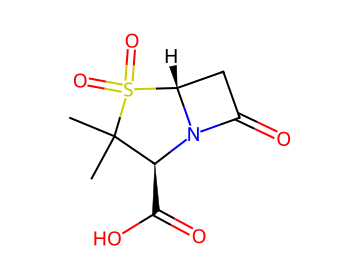
IDENTITY
COMPUTED
PROPERTIES
156
GHS
This chemical does not meet GHS hazard criteria for 1.2% (1 of 80) of reports.
Danger
H302 (51.2%): Harmful if swallowed [Warning Acute toxicity, oral];H317 (47.5%): May cause an allergic skin reaction [Warning Sensitization, Skin];H334 (47.5%): May cause allergy or asthma symptoms or breathing difficulties if inhaled [Danger Sensitization, respiratory]
P233, P260, P261, P264, P270, P271, P272, P280, P284, P301+P317, P302+P352, P304+P340, P321, P330, P333+P317, P342+P316, P362+P364, P403, and P501 (click each P-code to see the statement)
Aggregated GHS information provided per 80 reports by companies from 7 notifications to the ECHA C&L Inventory. Each notification may be associated with multiple companies.;Reported as not meeting GHS hazard criteria per 1 of 80 reports by companies.;There are 6 notifications provided by 79 of 80 reports by companies with hazard statement code(s).;Information may vary between notifications depending on impurities, additives, and other factors. The percentage value in parenthesis indicates the notified classification ratio from companies that provide hazard codes. Only hazard codes with percentage values above 10% are shown. For more detailed information, please visit ECHA C&L website.
HAZARDS
Status: Active Update: 05-05-2020 https://echa.europa.eu/registration-dossier/-/registered-dossier/23709
4-Thia-1-azabicyclo3.2.0heptane-2-carboxylic acid, 3,3-dimethyl-7-oxo-, 4,4-dioxide, (2S,5R)-: Does not have an individual approval but may be used as a component in a product covered by a group standard. It is not approved for use as a chemical in its own right.
Acute Tox. 4 (51.2%);Skin Sens. 1 (47.5%);Resp. Sens. 1 (47.5%)
REGULATORY
Status: Active Update: 05-05-2020 https://echa.europa.eu/registration-dossier/-/registered-dossier/23709
4-Thia-1-azabicyclo3.2.0heptane-2-carboxylic acid, 3,3-dimethyl-7-oxo-, 4,4-dioxide, (2S,5R)-: Does not have an individual approval but may be used as a component in a product covered by a group standard. It is not approved for use as a chemical in its own right.
PHARMACOLOGY
J - Antiinfectives for systemic use;J01 - Antibacterials for systemic use;J01C - Beta-lactam antibacterials, penicillins;J01CG - Beta-lactamase inhibitors;J01CG01 - Sulbactam
QJ - Antiinfectives for systemic use;QJ01 - Antibacterials for systemic use;QJ01C - Beta-lactam antibacterials, penicillins;QJ01CG - Beta-lactamase inhibitors;QJ01CG01 - Sulbactam
Sulbactam is approximately 38% reversibly bound to plasma proteins.
When given together with beta-lactam antibiotics, sulbactam broadens their antibacterial spectrum by blocking the enzyme involved in their hydrolysis. Sulbactam alone possesses weak intrinsic antibacterial activity except against the _Neisseriaceae_, _Acinetobacter spp._, and _Bacteroides fragilis_ as it can bind to the penicillin-binding proteins. Sulbactam restores the activity of beta-lactam antibiotics against a range of beta-lactamase-producing gram-positive and gram-negative bacteria.
Sulbactam is a competitive, irreversible bacterial beta (β)-lactamase inhibitor. It is reported to be more potent against class C beta-lactamases.
In healthy volunteers, the half-life is approximately one hour.
Metabolism of sulbactam has not been characterized.
S4TF6I2330
SULBACTAM
Established Pharmacologic Class [EPC] - beta Lactamase Inhibitor
Mechanisms of Action [MoA] - beta Lactamase Inhibitors
Sulbactam is a beta Lactamase Inhibitor. The mechanism of action of sulbactam is as a beta Lactamase Inhibitor.
Substances that inhibit the growth or reproduction of BACTERIA.
Endogenous substances and drugs that inhibit or block the activity of BETA-LACTAMASES.
Sulbactam is poorly absorbed after oral administration. Peak serum concentrations of ampicillin and sulbactam are reached following a 15-minute intravenous infusion. After the intravenous administration of 2000 mg of ampicillin plus 1000 mg sulbactam, peak sulbactam serum levels corresponded to 48 to 88 mcg/mL. After the intravenous administration of 1000 mg ampicillin plus 500 mg sulbactam, peak sulbactam serum levels corresponded to 21 to 40 mcg/mL. After an intramuscular injection of 1000 mg ampicillin plus 500 mg sulbactam, peak sulbactam serum levels ranged from 6 to 24 mcg/mL.
When given in combination with ampicillin in individuals with normal renal function, approximately 75 to 85% of the drug is excreted unchanged in the urine during the first eight hours after administration.
The steady-state volumes of distribution range from 12.2 to 16.3 L. Sulbactam exhibits extensive distribution in extracellular fluids and tissues. Penetration of sulbactam into cerebrospinal fluid is enhanced in the presence of inflamed meninges.
Eenal clearance is approximately 12 L/h following infusion over 15 to 30 minutes.
USES
Use (kg; approx.) in Germany (2009): >10000;Use (kg; exact) in Germany (2009): 27580;Use (kg) in USA (2002): 6920;Consumption (g per capita; approx.) in Germany (2009): 0.122;Consumption (g per capita; exact) in Germany (2009): 0.337;Consumption (g per capita) in the USA (2002): 0.0245;Excretion rate: 0.8;Calculated removal (%): 75.1
ALIASES
REACTIONS
uspto-grants-1988_08 · 10.6084/m9.figshare.5104873.v1 · US04762920
查看
uspto-grants-1980_11 · 10.6084/m9.figshare.5104873.v1 · US04234579
查看
uspto-grants-1980_11 · 10.6084/m9.figshare.5104873.v1 · US04234579
查看
uspto-grants-1980_11 · 10.6084/m9.figshare.5104873.v1 · US04234579
查看
uspto-grants-1980_11 · 10.6084/m9.figshare.5104873.v1 · US04234579
查看
uspto-grants-1987_11 · 10.6084/m9.figshare.5104873.v1 · US04704456
查看
uspto-grants-1983_03 · 10.6084/m9.figshare.5104873.v1 · US04377590
查看
uspto-grants-1984_08 · 10.6084/m9.figshare.5104873.v1 · US04468351
查看