
uspto-grants-1988_02 · 10.6084/m9.figshare.5104873.v1 · US04723002
查看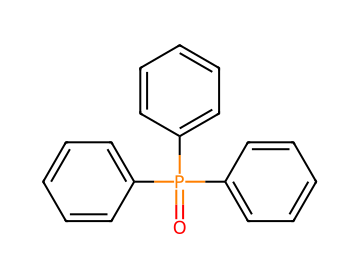
IDENTITY
COMPUTED
PROPERTIES
Solid; [IUCLID] Beige crystalline solid; [Aldrich MSDS]
2561;2576
162.9 Ų [M+H]+ [CCS Type: DT; Buffer gas: N2; Ionization: ESI+; Dataset: TOXCAST; Source Identifier: DTXSID2022121];163.0 Ų [M+H]+ [CCS Type: DT; Buffer gas: N2; Ionization: APCI+; Dataset: TOXCAST; Source Identifier: DTXSID2022121];182.6 Ų [M+Na]+ [CCS Type: DT; Buffer gas: N2; Ionization: ESI+; Dataset: TOXCAST; Source Identifier: DTXSID2022121]
GHS
This chemical does not meet GHS hazard criteria for 2% (5 of 245) of reports.
Warning
H302 (98%): Harmful if swallowed [Warning Acute toxicity, oral];H315 (18%): Causes skin irritation [Warning Skin corrosion/irritation];H319 (18.4%): Causes serious eye irritation [Warning Serious eye damage/eye irritation];H335 (18%): May cause respiratory irritation [Warning Specific target organ toxicity, single exposure; Respiratory tract irritation];H412 (96.3%): Harmful to aquatic life with long lasting effects [Hazardous to the aquatic environment, long-term hazard]
P261, P264, P264+P265, P270, P271, P273, P280, P301+P317, P302+P352, P304+P340, P305+P351+P338, P319, P321, P330, P332+P317, P337+P317, P362+P364, P403+P233, P405, and P501 (click each P-code to see the statement)
Aggregated GHS information provided per 245 reports by companies from 12 notifications to the ECHA C&L Inventory. Each notification may be associated with multiple companies.;Reported as not meeting GHS hazard criteria per 5 of 245 reports by companies.;There are 11 notifications provided by 240 of 245 reports by companies with hazard statement code(s).;Information may vary between notifications depending on impurities, additives, and other factors. The percentage value in parenthesis indicates the notified classification ratio from companies that provide hazard codes. Only hazard codes with percentage values above 10% are shown. For more detailed information, please visit ECHA C&L website.
HAZARDS
Chemical: Phosphine oxide, triphenyl-
Regulation (EC) No 1831/2003 (amended)
Status: Active Update: 10-10-2019 https://echa.europa.eu/registration-dossier/-/registered-dossier/25368;Status: Active Update: 05-09-2016 https://echa.europa.eu/registration-dossier/-/registered-dossier/17507
Triphenylphosphine oxide: Does not have an individual approval but may be used under an appropriate group standard
Causes convulsions, aggression, and dyspnea in oral lethal-dose studies of dogs (LD50 = 500 mg/kg); [RTECS] Causes liver injury in 3-month feeding study of dogs at 2,000 ppm; [IUCLID] An irritant; Harmful by ingestion; Targets nerves; [Aldrich MSDS] See Triphenylphosphine.
Acute Tox. 4 (98%);Skin Irrit. 2 (18%);Eye Irrit. 2 (18.4%);STOT SE 3 (18%);Aquatic Chronic 3 (96.3%)
Acute toxicity (Oral) - Category 4;Specific target organ toxicity - Single exposure - Category 2 (central nervous system);Specific target organ toxicity - Repeated exposure - Category 2 (liver);Hazardous to the aquatic environment (Acute) - Category 3;Hazardous to the aquatic environment (Long-term) - Category 3
TOXICITY
Neurotoxin - Other CNS neurotoxin;Occupational hepatotoxin - Secondary hepatotoxins: the potential for toxic effect in the occupational setting is based on cases of poisoning by human ingestion or animal experimentation.
0.02
PPRTV Current
0.02
PPRTV Current
Triphenylphosphine Oxide
2 x 10^-2 mg/kg-day
2 x 10^-2 mg/kg-day
PDF Document
Inadequate information to assess carcinogenic potential
2007
1.30e+03
1.60e+04
3.60e+02
5.00e+01
1.50e+00
2.00e-02
3.80e+03
4.90e+04
1.10e+03
5.00e+01
2.00e-02
Volatile
REGULATORY
Chemical: Phosphine oxide, triphenyl-
Regulation (EC) No 1831/2003 (amended)
Status: Active Update: 10-10-2019 https://echa.europa.eu/registration-dossier/-/registered-dossier/25368;Status: Active Update: 05-09-2016 https://echa.europa.eu/registration-dossier/-/registered-dossier/17507
Triphenylphosphine oxide: Does not have an individual approval but may be used under an appropriate group standard
USES
Used for processing (extraction, separation, and spectrophotometric determination) environmental samples of cadmium and mercury; [ChemIDplus]
Phosphine oxide, triphenyl-: ACTIVE
ALIASES
REACTIONS
uspto-grants-1988_02 · 10.6084/m9.figshare.5104873.v1 · US04723002
查看
uspto-grants-1988_02 · 10.6084/m9.figshare.5104873.v1 · US04727152
查看
uspto-grants-2006_08 · 10.6084/m9.figshare.5104873.v1 · US07087626B2
查看
uspto-grants-2005_02 · 10.6084/m9.figshare.5104873.v1 · US06855722B2
查看
uspto-grants-1988_08 · 10.6084/m9.figshare.5104873.v1 · US04764310
查看
uspto-grants-2016_09 · 10.6084/m9.figshare.5104873.v1 · US09440982B2
查看
uspto-grants-2016_09 · 10.6084/m9.figshare.5104873.v1 · US09440982B2
查看
uspto-grants-2014_09 · 10.6084/m9.figshare.5104873.v1 · US08841455B2
查看