
uspto-grants-1978_12 · 10.6084/m9.figshare.5104873.v1 · US04131622
查看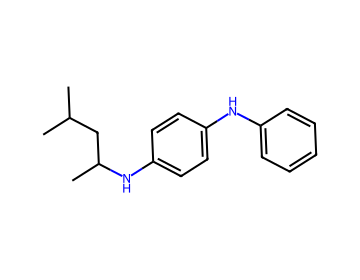
IDENTITY
COMPUTED
PROPERTIES
5.4
1.1 (NTP, 1992) - Denser than water; will sink
1.07
1.02 g/cm³
Relative density of the vapour/air-mixture at 20 °C (air = 1): 1.00
Dark, violet solid
less than 1 mg/mL at 63 °F (NTP, 1992)
Solubility in water, g/100ml at 20 °C: 0.01
400 °F (NTP, 1992)
204 °C
200 °C c.c.
500 °F at 760 mmHg (NTP, 1992)
370 °C (calculated)
113.4 to 113.9 °F (NTP, 1992)
50 °C
45-48 °C
0.000005 [mmHg]
Vapor pressure at 25 °C: negligible
N-(1,3-dimethylbutyl)-n'-phenyl-p-phenylenediamine is a purple flakes. (NTP, 1992)
Large Crystals; Liquid; Dry Powder; Liquid; Large Crystals; CBI; Large Crystals; Other Solid; Dry Powder; Other Solid
Dark violet solid; [HSDB] Brown to violet solid; Turns dark brown on light exposure; [ICSC]
BROWN-TO-VIOLET SOLID IN VARIOUS FORMS. TURNS DARK BROWN ON EXPOSURE TO LIGHT.
~500 °C
GHS
This chemical does not meet GHS hazard criteria for 0.3% (1 of 381) of reports.
Danger
H302 (80.1%): Harmful if swallowed [Warning Acute toxicity, oral];H317 (99.5%): May cause an allergic skin reaction [Warning Sensitization, Skin];H360 (17.1%): May damage fertility or the unborn child [Danger Reproductive toxicity];H360F (27.3%): May damage fertility [Danger Reproductive toxicity];H400 (98.4%): Very toxic to aquatic life [Warning Hazardous to the aquatic environment, acute hazard];H410 (99.5%): Very toxic to aquatic life with long lasting effects [Warning Hazardous to the aquatic environment, long-term hazard]
P203, P261, P264, P270, P272, P273, P280, P301+P317, P302+P352, P318, P321, P330, P333+P317, P362+P364, P391, P405, and P501 (click each P-code to see the statement)
Aggregated GHS information provided per 381 reports by companies from 20 notifications to the ECHA C&L Inventory. Each notification may be associated with multiple companies.;Reported as not meeting GHS hazard criteria per 1 of 381 reports by companies.;There are 19 notifications provided by 380 of 381 reports by companies with hazard statement code(s).;Information may vary between notifications depending on impurities, additives, and other factors. The percentage value in parenthesis indicates the notified classification ratio from companies that provide hazard codes. Only hazard codes with percentage values above 10% are shown. For more detailed information, please visit ECHA C&L website.
HAZARDS
Chemical: 1,4-Benzenediamine, N1-(1,3-dimethylbutyl)-N4-phenyl-
Hazard Traits - Bioaccumulation; Environmental Persistence;Authoritative List - OSPAR Priority Action Part A;Report - if used as a fragrance or flavor ingredient
1,4-Benzenediamine, N1-(1,3-dimethylbutyl)-N4-phenyl- is listed on the EPA's Chemical Data Reporting (CDR) system. Manufacturers and importers of 1,4-Benzenediamine, N1-(1,3-dimethylbutyl)-N4-phenyl- are required to report information about their production and use of this chemical to the EPA under the Toxic Substances Control Act (TSCA). (40 eCFR Part 711)
Status: Active Update: 02-12-2022 https://echa.europa.eu/registration-dossier/-/registered-dossier/15367
1,4-Benzenediamine, N-(1,3-dimethylbutyl)-N'-phenyl-: Does not have an individual approval but may be used under an appropriate group standard
IMAP assessments - 1,4-Benzenediamine, N-(1,3-dimethylbutyl)-N'-phenyl-: Human health tier I assessment
Class 9
This compound is combustible. (NTP, 1992)
Combustible. Gives off irritating or toxic fumes (or gases) in a fire.
SYMPTOMS: Symptoms resulting from exposure to this compound include skin irritation and fatigue.;ACUTE/CHRONIC HAZARDS: This compound may cause cumulative irritation or sensitization following dermal exposure. When heated to decomposition it emits toxic fumes. (NTP, 1992)
Reports of skin sensitization in employees in tire and rubber industries; Not mutagenic in four strains of Salmonella and not clastogenic in mice bone marrow cells; Emergency treatment: Paraphenylenediamine; In sensitized individuals, paraphenylenediamine may cause allergic contact dermatitis following application as a hair dye and asthma following inhalation; Following ingestion, can cause angioneurotic edema, methemoglobinemia, acute tubular necrosis, and hepatotoxicity; An adult died after ingestion of 3 grams of p-phenylenediamine; Another adult who ingested 1800 mg developed angioneurotic edema and acute renal failure; [HSDB] A mild skin and eye irritant; May cause skin sensitization; [ICSC] May cause skin irritation and sensitization; [CAMEO] A mild skin and eye irritant; Likely a skin sensitizer based on animal studies and positive patch test results in volunteers exposed to rubber formulations; [CHEMINFO] See p-Phenylenediamine.
Amines, Phosphines, and Pyridines
UN Hazard Class: 9; UN Pack Group: III
You should protect N-(1,3-DIMETHYLBUTYL)-N'-PHENYL-P-PHENYLENEDIAMINE from exposure to strong oxidizing agents such as chlorine or hydrogen peroxide. This material will ignite if heated strongly. (NTP, 1992)
Decomposes on burning. This produces toxic fumes including nitrogen oxides. Reacts with strong oxidants.
This chemical may be sensitive to prolonged exposure to air. Insoluble in water.
Acute Tox. 4 (80.1%);Skin Sens. 1 (99.5%);Repr. 1B (17.1%);Repr. 1B (27.3%);Aquatic Acute 1 (98.4%);Aquatic Chronic 1 (99.5%)
Acute toxicity (Oral) - Category 4;Serious eye damage/eye irritation - Category 2B;Skin sensitization - Category 1;Specific target organ toxicity - Single exposure - Category 3 (Narcotic effects);Specific target organ toxicity - Repeated exposure - Category 2 (blood system);Hazardous to the aquatic environment (Acute) - Category 1;Hazardous to the aquatic environment (Long-term) - Category 1
Acute toxicity (Oral) - Category 4;Serious eye damage/eye irritation - Category 2B;Skin sensitization - Category 1A;Reproductive toxicity - Category 1B;Specific target organ toxicity - Repeated exposure - Category 2 (blood system);Hazardous to the aquatic environment (Acute) - Category 1;Hazardous to the aquatic environment (Long-term) - Category 1
SAFETY
Fires involving this material should be controlled with a dry chemical, carbon dioxide or Halon extinguisher. (NTP, 1992)
Use water spray, powder.
Fresh air, rest.
Remove contaminated clothes. Rinse and then wash skin with water and soap.
First rinse with plenty of water for several minutes (remove contact lenses if easily possible), then refer for medical attention.
Rinse mouth. Refer for medical attention .
EYES: First check the victim for contact lenses and remove if present. Flush victim's eyes with water or normal saline solution for 20 to 30 minutes while simultaneously calling a hospital or poison control center. Do not put any ointments, oils, or medication in the victim's eyes without specific instructions from a physician. IMMEDIATELY transport the victim after flushing eyes to a hospital even if no symptoms (such as redness or irritation) develop.;SKIN: IMMEDIATELY flood affected skin with water while removing and isolating all contaminated clothing. Gently wash all affected skin areas thoroughly with soap and water. If symptoms such as redness or irritation develop, IMMEDIATELY call a physician and be prepared to transport the victim to a hospital for treatment.;INHALATION: IMMEDIATELY leave the contaminated area; take deep breaths of fresh air. If symptoms (such as wheezing, coughing, shortness of breath, or burning in the mouth, throat, or chest) develop, call a physician and be prepared to transport the victim to a hospital. Provide proper respiratory protection to rescuers entering an unknown atmosphere. Whenever possible, Self-Contained Breathing Apparatus (SCBA) should be used; if not available, use a level of protection greater than or equal to that advised under Protective Clothing.;INGESTION: DO NOT INDUCE VOMITING. If the victim is conscious and not convulsing, give 1 or 2 glasses of water to dilute the chemical and IMMEDIATELY call a hospital or poison control center. Be prepared to transport the victim to a hospital if advised by a physician. If the victim is convulsing or unconscious, do not give anything by mouth, ensure that the victim's airway is open and lay the victim on his/her side with the head lower than the body. DO NOT INDUCE VOMITING. IMMEDIATELY transport the victim to a hospital. (NTP, 1992)
Provision to contain effluent from fire extinguishing. Store in an area without drain or sewer access. Separated from strong oxidants.
2.0 [mg/m3], inhalable fraction[German Research Foundation (DFG)]
SMALL SPILLS AND LEAKAGE: Should a spill occur while you are handling this chemical, FIRST REMOVE ALL SOURCES OF IGNITION, then you should dampen the solid spill material with 60-70% ethanol and transfer the dampened material to a suitable container. Use absorbent paper dampened with 60-70% ethanol to pick up any remaining material. Seal the absorbent paper, and any of your clothes, which may be contaminated, in a vapor-tight plastic bag for eventual disposal. Solvent wash all contaminated surfaces with 60-70% ethanol followed by washing with a soap and water solution. Do not reenter the contaminated area until the Safety Officer (or other responsible person) has verified that the area has been properly cleaned.;STORAGE PRECAUTIONS: You should keep this material in a tightly closed container under an inert atmosphere, and store it at refrigerated temperatures. STORE AWAY FROM SOURCES OF IGNITION. (NTP, 1992)
SRP: At the time of review, criteria for land treatment or burial (sanitary landfill) disposal practices are subject to significant revision. Prior to implementing land disposal of waste residue (including waste sludge), consult with environmental regulatory agencies for guidance on acceptable disposal practices.
Personal protection: protective gloves and particulate filter respirator adapted to the airborne concentration of the substance. Do NOT let this chemical enter the environment. Sweep spilled substance into covered containers. If appropriate, moisten first to prevent dusting.
Excerpt from ERG Guide 171 [Substances (Low to Moderate Hazard)]:;IMMEDIATE PRECAUTIONARY MEASURE: Isolate spill or leak area in all directions for at least 50 meters (150 feet) for liquids and at least 25 meters (75 feet) for solids.;SPILL: Increase the immediate precautionary measure distance, in the downwind direction, as necessary.;FIRE: If tank, rail tank car or highway tank is involved in a fire, ISOLATE for 800 meters (1/2 mile) in all directions; also, consider initial evacuation for 800 meters (1/2 mile) in all directions. (ERG, 2024)
Wear safety goggles.
NO open flames.
A harmful concentration of airborne particles can be reached quickly when dispersed, especially if powdered.
TOXICITY
Occupational hepatotoxin - Secondary hepatotoxins: the potential for toxic effect in the occupational setting is based on cases of poisoning by human ingestion or animal experimentation.;Methemoglobinemia - The presence of increased methemoglobin in the blood; the compound is classified as secondary toxic effect;Skin Sensitizer - An agent that can induce an allergic reaction in the skin.
The substance can be absorbed into the body by ingestion.
Cough.
Redness.
Redness.
The substance is very toxic to aquatic organisms. It is strongly advised not to let the chemical enter into the environment.
TEN AUTOMOBILE TIRES MFR BY 8 FIRMS INDUCED CONTACT SENSITIVITY IN 7 SUBJECTS ALLERGIC TO N-ISOPROPYL-N'-PHENYL-P-PHENYLENEDIAMINE ANTIOZONANT. N-(1,3-DIMETHYLBUTYL)-N'-PHENYL-P-PHENYLENEDIAMINE, AN ANTIOZONANT PURPORTED TO BE NONSENSITIZING, GAVE POS RESPONSES IN ALL PATIENTS ALLERGIC TO N-ISOPROPYL-N'-PHENYL-P-PHENYLENEDIAMINE.
The case of a 48 year old woman who had worked for 16 years in a rubber factory, in the quality control department of a rubber factory was discussed. Part of her work included the weighing of rubber chemicals, primarily in powdered form or as pellets. Although the patient wore leather gloves and a face mask, after a short period of time pruritus, erythema and vesicles developed on the uncovered skin of the hands and neck. Contact allergies were noted to N-(1,3-dimethylbutyl)-N'-phenyl-p-phenylenediamine, 2,2,4-trimethyl-1,2-dihydroquinoline and also to N-isopropyl-N'-phenyl-p-phenylenediamine. When away from her work, the patient did heal, only to relapse on returning to the job.
N-(1,3-Dimethylbutyl)-N'-phenyl-p-phenylenediamine was evaluated for mutagenicity in the Salmonella/microsome preincubation assay using a standard protocol approved by the National Toxicology Program. Doses of 0, 0.1, 0.3, 1, 3.3, 10, 33, 100, and 200 ug/plate were tested in four Salmonella typhimurium strains (TA98, TA100, TA1535, and TA1537) in the presence and absence of Aroclor-induced rat or hamster liver S9. These tests were negative and the highest ineffective dose level tested in all four Salmonella tester strains under all treatment conditions was 3.3 ug/plate. The four highest dose levels caused clearing of the background lawn.
N-(1,3-Dimethylbutyl)-N-phenylparaphenylenediamine is a derivative of phenylenediamine which is widely used in the rubber industry as an antioxidant. N-(1,3-Dimethylbutyl)-N-phenylparaphenylenediamine which is a strong allergen, is least studied for its clastogenic potency. This study evaluated the genotoxic property of DMPPD in Swiss albino mice bone marrow cells by using chromosomal aberration and micronuclei assay. Three concentrations of N-(1,3-dimethylbutyl)-N-phenylparaphenylenediamine, i.e., 100, 150 and 200 mg/kg body wt. did not significantly increase the micronuclei in polychromatic erythrocytes or the ratio of poly to normochromatic erythrocytes. Chromosome aberration studies using 100 mg and 200 mg/kg body wt. showed that N-(1,3-dimethylbutyl)-N-phenylparaphenylenediamine is a non-inducer of chromosome aberrations. The results indicated non-clastogenicity of N-(1,3-dimethylbutyl)-N-phenylparaphenylenediamine in mice marrow cells up to a concentration of 200 mg/kg bw under our experimental conditions.
REGULATORY
Chemical: 1,4-Benzenediamine, N1-(1,3-dimethylbutyl)-N4-phenyl-
Hazard Traits - Bioaccumulation; Environmental Persistence;Authoritative List - OSPAR Priority Action Part A;Report - if used as a fragrance or flavor ingredient
1,4-Benzenediamine, N1-(1,3-dimethylbutyl)-N4-phenyl- is listed on the EPA's Chemical Data Reporting (CDR) system. Manufacturers and importers of 1,4-Benzenediamine, N1-(1,3-dimethylbutyl)-N4-phenyl- are required to report information about their production and use of this chemical to the EPA under the Toxic Substances Control Act (TSCA). (40 eCFR Part 711)
Status: Active Update: 02-12-2022 https://echa.europa.eu/registration-dossier/-/registered-dossier/15367
1,4-Benzenediamine, N-(1,3-dimethylbutyl)-N'-phenyl-: Does not have an individual approval but may be used under an appropriate group standard
USES
Used as an antiozonant and antioxidant for butadiene rubber, nitrile-butadiene rubber, styrene-butadiene rubber, and synthetic isoprene rubber; [HSDB]
Antioxidant/antiozonant (rubber)
Antiozonant, antioxidant, and polymer stabilizer.
ANTIOZONANT & ANTIOXIDANT FOR BUTADIENE RUBBER
ANTIOZONANT & ANTIOXIDANT FOR NITRILE-BUTADIENE RUBBER
For more Uses (Complete) data for 1,4-BENZENEDIAMINE, N-(1,3-DIMETHYLBUTYL)-N'-PHENYL- (6 total), please visit the HSDB record page.
(1979) 1.17X10+9 G (PRINCPL CUSTMS DISTS)
(1981) 7.92X10+7 G (PRINCPL CUSTMS DISTS)
2023: 55,000,000 - <70,000,000 lb;2022: 55,000,000 - <70,000,000 lb;2021: 70,000,000 - <85,000,000 lb;2020: 55,000,000 - <70,000,000 lb
(1979) PROBABLY GREATER THAN 1.36X10+6 GRAMS
(1981) PROBABLY GREATER THAN 1.36X10+6 GRAMS
Antioxidant;Filler;Stabilizing agent
Antioxidant;Other;Stabilizing agent;Filler
REDUCTION OF EITHER P-NITRO- OR P-NITROSODIPHENYLAMINE TO FORM P-AMINODIPHENYLAMINE, FOLLOWED BY REACTION WITH 4-METHYL-2-PENTANONE & HYDROGENATION OVER A CATALYST
...reductive alkylation of p-phenylenediamine with methyl isobutyl ketone
Methyl isobutyl ketone + p-aminodiphenylamine (reductive amination)
"Santoflex" /is/ trademark for a series of rubber antioxidants and antiozonants. /Santoflex/
WING-STAY IS TRADEMARK FOR SERIES OF PARAPHENYLENEDIAMINE DERIVATIVES USED AS STABILIZERS, ANTIOXIDANTS & ANTIOZONANTS FOR NATURAL & SYNTHETIC RUBBERS & LATICES. /WING-STAY/
Rubber Product Manufacturing;Synthetic Rubber Manufacturing;All other Petroleum and Coal Products Manufacturing;Other (requires additional information)
1,4-Benzenediamine, N1-(1,3-dimethylbutyl)-N4-phenyl-: ACTIVE
Staining antidegradents that act as anti-flex-cracking agents and antiozonants
ALIASES
REACTIONS
uspto-grants-1978_12 · 10.6084/m9.figshare.5104873.v1 · US04131622
查看
Training data from https://doi.org/10.1039/C8SC04228D (8/10) · 10.1039/C8SC04228D
查看
Test data from https://doi.org/10.1039/C8SC04228D · 10.1039/C8SC04228D
查看
uspto-grants-1991_05 · 10.6084/m9.figshare.5104873.v1 · US05019611
查看
uspto-grants-1991_05 · 10.6084/m9.figshare.5104873.v1 · US05019611
查看