
uspto-grants-1980_09 · 10.6084/m9.figshare.5104873.v1 · US04225476
查看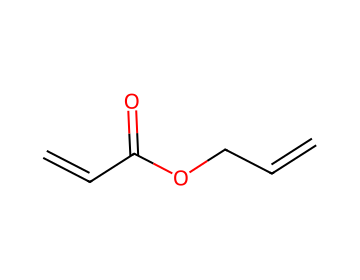
IDENTITY
COMPUTED
PROPERTIES
0.9441 (NTP, 1992) - Less dense than water; will float
1 to 5 mg/mL at 64 °F (NTP, 1992)
less than 69 °F (NTP, 1992)
252 to 255 °F at 760 mmHg (NTP, 1992)
Allyl acrylate is a clear colorless liquid. (NTP, 1992)
734;742
GHS
Danger
H226 (13.3%): Flammable liquid and vapor [Warning Flammable liquids];H311 (13.3%): Toxic in contact with skin [Danger Acute toxicity, dermal];H315 (100%): Causes skin irritation [Warning Skin corrosion/irritation];H319 (100%): Causes serious eye irritation [Warning Serious eye damage/eye irritation];H330 (13.3%): Fatal if inhaled [Danger Acute toxicity, inhalation];H335 (95.6%): May cause respiratory irritation [Warning Specific target organ toxicity, single exposure; Respiratory tract irritation];H411 (86.7%): Toxic to aquatic life with long lasting effects [Hazardous to the aquatic environment, long-term hazard]
P210, P233, P240, P241, P242, P243, P260, P261, P262, P264, P264+P265, P270, P271, P273, P280, P284, P302+P352, P303+P361+P353, P304+P340, P305+P351+P338, P316, P319, P320, P321, P332+P317, P337+P317, P361+P364, P362+P364, P370+P378, P391, P403+P233, P403+P235, P405, and P501 (click each P-code to see the statement)
Aggregated GHS information provided per 45 reports by companies from 5 notifications to the ECHA C&L Inventory. Each notification may be associated with multiple companies.;Information may vary between notifications depending on impurities, additives, and other factors. The percentage value in parenthesis indicates the notified classification ratio from companies that provide hazard codes. Only hazard codes with percentage values above 10% are shown. For more detailed information, please visit ECHA C&L website.
HAZARDS
Poison Flammable Liquid
This chemical is flammable. (NTP, 1992)
Excerpt from ERG Guide 131 [Flammable Liquids - Toxic]:;TOXIC; may be fatal if inhaled, ingested or absorbed through skin. Inhalation or contact with some of these materials will irritate or burn skin and eyes. Methyl chloroacetate (UN2295) is an eye irritant/lachrymator (causes flow of tears). Fire will produce irritating, corrosive and/or toxic gases. Vapors may cause dizziness or asphyxiation, especially when in closed or confined areas. Runoff from fire control or dilution water may cause environmental contamination. (ERG, 2024)
Esters, Sulfate Esters, Phosphate Esters, Thiophosphate Esters, and Borate Esters;Acrylates and Acrylic Acids;Polymerizable Compounds
Highly Flammable;Polymerizable
The unsaturated aliphatic hydrocarbons, like allyl acrylate, are generally much more reactive than the alkanes, which are saturated aliphatic hydrocarbons. Strong oxidizers may react vigorously with them. Reducing agents can react exothermically to release gaseous hydrogen. In the presence of various catalysts (such as acids) or initiators, compounds in this class can undergo very exothermic addition polymerization reactions. Many of these compounds undergo autoxidation upon exposure to the air to form explosive peroxides. These peroxide and polyperoxide substances are usually extremely unstable and liable to detonation. The peroxidation of butadiene has been involved in several serious industrial accidents. Esters react with acids to liberate heat along with alcohols and acids. Strong oxidizing acids may cause a vigorous reaction that is sufficiently exothermic to ignite the reaction products. Heat is also generated by the interaction of esters with caustic solutions. Flammable hydrogen is generated by mixing esters with alkali metals and hydrides.
Highly flammable. Slightly soluble in water.
Flam. Liq. 3 (13.3%);Acute Tox. 3 (13.3%);Skin Irrit. 2 (100%);Eye Irrit. 2 (100%);Acute Tox. 1 (13.3%);STOT SE 3 (95.6%);Aquatic Chronic 2 (86.7%)
SAFETY
Fires involving this material can be controlled with a dry chemical, carbon dioxide or Halon extinguisher. (NTP, 1992)
EYES: First check the victim for contact lenses and remove if present. Flush victim's eyes with water or normal saline solution for 20 to 30 minutes while simultaneously calling a hospital or poison control center. Do not put any ointments, oils, or medication in the victim's eyes without specific instructions from a physician. IMMEDIATELY transport the victim after flushing eyes to a hospital even if no symptoms (such as redness or irritation) develop.;SKIN: IMMEDIATELY flood affected skin with water while removing and isolating all contaminated clothing. Gently wash all affected skin areas thoroughly with soap and water. If symptoms such as redness or irritation develop, IMMEDIATELY call a physician and be prepared to transport the victim to a hospital for treatment.;INHALATION: IMMEDIATELY leave the contaminated area; take deep breaths of fresh air. If symptoms (such as wheezing, coughing, shortness of breath, or burning in the mouth, throat, or chest) develop, call a physician and be prepared to transport the victim to a hospital. Provide proper respiratory protection to rescuers entering an unknown atmosphere. Whenever possible, Self-Contained Breathing Apparatus (SCBA) should be used; if not available, use a level of protection greater than or equal to that advised under Protective Clothing.;INGESTION: DO NOT INDUCE VOMITING. If the victim is conscious and not convulsing, give 1 or 2 glasses of water to dilute the chemical and IMMEDIATELY call a hospital or poison control center. Be prepared to transport the victim to a hospital if advised by a physician. If the victim is convulsing or unconscious, do not give anything by mouth, ensure that the victim's airway is open and lay the victim on his/her side with the head lower than the body. DO NOT INDUCE VOMITING. IMMEDIATELY transport the victim to a hospital. (NTP, 1992)
SMALL SPILLS AND LEAKAGE: If you spill this chemical, use absorbent paper to pick up all liquid spill material. Your contaminated clothing and absorbent paper should be sealed in a vapor-tight plastic bag for eventual disposal. Solvent wash all contaminated surfaces with alcohol followed by washing with a strong soap and water solution. Do not reenter the contaminated area until the Safety Officer (or other responsible person) has verified that the area has been properly cleaned.;STORAGE PRECAUTIONS: You should store this chemical under refrigerated temperatures and away from mineral acids and bases. (NTP, 1992)
Excerpt from ERG Guide 131 [Flammable Liquids - Toxic]:;IMMEDIATE PRECAUTIONARY MEASURE: Isolate spill or leak area for at least 50 meters (150 feet) in all directions.;SPILL: Increase the immediate precautionary measure distance, in the downwind direction, as necessary.;FIRE: If tank, rail tank car or highway tank is involved in a fire, ISOLATE for 800 meters (1/2 mile) in all directions; also, consider initial evacuation for 800 meters (1/2 mile) in all directions. (ERG, 2024)
RECOMMENDED RESPIRATOR: When working with this chemical, wear a NIOSH-approved full face chemical cartridge respirator equipped with the appropriate organic vapor cartridges. If that is not available, a half face respirator similarly equipped plus airtight goggles can be substituted. However, please note that half face respirators provide a substantially lower level of protection than do full face respirators. (NTP, 1992)
USES
2-Propenoic acid, 2-propen-1-yl ester: ACTIVE
ALIASES
REACTIONS
uspto-grants-1980_09 · 10.6084/m9.figshare.5104873.v1 · US04225476
查看
uspto-grants-1980_09 · 10.6084/m9.figshare.5104873.v1 · US04225476
查看
uspto-grants-2016_09 · 10.6084/m9.figshare.5104873.v1 · US09440995B2
查看
uspto-grants-1977_04 · 10.6084/m9.figshare.5104873.v1 · US04017557
查看
uspto-grants-2016_01 · 10.6084/m9.figshare.5104873.v1 · US09233985B2
查看
uspto-grants-1985_12 · 10.6084/m9.figshare.5104873.v1 · US04558111
查看
uspto-grants-1976_08 · 10.6084/m9.figshare.5104873.v1 · US03972961
查看
uspto-grants-1981_09 · 10.6084/m9.figshare.5104873.v1 · USRE030754
查看