
uspto-grants-1980_11 · 10.6084/m9.figshare.5104873.v1 · US04234565
查看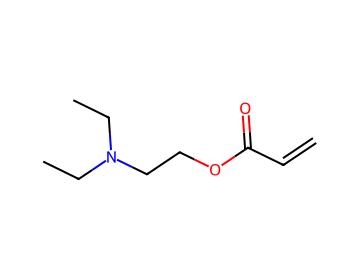
IDENTITY
COMPUTED
PROPERTIES
1.4425 @ 20 °C/4 °C
195 °F (91 °C) (open cup)
70 °C @ 0.67 kPa (5 mm Hg)
When heated to decomposition it emits toxic fumes of nitroxides.
< -60 °C
5.9 (AIR= 1)
0.23 [mmHg]
Index of refraction: 0.9251 @ 20 °C/D
Clear light yellow liquid; [MSDSonline]
DECOMPOSES @ BP; DECOMPOSED BY WATER
React readily with electrophilic, free-radical, and nucleophilic agents /Acrylic acid & esters/
GHS
Danger
H302 (97.6%): Harmful if swallowed [Warning Acute toxicity, oral];H310 (95.2%): Fatal in contact with skin [Danger Acute toxicity, dermal];H314 (97.6%): Causes severe skin burns and eye damage [Danger Skin corrosion/irritation];H317 (95.2%): May cause an allergic skin reaction [Warning Sensitization, Skin]
P260, P261, P262, P264, P270, P272, P280, P301+P317, P301+P330+P331, P302+P352, P302+P361+P354, P304+P340, P305+P354+P338, P316, P321, P330, P333+P317, P361+P364, P362+P364, P363, P405, and P501 (click each P-code to see the statement)
Aggregated GHS information provided per 42 reports by companies from 5 notifications to the ECHA C&L Inventory. Each notification may be associated with multiple companies.;Information may vary between notifications depending on impurities, additives, and other factors. The percentage value in parenthesis indicates the notified classification ratio from companies that provide hazard codes. Only hazard codes with percentage values above 10% are shown. For more detailed information, please visit ECHA C&L website.
HAZARDS
Chemical: 2-Propenoic acid, 2-(diethylamino)ethyl ester
The New Jersey Worker and Community Right to Know Act requires public and private employers to provide information about hazardous substances at their workplaces. (N.J.S.A. 34:5A-1 et. seq.)
Severely irritating to skin and eyes; [SAX] External application to rabbit eyes scored 9 on a scale of 1-10 (10 being most severe) for degree of injury after 24 hours; [HSDB] A corrosive substance that can cause injury to the skin, eyes, and respiratory tract; May cause immediate skin blistering; Inhalation may cause chemical pneumonitis and pulmonary edema; May cause skin sensitization; Can be absorbed through skin; [MSDSonline] See ACRYLIC RESINS (MONOMERS).
2 - Materials that, under emergency conditions, can cause temporary incapacitation or residual injury.
2 - Materials that must be moderately heated or exposed to relatively high ambient temperatures before ignition can occur. Materials would not under normal conditions form hazardous atmospheres with air, but under high ambient temperatures or under moderate heating could release vapor in sufficient quantities to produce hazardous atmospheres with air.
1 - Materials that in themselves are normally stable but that can become unstable at elevated temperatures and pressures.
Acute Tox. 4 (97.6%);Acute Tox. 2 (95.2%);Skin Corr. 1B (97.6%);Skin Sens. 1 (95.2%)
Flammable agents - 2nd degree, Reactive agents - 2nd degree
THE LOWER-MOL-WT ESTERS OF ACRYLIC ACIDS ARE IRRITANTS TO SKIN, EYES & MUCOUS MEMBRANES. /ACRYLIC ACID ESTERS/
A severe skin and eye irritant.
SAFETY
The effectiveness of phenolic inhibitors is dependent on the presence of oxygen and the monomers must be stored under air rather than an inert atmosphere. Temp must be kept low to minimize formation of peroxides and other products. ... The acrylic esters may be stored in mild or stainless steel, or aluminum. /Acrylic acid & derivatives/
SRP: At the time of review, criteria for land treatment or burial (sanitary landfill) disposal practices are subject to significant revision. Prior to implementing land disposal of waste residue (including waste sludge), consult with environmental regulatory agencies for guidance on acceptable disposal practices.
Awareness of the dangers and of good engineering design are essential to safety. Employees should be instructed about the necessity of cleansing the skin if it is contaminated by materials which are irritants or skin-absorbed. With careful design, however, and complete enclosure of those processes where toxic chemicals or intermediates occur, dangerous exposures can be avoided. /Acrylic acid & derivatives/
SRP: Contaminated protective clothing should be segregated in such a manner so that there is no direct personal contact by personnel who handle, dispose, or clean the clothing. Quality assurance to ascertain the completeness of the cleaning procedures should be implemented before the decontaminated protective clothing is returned for reuse by the workers. Contaminated clothing should not be taken home at end of shift, but should remain at employee's place of work for cleaning.
SRP: The scientific literature for the use of contact lenses in industry is conflicting. The benefit or detrimental effects of wearing contact lenses depend not only upon the substance, but also on factors including the form of the substance, characteristics and duration of the exposure, the uses of other eye protection equipment, and the hygiene of the lenses. However, there may be individual substances whose irritating or corrosive properties are such that the wearing of contact lenses would be harmful to the eye. In those specific cases, contact lenses should not be worn. In any event, the usual eye protection equipment should be worn even when contact lenses are in place.
SUITABLE PROTECTIVE CLOTHING & SELF-CONTAINED RESP PROTECTIVE APPARATUS SHOULD BE AVAILABLE FOR USE OF THOSE WHO MAY HAVE TO RESCUE PERSONS OVERCOME BY FUMES. /ACRYLIC ACID & DERIVATIVES/
Protection required for safe handling of acrylic acid and esters commonly includes use of impervious gloves, shoe soles, and clothing; splash-proof goggles ... /Acrylic acid & derivatives/
TOXICITY
Dermatotoxin - Skin burns.;Skin Sensitizer - An agent that can induce an allergic reaction in the skin.;Toxic Pneumonitis - Inflammation of the lungs induced by inhalation of metal fumes or toxic gases and vapors.
THE ACUTE TOXICITY OF THE ACRYLATES DECREASES WITH INCREASING MOLECULAR WEIGHT. ... HUMAN SIGNS & SYMPTOMS FOLLOWING INGESTION OF ACRYLIC MONOMERS INCL COLLAPSE, SEVERE RESPIRATORY DIFFICULTIES, & CNS STIMULATION. ACUTE INHALATION OF HIGHER CONCN MAY CAUSE MARKED IRRITATION, SALIVATION, CONJUNCTIVAL IRRITATION, & PRONOUNCED PULMONARY IRRITATION OR EDEMA. PROLONGED SKIN OR EYE CONTACT MAY RESULT IN SEVERE TISSUE DAMAGE. THE PATHOLOGY FROM SINGLE EXPOSURE IS NONSPECIFIC, CONTRARY TO REPEATED EXPOSURE EFFECTS, WHICH INCL PULMONARY CONGESTION OR HEMORRHAGE & CLOUDY SWELLING OF LIVER & KIDNEY. /ACRYLATES/
Acrylic acid N,N-diethylaminoethyl ester has been tested externally on the eyes of rabbits & ... rated 9 on scale of 1 to 10 according to the degree of injury observed after 24 hr. The most severely injurious substances have been rated 10.
Contact sensitivity was produced in guinea pigs with mono-, di-, and tri- acrylate compounds. /Mono-, di-, and tri- acrylate compounds/
Basic treatment: Establish a patent airway. Suction if necessary. Encourage patient to take deep breaths. Watch for signs of respiratory insufficiency and assist ventilations if necessary. Administer oxygen by nonrebreather mask at 10 to 15 L/min. Monitor for pulmonary edema and treat if necessary ... . Monitor for shock and treat if necessary ... . Anticipate seizures and treat if necessary ... . For eye contamination, flush eyes immediately with water. Irrigate each eye continuously with normal saline during transport ... . Do not use emetics. For ingestion, rinse mouth and administer 5 mL/kg up to 200 mL of water for dilution if the patient can swallow, has a strong gag reflex, and does not drool ... . /Irritating materials/
Advanced treatment: Consider orotracheal or nasotracheal intubation for airway control in the patient who is unconscious, has severe pulmonary edema, or is in respiratory arrest. Early intubation at the first sign of upper airway obstruction may be necessary. Positive-pressure ventilation techniques with a bag-valve mask device may be beneficial. Monitor cardiac rhythm and treat arrhythmias if necessary ... . Start an IV with D5W TKO /SRP: "To keep open", minimal flow rate/. Use lactated Ringer's if signs of hypovolemia are present. Watch for signs of fluid overload. Consider drug therapy for pulmonary edema ... . Treat seizures with diazepam (Valium) ... . Use proparacaine hydrochloride to assist eye irrigation ... . /Irritating materials/
LD50 Rat oral 770 mg/kg
LD50 Rabbit skin 200 mg/kg
REGULATORY
Chemical: 2-Propenoic acid, 2-(diethylamino)ethyl ester
The New Jersey Worker and Community Right to Know Act requires public and private employers to provide information about hazardous substances at their workplaces. (N.J.S.A. 34:5A-1 et. seq.)
USES
Used to make polymeric quaternaries for water treatment and as monomer for polymers used in inks and surface coatings; [HSDB]
Painting (Pigments, Binders, and Biocides) [Category: Paint];Plastic Composites Manufacturing [Category: Industry];Textiles (Printing, Dyeing, or Finishing) [Category: Industry];Silk-Screen Printing [Category: Other]
CHEM INT FOR POLYMERIC QUATERNARIES FOR WATER TREATMENT
MONOMER FOR POLYMERS USED IN INKS & SURFACE COATINGS
(1983) 1.36x10+9 g /Acrylates & Acrylic Acid/
(1979) PROBABLY GREATER THAN 4.54X10+6 G
(1981) PROBABLY GREATER THAN 4.54X10+6 G
Acrylates can be prepared by ... Dehydration of the corresponding hydroxyalkanoic acid, saponification of the alkene nitrile, catalytic hydration of acetylene and carbon monoxide, or the reaction of acetone with hydrocyanic acid. /Acrylates/
TRANSESTERIFICATION OR ESTERIFICATION OF DIETHYLAMINOETHANOL WITH EITHER METHYL ACRYLATE OR ACRYLIC ACID
In ... propylene oxidation process acrolein is first formed by the catalytic oxidation of propylene vapor at high temp in the presence of steam. The acrolein is then oxidized to acrylic acid. ... The acrylic acid is esterified with alcohol to the ... acrylic ester in a separate process. /Acrylic ester monomers/
... Hydroquinone or monomethyl ether hydroquinone is added to acrylic monomers to stabilize them ... . /Acrylic ester monomers/
2-Propenoic acid, 2-(diethylamino)ethyl ester: ACTIVE
ALIASES
REACTIONS
uspto-grants-1980_11 · 10.6084/m9.figshare.5104873.v1 · US04234565
查看
uspto-grants-2012_01 · 10.6084/m9.figshare.5104873.v1 · US08105744B2
查看
Test data from https://doi.org/10.1039/C8SC04228D · 10.1039/C8SC04228D
查看
uspto-grants-1979_12 · 10.6084/m9.figshare.5104873.v1 · US04177255
查看
uspto-grants-1987_03 · 10.6084/m9.figshare.5104873.v1 · US04652669
查看