
Training data from https://doi.org/10.1039/C8SC04228D (2/10) · 10.1039/C8SC04228D
查看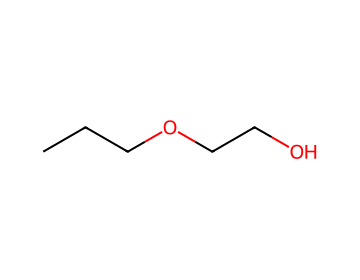
IDENTITY
COMPUTED
PROPERTIES
0.08
Mild ethereal odor
Bitter taste
0.908 at 73 °F (USCG, 1999) - Less dense than water; will float
Sp gr: 0.9112 at 20 °C/4 °C
Relative density (water = 1): 0.91
0.9112 @ 20°C
Volatile liquid
Soluble in water, alcohol, ether
Solubility in water: miscible
120 °F (USCG, 1999)
57 °C
125 °F (OPEN CUP)
57 °C c.c.
301 °F at 760 mmHg (USCG, 1999)
150-152 °C at 760 mm Hg
149-152 °C
149.8 °C @760 [mm Hg]
-90 °C
3.6 (USCG, 1999) - Heavier than air; will sink (Relative to Air)
Relative vapor density (air = 1): 3.6
3.12 [mmHg]
2.9 mm Hg at 25 °C
Vapor pressure, Pa at 25 °C: 130
7.5 [mm Hg] @40 °C
Index of Refraction: 1.412 at 25 °C
GHS
Warning
H312: Harmful in contact with skin [Warning Acute toxicity, dermal];H319: Causes serious eye irritation [Warning Serious eye damage/eye irritation]
P264+P265, P280, P302+P352, P305+P351+P338, P317, P321, P337+P317, P362+P364, and P501 (click each P-code to see the statement)
This chemical does not meet GHS hazard criteria for < 0.1% (1 of 1333) of reports.
HAZARDS
Chemical: Ethanol, 2-propoxy-
Ethanol, 2-propoxy- is listed on the EPA's Chemical Data Reporting (CDR) system. Manufacturers and importers of Ethanol, 2-propoxy- are required to report information about their production and use of this chemical to the EPA under the Toxic Substances Control Act (TSCA). (40 eCFR Part 711)
Status: Active Update: 15-01-2021 https://echa.europa.eu/registration-dossier/-/registered-dossier/5863
Ethanol, 2-propoxy-: HSNO Approval: HSR001161 Approved with controls
IMAP assessments - Ethanol, 2-propoxy-: Human health tier II assessment;IMAP assessments - Ethanol, 2-propoxy-: Environment tier I assessment
Flammable Liquid
Combustible: Carbon dioxide and carbon monoxide may be produced in a fire. (USCG, 1999)
Flammable. Above 57 °C explosive vapour/air mixtures may be formed.
VAPOR: Irritating eyes and nose. LIQUID: Can cause corneal damage. INHALATION: Can cause toxic effects. SKIN: Contact can cause toxic effects. (USCG, 1999)
A skin, eye, and respiratory tract irritant; The substance may cause effects on the blood , resulting in lesions of blood cells. [ICSC] Danger of cutaneous absorption; [MAK] May form unstable peroxides on exposure to air; An irritant; May cause serious eye injury; Readily absorbed through skin; Causes injury to blood, lungs, liver, and kidneys in high-dose animal studies; [MSDSonline] See GLYCOL ETHERS.
Ethers
Symbol: Xn; R: 21-36; S: (2)-26-36/37-46
UN Hazard Class: 3; UN Pack Group: III
Peroxidizable Compound
Ethers, such as ETHYLENE GLYCOL PROPYL ETHER can act as bases. They form salts with strong acids and addition complexes with Lewis acids. The complex between diethyl ether and boron trifluoride is an example. Ethers may react violently with strong oxidizing agents. In other reactions, which typically involve the breaking of the carbon-oxygen bond, ethers are relatively inert.
This action promulgates standards of performance for equipment leaks of Volatile Organic Compounds (VOC) in the Synthetic Organic Chemical Manufacturing Industry (SOCMI). The intended effect of these standards is to require all newly constructed, modified, and reconstructed SOCMI process units to use the best demonstrated system of continuous emission reduction for equipment leaks of VOC, considering costs, non air quality health and environmental impact and energy requirements. Ethylene glycol monopropyl ether is produced, as an intermediate or final product, by process units covered under this subpart.
SAFETY
Combustible: Extinguish with dry chemical, alcohol foam, or carbon dioxide. Cool exposed containers with water. (USCG, 1999)
Use water spray, powder, alcohol-resistant foam, carbon dioxide. In case of fire: keep drums, etc., cool by spraying with water.
Fresh air, rest.
Rinse skin with plenty of water or shower.
First rinse with plenty of water for several minutes (remove contact lenses if easily possible), then refer for medical attention.
Rinse mouth. Give one or two glasses of water to drink. Refer for medical attention .
INHALATION: Remove to fresh air.;SKIN OR EYES: Immediately flush with plenty of water. Remove contaminated clothing and shoes. (USCG, 1999)
Fireproof. Separated from strong oxidants.
10.0 [ppm]
If material on fire or involved in fire: Do not extinguish fire unless flow can be stopped or safely confined. Use water in flooding quantities as fog. Cool all affected containers with flooding quantities of water. Apply water from as far a distance as possible. Use foam, dry chemical, or carbon dioxide. Keep run-off water out of sewers and water sources.
Remove all ignition sources; call fire department; avoid contact with liquid; notify local health and pollution control agencies; protect water intakes. (USCG, 1999)
SRP: At the time of review, criteria for land treatment or burial (sanitary landfill) disposal practices are subject to significant revision. Prior to implementing land disposal of waste residue (including waste sludge), consult with environmental regulatory agencies for guidance on acceptable disposal practices.
Personal protection: filter respirator for organic gases and vapours adapted to the airborne concentration of the substance. Ventilation. Collect leaking liquid in sealable containers. Wash away remainder with plenty of water.
If material not on fire and not involved in fire: Keep sparks, flames, and other sources of ignition away. Keep material out of water sources and sewers. Build dikes to contain flow as necessary. Attempt to stop leak if without undue personnel hazard.
Personnel protection: Avoid breathing vapors. Keep upwind. ... Do not handle broken packages unless wearing appropriate personal protective equipment. Wash away any material which may have contacted the body with copious amounts of water or soap and water.
Excerpt from ERG Guide 128 [Flammable Liquids (Water-Immiscible)]:;IMMEDIATE PRECAUTIONARY MEASURE: Isolate spill or leak area for at least 50 meters (150 feet) in all directions.;LARGE SPILL: Consider initial downwind evacuation for at least 300 meters (1000 feet).;FIRE: If tank, rail tank car or highway tank is involved in a fire, ISOLATE for 800 meters (1/2 mile) in all directions; also, consider initial evacuation for 800 meters (1/2 mile) in all directions. (ERG, 2024)
Wear safety goggles.
TOXICITY
TERRESTRIAL FATE: Based on a recommended classification scheme(1), an estimated Koc value of 1(SRC), determined from a structure estimation method(2), indicates that ethylene glycol monopropyl ether should have very high mobility in soil(SRC). Volatilization of ethylene glycol monopropyl ether is not expected to be important from moist soil surfaces(SRC) given an estimated Henry's Law constant of 1.5X10⁻⁸ atm-cu m/mole(3,SRC), but may occur from dry soil surfaces(SRC), based on an experimental vapor pressure of 2.9 mm Hg(4). Alcohols and ethers are generally resistant to hydrolysis(5). According to biodegradation studies on a structurally similar compound, ethylene glycol mono-n-butyl ether(6-12), ethylene glycol monopropyl ether may biodegrade quickly in soil(SRC).
AQUATIC FATE: Based on a recommended classification scheme(1), an estimated Koc value of 1(SRC), determined from a structure estimation method(2), indicates that ethylene glycol monopropyl ether is not expected to adsorb to suspended solids and sediment(SRC) in the water. Ethylene glycol monopropyl ether will be essentially non-volatile from water surfaces based on an estimated Henry's Law constant of 1.5X10⁻⁸ atm-cu m/mole(SRC), developed using a fragment constant estimation method(3). An estimated BCF value of 0.7(1,SRC), from an estimated log Kow(4,SRC), suggests that ethylene glycol monopropyl ether will not bioconcentrate in aquatic organisms(SRC), according to a recommended classification scheme(5). Alcohols and ethers are generally resistant to hydrolysis(6). According to biodegradation studies on a structurally similar compound, ethylene glycol mono-n-butyl ether(7-13), ethylene glycol monopropyl ether may biodegrade quickly in water(SRC).
ATMOSPHERIC FATE: According to a model of gas/particle partitioning of semivolatile organic compounds in the atmosphere(1), ethylene glycol monopropyl ether, which has an experimental vapor pressure of 2.9 mm Hg at 25 °C(2), will exist as a vapor in the ambient atmosphere. Vapor-phase ethylene glycol monopropyl ether is degraded in the atmosphere by reaction with photochemically produced hydroxyl radicals(SRC); the half-life for this reaction in air is estimated to be about 18 hours(3,SRC).
Neurotoxin - Acute solvent syndrome;Occupational hepatotoxin - Secondary hepatotoxins: the potential for toxic effect in the occupational setting is based on cases of poisoning by human ingestion or animal experimentation.;Nephrotoxin - The chemical is potentially toxic to the kidneys in the occupational setting.;Hemolytic anemia - Decreased hemoglobin or number of red blood cells.;Reproductive Toxin - A chemical that is toxic to the reproductive system, including defects in the progeny and injury to male or female reproductive function. Reproductive toxicity includes developmental effects. See Guidelines for Reproductive Toxicity Risk Assessment.
The substance can be absorbed into the body by inhalation of its vapour, through the skin and by ingestion.
Cough. Sore throat.
Redness. Dry skin.
Redness. Pain.
Using a structure estimation method based on molecular connectivity indices(1), the Koc for ethylene glycol monopropyl ether can be estimated to be about 1(SRC). According to a recommended classification scheme(2), this estimated Koc value suggests that ethylene glycol monopropyl ether should have very high mobility in soil(SRC).
Ethylene glycol monopropyl ether (2807-30-9) was evaluated for developmental effects in groups of 30 female Charles River rats administered the test substance by inhalation at concentrations of 100, 200, 300 or 400 ppm for 6 hours day on days 6 through 15 of gestation. Red blood cell count was slightly reduced and mean corpuscular volume and hemoglobin were increased at 200, 300, and 400 ppm. Animals at 200, 300, and 400 ppm showed red urine after the first and second exposures. The absolute and relative spleen weight was increased in maternal animals at 300 and 400 ppm. The pregnancy rate, number of implantations and corpora lutea, number of resorptions, and number of viable fetuses per litter were not affected at any of the treatment levels. Fetuses from the 200, 300, and 400 ppm groups exhibited an increased incidence of 14th rudimentary ribs. The maternal and fetal NOAEL was 100 ppm.
Ethylene glycol monopropyl ether's production and use as a solvent in the coating industry(1) may result in its release to the environment through various waste streams(SRC).
Four strains of bacteria isolated from soil, MC11, TE8, PE18, and OEH8, were not able to grow using ethylene glycol monopropyl ether as the sole source of carbon(1). However, based on biodegradation studies for a structurally similar compound, ethylene gylcol mono-n-butyl ether(2-8), ethylene glycol monopropyl ether is expected to rapidly biodegrade in both soil and water(SRC).
An estimated BCF value of 0.6 was calculated for ethylene glycol monopropyl ether(SRC), using an estimated log Kow of 0.08(1,SRC) and a recommended regression-derived equation(2). According to a recommended classification scheme(3), this BCF value suggests that bioconcentration in aquatic organisms will not be an important fate process(SRC).
The Henry's Law constant for ethylene glycol monopropyl ether is estimated as 1.5X10⁻⁸ atm-cu m/mole(SRC) using a fragment constant estimation method(1). This value indicates that ethylene glycol monopropyl ether will be essentially nonvolatile from water surfaces(2,SRC). Ethylene glycol monopropyl ether's vapor pressure, 2.9 mm Hg(3) indicates that volatilization from dry soil surfaces may occur(SRC) but ethylene glycol monopropyl ether's Henry's Law constant(1,SRC) indicates that volatilization from moist soil surfaces should not occur(SRC).
... A single subcutaneous injection of 1 ml/kg in the rabbit caused death with serious kidney injury and blood pigments in the urine.
A guinea pig given an intrperitoneal injection of 1 ml/kg died and showed considerable kidney injury, but one given 0.5 ml/kg survived.
Repeated subcutaneous injections of 0.5 ml/kg were survived by the guinea pig and the rabbit, but when the dosage was 1 ml/kg, the guinea pig died several days after the seventh injection.
The material is appreciably irritating to the eyes of rabbits, causing injury to the conjunctival membranes and the cornea, and also some iritis; healing appeared to be complete within a week.
For more Non-Human Toxicity Excerpts (Complete) data for ETHYLENE GLYCOL MONOPROPYL ETHER (8 total), please visit the HSDB record page.
The rate constant for the vapor-phase reaction of ethylene glycol monopropyl ether with photochemically produced hydroxyl radicals has been estimated as 2.2X10⁻¹¹ cu cm/molecule-sec at 25 °C(SRC) using a structure estimation method(1,SRC). This corresponds to an atmospheric half-life of about 18 hours at an atmospheric concentration of 5X10+5 hydroxyl radicals per cu cm(1,SRC).
REGULATORY
Chemical: Ethanol, 2-propoxy-
Ethanol, 2-propoxy- is listed on the EPA's Chemical Data Reporting (CDR) system. Manufacturers and importers of Ethanol, 2-propoxy- are required to report information about their production and use of this chemical to the EPA under the Toxic Substances Control Act (TSCA). (40 eCFR Part 711)
Status: Active Update: 15-01-2021 https://echa.europa.eu/registration-dossier/-/registered-dossier/5863
Ethanol, 2-propoxy-: HSNO Approval: HSR001161 Approved with controls
This action promulgates standards of performance for equipment leaks of Volatile Organic Compounds (VOC) in the Synthetic Organic Chemical Manufacturing Industry (SOCMI). The intended effect of these standards is to require all newly constructed, modified, and reconstructed SOCMI process units to use the best demonstrated system of continuous emission reduction for equipment leaks of VOC, considering costs, non air quality health and environmental impact and energy requirements. Ethylene glycol monopropyl ether is produced, as an intermediate or final product, by process units covered under this subpart.
PHARMACOLOGY
... The material may be absorbed through the skin in lethal amounts.
USES
Used as a solvent in the coating industry; [HSDB] Used to make soaps, dyes, and other chemicals; [CAMEO]
Painting (Solvents) [Category: Paint]
As a solvent in the coating industry.
2023: 5,000,000 - <10,000,000 lb;2022: 10,000,000 - <50,000,000 lb;2021: 10,000,000 - <50,000,000 lb;2020: 10,000,000 - <50,000,000 lb
Not Known or Reasonably Ascertainable;Solvent
Solvent;Not Known or Reasonably Ascertainable
Information on 28 consumer products that contain Ethylene glycol monopropyl ether in the following categories is provided:;• Auto Products;• Commercial / Institutional;• Home Maintenance;• Inside the Home
Miscellaneous Manufacturing;All Other Basic Organic Chemical Manufacturing;Paint and Coating Manufacturing;Not Known or Reasonably Ascertainable
Ethanol, 2-propoxy-: ACTIVE
ALIASES
REACTIONS
Training data from https://doi.org/10.1039/C8SC04228D (2/10) · 10.1039/C8SC04228D
查看
uspto-grants-1980_11 · 10.6084/m9.figshare.5104873.v1 · US04233237
查看
uspto-grants-2012_01 · 10.6084/m9.figshare.5104873.v1 · US08097621B2
查看
uspto-grants-2002_04 · 10.6084/m9.figshare.5104873.v1 · US06369083B1
查看
uspto-grants-2007_08 · 10.6084/m9.figshare.5104873.v1 · US07262192B2
查看
uspto-grants-2003_02 · 10.6084/m9.figshare.5104873.v1 · US06518282B1
查看
Training data from https://doi.org/10.1039/C8SC04228D (7/10) · 10.1039/C8SC04228D
查看
Training data from https://doi.org/10.1039/C8SC04228D (7/10) · 10.1039/C8SC04228D
查看