
uspto-grants-2013_09 · 10.6084/m9.figshare.5104873.v1 · US08530470B2
查看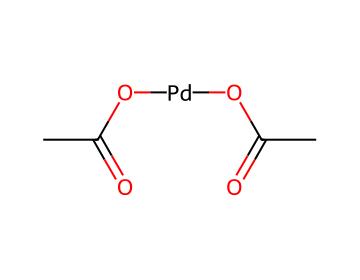
IDENTITY
COMPUTED
PROPERTIES
Reddish-brown solid; Insoluble in water; [Hawley] Powder; [MSDSonline]
GHS
Danger
H302 (11.3%): Harmful if swallowed [Warning Acute toxicity, oral];H317 (73.6%): May cause an allergic skin reaction [Warning Sensitization, Skin];H318 (98.9%): Causes serious eye damage [Danger Serious eye damage/eye irritation];H400 (67.5%): Very toxic to aquatic life [Warning Hazardous to the aquatic environment, acute hazard];H410 (67.5%): Very toxic to aquatic life with long lasting effects [Warning Hazardous to the aquatic environment, long-term hazard]
P261, P264, P264+P265, P270, P272, P273, P280, P301+P317, P302+P352, P305+P354+P338, P317, P321, P330, P333+P317, P362+P364, P391, and P501 (click each P-code to see the statement)
Aggregated GHS information provided per 265 reports by companies from 18 notifications to the ECHA C&L Inventory. Each notification may be associated with multiple companies.;Information may vary between notifications depending on impurities, additives, and other factors. The percentage value in parenthesis indicates the notified classification ratio from companies that provide hazard codes. Only hazard codes with percentage values above 10% are shown. For more detailed information, please visit ECHA C&L website.
HAZARDS
Chemical: Acetic acid, palladium(2+) salt
Status: Active Update: 21-02-2022 https://echa.europa.eu/registration-dossier/-/registered-dossier/17957
Palladium (II) acetate: Does not have an individual approval but may be used under an appropriate group standard
IMAP assessments - Acetic acid, palladium(2+) salt: Environment tier I assessment;IMAP assessments - Acetic acid, palladium(2+) salt: Human health tier I assessment
Corrosive to eyes; [eChemPortal: ERMA] An irritant; May cause serious injury to eyes; [MSDSonline]
Acute Tox. 4 (11.3%);Skin Sens. 1 (73.6%);Eye Dam. 1 (98.9%);Aquatic Acute 1 (67.5%);Aquatic Chronic 1 (67.5%)
TOXICITY
Contact with palladium may cause palladium sensitivity and allergy. Animal studies have shown that palladium may damage the liver and kidney. (L798)
Due to their ability to form strong complexes with both inorganic and organic ligands, palladium ions can disturb cellular equilibria, replace other essential ions, and interact with functional groups of macromolecules, such as proteins or DNA. Palladium complexes binding to DNA and RNA leads to strand breakage. Palladium ions are able to inhibit most major cellular functions, including DNA and RNA synthesis. Palladium compounds have been shown to bind to and inhibit various enzymes, including creatine kinase and prolyl hydroxylase. (L798)
Skin contact with palladium may cause contact dermatitis, erythema, and oedema. (L798)
No indication of carcinogenicity to humans (not listed by IARC).
REGULATORY
Chemical: Acetic acid, palladium(2+) salt
Status: Active Update: 21-02-2022 https://echa.europa.eu/registration-dossier/-/registered-dossier/17957
Palladium (II) acetate: Does not have an individual approval but may be used under an appropriate group standard
PHARMACOLOGY
Palladium may be absorbed through oral, dermal, and inhalation exposure. Once in the body it distributes to the kidney, liver, spleen, lymph nodes, adrenal gland, lung and bone. Palladium's ability to form complexes allows it the bind to amino acids, proteins, DNA, and other macromolecules. Palladium and its metabolites are excreted in the urine and faeces. (A21)
USES
Used as a catalyst in organic chemistry; [Hawley]
Palladium acetate is used as a catalyst for many organic reactions and as a precursor to other palladium(II) compounds. (L804)
Acetic acid, palladium(2+) salt (2:1): ACTIVE
Acetic acid, palladium salt (1:?): INACTIVE
ALIASES
REACTIONS
uspto-grants-2013_09 · 10.6084/m9.figshare.5104873.v1 · US08530470B2
查看
uspto-grants-2013_09 · 10.6084/m9.figshare.5104873.v1 · US08530470B2
查看
uspto-grants-2013_09 · 10.6084/m9.figshare.5104873.v1 · US08530470B2
查看
uspto-grants-2013_09 · 10.6084/m9.figshare.5104873.v1 · US08530470B2
查看
uspto-grants-2013_09 · 10.6084/m9.figshare.5104873.v1 · US08530470B2
查看
uspto-grants-2013_09 · 10.6084/m9.figshare.5104873.v1 · US08530470B2
查看
uspto-grants-2013_09 · 10.6084/m9.figshare.5104873.v1 · US08530470B2
查看
uspto-grants-2013_09 · 10.6084/m9.figshare.5104873.v1 · US08530470B2
查看