
uspto-grants-2008_09 · 10.6084/m9.figshare.5104873.v1 · US07425557B2
查看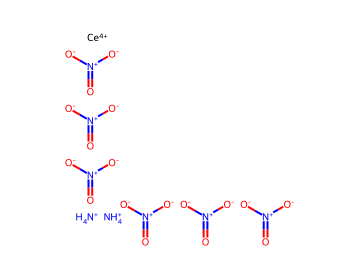
IDENTITY
COMPUTED
PROPERTIES
Orange solid, soluble in water; [Merck Index]
GHS
Danger
H272 (99.4%): May intensify fire; oxidizer [Danger Oxidizing liquids; Oxidizing solids];H302 (92.6%): Harmful if swallowed [Warning Acute toxicity, oral];H314 (67.4%): Causes severe skin burns and eye damage [Danger Skin corrosion/irritation];H315 (28%): Causes skin irritation [Warning Skin corrosion/irritation];H317 (66.3%): May cause an allergic skin reaction [Warning Sensitization, Skin];H318 (68%): Causes serious eye damage [Danger Serious eye damage/eye irritation];H319 (29.1%): Causes serious eye irritation [Warning Serious eye damage/eye irritation];H335 (26.9%): May cause respiratory irritation [Warning Specific target organ toxicity, single exposure; Respiratory tract irritation];H400 (65.1%): Very toxic to aquatic life [Warning Hazardous to the aquatic environment, acute hazard];H410 (65.7%): Very toxic to aquatic life with long lasting effects [Warning Hazardous to the aquatic environment, long-term hazard]
P210, P220, P260, P261, P264, P264+P265, P270, P271, P272, P273, P280, P301+P317, P301+P330+P331, P302+P352, P302+P361+P354, P304+P340, P305+P351+P338, P305+P354+P338, P316, P317, P319, P321, P330, P332+P317, P333+P317, P337+P317, P362+P364, P363, P370+P378, P391, P403+P233, P405, and P501 (click each P-code to see the statement)
Aggregated GHS information provided per 175 reports by companies from 19 notifications to the ECHA C&L Inventory. Each notification may be associated with multiple companies.;Information may vary between notifications depending on impurities, additives, and other factors. The percentage value in parenthesis indicates the notified classification ratio from companies that provide hazard codes. Only hazard codes with percentage values above 10% are shown. For more detailed information, please visit ECHA C&L website.
HAZARDS
Status: Active Update: 24-03-2022 https://echa.europa.eu/registration-dossier/-/registered-dossier/11355
See Cerium. See RARE EARTH METALS and linked occupational diseases.
Ox. Sol. 2 (99.4%);Acute Tox. 4 (92.6%);Skin Corr. 1B (67.4%);Skin Irrit. 2 (28%);Skin Sens. 1A (66.3%);Eye Dam. 1 (68%);Eye Irrit. 2 (29.1%);STOT SE 3 (26.9%);Aquatic Acute 1 (65.1%);Aquatic Chronic 1 (65.7%)
SAFETY
0.054 [mg/m3]
0.58 [mg/m3]
3.5 [mg/m3]
TOXICITY
Methemoglobinemia can be treated with supplemental oxygen and methylene blue 1% solution administered intravenously slowly over five minutes followed by IV flush with normal saline. Methylene blue restores the iron in hemoglobin to its normal (reduced) oxygen-carrying state. (L1613)
Nitrate and nitrite poisoning causes methemoglobinemia. Nitrites may cause pregnancy complications and developmental effects. They may also be carcinogenic. (L1137)
Fibrogenic - Inducing tissue injury and fibrosis (scarring).
Oral (L1137) ; inhalation (L1137)
Nitrate's toxicity is a result of it's conversion to nitrite once in the body. Nitrite causes the autocatalytic oxidation of oxyhemoglobin to hydrogen peroxide and methemoglobin. This elevation of methemoglobin levels is a condition known as methemoglobinemia, and is characterized by tissue hypoxia, as methemoglobin cannot bind oxygen. (A2450, L1613)
Nitrate and nitrite poisoning causes methemoglobinemia. Symptoms include cyanosis, cardiac dysrhythmias and circulatory failure, and progressive central nervous system (CNS) effects. CNS effects can range from mild dizziness and lethargy to coma and convulsions. (L1137)
Ingested nitrate or nitrite under conditions that result in endogenous nitrosation is probably carcinogenic to humans (Group 2A). (L135)
REGULATORY
Status: Active Update: 24-03-2022 https://echa.europa.eu/registration-dossier/-/registered-dossier/11355
PHARMACOLOGY
Intake of some amount of nitrates and nitrites is a normal part of the nitrogen cycle in humans. In vivo conversion of nitrates to nitrites can occur in the gastrointestional tract under the right conditions, significantly enhancing nitrates' toxic potency. The major metabolic pathway for nitrate is conversion to nitrite, and then to ammonia. Nitrites, nitrates, and their metabolites are excreted in the urine. (L1137)
USES
Used as a standard in oxidimetry and an oxidant in redox reactions; Used in a solution of perchloric acid to etch printed circuits; [Merck Index]
Cerate(2-), hexakis(nitrato-.kappa.O)-, ammonium (1:2), (OC-6-11)-: ACTIVE
ALIASES
REACTIONS
uspto-grants-2008_09 · 10.6084/m9.figshare.5104873.v1 · US07425557B2
查看
uspto-grants-2013_09 · 10.6084/m9.figshare.5104873.v1 · US08524721B2
查看
uspto-grants-2016_09 · 10.6084/m9.figshare.5104873.v1 · US09434712B2
查看
uspto-grants-2016_09 · 10.6084/m9.figshare.5104873.v1 · US09434712B2
查看
uspto-grants-2016_09 · 10.6084/m9.figshare.5104873.v1 · US09447006B2
查看
uspto-grants-2016_09 · 10.6084/m9.figshare.5104873.v1 · US09447006B2
查看
uspto-grants-2016_09 · 10.6084/m9.figshare.5104873.v1 · US09447006B2
查看
uspto-grants-2016_09 · 10.6084/m9.figshare.5104873.v1 · US09447006B2
查看