
uspto-grants-2016_01 · 10.6084/m9.figshare.5104873.v1 · US09238021B2
查看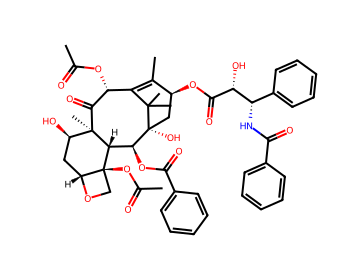
IDENTITY
COMPUTED
GHS
Danger
H301 (33.3%): Toxic if swallowed [Danger Acute toxicity, oral];H315 (33.3%): Causes skin irritation [Warning Skin corrosion/irritation];H317 (33.3%): May cause an allergic skin reaction [Warning Sensitization, Skin];H318 (33.3%): Causes serious eye damage [Danger Serious eye damage/eye irritation];H334 (33.3%): May cause allergy or asthma symptoms or breathing difficulties if inhaled [Danger Sensitization, respiratory];H335 (33.3%): May cause respiratory irritation [Warning Specific target organ toxicity, single exposure; Respiratory tract irritation];H340 (33.3%): May cause genetic defects [Danger Germ cell mutagenicity];H341 (66.7%): Suspected of causing genetic defects [Warning Germ cell mutagenicity];H351 (33.3%): Suspected of causing cancer [Warning Carcinogenicity];H360 (33.3%): May damage fertility or the unborn child [Danger Reproductive toxicity];H360FD (33.3%): May damage fertility; May damage the unborn child [Danger Reproductive toxicity];H361 (33.3%): Suspected of damaging fertility or the unborn child [Warning Reproductive toxicity];H372 (33.3%): Causes damage to organs through prolonged or repeated exposure [Danger Specific target organ toxicity, repeated exposure]
P203, P233, P260, P261, P264, P264+P265, P270, P271, P272, P280, P284, P301+P316, P302+P352, P304+P340, P305+P354+P338, P317, P318, P319, P321, P330, P332+P317, P333+P317, P342+P316, P362+P364, P403, P403+P233, P405, and P501 (click each P-code to see the statement)
Aggregated GHS information provided per 3 reports by companies from 3 notifications to the ECHA C&L Inventory. Each notification may be associated with multiple companies.;Information may vary between notifications depending on impurities, additives, and other factors. The percentage value in parenthesis indicates the notified classification ratio from companies that provide hazard codes. Only hazard codes with percentage values above 10% are shown. For more detailed information, please visit ECHA C&L website.
HAZARDS
Acute Tox. 3 (33.3%);Skin Irrit. 2 (33.3%);Skin Sens. 1 (33.3%);Eye Dam. 1 (33.3%);Resp. Sens. 1 (33.3%);STOT SE 3 (33.3%);Muta. 1B (33.3%);Muta. 2 (66.7%);Carc. 2 (33.3%);Repr. 1B (33.3%);Repr. 1B (33.3%);Repr. 2 (33.3%);STOT RE 1 (33.3%)
TOXICITY
When a 24 hour infusion of 135 mg/m^2 is given to ovarian cancer patients, the maximum plasma concentration (Cmax) is 195 ng/mL, while the AUC is 6300 ng*h/mL.
Paclitaxel interferes with the normal function of microtubule growth. Whereas drugs like colchicine cause the depolymerization of microtubules in vivo, paclitaxel arrests their function by having the opposite effect; it hyper-stabilizes their structure. This destroys the cell's ability to use its cytoskeleton in a flexible manner. Specifically, paclitaxel binds to the β subunit of tubulin. Tubulin is the 'building block' of mictotubules, and the binding of paclitaxel locks these building blocks in place. The resulting microtubule/paclitaxel complex does not have the ability to disassemble. This adversely affects cell function because the shortening and lengthening of microtubules (termed dynamic instability) is necessary for their function as a transportation highway for the cell. Chromosomes, for example, rely upon this property of microtubules during mitosis. Further research has indicated that paclitaxel induces programmed cell death (apoptosis) in cancer cells by binding to an apoptosis stopping protein called Bcl-2 (B-cell leukemia 2) and thus arresting its function.
No indication of carcinogenicity to humans (not listed by IARC).
Rat (ipr) LD<sub>50</sub>=32530 µg/kg.
PHARMACOLOGY
Hepatic. In vitro studies with human liver microsomes and tissue slices showed that paclitaxel was metabolized primarily to 6a-hydrox-ypaclitaxel by the cytochrome P450 isozyme CYP2C8; and to two minor metabolites, 3’-p-hydroxypaclitaxel and 6a, 3’-p-dihydroxypaclitaxel, by CYP3A4. Route of Elimination: In 5 patients administered a 225 or 250 mg/m2 dose of radiolabeled paclitaxel as a 3-hour infusion, a mean of 71% of the radioactivity was excreted in the feces in 120 hours, and 14% was recovered in the urine. Half Life: When a 24 hour infusion of 135 mg/m^2 is given to ovarian cancer patients, the elimination half=life is 52.7 hours.
Agents obtained from higher plants that have demonstrable cytostatic or antineoplastic activity.
Agents that interact with TUBULIN to inhibit or promote polymerization of MICROTUBULES.
USES
Used in the treatment of Kaposi's sarcoma and cancer of the lung, ovarian, and breast. Abraxane™ is specfically indicated for the treatment of metastatic breast cancer and locally advanced or metastatic non-small cell lung cancer.
ALIASES
REACTIONS
uspto-grants-2016_01 · 10.6084/m9.figshare.5104873.v1 · US09238021B2
查看
uspto-grants-2016_01 · 10.6084/m9.figshare.5104873.v1 · US09238021B2
查看
uspto-grants-2011_12 · 10.6084/m9.figshare.5104873.v1 · US08075913B2
查看
uspto-grants-2011_12 · 10.6084/m9.figshare.5104873.v1 · US08075913B2
查看
uspto-grants-2014_03 · 10.6084/m9.figshare.5104873.v1 · US08663606B2
查看
uspto-grants-2014_03 · 10.6084/m9.figshare.5104873.v1 · US08663606B2
查看
uspto-grants-2010_09 · 10.6084/m9.figshare.5104873.v1 · US07794747B2
查看
uspto-grants-2010_09 · 10.6084/m9.figshare.5104873.v1 · US07794747B2
查看