
uspto-grants-1988_02 · 10.6084/m9.figshare.5104873.v1 · US04724202
查看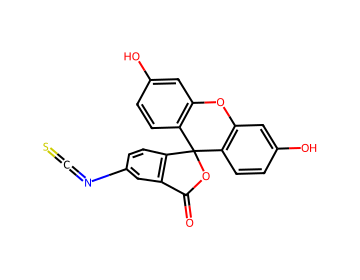
IDENTITY
COMPUTED
PROPERTIES
Orange solid; [Merck Index] Orange powder; [Alfa Aesar MSDS]
GHS
Danger
H317 (100%): May cause an allergic skin reaction [Warning Sensitization, Skin];H334 (100%): May cause allergy or asthma symptoms or breathing difficulties if inhaled [Danger Sensitization, respiratory]
P233, P260, P261, P271, P272, P280, P284, P302+P352, P304+P340, P321, P333+P317, P342+P316, P362+P364, P403, and P501 (click each P-code to see the statement)
Aggregated GHS information provided per 169 reports by companies from 6 notifications to the ECHA C&L Inventory. Each notification may be associated with multiple companies.;Information may vary between notifications depending on impurities, additives, and other factors. The percentage value in parenthesis indicates the notified classification ratio from companies that provide hazard codes. Only hazard codes with percentage values above 10% are shown. For more detailed information, please visit ECHA C&L website.
HAZARDS
Chemical: Spiro[isobenzofuran-1(3H),9'-(9H)xanthen]-3-one, 3',6'-dihydroxy-5-isothiocyanato-
Spiro[isobenzofuran-1(3H),9'-[9H]xanthen]-3-one, 3',6'-dihydroxy-5-isothiocyanato-: Does not have an individual approval but may be used under an appropriate group standard
Causes cutaneous sensitization (experimental) and effects on inflammation in 3-day intermittent dermal studies of mice; [RTECS] May cause irritation; May cause skin and respiratory sensitization; [Alfa Aesar MSDS]
Skin Sens. 1 (100%);Resp. Sens. 1 (100%)
TOXICITY
EYES: irrigate opened eyes for several minutes under running water. INGESTION: do not induce vomiting. Rinse mouth with water (never give anything by mouth to an unconscious person). Seek immediate medical advice. SKIN: should be treated immediately by rinsing the affected parts in cold running water for at least 15 minutes, followed by thorough washing with soap and water. If necessary, the person should shower and change contaminated clothing and shoes, and then must seek medical attention. INHALATION: supply fresh air. If required provide artificial respiration.
Exposure to high levels of cyanide for a short time harms the brain and heart and can even cause coma, seizures, apnea, cardiac arrest and death. Chronic inhalation of cyanide causes breathing difficulties, chest pain, vomiting, blood changes, headaches, and enlargement of the thyroid gland. Skin contact with cyanide salts can irritate and produce sores. (L96, L97)
Skin Sensitizer - An agent that can induce an allergic reaction in the skin.
Oral (L96) ; inhalation (L96) ; dermal (L96)
Cyanide is an inhibitor of cytochrome c oxidase in the fourth complex of the electron transport chain (found in the membrane of the mitochondria of eukaryotic cells). It complexes with the ferric iron atom in this enzyme. The binding of cyanide to this cytochrome prevents transport of electrons from cytochrome c oxidase to oxygen. As a result, the electron transport chain is disrupted and the cell can no longer aerobically produce ATP for energy. Tissues that mainly depend on aerobic respiration, such as the central nervous system and the heart, are particularly affected. Cyanide is also known produce some of its toxic effects by binding to catalase, glutathione peroxidase, methemoglobin, hydroxocobalamin, phosphatase, tyrosinase, ascorbic acid oxidase, xanthine oxidase, succinic dehydrogenase, and Cu/Zn superoxide dismutase. Cyanide binds to the ferric ion of methemoglobin to form inactive cyanmethemoglobin. (L97)
Cyanide poisoning is identified by rapid, deep breathing and shortness of breath, general weakness, giddiness, headaches, vertigo, confusion, convulsions/seizures and eventually loss of consciousness. (L96, L97)
No indication of carcinogenicity to humans (not listed by IARC).
REGULATORY
Chemical: Spiro[isobenzofuran-1(3H),9'-(9H)xanthen]-3-one, 3',6'-dihydroxy-5-isothiocyanato-
Spiro[isobenzofuran-1(3H),9'-[9H]xanthen]-3-one, 3',6'-dihydroxy-5-isothiocyanato-: Does not have an individual approval but may be used under an appropriate group standard
PHARMACOLOGY
Cyanide is rapidly alsorbed through oral, inhalation, and dermal routes and distributed throughout the body. Cyanide is mainly metabolized into thiocyanate by either rhodanese or 3-mercaptopyruvate sulfur transferase. Cyanide metabolites are excreted in the urine. (L96)
Chemicals that emit light after excitation by light. The wave length of the emitted light is usually longer than that of the incident light. Fluorochromes are substances that cause fluorescence in other substances, i.e., dyes used to mark or label other compounds with fluorescent tags.
USES
Used as a fluorescent indicator to probe biological systems and monitor sewage; [Merck Index]
Fluorescein isothiocyanate is used in flow cytometry. (L552)
Spiro[isobenzofuran-1(3H),9'-[9H]xanthen]-3-one, 3',6'-dihydroxy-5-isothiocyanato-: ACTIVE
ALIASES
REACTIONS
uspto-grants-1988_02 · 10.6084/m9.figshare.5104873.v1 · US04724202
查看
uspto-grants-1979_04 · 10.6084/m9.figshare.5104873.v1 · US04150949
查看
uspto-grants-1995_05 · 10.6084/m9.figshare.5104873.v1 · US05416016
查看
uspto-grants-1979_11 · 10.6084/m9.figshare.5104873.v1 · US04174384
查看
uspto-grants-2016_09 · 10.6084/m9.figshare.5104873.v1 · US09446155B2
查看
uspto-grants-1986_09 · 10.6084/m9.figshare.5104873.v1 · US04609689
查看
uspto-grants-1981_03 · 10.6084/m9.figshare.5104873.v1 · US04255329
查看
uspto-grants-1980_11 · 10.6084/m9.figshare.5104873.v1 · US04235869
查看