
Training data from https://doi.org/10.1039/C8SC04228D (2/10) · 10.1039/C8SC04228D
查看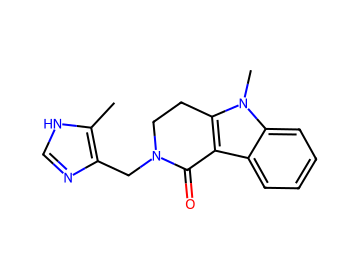
IDENTITY
COMPUTED
PROPERTIES
2
2
4.38e-01 g/L
Solid
TOXICITY
The most common adverse effect associated with alosetron administration is constipation. A randomized, double-blind, placebo-controlled study assessed the efficacy and safety of alosetron 0.5 mg and 1 mg in women with severe IBS-D. The study data revealed that constipation occurred in patients receiving 0.5 mg (9%), 1 mg once daily (16%), and 1 mg twice daily (19%).;Other common adverse effects associated with alosetron therapy include:;* Abdominal discomfort and pain;* Nausea;* Abdominal distension;* Regurgitation and reflux;* Hemorrhoids;* Headache;* Fatigue;Although rare, ischemic colitis has been reported in patients taking alosetron to treat IBS. Clinical trials comparing patients receiving alosetron 1 mg twice daily to patients receiving placebo showed that the cumulative incidence of ischemic colitis was 0.2% within the first 3 months and 0.3% within the first 6 months. A statistically significant increase in the incidence of ischemic colitis was observed in the pooled data of clinical trials involving patients receiving alosetron compared with placebo (0.15% vs 0.00%, p=0.03). No precise mechanism for this observation is known, but many have been hypothesized. One possible mechanism involves the blockade of 5-HT3 receptors, increasing free serotonin available to stimulate other serotonin receptors (ie, 5-HT1 and 5-HT2) that may be involved in vasoconstriction. This vasoconstriction may increase the risk of developing ischemic colitis in patients with concomitant atherosclerotic disease in vessels feeding the GI tract. Another hypothesis postulates that ischemic colitis may result from alosetron's effects on colonic motility and intestinal blood flow. Because alosetron is associated with severe constipation, patients with existing vascular disease may be at increased risk of developing intestinal ischemia. These predictions are based on observations of animal models and have not been studied in humans.;Gastrointestinal adverse reactions are common in postmarketing surveillance studies. GI perforation, impaction, ulceration, small bowel mesenteric ischemia, headache, and skin rash have been reported in patients receiving alosetron.;Drug-Drug Interactions;* CYP1A2 inhibitors: Fluvoxamine, a potent CYP1A2 inhibitor, can inhibit the metabolism of alosetron if coadministered, leading to alosetron toxicity. Fluvoxamine can increase the mean plasma concentration of alosetron by 6-fold and prolong the half-life by 3-fold. Moderate CYP1A2 inhibitors (eg, cimetidine, quinolone antibiotics) should be avoided unless clinically indicated.;* CYP3A4 inhibitors: Ketoconazole, clarithromycin, telithromycin, voriconazole, itraconazole, and protease inhibitors are strong CYP3A4 inhibitors and may increase alosetron toxicity. Due to potential drug interactions, clinicians should exercise caution when administering alosetron and CYP3A4 inhibitors concomitantly.
Signs and Symptoms of Overdose;During clinical studies, doses up to 16 mg (8 times the recommended daily dose) have been administered without significant adverse reactions.;Management of Overdose;There is no specific antidote for alosetron. Patients should be managed with appropriate supportive therapy. Overdose with alosetron may reduce the first-pass metabolism of other drugs. A poison control center should be contacted for overdose treatment protocol.
Drug-Induced Liver Injury Severity and Toxicity (DILIst)
alosetron
DILI Positive
Oral
DOI:10.1016/j.drudis.2019.09.022
◉ Summary of Use during Lactation;No information is available on the use of alosetron during breastfeeding. Because of relatively high protein binding and only moderate bioavailability, exposure of the breastfed infant is likely to be low. Until more data are available, alosetron should only be used with careful infant monitoring during breastfeeding.;◉ Effects in Breastfed Infants;Relevant published information was not found as of the revision date.;◉ Effects on Lactation and Breastmilk;Relevant published information was not found as of the revision date.
PHARMACOLOGY
A - Alimentary tract and metabolism;A03 - Drugs for functional gastrointestinal disorders;A03A - Drugs for functional gastrointestinal disorders;A03AE - Serotonin receptor antagonists;A03AE01 - Alosetron
QA - Alimentary tract and metabolism;QA03 - Drugs for functional gastrointestinal disorders;QA03A - Drugs for functional gastrointestinal disorders;QA03AE - Serotonin receptor antagonists;QA03AE01 - Alosetron
82%
Alosetron is a potent and selective antagonist of the serotonin 5-HT<sub>3</sub> receptor type. Activation of these receptors and the resulting neuronal depolarization affects the regulation of visceral pain, colonic transit, and GI secretions processes that are related to IBS. By blocking these receptors, alosetron is able to effectively control IBS.
Alosetron is a potent and selective 5-HT<sub>3</sub> receptor antagonist. 5-HT<sub>3</sub> receptors are nonselective cation channels that are extensively distributed on enteric neurons in the human gastrointestinal tract, as well as other peripheral and central locations. Activation of these channels and the resulting neuronal depolarization affect the regulation of visceral pain, colonic transit and gastrointestinal secretions, processes that relate to the pathophysiology of irritable bowel syndrome (IBS). 5-HT<sub>3</sub> receptor antagonists such as alosetron inhibit activation of non-selective cation channels which results in the modulation of serotonin-sensitive GI motor and sensory processes.
1.5 hours
Hepatic, via microsomal cytochrome P450 (CYP)
Alosetron has known human metabolites that include 6-hydroxy-5-methyl-2-[(5-methyl-2-oxo-1,3-dihydroimidazol-4-yl)methyl]-3,4-dihydropyrido[4,3-b]indol-1-one and 6-Hydroxy-5-methyl-2-[(5-methyl-1H-imidazol-4-yl)methyl]-3,4-dihydropyrido[4,3-b]indol-1-one.
13Z9HTH115
ALOSETRON
Mechanisms of Action [MoA] - Serotonin 3 Receptor Antagonists
Established Pharmacologic Class [EPC] - Serotonin-3 Receptor Antagonist
Alosetron is a Serotonin-3 Receptor Antagonist. The mechanism of action of alosetron is as a Serotonin 3 Receptor Antagonist.
ALOSETRON
Drugs used for their effects on the gastrointestinal system, as to control gastric acidity, regulate gastrointestinal motility and water flow, and improve digestion.
Drugs that bind to but do not activate serotonin receptors, thereby blocking the actions of serotonin or SEROTONIN RECEPTOR AGONISTS.
50-60 %
Renal elimination of unchanged alosetron accounts for only 6% of the dose. Alosetron is extensively metabolized in humans.
65 to 95 L
600 mL/min
Membrane
ALIASES
REACTIONS
Training data from https://doi.org/10.1039/C8SC04228D (2/10) · 10.1039/C8SC04228D
查看
Training data from https://doi.org/10.1039/C8SC04228D (8/10) · 10.1039/C8SC04228D
查看
uspto-grants-1993_07 · 10.6084/m9.figshare.5104873.v1 · US05229407
查看
uspto-grants-1993_07 · 10.6084/m9.figshare.5104873.v1 · US05229407
查看
Validation data from https://doi.org/10.1039/C8SC04228D · 10.1039/C8SC04228D
查看
uspto-grants-1994_01 · 10.6084/m9.figshare.5104873.v1 · US05276050
查看
Training data from https://doi.org/10.1039/C8SC04228D (5/10) · 10.1039/C8SC04228D
查看
uspto-grants-1993_06 · 10.6084/m9.figshare.5104873.v1 · US05221687
查看