
uspto-grants-1998_11 · 10.6084/m9.figshare.5104873.v1 · US05840712
查看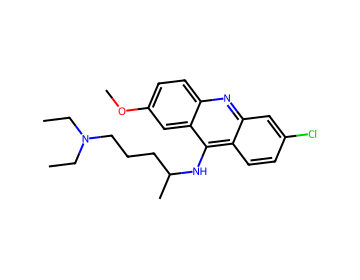
IDENTITY
COMPUTED
PROPERTIES
5.5
5.5
Bright yellow crystals
Slight
1g in 36 ml water
Slightly soluble in ethanol
Insoluble in alcohol, benzene, chloroform and ether
2.39e-03 g/L
248-250 °C
Decomposes at 248 °C
Melting point: ca 250 °C /Hydrochloride/
248 - 250 °C
Solid
Sensitive to light. /Quinacrine hydrochloride/
10.3
194.62 Ų [M+H]+ [CCS Type: TW; Method: calibrated with polyalanine and drug standards];192.67 Ų [M+K]+ [CCS Type: TW; Method: calibrated with polyalanine and drug standards]
Upon decomposition emits NOx
Bright bright yellow crystals. Decomposes 248-258 °C. MP poorly discernable. 1 gram soluble in 35 mL water. Slightly soluble in Ethanol. Somewhat more soluble in methanol. Insoluble in ether, benzene and acetone. pH of 1% aq soln approx 4.5. Under UV light yellow aq soln exhibit a vivid fluorescence whihc is detectable in dilution of 1:5,000,000. /Dihydrochloride dihydrate/
Bright bright yellow crystals; 1 part dissolves in 3 parts water at 15.5 °C, 36 parts ethanol at 15.5 °C. pH of 2% soln 3-5 /Methane sulfonate/
Yellowish needles from water; max absorption (water, pH 6.5): 343 nm (log E= 3.7); 424 nm (log E= 3.9); 444 nm (log E= 3.9) /Hydrochloride, dl/
SAFETY
Store below 40 °C (104 °F), preferably between 15 and 30 °C (59 and 86 °F) in a light-resistant container, unless otherwise specified by manufacturer. Store in a tight container.
SRP: At the time of review, criteria for land treatment or burial (sanitary landfill) disposal practices are subject to significant revision. Prior to implementing land disposal of waste residue (including waste sludge), consult with environmental regulatory agencies for guidance on acceptable disposal practices.
TOXICITY
Convulsive seizures have occurred in patients receiving quinacrine and corticosteroids concomitantly. /Quinacrine hydrochloride/
Concurrent use /of primaquine/ with quinacrine may inhibit the metabolism of primaquine or may displace if from tissue-binding sites, thereby increasing serum concentrations and potential toxicity of primaquine.
Aldehyde dehydrogenase may be inhibited by quinacrine, resulting in acummulation of acetaldehyde after alcohol ingestion and possibly "disulfram-like" reaction...
Mepacrine has been reported to cause elevations in serum enzymes, but the frequency of such changes is unknown, arising after 1 to 6 weeks with a mixed pattern of enzyme elevations and resolving within 1 to 2 months of stopping. Most patients are asymptomatic and liver enzyme elevations can resolve with, and sometimes without dose modification. Clinically apparent liver injury from mepacrine has also been reported, but the clinical features of the injury have not been well defined. Because mepacrine causes a yellowing of the skin, jaundice is not a reliable finding and most reports of liver injury from mepacrine have not included bilirubin elevations. Nevertheless, several instances of acute liver failure and death have been attributed to mepacrine therapy, although the reports usually predated the availability of tests for hepatitis A, B and C and often lacked histological documentation. Mepacrine has also been implicated in cases of aplastic anemia and in hypersensitivity reactions with exfoliative dermatitis, suggestive of Stevens Johnson syndrome, conditions that can be associated with liver injury that may be severe.;Likelihood score: E* (unproven but suspected cause of clinically apparent liver injury).
LC50 Ictalurus punctatus (Channel catfish) 198 mg/L/24 hr (95% confidence limit: 169-232 mg/L); static
LC50 Ictalurus punctatus (Channel catfish) 70 mg/L/48 hr (95% confidence limit: 59.3-82.6 mg/L); static
LC50 Lepomis macrochirus (Bluegill) 120 mg/L/24 hr (95% confidence limit: 73-198 mg/L); static
LC50 Lepomis macrochirus (Bluegill) 79 mg/L/48 hr (95% confidence limit: 54.1-115.3 mg/L); static
For more Ecotoxicity Values (Complete) data for QUINACRINE (10 total), please visit the HSDB record page.
TERRESTRIAL FATE: Based on a classification scheme(1), an estimated Koc value of 4.9X10+6(SRC), determined from a structure estimation method(2), indicates that quinacrine is expected to be immobile in soil(SRC). Estimated pKa values of 9.4 and 10.7 (amine groups)(3) indicate quinacrine will exist almost entirely in the cation form at pH values of 5 to 9 and therefore volatilization from moist soil surfaces is not expected to be an important fate process. Quinacrine is not expected to volatilize from dry soil surfaces(SRC) based upon an estimated vapor pressure of 1.8X10⁻¹⁰ mm Hg(SRC), determined from a fragment constant method(4). Biodegradation data were not available(SRC, 2005).
AQUATIC FATE: Based on a classification scheme(1), an estimated Koc value of 4.9X10+6(SRC), determined from a structure estimation method(2), indicates that quinacrine is expected to adsorb to suspended solids and sediment(SRC). Estimated pKa values of 9.4 and 10.7 (amine groups)(3) indicate quinacrine will exist almost entirely in the cation form at pH values of 5 to 9 and therefore volatilization from water surfaces is not expected to be an important fate process. Cations generally adsorb more strongly to organic carbon and clay than their neutral counterparts(4). According to a classification scheme(5), an estimated BCF of 5,400(SRC), from an estimated log Kow of 5.75(6) and a regression-derived equation(7), suggests the potential for bioconcentration in aquatic organisms is very high(SRC). Hydrolysis is not expected to be an important environmental fate process since this compound lacks functional groups that hydrolyze under environmental conditions(8). Biodegradation data were not available(SRC, 2005).
ATMOSPHERIC FATE: According to a model of gas/particle partitioning of semivolatile organic compounds in the atmosphere(1), quinacrine, which has an estimated vapor pressure of 1.8X10⁻¹⁰ mm Hg at 25 °C(SRC), determined from a fragment constant method(2), is expected to exist solely in the particulate phase in the ambient atmosphere. Particulate-phase quinacrine may be removed from the air by wet and dry deposition(SRC). Quinacrine absorbs at wavelengths >290 nm(3) and therefore may be expected to be susceptible to direct photolysis by sunlight(SRC).
Using a structure estimation method based on molecular connectivity indices(1), the Koc of quinacrine can be estimated to be 4.9X10+6(SRC). According to a classification scheme(2), this estimated Koc value suggests that quinacrine is expected to be immobile in soil. The estimated pKa values for quinacrine are 9.4 and 10.7(3), indicating that this compound will primarily exist in the cation form in the environment and cations generally adsorb more strongly to organic carbon and clay than their neutral counterparts(4).
/HUMAN EXPOSURE STUDIES/ ... People exposed to quinacrine dust in its manufacture have complained of seeing blue haloes or multicolored rings about lights. This has been attributed to brown particles 5-10 um in diameter deposited in the corneal epithelium. Discontinuation of exposure to quinacrine resulted in return of the corneas to normal, and relief of the assoc symptoms in all cases.
/SIGNS AND SYMPTOMS/ Although some adults have survived single quinacrine hydrochloride doses up to 25 g, a dose of 6.8 g has been fatal when given intraduodenally.Symptoms of acute quinacrine toxicity include CNS excitation with restlessness, insomnia, psychic stimulation, and seizures; GI disorders such as nausea, vomiting, abdominal cramps and diarrhea; vascular collapse with hypotension, shock, cardiac arrhythmias or arrest; and yellow skin pigmentation.
/SIGNS AND SYMPTOMS/ Reversible corneal edema or deposits, manifested by visual halos, focusing difficulty, and blurred vision, have been reported in patients receiving long-term quinacrine therapy for suppression of malaria. Retinopathy has been reported rarely in patients receiving high doses of quinacrine for prolonged periods in the treatment of certain chronic diseases, but not patients receiving the drug for cestodiasis or suppression or treatment of malaria.
/CASE REPORTS/ In two patients quinacrine is alleged to have caused optic neuritis, but this does not seem positively established. In one of these cases, a child having malaria, possibly pulmonary tuberculosis, and iridocyclitis in one eye, developed transient optic neuritis in the other eye after receiving several doses of quinacrine plus pamaquine. In the second case the patient was taking quinine as well as quinacrine for malaria. This patient had xanthopsia for 10 days before gradually becoming blind. Papilledema was the only abnormality observed in the fundus. In the course of a month after quinacrine was discontinued, vision recovered completely, although quinine was still being given.
For more Human Toxicity Excerpts (Complete) data for QUINACRINE (6 total), please visit the HSDB record page.
Quinacrine's production and use as an anitmalarial(1) may result in its release to the environment through various waste streams(SRC).
An estimated BCF of 5400 was calculated for quinacrine(SRC), using an estimated log Kow of 5.75(1) and a regression-derived equation(2). According to a classification scheme(3), this BCF suggests the potential for bioconcentration in aquatic organisms is very high(SRC), provided the compound is not metabolized by the organism(SRC).
Estimated pKa values of 9.4 and 10.7 (amine groups) indicate quinacrine will exist almost entirely in the cation form at pH values of 5 to 9 and therefore volatilization from moist soil and water surfaces is not expected to be an important fate process. Quinacrine is not expected to volatilize from dry soil surfaces(SRC) based upon an estimated vapor pressure of 1.8X10⁻¹⁰ mm Hg(SRC), determined from a fragment constant method(2).
/LABORATORY ANIMALS: Subchronic or Prechronic Exposure/ Experimental administration of 0.375-0.5 g of quinacrine to dogs for 5-15 days produced disturbances in histology of optic nerves... These doses were, however, lethal for most of the animals.
/LABORATORY ANIMALS: Chronic Exposure or Carcinogenicity/ This study investigated whether the growth of transplanted mammary tumors is altered in rats by treatment with the antimalarial drugs chloroquine (CQ) and quinacrine (QN). Female inbred F344 rats were divided into three experimental groups. Animals were injected ip with either CQ, QN or normal saline for 5 days/week throughout the entire experimental period (25 days). After 7 days of drug treatment each rat received sc one 2 mm aliquot of R3230AC mammary adenocarcinoma in the mid-thoracic region. Eighteen days after implantation, all rats were sacrificed and tumors were excised, weighed and measured. The results indicate that weights and volumes of tumors as well as tumor to body weight ratios were significantly higher in CQ and QN treated animals than those in saline treated animals. The final body weights of rats treated with QN were significantly lower than those treated with saline. The prostaglandin E2 content of tumors was significantly reduced by CQ treatment. Erythrocyte glutathione reductase activity coefficient and reduced glutathione concentrations remained unaffected by both treatments. These results suggest that CQ and QN have significant stimulatory effects on the growth of mammary adenocarcinoma in rats.
/LABORATORY ANIMALS: Developmental or Reproductive Toxicity/ 120 mg/kg of quinacrine were injected subcutaneously into rats on the 13th through the 19th gestational days. Fetal death was increased but no defective fetuses were found. The level of quinacrine in the fetal liver was only 9 ug as conpared to the maternal liver of 549 ug.
... Quinacrine ... /is a/ oxidizing agent and can cause methemoglobinemia or hemolytic anemia (especially in patients with glucose-6-phosphate dehydrogenase (G6PD) deficiency).
Quinacrine is not expected to undergo hydrolysis in the environment due to the lack of hydrolyzable functional groups(1). Quinacrine absorbs at wavelengths >290 nm(2) and therefore may be susceptible to direct photolysis by sunlight(SRC).
PHARMACOLOGY
P - Antiparasitic products, insecticides and repellents;P01 - Antiprotozoals;P01A - Agents against amoebiasis and other protozoal diseases;P01AX - Other agents against amoebiasis and other protozoal diseases;P01AX05 - Mepacrine
QP - Antiparasitic products, insecticides and repellents;QP51 - Antiprotozoals;QP51A - Agents against protozoal diseases;QP51AX - Other antiprotozoal agents;QP51AX04 - Mepacrine
80-90%
Quinacrine has been used as an antimalarial drug and as an antibiotic. It is used to treat giardiasis, a protozoal infection of the intestinal tract, and certain types of lupus erythematosus, an inflammatory disease that affects the joints, tendons, and other connective tissues and organs. Quinacrine may be injected into the space surrounding the lungs to prevent reoccurrence of pneumothorax. The exact way in which quinacrine works is unknown. It appears to interfere with the parasite's metabolism.
The exact mechanism of antiparasitic action is unknown; however, quinacrine binds to deoxyribonucleic acid (DNA) in vitro by intercalation between adjacent base pairs, inhibiting transcription and translation to ribonucleic acid (RNA). Quinacrine does not appear to localize to the nucleus of Giaridia trophozoites, suggesting that DNA binding may not be the primary mechanism of its antimicrobial action. Fluorescence studies using Giardia suggest that the outer membranes may be involved. Quinacrine inhibits succinate oxidation and interferes with electron transport. In addition, by binding to nucleoproteins, quinacrine suppress the lupus erythematous cell factor and acts as a strong inhibitor of cholinesterase.
Exact mechanism of antiparasitic action unknown; however, quinacrine binds to deoxyribonucleic acid (DNA) by intercalation between adjacent base pairs, inhibiting transcription ... It also inhibits succinate oxidation and interferes with electron transport. In addition, it binds to nucleoproteins, which can suppress the lupus erythematous (LE) cell factor, and acts as a strong inhibitor of cholinesterase.
Although the exact mechanism of anthelmintic activity of quinacrine has not been fully elucidated, the drug appears to be readily intercalated into DNA. Quinacrine does not kill susceptible cestodes, but causes the scolex of the cestode to be dislodged from the intestinal wall, thereby allowing the worm to be expelled from the GI tract by purging.
Although the exact mechanism of antimalarial activity of quinacrine has not been established, most authorities believe the drug acts by combining with nucleic acid in plasmodia; however, some investigators believe the drug acts by inhibiting digestion of hemoglobin by the plasmodia. Quinacrine also has been shown to inhibit incorporation of phosphate into the DNA and RNA of plasmodium species in animals and in vitro in parasitized whole blood.The selective toxicity of quinacrine for plasmodia results from exposure of plasmodia to high concentrations of the drug attained in parasitized erythrocytes.
... Quinacrine ... /is a/ oxidizing agent and can cause methemoglobinemia or hemolytic anemia (especially in patients with glucose-6-phosphate dehydrogenase (G6PD) deficiency).
5 to 14 days
Small amt of unchanged drug is eliminated (l-form; apparently d-form is metabolized completely) by man and other animals. Several metabolites have been found in small amt, but there is some disagreement as to their structure.
Mepacrine yields 6-chloro-9-(4-ethylamino-1-methylbutyl amino)-2-methoxyacridine in rabbits
Agents used to treat tapeworm infestations in man or animals.
Agents used in the treatment of malaria. They are usually classified on the basis of their action against plasmodia at different stages in their life cycle in the human. (From AMA, Drug Evaluations Annual, 1992, p1585)
Substances used in the treatment or control of nematode infestations. They are used also in veterinary practice.
Substances that inhibit or prevent the proliferation of NEOPLASMS.
Compounds or agents that combine with an enzyme in such a manner as to prevent the normal substrate-enzyme combination and the catalytic reaction.
Absorbed rapidly from the gastrointestinal tract following oral administration.
Rapidly absorbed from the gastrointestinal tract following oral administration. Also rapidly absorbed after intrapleural administration.
Widely distributed; concentrates in the liver, spleen, lungs, and adrenal glands. Concentration in the liver may be 20,000 times that in the plasma. Also deposited in skin, fingernails, and hair. Cerebrospinal fluid (CSF) concentration are 1 to 5% of corresponding plasma level. Lowest concentrations are found in the brain, heart, skeletal muscles, and breast milk.
Less than 11% eliminated in the urine daily; acidification of urine increases urinary excretion of quinacrine by up to 14%; excreted slowly, significant amounts being excreted in the urine for 2 months or more after discontinuation of quinacrine. Small amounts also excreted in bile, sweat, and saliva.
Quinacrine crosses the placenta and concentrations of drugs in fetal tissue are similar to maternal concentrations.
A small amount of quinacrine is excreted in breast milk.
Cytoplasm;Membrane
USES
Antimalarial, anthelmintic, antiprotozoal (vet)
MEDICATION (VET)
MEDICATION
Prepared by condensing 1-diethylamino-4-aminopentane with 3,9-dichloro-7-methoxyacridine: F. Mietzsch, H. Mauss, German patents 553,072; 571,499 (1934); /corresponds to/ US 2,113,357 (1938 to Winthrop Chemical) ... Jensch, Eisleb, US 1,782,727 (1930); Schulemann et al., US 1,889,704 (1932).
Prepared by treating quinacrine base with methanesulfonic acid in alcoholic solution and precipitation methanesulfonate with ether. /Methanesulfonate/
2,4-Dichlorobenzoyl chloride + p-anisidine + 4-amino-1-diethylaminopentane (Friedel-Crafts acylation/amine formation/reductive amination)
Quinacrine is available as hydrochloride, designated quinacrine hydrochloride, USP (mepacrine hydrochloride; Atabrine). It contains approx 80% quinacrine base and is supplied as tablets, containing 100 mg of dihydrochloride. It is available also as methanesulfonate for im admin. /Quinacrine hydrochloride/
Protolytic dissociation from heterocyclic ring nitrogen of chloroquine and quinacrine occurs over pH 6-12.
ALIASES
REACTIONS
uspto-grants-1998_11 · 10.6084/m9.figshare.5104873.v1 · US05840712
查看
uspto-grants-1998_11 · 10.6084/m9.figshare.5104873.v1 · US05840880
查看
uspto-grants-1999_02 · 10.6084/m9.figshare.5104873.v1 · US05869465
查看
uspto-grants-1998_04 · 10.6084/m9.figshare.5104873.v1 · US05739287
查看
uspto-grants-2000_07 · 10.6084/m9.figshare.5104873.v1 · US06083926
查看