
uspto-grants-1998_03 · 10.6084/m9.figshare.5104873.v1 · US05726159
查看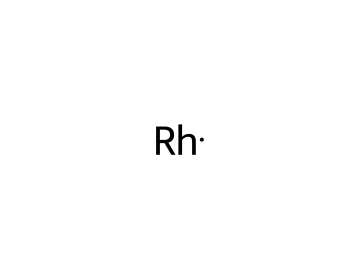
IDENTITY
COMPUTED
PROPERTIES
12.41 (metal) (NIOSH, 2024) - Denser than water; will sink
12.41 g/cu cm @ 20 °C
12.4 g/cm³
12.41 (metal)
12.41 @25 °C
12.41 (metal)
Silvery-white, soft, ductile, malleable metal; face-centered cubic structure
...In air, it occurs in the form of gray fume or dust.
Insoluble (NIOSH, 2024)
Insoluble in acids and aqua regia; soluble in fused potassium bisulfate.
Insoluble in hot or cold water; soluble in concentrations of sulfuric acid and in sulfuric acid + hydrochloric acid.
Solubility in water: none
Insoluble
6741 °F at 760 mmHg (NIOSH, 2024)
3695 °C
3695 °C
6741 °F
3727 °C @760 [mm Hg]
6741 °F
3571 °F (NIOSH, 2024)
1964 °C
1965 °C
3571 °F
1966 °C
3571 °F
0 mmHg (approx) (NIOSH, 2024)
1 Pa @ 2015 °C; 10 Pa @ 2223 °C; 100 Pa @ 2476 °C; 1 kPa @ 2790 °C; 10 kPa @ 3132 °C; 100 kPa @ 3724 °C
0 mmHg (approx)
depends upon the specific compound
0 mmHg (approx)
Rhodium metal fume is a reddish-gray to black dust-like powder. mp: 1966 °C, bp: 3727 °C. Insoluble in water. Bulk rhodium is a white or blueish-white, hard, ductile, malleable metal. The appearance and other properties of insoluble Rh compounds varies depending upon the specific compound.
Dry Powder; Other Solid; Other Solid
Metal: White, hard, ductile, malleable solid with a bluish-gray luster; [NIOSH]
GREY-TO-BLACK POWDER.
White, hard, ductile, malleable solid with a bluish-gray luster. Metal fume is a reddish-gray to black dust-like powder.
Appearance and odor vary depending upon the specific soluble rhodium compound.
Absorbs oxygen when melted; at a red heat is slowly oxidized to the sesquioxide.
Converted to trihalide by chlorine or bromine at a red heat; not attacked by fluorine.
Atomic number 45; valences 1-6; most common states 1, 3; One naturally occurring isotope:103; artificial radioactive isotopes: 97-102; 104-110
Electrical resistivity 4.51 microohm-cm @ 0 °C; Brinell hardness: 100; Not attacked by acids even aqua regia when in compact form; the finely divided metal reacts with aqua regia; Absorbs oxygen when melted; at a read heat is slowly oxidized to the sesquioxide; Converted to the trihalide by chlorine or bromine at a red heat; not attacked by fluorine.
Enthalpy of formation: 556.9 kJ/mol (gas); Heat capacity: 25.0 J/mol K (crystal); 21.0 J/mol K (gas)
Enthalpy of fusion: 26.59 kJ/mol
For more Other Experimental Properties (Complete) data for RHODIUM (9 total), please visit the HSDB record page.
GHS
This chemical does not meet GHS hazard criteria for 81.3% (239 of 294) of all reports.
Danger
H228 (15.3%): Flammable solid [Danger Flammable solids]
P210, P240, P241, P280, and P370+P378 (click each P-code to see the statement)
Aggregated GHS information provided per 294 reports by companies from 11 notifications to the ECHA C&L Inventory.;Reported as not meeting GHS hazard criteria per 239 of 294 reports by companies.;There are 9 notifications provided by 55 of 294 reports by companies with hazard statement code(s).;Information may vary between notifications depending on impurities, additives, and other factors. The percentage value in parenthesis indicates the notified classification ratio from companies that provide hazard codes. Only hazard codes with percentage values above 10% are shown. For more detailed information, please visit ECHA C&L website.
HAZARDS
Chemical: Rhodium
Rhodium is listed on the EPA's Chemical Data Reporting (CDR) system. Manufacturers and importers of Rhodium are required to report information about their production and use of this chemical to the EPA under the Toxic Substances Control Act (TSCA). (40 eCFR Part 711)
Status: Active Update: 21-06-2022 https://echa.europa.eu/registration-dossier/-/registered-dossier/21075
Rhodium: Does not have an individual approval but may be used under an appropriate group standard
IMAP assessments - Rhodium: Environment tier I assessment;IMAP assessments - Rhodium: Human health tier I assessment
Flammable Solid
Excerpt from ERG Guide 170 [Metals (Powders, Dusts, Shavings, Borings, Turnings, or Cuttings, etc.)]:;May react violently or explosively on contact with water. Some are transported in flammable liquids. May be ignited by friction, heat, sparks or flames. Some of these materials will burn with intense heat. Dusts or fumes may form explosive mixtures in air. Containers may explode when heated. May re-ignite after fire is extinguished. (ERG, 2024)
Many reactions may cause fire or explosion.
Moderate when exposed to heat or flame.
Flammable in powder form.
Excerpt from NIOSH Pocket Guide for Rhodium (metal fume and insoluble compounds, as Rh):;Exposure Routes: Inhalation;Symptoms: Possible respiratory sensitization;Target Organs: Respiratory system (NIOSH, 2024)
Can cause occupational contact urticaria; [Kanerva, p. 219] The metals in this group [platinum, palladium, iridium, osmium, rhodium, and ruthenium] generally are nontoxic in the metallic state, but the soluble halide salts (particularly of Pt) and osmium tetroxide are highly reactive. Exposure to these elements results in hypersensitivity allergic reactions in susceptible individuals. [Sullivan, p. 911] Tram drivers in Rome were exposed to Pt, Rh and Pd from catalytic converters at levels about 10 times lower than those known to cause adverse effects in workers. [PMID 18849761] Occupational asthma in a electroplating worker confirmed by bronchoprovocation testing; [Malo]
Metals, Less Reactive
Highly Flammable;Strong Reducing Agent;Known Catalytic Activity
Permissible Exposure Limit: Table Z-1 8-Hour Time Weighted Avg: 0.1 mg/cu m. /Rhodium (as Rh), metal fume and insoluble compounds/
RHODIUM (METAL FUME) is flammable. Acts as a reducing agent. Reacts violently with BrF5, ClF3 and OF2. Reacts with fluorine, with chlorine (when heated), hydrogen peroxide, sulfur dioxide (when heated), and nitrogen dioxide. Also incompatible with Zn. May catalyze reactions between other materials.;Reactivity may be altered by the presence of insoluble rhodium compounds depending on the specific compounds and their proportions in the mixture.
Reacts violently with halogens. This generates fire hazard. Rhodium is a catalytic substance and may cause reaction in contact with many organic and inorganic substances, causing fire and explosion hazard.
SAFETY
Excerpt from ERG Guide 170 [Metals (Powders, Dusts, Shavings, Borings, Turnings, or Cuttings, etc.)]:;DO NOT USE WATER, FOAM OR CO2. Dousing metallic fires with water will generate hydrogen gas, an extremely dangerous explosion hazard, particularly if fire is in a confined environment (i.e., building, cargo hold, etc.). Use DRY sand, graphite powder, dry sodium chloride-based extinguishers, or class D extinguishers. Confining and smothering metal fires is preferable rather than applying water. If it can be done safely, move undamaged containers away from the area around the fire.;FIRE INVOLVING TANKS, RAIL TANK CARS OR HIGHWAY TANKS: If impossible to extinguish, protect surroundings and allow fire to burn itself out. (ERG, 2024)
In case of fire in the surroundings, use appropriate extinguishing media.
Fresh air, rest.
Rinse and then wash skin with water and soap.
First rinse with plenty of water for several minutes (remove contact lenses if easily possible), then refer for medical attention.
Rinse mouth.
Excerpt from NIOSH Pocket Guide for Rhodium (metal fume and insoluble compounds, as Rh):;Breathing: RESPIRATORY SUPPORT - If a person breathes large amounts of this chemical, move the exposed person to fresh air at once. If breathing has stopped, perform artificial respiration. Keep the affected person warm and at rest. Get medical attention as soon as possible.;Swallow: MEDICAL ATTENTION IMMEDIATELY - If this chemical has been swallowed, get medical attention immediately. (NIOSH, 2024)
(General first aid procedures);Breathing: Respiratory support;Swallow: Medical attention immediately - If this chemical has been swallowed, get medical attention immediately.
See Chemical Dangers.
Excerpt from ERG Guide 170 [Metals (Powders, Dusts, Shavings, Borings, Turnings, or Cuttings, etc.)]:;ELIMINATE all ignition sources (no smoking, flares, sparks or flames) from immediate area. Do not touch or walk through spilled material. Stop leak if you can do it without risk. Prevent entry into waterways, sewers, basements or confined areas. (ERG, 2024)
SRP: At the time of review, criteria for land treatment or burial (sanitary landfill) disposal practices are subject to significant revision. Prior to implementing land disposal of waste residue (including waste sludge), consult with environmental regulatory agencies for guidance on acceptable disposal practices.
Personal protection: particulate filter respirator adapted to the airborne concentration of the substance. Sweep spilled substance into covered containers. If appropriate, moisten first to prevent dusting. Carefully collect remainder. Then store and dispose of according to local regulations.
Excerpt from ERG Guide 170 [Metals (Powders, Dusts, Shavings, Borings, Turnings, or Cuttings, etc.)]:;IMMEDIATE PRECAUTIONARY MEASURE: Isolate spill or leak area in all directions for at least 50 meters (150 feet) for liquids and at least 25 meters (75 feet) for solids.;LARGE SPILL: Consider initial downwind evacuation for at least 50 meters (160 feet).;FIRE: If tank, rail tank car or highway tank is involved in a fire, ISOLATE for 800 meters (1/2 mile) in all directions; also, consider initial evacuation for 800 meters (1/2 mile) in all directions. (ERG, 2024)
Wear safety goggles.
A harmful concentration of airborne particles can be reached quickly when dispersed.
Protective gloves.
PREVENT DISPERSION OF DUST!
TOXICITY
respiratory system
Asthma - Reversible bronchoconstriction (narrowing of bronchioles) initiated by the inhalation of irritating or allergenic agents.;ACGIH Carcinogen - Not Classifiable.
inhalation
Cough.
Redness.
Possible resp sensitization
Belongs to the platinum group of metals. One of rarest elements; constitutes about 1x10⁻⁷% of the crust of the earth; found in small quantities associated with all native platinum: in minerals rhodite, sperrylite and iridosmine... Discovered in 1803 by Wollaston...
...Obtained from South America. ...In river sands of the Urals and in North America and South America. ...With other platinum metals in copper-nickel sulfide ores of the Sudbury, Ontario, region.
/HUMAN EXPOSURE STUDIES/ No toxic effects of rhodium have been reported from...observations of human beings.
/HUMAN EXPOSURE STUDIES/ Workers wearing rings coated with rhodium showed negative rhodium patch tests though all other metals of which rings were constituted gave positive results.
/HUMAN EXPOSURE STUDIES/ Potential symptom of overexposure to metal fumes and insoluble compounds is respiratory sensitization.
A4; Not classifiable as a human carcinogen. /Rhodium metal & insol and sol cmpd, as Rh/
Basic treatment: Establish a patent airway. Suction if necessary. Watch for signs of respiratory insufficiency and assist ventilations if needed. Administer oxygen by nonrebreather mask at 10 to 15 L/min. Monitor for pulmonary edema and treat if necessary ... . Monitor for shock and treat if necessary ... . Anticipate seizures and treat if necessary ... . For eye contamination, flush eyes immediately with water. Irrigate each eye continuously with normal saline during transport ... . Do not use emetics. For ingestion, rinse mouth and administer 5 ml/kg up to 200 ml of water for dilution if the patient can swallow, has a strong gag reflex, and does not drool ... . Cover skin burns with dry sterile dressings after decontamination ... . /Poison A and B/
Advanced treatment: Consider orotracheal or nasotracheal intubation for airway control in the patient who is unconscious, has severe pulmonary edema, or is in respiratory arrest. Positive pressure ventilation techniques with a bag valve mask device may be beneficial. Monitor cardiac rhythm and treat arrhythmias as necessary ... . Start an IV with D5W /SRP: "To keep open", minimal flow rate/. Use lactated Ringer's if signs of hypovolemia are present. Watch for signs of fluid overload. Consider drug therapy for pulmonary edema ... . For hypotension with signs of hypovolemia, administer fluid cautiously. Watch for signs of fluid overload ... . Treat seizures with diazepam (Valium) ... . Use proparacaine hydrochloride to assist eye irrigation ... . /Poison A and B/
REGULATORY
Chemical: Rhodium
Rhodium is listed on the EPA's Chemical Data Reporting (CDR) system. Manufacturers and importers of Rhodium are required to report information about their production and use of this chemical to the EPA under the Toxic Substances Control Act (TSCA). (40 eCFR Part 711)
Status: Active Update: 21-06-2022 https://echa.europa.eu/registration-dossier/-/registered-dossier/21075
Rhodium: Does not have an individual approval but may be used under an appropriate group standard
USES
Used in rhodium-platinum alloys for spinnerets; Used in furnace windings, laboratory crucibles, catalysts, and nitric acid manufacturing; Also used in the surfacing of reflectors, electrical contacts, scientific instruments, and jewelry; [ACGIH] Main application is catalytic converter for automobiles to reduce emissions; [Nordberg, p. 1143]
As a corrosion-resistant electroplate for protecting silverware from tarnishing; for making high-reflectivity mirrors for cinema projectors, searchlights. Spongy or black rhodium is used as a catalyst in various organic hydrogenation and oxidation reactions.
Plating optical instruments; for jewelry and decoration.
Strong, complexing agent.
Among the industrial applications of rhodium is its use in rhodium-platinum alloys for spinnerets and bushings for synthetic fiber extrusion, high-temperature furnace windings, laboratory crucibles, and as catalysts for various organic and inorganic reactions, including the oxidation of ammonia in the manufacture of nitric acid. Rhodiums capacity for making a highly resistant coating is utilized in the surfacing of reflectors, electrical contacts, scientific instruments and jewelry.
Rhodium coatings are often used with electrodeposited nickel parabolic reflectors. /Rhodium/
(1972) No Data
(1975) No Data
(1972) 1.58X10+6 GRAMS
(1975) 2.55X10+6 GRAMS
2023: 75,000 - <500,000 lb;2022: 75,000 - <500,000 lb;2021: 75,000 - <500,000 lb;2020: 75,000 - <500,000 lb
(1972) 1.85X10+6 GRAMS (PRIMARY & SECONDARY)
(1975) 1.77X10+6 G (PRIMARY & SECONDARY)
44% as a catalyst; 22% in electrical applications; 13% for electroplating jewelry; 12% for decorating glass and porcelain; 9% in misc applications (1975).
Catalyst;Not Known or Reasonably Ascertainable
REACTION OF PLATINUM METAL CONCENTRATE AND NITRIC ACID FOLLOWED BY SEQUENTIAL TREATMENT WITH SODIUM BISULFATE, SODIUM HYDROXIDE, HYDROCHLORIC ACID, SODIUM NITRITE, AMMONIUM CHLORIDE, & HYDROCHLORIC ACID, PURIFIED BY ION EXCHANGE CHROMATOGRAPHY, AND PRECIPITATED WITH FORMIC ACID
VAUQUELIN, ETC, CITED BY MELLOR, A COMPREHENSIVE TREATISE ON INORGANIC & THEORETICAL CHEMISTRY 15, 546 (1936). PRACTICAL METHODS OF SEPARATION: WICHERS, GILCHRIST, TRANS AM INST MINING METALLURG ENG 76, 619 (1928).
POWDERED OSMIRIDIUM IS FUSED WITH SODIUM PEROXIDE...DISTILLED IN CURRENT OF CHLORINE TO ISOLATE OSMIUM & RUTHENIUM. UNDISTILLED LIQ IS TREATED WITH AQUA REGIA TO ISOLATE AMMONIUM CHLOROPLATINATE &...CHLOROIRIDATE LEAVING RH & PALLADIUM IN FILTRATE...RH PRECIPITATED WITH MAGNESIUM.
PURE RHODIUM IS OBTAINED BY THE THERMAL REDN OF ITS AMINO SALT, DICHLOROPENTAMINORHODIUM, THE RESULTING POWDER BEING PRESSED INTO BARS, SINTERED IN HYDROGEN & REDUCED BY FORGING.
PRODUCED AS POWDER...SINGLE CRYSTALS ARE AVAILABLE.
Not Known or Reasonably Ascertainable;All Other Basic Inorganic Chemical Manufacturing
Rhodium: ACTIVE
Annual world production...only 2 or 3 tons. ...Rhodium in small quantities costs about $450/Troy ounce.
Harder and higher-melting than platinum or palladium; highest in electrical and thermal conductivity of platinum group.
ALIASES
REACTIONS
uspto-grants-1998_03 · 10.6084/m9.figshare.5104873.v1 · US05726159
查看
uspto-grants-1998_03 · 10.6084/m9.figshare.5104873.v1 · US05731299
查看
uspto-grants-1998_03 · 10.6084/m9.figshare.5104873.v1 · US05731299
查看
uspto-grants-1993_09 · 10.6084/m9.figshare.5104873.v1 · US05243062
查看
uspto-grants-1993_09 · 10.6084/m9.figshare.5104873.v1 · US05244888
查看
uspto-grants-1993_09 · 10.6084/m9.figshare.5104873.v1 · US05246969
查看
uspto-grants-2006_08 · 10.6084/m9.figshare.5104873.v1 · US07084277B2
查看
uspto-grants-2006_08 · 10.6084/m9.figshare.5104873.v1 · US07091232B2
查看