
uspto-grants-1997_01 · 10.6084/m9.figshare.5104873.v1 · US05597771
查看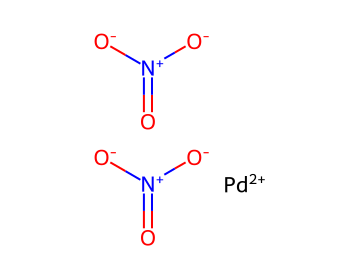
IDENTITY
COMPUTED
PROPERTIES
Liquid
Brown deliquescent solid; Soluble in water; [Merck Index]
GHS
This chemical does not meet GHS hazard criteria for 0.5% (1 of 204) of reports.
Danger
H271 (73.5%): May cause fire or explosion; strong Oxidizer [Danger Oxidizing liquids; Oxidizing solids];H272 (23.5%): May intensify fire; oxidizer [Danger Oxidizing liquids; Oxidizing solids];H290 (75.5%): May be corrosive to metals [Warning Corrosive to Metals];H302 (76%): Harmful if swallowed [Warning Acute toxicity, oral];H314 (98%): Causes severe skin burns and eye damage [Danger Skin corrosion/irritation];H318 (75.5%): Causes serious eye damage [Danger Serious eye damage/eye irritation];H400 (75%): Very toxic to aquatic life [Warning Hazardous to the aquatic environment, acute hazard];H410 (76.5%): Very toxic to aquatic life with long lasting effects [Warning Hazardous to the aquatic environment, long-term hazard]
P210, P220, P234, P260, P264, P264+P265, P270, P273, P280, P283, P301+P317, P301+P330+P331, P302+P361+P354, P304+P340, P305+P354+P338, P306+P360, P316, P317, P321, P330, P363, P370+P378, P371+P380+P375, P390, P391, P405, P406, P420, and P501 (click each P-code to see the statement)
Aggregated GHS information provided per 204 reports by companies from 15 notifications to the ECHA C&L Inventory. Each notification may be associated with multiple companies.;Reported as not meeting GHS hazard criteria per 1 of 204 reports by companies.;There are 14 notifications provided by 203 of 204 reports by companies with hazard statement code(s).;Information may vary between notifications depending on impurities, additives, and other factors. The percentage value in parenthesis indicates the notified classification ratio from companies that provide hazard codes. Only hazard codes with percentage values above 10% are shown. For more detailed information, please visit ECHA C&L website.
HAZARDS
Nitric acid, palladium(2+) salt (2:1) is listed on the EPA's Chemical Data Reporting (CDR) system. Manufacturers and importers of Nitric acid, palladium(2+) salt (2:1) are required to report information about their production and use of this chemical to the EPA under the Toxic Substances Control Act (TSCA). (40 eCFR Part 711)
Status: Active Update: 13-01-2022 https://echa.europa.eu/registration-dossier/-/registered-dossier/19319
Palladium nitrate: Does not have an individual approval but may be used under an appropriate group standard
An eye irritant; [eChemPortal: ERMA] May cause irritation; [MSDSonline] See NITRATES and NITRITES.
Ox. Sol. 1 (73.5%);Ox. Sol. 2 (23.5%);Met. Corr. 1 (75.5%);Acute Tox. 4 (76%);Skin Corr. 1B (98%);Eye Dam. 1 (75.5%);Aquatic Acute 1 (75%);Aquatic Chronic 1 (76.5%)
SAFETY
7.9 [mg/m3]
87 [mg/m3]
520 [mg/m3]
TOXICITY
Methemoglobinemia can be treated with supplemental oxygen and methylene blue 1% solution administered intravenously slowly over five minutes followed by IV flush with normal saline. Methylene blue restores the iron in hemoglobin to its normal (reduced) oxygen-carrying state. (L1613)
Contact with palladium may cause palladium sensitivity and allergy. Animal studies have shown that palladium may damage the liver and kidney. Nitrate and nitrite poisoning causes methemoglobinemia. Nitrites may cause pregnancy complications and developmental effects. They may also be carcinogenic. (L1137, L798)
Oral (L1137) ; inhalation (L1137)
Due to their ability to form strong complexes with both inorganic and organic ligands, palladium ions can disturb cellular equilibria, replace other essential ions, and interact with functional groups of macromolecules, such as proteins or DNA. Palladium complexes binding to DNA and RNA leads to strand breakage. Palladium ions are able to inhibit most major cellular functions, including DNA and RNA synthesis. Palladium compounds have been shown to bind to and inhibit various enzymes, including creatine kinase and prolyl hydroxylase. Nitrate's toxicity is a result of it's conversion to nitrite once in the body. Nitrite causes the autocatalytic oxidation of oxyhemoglobin to hydrogen peroxide and methemoglobin. This elevation of methemoglobin levels is a condition known as methemoglobinemia, and is characterized by tissue hypoxia, as methemoglobin cannot bind oxygen. (A2450, L1613, L798)
Skin contact with palladium may cause contact dermatitis, erythema, and oedema. Nitrate and nitrite poisoning causes methemoglobinemia. Symptoms include cyanosis, cardiac dysrhythmias and circulatory failure, and progressive central nervous system (CNS) effects. CNS effects can range from mild dizziness and lethargy to coma and convulsions. (L1137, L798)
Ingested nitrate or nitrite under conditions that result in endogenous nitrosation is probably carcinogenic to humans (Group 2A). (L135)
REGULATORY
Nitric acid, palladium(2+) salt (2:1) is listed on the EPA's Chemical Data Reporting (CDR) system. Manufacturers and importers of Nitric acid, palladium(2+) salt (2:1) are required to report information about their production and use of this chemical to the EPA under the Toxic Substances Control Act (TSCA). (40 eCFR Part 711)
Status: Active Update: 13-01-2022 https://echa.europa.eu/registration-dossier/-/registered-dossier/19319
Palladium nitrate: Does not have an individual approval but may be used under an appropriate group standard
PHARMACOLOGY
Palladium may be absorbed through oral, dermal, and inhalation exposure. Once in the body it distributes to the kidney, liver, spleen, lymph nodes, adrenal gland, lung and bone. Palladium's ability to form complexes allows it the bind to amino acids, proteins, DNA, and other macromolecules. Palladium and its metabolites are excreted in the urine and faeces. Intake of some amount of nitrates and nitrites is a normal part of the nitrogen cycle in humans. In vivo conversion of nitrates to nitrites can occur in the gastrointestional tract under the right conditions, significantly enhancing nitrates' toxic potency. The major metabolic pathway for nitrate is conversion to nitrite, and then to ammonia. Nitrites, nitrates, and their metabolites are excreted in the urine. (L1137, A21)
USES
Used to separate Cl2 and I2; Also used as a catalyst; [Merck Index]
2023: 250,000 - <400,000 lb;2022: 250,000 - <400,000 lb;2021: 250,000 - <400,000 lb;2020: 100,000 - <250,000 lb
Catalyst
Other;Intermediate;Catalyst
Transportation Equipment Manufacturing;All Other Basic Inorganic Chemical Manufacturing;All Other Chemical Product and Preparation Manufacturing
Nitric acid, palladium(2+) salt (2:1): ACTIVE
ALIASES
REACTIONS
uspto-grants-1997_01 · 10.6084/m9.figshare.5104873.v1 · US05597771
查看
uspto-grants-1988_12 · 10.6084/m9.figshare.5104873.v1 · US04791226
查看
uspto-grants-2016_03 · 10.6084/m9.figshare.5104873.v1 · US09283546B2
查看
uspto-grants-2008_03 · 10.6084/m9.figshare.5104873.v1 · US07338917B2
查看
uspto-grants-1977_01 · 10.6084/m9.figshare.5104873.v1 · US04005049
查看
uspto-grants-1984_10 · 10.6084/m9.figshare.5104873.v1 · US04476242
查看
uspto-grants-2007_06 · 10.6084/m9.figshare.5104873.v1 · US07232783B2
查看
uspto-grants-2013_01 · 10.6084/m9.figshare.5104873.v1 · US08363384B2
查看