
uspto-grants-2008_09 · 10.6084/m9.figshare.5104873.v1 · US07423165B2
查看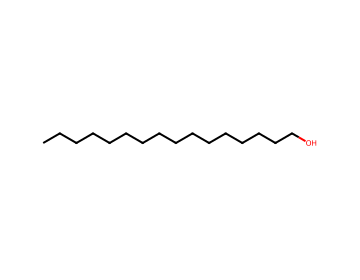
IDENTITY
COMPUTED
PROPERTIES
Faint odor
ODORLESS
BLAND, MILD TASTE
0.8187 at 50 °C/4 °C
0.8152 (55 °C)
0.8176 @ 50°C/4°C
53 mPa-s (=cP) at 75 °C
FLAKES FROM ETHYL ACETATE
SOLID OR LEAF-LIKE CRYSTALS
White crystals
UNCTUOUS, WHITE FLAKES, GRANULES, CUBES, OR CASTINGS
White, waxy solid
Insoluble
Slightly soluble in alcohol; soluble in acetone; very soluble in ether, benzene, chloroform
Soluble in alcohol, chloroform, ether
In water, 4.1X10⁻² mg/L at 25 °C
1.34e-05 mg/mL at 25 °C
insoluble in water; soluble in ether
175 °C
344
334 °C at 760 mm Hg
344 °C
When heated to decomposition it emits acrid smoke and fumes.
49.3
49.3 °C
49.3 °C
50 °C
8.360 (AIR= 1)
0.00000306 [mmHg]
6X10⁻⁶ mm Hg at 25 °C
GHS
This chemical does not meet GHS hazard criteria for 70.6% (2392 of 3386) of all reports.
Warning
H319 (21.9%): Causes serious eye irritation [Warning Serious eye damage/eye irritation]
P264+P265, P280, P305+P351+P338, and P337+P317 (click each P-code to see the statement)
Aggregated GHS information provided per 3386 reports by companies from 24 notifications to the ECHA C&L Inventory.;Reported as not meeting GHS hazard criteria per 2392 of 3386 reports by companies.;There are 21 notifications provided by 994 of 3386 reports by companies with hazard statement code(s).;Information may vary between notifications depending on impurities, additives, and other factors. The percentage value in parenthesis indicates the notified classification ratio from companies that provide hazard codes. Only hazard codes with percentage values above 10% are shown. For more detailed information, please visit ECHA C&L website.
HAZARDS
Chemical: Hexadecanol
Chemical: 1-Hexadecanol
1-Hexadecanol is listed on the EPA's Chemical Data Reporting (CDR) system. Manufacturers and importers of 1-Hexadecanol are required to report information about their production and use of this chemical to the EPA under the Toxic Substances Control Act (TSCA). (40 eCFR Part 711)
Status: Active Update: 29-03-2023 https://echa.europa.eu/registration-dossier/-/registered-dossier/15942
Hexadecanol: Does not have an individual approval but may be used as a component in a product covered by a group standard. It is not approved for use as a chemical in its own right.
1-Hexadecanol: Does not have an individual approval but may be used under an appropriate group standard
IMAP assessments - 1-Hexadecanol: Human health tier I assessment
IMAP assessments - Hexadecanol: Human health tier I assessment;Evaluation - Chemicals that are unlikely to require further regulation to manage risks to environment
Flammable when exposed to heat or flame
Higher alcohols are not highly toxic in the industrial setting; Can cause liver injury, somnolence, and respiratory depression in experimental animals; [HSDB] In high-dose feeding studies, causes somnolence in rats and ataxia in dogs; [RTECS] Safe when used as a flavoring agent in food; [JECFA] An irritant; [MSDSonline]
Diluents in color additive mixtures for food use exempt from certification. The following substances may be safely used as diluents in color additive mixtures for food use exempt from certification, subject to the condition that each straight color in the mixture has been exempted from certification or, if not so exempted, is from a batch that has previously been certified and has not changed in composition since certification. If a specification for a particular diluent is not set forth in this part 73, the material shall be of a purity consistent with its intended use. Cetyl alcohol is included on this list.
Diluents in color additive mixtures for drug use exempt from certification. The following diluents may be safely used in color additive mixtures that are exempt from certification and which are to be used for coloring drugs, subject to the condition that each straight color in the mixture has been exempted from certification or, if not so exempted, is from a batch that has previously been certified and has not changed in composition since certification. Such listing of diluents is not to be construed as superseding any of the other requirements of the Federal Food, Drug, and Cosmetic Act with respect to drugs, including new drugs. If a definition and specification for a particular diluent is not set forth in this subpart, the material shall be of a purity consistent with its intended use. Cetyl alcohol is included on this list.
Cetyl Alcohol is an indirect food additive for use as a component of adhesives.
Cetyl alcohol is a food additive permitted for direct addition to food for human consumption as a synthetic flavoring substance and adjuvant in accordance with the following conditions: a) they are used in the minimum quantity required to produce their intended effect, and otherwise in accordance with all the principles of good manufacturing practice, and 2) they consist of one or more of the following, used alone or in combination with flavoring substances and adjuvants generally recognized as safe in food, prior-sanctioned for such use, or regulated by an appropriate section in this part.
Drug products containing certain active ingredients offered over-the-counter (OTC) for certain uses. A number of active ingredients have been present in OTC drug products for various uses, as described below. However, based on evidence currently available, there are inadequate data to establish general recognition of the safety and effectiveness of these ingredients for the specified uses: cetyl alcohol is included in skin protectant drug products; insect bite and sting drug products; and poison ivy, poison oak, and poison sumac drug products.
As the federal pesticide law FIFRA directs, EPA is conducting a comprehensive review of older pesticides to consider their health and environmental effects and make decisions about their future use. Under this pesticide reregistration program, EPA examines health and safety data for pesticide active ingredients initially registered before November 1, 1984, and determines whether they are eligible for reregistration. In addition, all pesticides must meet the new safety standard of the Food Quality Protection Act of 1996. Pesticides for which EPA had not issued Registration Standards prior to the effective date of FIFRA, as amended in 1988, were divided into three lists based upon their potential for human exposure and other factors, with List B containing pesticides of greater concern and List D pesticides of less concern. Cetyl alcohol is found on List D. Case No: 4004; Pesticide type: Insecticide, herbicide; Case Status: OPP is reviewing data from the pesticide's producers regarding its human health and/or environmental effects, or OPP is determining the pesticide's eligibility for reregistration and developing the Reregistration Eligibility Decision (RED) document.; Active ingredient (AI): Cetyl alcohol; AI Status: The active ingredient is no longer contained in any registered pesticide products ... "cancelled."
Residues of cetyl alcohol are exempted from the requirement of a tolerance when used as an evaporation retardant (limit: not more than 5.0% of pesticide formulation) in accordance with good agricultural practice as inert (or occasionally active) ingredients in pesticide formulations applied to growing crops or to raw agricultural commodities after harvest.
Eye Irrit. 2A (21.9%)
Not Classified
Critical temperature = 761 K; Critical pressure = 1.51E+06 Pa
SAFETY
To fight fire, use foam, carbon dioxide, dry chemical.
In general, materials which are toxic as stored or which can decompose into toxic components ... should be stored in a cool, well-ventilated place, out of direct rays of the sun, away from areas of high fire hazard, and should be periodically inspected ... incompatible materials should be isolated from each other.
AEROBIC: In a 5-day incubation study using an activated sludge seed from a municipal sewage treatment plant, 28.0% of initial 1-hexadecanol was mineralized (CO2 measurement)(1). A theoretical BOD of 0% was observed using the AFNOR (the French norm procedure) screening test and a 5-day incubation period(2). In standard 5-day BOD tests using emulsified 1-hexadecanol, 30-60% of initial 1-hexadecanol was oxidized(3). In studies designed to examine the biodegradability of 1-hexadecanol in thin films (monolayer) on water surfaces, it was found that biological destruction of the monolayer resulted in measurable consumption of the material with all substrates that were tested; substrates included 2% settled domestic sewage in BOD dilution water, 50% Ohio River water + 50% BOD dilution water, water from a stock pond near San Antonio, TX, and other combinations of BOD dilution water and mineral supplements; oxidation rates varied with substrates; oxidation rates varied from 6.2 to 14.3% over incubation periods of 20 to 48 days(3). In Warburg respirometer tests using activated sludge and 500 mg/L of 1-hexadecanol (well above its aqueous solubility), the theoretical oxygen demand was only 0.4% after a 12-hr incubation period(4). In static culture tests examining the disappearance of 1-hexadecanol in seeded media as compared to unseeded control media over a 10-day incubation period, almost none disappeared from the control media while nearly 20% disappeared from the seeded media; in shake flask tests using seeded media and a fine granular form of 1-hexadecanol, the initial 1-hexadecanol concn of 100 mg/L decreased to only 0.25 mg/L after 30 days of incubation; the overall results of the study concluded that given sufficient time in contact with adapted microbial species under conditions otherwise non-limiting, the complete disappearance of 1-hexadecanol as an identifiable molecular species will occur; one limiting condition is the relative insolubility of 1-hexadecanol in water;
ANAEROBIC: The anaerobic degradation of 14-C-labeled 1-hexadecanol was studied in model sludge digester over a 28-day incubation period(1); 25.1% of radioactivity was recovered in methane gas and 72.0% was recovered in CO2 gas(1).
SRP: The most favorable course of action is to use an alternative chemical product with less inherent propensity for occupational exposure or environmental contamination. Recycle any unused portion of the material for its approved use or return it to the manufacturer or supplier. Ultimate disposal of the chemical must consider: the material's impact on air quality; potential migration in soil or water; effects on animal, aquatic, and plant life; and conformance with environmental and public health regulations.
Residues of cetyl alcohol are exempted from the requirement of a tolerance when used as an evaporation retardant (limit: not more than 5.0% of pesticide formulation) in accordance with good agricultural practice as inert (or occasionally active) ingredients in pesticide formulations applied to growing crops or to raw agricultural commodities after harvest.
1.7 [mg/m3]
18 [mg/m3]
110 [mg/m3]
TOXICITY
... Chymotrypsin showed loss of activity in the presence of triethanolamine stearate, glyceryl tripalmitate and cetyl alcohol within 30 min.
EC50 Scenedesmus subspicatus (Algae) 676 mg/L/72 hr; Effect: cell multiplication inhibition test
TERRESTRIAL FATE: Based on a classification scheme(1), an estimated Koc value of 25,000(SRC), determined from a water solubility of 4.1X10⁻²(2) and a regression-derived equation(3), indicates that 1-hexadecanol is expected to be immobile in soil(SRC). Volatilization of 1-hexadecanol from moist soil surfaces is expected to be an important fate process(SRC) given an estimated Henry's Law constant of 4.6X10⁻⁵ atm-cu m/mole(SRC), derived from its vapor pressure, 6X10⁻⁶ mm Hg(4), and water solubility(2). However, adsorption to soil is expected to attenuate volatilization(SRC). 1-Hexadecanol is not expected to volatilize from dry soil surfaces(SRC) based upon its vapor pressure(4). A CO2 mineralization of 28.0% in a 5-day incubation study using an activated sludge seed from a municipal sewage treatment plant(5), indicates that biodegradation may be an important environmental fate process in soil(SRC).
AQUATIC FATE: Based on a classification scheme(1), an estimated Koc value of 25,000(SRC), determined from a water solubility of 4.1X10⁻²(2) and a regression-derived equation(3), indicates that 1-hexadecanol is expected to adsorb to suspended solids and sediment(SRC). Volatilization from water surfaces is expected(3) based upon an estimated Henry's Law constant of 4.6X10⁻⁵ atm-cu m/mole(SRC), derived from its vapor pressure, 6X10⁻⁶ mm Hg(4), and water solubility(2). Using this Henry's Law constant and an estimation method(3), volatilization half-lives for a model river and model lake are 23 hours and 12 days, respectively(SRC). However, volatilization from water surfaces is expected to be attenuated by adsorption to suspended solids and sediment in the water column. The estimated volatilization half-life from a model pond is 1.8 years if adsorption is considered(5). According to a classification scheme(6), a BCF of 56 using golden orfe fish (Leuciscus idus melanotus)(7) suggests bioconcentration in aquatic organisms is moderate(SRC). A CO2 mineralization of 28.0% in a 5-day incubation study using an activated sludge seed from a municipal sewage treatment plant(7), indicates that biodegradation may be an important environmental fate process in water(SRC).
ATMOSPHERIC FATE: According to a model of gas/particle partitioning of semivolatile organic compounds in the atmosphere(1), 1-hexadecanol, which has a vapor pressure of 6X10⁻⁶ mm Hg at 25 °C(2), will exist in both the vapor and particulate phases in the ambient atmosphere. Vapor-phase 1-hexadecanol is degraded in the atmosphere by reaction with photochemically-produced hydroxyl radicals(SRC); the half-life for this reaction in air is estimated to be 16 hours(SRC), calculated from its rate constant of 2.4X10⁻¹¹ cu cm/molecule-sec at 25 °C(SRC) that was derived using a structure estimation method(3). Particulate-phase 1-hexadecanol may be removed from the air by wet or dry deposition(SRC).
Neurotoxin - Acute solvent syndrome;Occupational hepatotoxin - Secondary hepatotoxins: the potential for toxic effect in the occupational setting is based on cases of poisoning by human ingestion or animal experimentation.
Safe in the present practices of use and concentration. Ingredient, concentration, and use information are available in documents discoverable at https://cir-reports.cir-safety.org
1-Hexadecanol emission rates from green leaf composite samples and dead leaves were 23 ug/g and 13 ug/g, respectively(1).
1-Hexadecanol has been detected in wastewater effluents collected from the following industries(1): textile mills, organic chemicals manufacturing and public owned treatment works(1). 1-Hexadecanol emission rates from road dust samples was 2.4 ug/g(2).
The Koc of 1-hexadecanol is estimated as 25,000(SRC), using a water solubility of 4.122X10⁻²(1) and a regression-derived equation(2). According to a classification scheme(3), this estimated Koc value suggests that 1-hexadecanol is expected to be immobile in soil.
1-Hexadecanol emission rates from green leaf composite samples and dead leaves were 23 ug/g and 13 ug/g, respectively(1).
RURAL/REMOTE: 1-Hexadecanol was found in California at atmospheric concentrations of 0.6 ng/cu m, 1.9 ng/cu m, and 1.6 ng/cu m in Kern Wildlife Refuge, Bakersfield, and Fresno, respectively(1).
/HUMAN EXPOSURE STUDIES/ A maximization test was carried out on 26 volunteers. The material was tested at a concentration of 12% in petrolatum and produced no sensitization reactions. Hexadecyl alcohol produced a case of urticaria-like dermatitis in a 28 year old white woman.
/SIGNS AND SYMPTOMS/ ... Autopsy findings in 15 infants treated with exogenous beractant (Survanta) or cetyl alcohol in combination with colfosceril palmitate and tyloxapol (Exosurf Neonatal) and in 29 infants who died before the introduction of surfactant therapy were compared. High rates of pulmonary hemorrhage were present in both groups (treated 80% vs untreated 83%).
/CASE REPORTS/ A 66-year-old female developed increasing eczematous reactions after treatment of her leg ulcer with a corticoid ointment. She reacted positive to fludroxycortide (flurandrenolone) and cetyl alcohol.
/CASE REPORTS/ 23 patients who had used silver sulfadiazine cream were patch tested. 2 vehicle components, cetyl alcohol and propylene glycol, were positive.
/CASE REPORTS/ A total of 330 patients with eczematous lesions were tested with 27 topical substances. ... great number of allergic reactions of cetyl alcohol (11.2%).
1-Hexadecanol was detected in fish (lake trout and walleye) collected from Lake St Clair in 1977(1).
REGULATORY
Chemical: Hexadecanol
Chemical: 1-Hexadecanol
1-Hexadecanol is listed on the EPA's Chemical Data Reporting (CDR) system. Manufacturers and importers of 1-Hexadecanol are required to report information about their production and use of this chemical to the EPA under the Toxic Substances Control Act (TSCA). (40 eCFR Part 711)
Status: Active Update: 29-03-2023 https://echa.europa.eu/registration-dossier/-/registered-dossier/15942
Hexadecanol: Does not have an individual approval but may be used as a component in a product covered by a group standard. It is not approved for use as a chemical in its own right.
1-Hexadecanol: Does not have an individual approval but may be used under an appropriate group standard
Diluents in color additive mixtures for food use exempt from certification. The following substances may be safely used as diluents in color additive mixtures for food use exempt from certification, subject to the condition that each straight color in the mixture has been exempted from certification or, if not so exempted, is from a batch that has previously been certified and has not changed in composition since certification. If a specification for a particular diluent is not set forth in this part 73, the material shall be of a purity consistent with its intended use. Cetyl alcohol is included on this list.
Diluents in color additive mixtures for drug use exempt from certification. The following diluents may be safely used in color additive mixtures that are exempt from certification and which are to be used for coloring drugs, subject to the condition that each straight color in the mixture has been exempted from certification or, if not so exempted, is from a batch that has previously been certified and has not changed in composition since certification. Such listing of diluents is not to be construed as superseding any of the other requirements of the Federal Food, Drug, and Cosmetic Act with respect to drugs, including new drugs. If a definition and specification for a particular diluent is not set forth in this subpart, the material shall be of a purity consistent with its intended use. Cetyl alcohol is included on this list.
Cetyl Alcohol is an indirect food additive for use as a component of adhesives.
Cetyl alcohol is a food additive permitted for direct addition to food for human consumption as a synthetic flavoring substance and adjuvant in accordance with the following conditions: a) they are used in the minimum quantity required to produce their intended effect, and otherwise in accordance with all the principles of good manufacturing practice, and 2) they consist of one or more of the following, used alone or in combination with flavoring substances and adjuvants generally recognized as safe in food, prior-sanctioned for such use, or regulated by an appropriate section in this part.
Drug products containing certain active ingredients offered over-the-counter (OTC) for certain uses. A number of active ingredients have been present in OTC drug products for various uses, as described below. However, based on evidence currently available, there are inadequate data to establish general recognition of the safety and effectiveness of these ingredients for the specified uses: cetyl alcohol is included in skin protectant drug products; insect bite and sting drug products; and poison ivy, poison oak, and poison sumac drug products.
As the federal pesticide law FIFRA directs, EPA is conducting a comprehensive review of older pesticides to consider their health and environmental effects and make decisions about their future use. Under this pesticide reregistration program, EPA examines health and safety data for pesticide active ingredients initially registered before November 1, 1984, and determines whether they are eligible for reregistration. In addition, all pesticides must meet the new safety standard of the Food Quality Protection Act of 1996. Pesticides for which EPA had not issued Registration Standards prior to the effective date of FIFRA, as amended in 1988, were divided into three lists based upon their potential for human exposure and other factors, with List B containing pesticides of greater concern and List D pesticides of less concern. Cetyl alcohol is found on List D. Case No: 4004; Pesticide type: Insecticide, herbicide; Case Status: OPP is reviewing data from the pesticide's producers regarding its human health and/or environmental effects, or OPP is determining the pesticide's eligibility for reregistration and developing the Reregistration Eligibility Decision (RED) document.; Active ingredient (AI): Cetyl alcohol; AI Status: The active ingredient is no longer contained in any registered pesticide products ... "cancelled."
Residues of cetyl alcohol are exempted from the requirement of a tolerance when used as an evaporation retardant (limit: not more than 5.0% of pesticide formulation) in accordance with good agricultural practice as inert (or occasionally active) ingredients in pesticide formulations applied to growing crops or to raw agricultural commodities after harvest.
PHARMACOLOGY
Cetyl alcohol exhibits skin protect properties against skin irritations caused by bites, rashes and stings. The inhibitory action of cetyl alcohol against the growth of _Mycoplasma gallisepticum_ and _Mycopiasma pneumoniae_ has been reported.
Cetyl alcohol has hydrating properties that makes it a suitable emulsifier and stabilizer in pharmaceutical formulations. It is also present in washable ointment base due to its dispersant abilities and stabilizing properties. Potential antimicrobial activity of cetyl alcohol may be due to a change in cell membrane permeability that either blocks absorption of essential nutrients and induction of outward diffusion vital cellular components. This proposed mechanism of action is thought to be similar for other long-chain aliphatic alcohols with same antimicrobial activity, such as myristyl alcohol and behenyl alcohol.
Following ingestion at a dose level of 2.0 g/kg in rats, cetyl alcohol was partly metabolized to palmitic acid. After administration of 0.2 mg cetyl alcohol in rat by stomach tube, cetyl alcohol was mostly oxidized to palmitic acid and incorporated into triglycerides and phospholipids during its passage through the mucosal cells of the small intestine.
Cetyl alcohol is oxidized in rats to the corresponding fatty acid, palmitic acid.
The primary aliphatic alcohols undergo two general reactions in vivo, namely oxidation to carboxylic acids and direct conjugation with glucuronic acid. The first reaction proceeds with the intermediate formation of an aldehyde, and the carboxylic acid from this may be either oxidized completely to carbon dioxide or excreted as such or combined with glucuronic acid as an ester glucuronide. The extent to which as alcohol undergoes the second reaction, i.e. direct conjugation to an ether glucuronide, appears to depend upon the speed of the first reaction, for alcohols which are rapidly oxidized from very little ether glucuronide unless given in high doses.
Following ingestion at a dose level of 2.0 g/kg in rats, cetyl alcohol was partly absorbed. Administration of 0.2 mg cetyl alcohol in rat by stomach tube indicated good absorption as 63-96 % of radiolabeled cetyl alcohol was detected in the lymph. About 15% of total cetyl alcohol was unchanged during its passage through the mucosal cells of the small intestine but mostly underwent oxidation to palmitic acid. The extent of absorption was reported to be 26% in poultry.
Following ingestion at a dose level of 2.0 g/kg in rats, about 20% of the dose was recovered as unchanged molecule in the feces. This may be due to the interconvertibility of fatty acids and alcohols, resulting in the conversion of palmitic acid to cetyl alcohol during its passage through the intestinal mucosal cells into the intestinal lumen. In rats, cetyl Alcohol was also excreted in the urine as conjugated glucuronic acid and as expired carbon dioxide.
Following ingestion at a dose level of 2.0 g/kg bw /in rats/, 1-hexadecanone is partly absorbed and metabolized, about 20% of the dose being recovered unchanged in the feces.
Fibroblasts
Extracellular;Membrane
Plasmalogen Synthesis
USES
CIR ingredient: Cetyl Alcohol
Used in cosmetics, pharmaceuticals, perfumes, and shampoos (emollient and emulsion modifier) and to make face creams, lotions, lipsticks, toilet preparations, and antiperspirant sticks; Also used as a coupling agent, foam stabilizer in detergents, base for making sulfonated fatty acids, monomer lubricant in suspension polymerization, and to retard evaporation of water when spread as a film on reservoirs or sprayed on growing plants; [HSDB]
Dressing Hair [Category: Other]
For Cetyl Alcohol (USEPA/OPP Pesticide Code: 001508) there are 0 labels match. /SRP: Not registered for current use in the U.S., but approved pesticide uses may change periodically and so federal, state and local authorities must be consulted for currently approved uses./
The active ingredient is no longer contained in any registered pesticide products ... "cancelled."
In cosmetics as emollient, emulsion modifier, coupling agent. Pharmaceutical aid (emulsifying and stiffening agent).
(1972) 1.22X10+9 GRAMS (7 FATTY ALCOHOLS)
(1975) 2.24X10+9 G-9 CARBON ALCOHOLS & HIGHER
(1972) 2.73X10+8 GRAMS (FATTY ALCOHOLS)
(1975) 7.57X10+8 G (INCL OTHER FATTY ALCOHOLS)
2023: 70,000,000 - <85,000,000 lb;2022: 70,000,000 - <85,000,000 lb;2021: 70,000,000 - <85,000,000 lb;2020: 55,000,000 - <70,000,000 lb
This chemical is listed as a High Production Volume (HPV) (65FR81686). Chemicals listed as HPV were produced in or imported into the U.S. in >1 million pounds in 1990 and/or 1994. The HPV list is based on the 1990 Inventory Update Rule. (IUR) (40 CFR part 710 subpart B; 51FR21438).
(1971) 2.7X10+9 GRAMS (HEXADECYL ALCOHOLS)
(1975) GREATER THAN 9.08X10+5 GRAMS
(1984) 2.48X10+11/ALCOHOLS C12 OR HIGHER/
For more U.S. Production (Complete) data for 1-HEXADECANOL (10 total), please visit the HSDB record page.
Not Known or Reasonably Ascertainable;Lubricating agent;Other;Solvent;Opacifer;Surfactant (surface active agent)
Stabilizing agent;Thickening agent;Not Known or Reasonably Ascertainable;Intermediate;Solvent;Other;Lubricating agent;Surfactant (surface active agent)
Catalytic hydrogenation of the triglycerides obtained from coconut oil or tallow; oxidation of a chain growth product of ethylene oligomerized on a triethylaluminum catalyst
Prepared from palmitoyl chloride plus sodium borohydride ... from methylthiopalmitate plus Raney nickel: Ruzicka, Prelog, US patent 2,509,171 (1950 to Ciba); from hexadecyl bromide: Levine, Clippinger, US 3,018,308 (1962 to California Res. Corp.).
By saponifying spermaceti with caustic alkali, reduction of palmitic acid
Grades: Technical; cosmetic; national formulary.
A typical anionic and cationic based all purpose face, head and body lotion contains 1% cetyl alcohol
Present in a popular cosmetic cream at 3%
Present in a typical depilatory formula at 6.15 wt%
National Formulary, natural, synthetic grades; flaked form; Flake, National Formulary/Cosmetic Fragerances Toiletries Association (CFTA) grades
Information on 1 consumer products that contain Hexadecanol in the following categories is provided:;• Personal Care
Information on 959 consumer products that contain Cetyl alcohol in the following categories is provided:;• Commercial / Institutional;• Inside the Home;• Personal Care;• Pesticides;• Pet Care
Fragrance Ingredients
Flavouring Agent -> FLAVOURING_AGENT -> JECFA Functional Classes
Flavoring Agents -> JECFA Flavorings Index
Flavouring Agent -> FLAVOURING_AGENT -> JECFA Functional Classes
Plastics -> Polymer Type -> N.a.
Cosmetics -> Skin conditioning; Viscosity controlling; Emollient; Opacifying; Emulsifying
Soap, Cleaning Compound, and Toilet Preparation Manufacturing;Petroleum Lubricating Oil and Grease Manufacturing;Wholesale and Retail Trade;Pesticide, Fertilizer, and Other Agricultural Chemical Manufacturing;Machinery Manufacturing;Other (requires additional information);All Other Basic Organic Chemical Manufacturing;Paint and Coating Manufacturing;Not Known or Reasonably Ascertainable
1-Hexadecanol: ACTIVE
Hexadecyl alcohol. ... Primary, branched chain, C16 alcohol, made up of an array of isomeric compounds maintained in constant proportion by a complex manufacturing process (not from spermaceti)
Method of purification: crystallization; distillation.
Reported uses: ice cream, ices ... 2.0 ppm; candy 2.0 ppm
ALIASES
REACTIONS
uspto-grants-2008_09 · 10.6084/m9.figshare.5104873.v1 · US07423165B2
查看
uspto-grants-1988_08 · 10.6084/m9.figshare.5104873.v1 · US04761407
查看
uspto-grants-1995_05 · 10.6084/m9.figshare.5104873.v1 · US05411983
查看
uspto-grants-2013_09 · 10.6084/m9.figshare.5104873.v1 · US08536228B2
查看
uspto-grants-2013_09 · 10.6084/m9.figshare.5104873.v1 · US08536228B2
查看
uspto-grants-1981_03 · 10.6084/m9.figshare.5104873.v1 · US04255426
查看
Training data from https://doi.org/10.1039/C8SC04228D (9/10) · 10.1039/C8SC04228D
查看
Training data from https://doi.org/10.1039/C8SC04228D (9/10) · 10.1039/C8SC04228D
查看