
uspto-grants-1995_06 · 10.6084/m9.figshare.5104873.v1 · US05424295
查看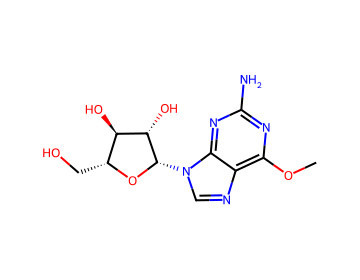
IDENTITY
COMPUTED
PROPERTIES
-1
Slightly soluble to soluble in water
1.39e+01 g/L
209-217 °C (with decomposition)
209 - 217 °C (decomposition)
Solid
GHS
Danger
H302 (16.7%): Harmful if swallowed [Warning Acute toxicity, oral];H315 (16.7%): Causes skin irritation [Warning Skin corrosion/irritation];H319 (16.7%): Causes serious eye irritation [Warning Serious eye damage/eye irritation];H335 (16.7%): May cause respiratory irritation [Warning Specific target organ toxicity, single exposure; Respiratory tract irritation];H341 (66.7%): Suspected of causing genetic defects [Warning Germ cell mutagenicity];H351 (50%): Suspected of causing cancer [Warning Carcinogenicity];H360 (16.7%): May damage fertility or the unborn child [Danger Reproductive toxicity];H361 (50%): Suspected of damaging fertility or the unborn child [Warning Reproductive toxicity];H361fd (33.3%): Suspected of damaging fertility; Suspected of damaging the unborn child [Warning Reproductive toxicity];H372 (66.7%): Causes damage to organs through prolonged or repeated exposure [Danger Specific target organ toxicity, repeated exposure];H413 (33.3%): May cause long lasting harmful effects to aquatic life [Hazardous to the aquatic environment, long-term hazard]
P203, P260, P261, P264, P264+P265, P270, P271, P273, P280, P301+P317, P302+P352, P304+P340, P305+P351+P338, P318, P319, P321, P330, P332+P317, P337+P317, P362+P364, P403+P233, P405, and P501 (click each P-code to see the statement)
Aggregated GHS information provided per 6 reports by companies from 6 notifications to the ECHA C&L Inventory. Each notification may be associated with multiple companies.;Information may vary between notifications depending on impurities, additives, and other factors. The percentage value in parenthesis indicates the notified classification ratio from companies that provide hazard codes. Only hazard codes with percentage values above 10% are shown. For more detailed information, please visit ECHA C&L website.
HAZARDS
Muta. 2 (66.7%);Carc. 2 (50%);Repr. 1B (16.7%);Repr. 2 (50%);Repr. 2 (33.3%);STOT RE 1 (66.7%);Aquatic Chronic 4 (33.3%)
TOXICITY
In clinical trials, serum enzymes elevations occurred in a small proportion of patients treated with nelarabine when given as sole therapy for refractory or relapsed acute leukemia. These elevations are generally mild-to-moderate, transient and asymptomatic. Elevations of aminotransferase levels above 5 times the upper limit of normal are reported in 4% of patients with leukemia receiving nelarabine. The elevations rarely require dose adjustment or delay in therapy. Cases of clinically apparent liver injury due to nelarabine have been reported to occur, but few details are available. A single case report of clinically apparent liver injury attributed to nelarabine has been published with rapid onset of jaundice during a second course of nelarabine, a hepatocellular pattern of enzyme elevations, no immunoallergic or autoimmune features and a rapid improvement upon stopping.;Likelihood score: E* (unproven but suspected cause of clinically apparent liver injury).
Drug Induced Liver Injury Rank (DILIrank 2.0)
Nelarabine
vLess-DILI-concern
4
Adverse reactions
DOI:10.1016/j.drudis.2016.02.015
PHARMACOLOGY
L01BB07
L - Antineoplastic and immunomodulating agents;L01 - Antineoplastic agents;L01B - Antimetabolites;L01BB - Purine analogues;L01BB07 - Nelarabine
QL - Antineoplastic and immunomodulating agents;QL01 - Antineoplastic agents;QL01B - Antimetabolites;QL01BB - Purine analogues;QL01BB07 - Nelarabine
Nelarabine and ara-G are not substantially bound to human plasma proteins (< 25%) in vitro, and binding is independent of nelarabine or ara-G concentrations up to 600 µM.
Nelarabine is a prodrug of the cytotoxic deoxyguanosine analogue 9-ß-D-arabinofuranosylguanine (ara-G). Nelarabine is demethylated by adenosine deaminase (ADA) to ara-G. Ara-G is then transported into cells, where it undergoes three phosphorylation steps, resulting in the formation of ara-G triphosphate (ara-GTP). In the first phosphorylation step, ara-G is converted to ara-G monophosphate (ara-GMP). Ara-GMP is then monophosphorylated by deoxyguanosine kinase and deoxycytidine kinase to ara-G diphosphate, and then subsequently to the active ara-G triphosphate (ara-GTP). Ara-GTP is the one that exerts the pharmacological effect. Pre-clinical studies have demonstrated that targeted T-cells possess marked sensitivity to the agent. Since T lymphoblasts have a higher expression of deoxycytidine kinase, ara-G preferentially accumulates in T cells over B cells, thus showing higher toxicity to T lymphoblasts.[A2331,AA2334,A2335]
Once nelarabine is metabolized into ara-GTP, the metabolite accumulates in leukemic blasts and incorporates into DNA to exert its S phase-specific cytotoxic effects, leading to the induction of fragmentation and apoptosis. As a nucleoside analog, Ara-GTP competes with endogenous deoxyGTP (dGTP) for incorporation into DNA. Due to its intact 3'-OH group, ara-GTP can be incorporated into the growing DNA strand without absolute chain termination. Despite that, the inclusion of ara-GTP into DNA strand can impair proper DNA repair processes, although the exact mechanism is not well understood, leading to inhibition of DNA elongation, apoptosis, and cellular destruction. Additional cytotoxic activities may exist, but these are not fully understood.
Nelarabine and ara-G are rapidly eliminated from plasma with a mean half-life of 18 minutes and 3.2 hours, respectively, in adult patients. For pediatric patients, the half-life of nelarabine and ara-G are 13 minutes and 2 hours, respectively. Because the intracellular levels of ara-GTP were so prolonged, its elimination half-life could not be accurately estimated.
The principal route of metabolism for nelarabine is O-demethylation by adenosine deaminase to form ara-G, which undergoes hydrolysis to form guanine. In addition, some nelarabine is hydrolyzed to form methylguanine, which is O-demethylated to form guanine. Guanine is N-deaminated to form xanthine, which is further oxidized to yield uric acid. Ring opening of uric acid followed by further oxidation results in the formation of allantoin. Ring opening of uric acid followed by further oxidation results in the formation of allantoin.
60158CV180
NELARABINE
Mechanisms of Action [MoA] - Nucleic Acid Synthesis Inhibitors
Established Pharmacologic Class [EPC] - Nucleoside Metabolic Inhibitor
Nelarabine is a Nucleoside Metabolic Inhibitor. The mechanism of action of nelarabine is as a Nucleic Acid Synthesis Inhibitor.
NELARABINE
Following intravenous administration of nelarabine to adult patients with refractory leukemia or lymphoma, plasma ara-G Cmax values generally occurred at the end of the nelarabine infusion and were generally higher than nelarabine Cmax values, suggesting rapid and extensive conversion of nelarabine to ara-G. Mean plasma nelarabine and ara-G Cmax values were 5.0 ± 3.0 mcg/mL and 31.4 ± 5.6 mcg/mL, respectively, after a 1,500 mg/m2 nelarabine dose infused over 2 hours in adult patients. The area under the concentration-time curve (AUC) of ara-G is 37 times higher than that for nelarabine on Day 1 after nelarabine IV infusion of 1,500 mg/m2 dose (162 ± 49 mcg.h/mL versus 4.4 ± 2.2 mcg.h/mL, respectively). Comparable Cmax and AUC values were obtained for nelarabine between Days 1 and 5 at the nelarabine adult dosage of 1,500 mg/m2, indicating that nelarabine does not accumulate after multiple dosing. There are not enough ara-G data to make a comparison between Day 1 and Day 5. After a nelarabine adult dose of 1,500 mg/m2, intracellular Cmax for ara-GTP appeared within 3 to 25 hours on Day 1. Exposure (AUC) to intracellular ara-GTP was 532 times higher than that for nelarabine and 14 times higher than that for ara-G (2,339 ± 2,628 mcg.h/mL versus 4.4 ± 2.2 mcg.h/mL and 162 ± 49 mcg.h/mL, respectively).
Nelarabine and ara-G are partially eliminated by the kidneys. Mean urinary excretion of nelarabine and ara-G was 6.6 ± 4.7% and 27 ± 15% of the administered dose, respectively, in 28 adult patients over the 24 hours after nelarabine infusion on Day 1.
Nelarabine and ara-G are extensively distributed throughout the body. For nelarabine, V<sub>ss</sub> values were 197 ± 216 L/m<sup>2</sup> in adult patients. For ara-G, V<sub>ss</sub>/F values were 50 ± 24 L/m<sup>2</sup> in adult patients.
Renal clearance averaged 24 ± 23 L/h for nelarabine and 6.2 ± 5.0 L/h for ara-G in 21 adult patients. Combined Phase I pharmacokinetic data at nelarabine doses of 199 to 2,900 mg/m<sup>2</sup> (n = 66 adult patients) indicate that the mean clearance (CL) of nelarabine is 197 ± 189 L/h/m<sup>2</sup> on Day 1. The apparent clearance of ara-G (CL/F) is 10.5 ± 4.5 L/h/m<sup>2</sup> on Day 1. For pediatric patients receiving at a dose of 104 to 2,900 mg/m<sup>2</sup>, the combined Phase I pharmacokinetic data indicate that the mean clearance (CL) of nelarabine is 259 ± 409 L/h/m<sup>2</sup>, 30% higher than in adult patients. The apparent clearance of ara-G on day 1 is also higher in pediatric patients than in adult patients, estimated to be 11.3 ± 4.2 L/h/m<sup>2</sup>.
Cytoplasm
ALIASES
REACTIONS
uspto-grants-1995_06 · 10.6084/m9.figshare.5104873.v1 · US05424295
查看
uspto-grants-1995_06 · 10.6084/m9.figshare.5104873.v1 · US05424295
查看
uspto-grants-1995_06 · 10.6084/m9.figshare.5104873.v1 · US05424295
查看
uspto-grants-1998_10 · 10.6084/m9.figshare.5104873.v1 · US05821236
查看
uspto-grants-1998_05 · 10.6084/m9.figshare.5104873.v1 · US05747472
查看
uspto-grants-1996_07 · 10.6084/m9.figshare.5104873.v1 · US05539098
查看
uspto-grants-1996_07 · 10.6084/m9.figshare.5104873.v1 · US05539098
查看
uspto-grants-1996_02 · 10.6084/m9.figshare.5104873.v1 · US05492897
查看