
uspto-grants-1988_02 · 10.6084/m9.figshare.5104873.v1 · US04725305
查看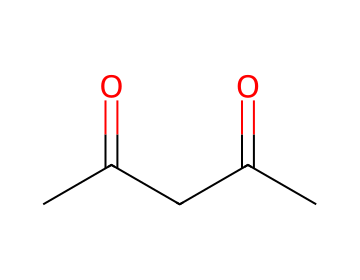
IDENTITY
COMPUTED
PROPERTIES
log Kow = 0.40
0.40
Pleasant odor
Mild ketone-like odor
0.975 at 68 °F (USCG, 1999) - Less dense than water; will float
0.9721 at 25 °C/4 °C
Bulk density = 8.1 lb/gal
Relative density (water = 1): 0.98
0.975
0.9721 @25 °C
0.6 mPa.s at 20 °C
Colorless or slightly yellow liquid
Mobile, colorless or yellowish liquid; when cooled, solidifies to lustrous, pearly spangles. The liquid is affected by light, turning brown and forming resins.
In water, 166,000 mg/L at 20 °C
One part dissolves in about 8 parts water
Fairly soluble in neutral water
Miscible with alcohol, ether, chloroform, benzene, acetone, glacial acetic acid
For more Solubility (Complete) data for Acetyl acetone (7 total), please visit the HSDB record page.
166 mg/mL at 20 °C
93 °F (USCG, 1999)
38 °C (100 °F) - closed cup
105 °F - open cup
93 °F (34 °C) (Closed cup)
34 °C c.c.
93 °F
284.7 °F at 760 mmHg (USCG, 1999)
138 °C
136.00 to 138.00 °C. @ 760.00 mm Hg
140 °C
284.7 °F
139 °C @760 [mm Hg]
Hazardous decomposition products formed under fire conditions - Carbon oxides.
-10.3 °F (USCG, 1999)
-23 °C
-23 °C
-23 °C
-10.3 °F
-23.2 °C
3.5 (Air = 1)
Relative vapor density (air = 1): 3.45
0.010 ppm
GHS
Warning
H226: Flammable liquid and vapor [Warning Flammable liquids];H302: Harmful if swallowed [Warning Acute toxicity, oral]
P210, P233, P240, P241, P242, P243, P264, P270, P280, P301+P317, P303+P361+P353, P330, P370+P378, P403+P235, and P501 (click each P-code to see the statement)
Danger
HAZARDS
Chemical: 2,4-Pentanedione
Commission Regulation (EC) No 1565/2000 (Repealed by Com. Implementing Reg. (EU) No 872/2012)
2,4-Pentanedione is listed on the EPA's Chemical Data Reporting (CDR) system. Manufacturers and importers of 2,4-Pentanedione are required to report information about their production and use of this chemical to the EPA under the Toxic Substances Control Act (TSCA). (40 eCFR Part 711)
SP - indicates a substance that is identified in a proposed Significant New Use Rule.
Status: Active Update: 30-08-2022 https://echa.europa.eu/registration-dossier/-/registered-dossier/14713;Status: Active Update: 10-11-2021 https://echa.europa.eu/registration-dossier/-/registered-dossier/33689
2,4-Pentanedione: HSNO Approval: HSR001072 Approved with controls
IMAP assessments - 2,4-Pentanedione: Human health tier II assessment
Flammable Liquid Poison
Behavior in Fire: Vapor is heavier than air and may travel to a source of ignition and flash back. (USCG, 1999)
· HIGHLY FLAMMABLE: Will be easily ignited by heat, sparks or flames.;CAUTION: Methanol (UN1230) will burn with an invisible flame. Use an alternate method of detection (thermal camera, broom handle, etc.);· Vapors may form explosive mixtures with air.;· Vapors may travel to source of ignition and flash back.;· Most vapors are heavier than air. They will spread along the ground and collect in low or confined areas (sewers, basements, tanks, etc.).;· Vapor explosion and poison hazard indoors, outdoors or in sewers.;· Those substances designated with a (P) may polymerize explosively when heated or involved in a fire.;· Runoff to sewer may create fire or explosion hazard.;· Containers may explode when heated.;· Many liquids will float on water.
Flammable. Above 34 °C explosive vapour/air mixtures may be formed.
Flammable liquid when exposed to heat or flame.
Moderate fire risk.
Inhalation causes dizziness, headache, nausea, vomiting and loss of consciousness. Contact with liquid irritates eyes. (USCG, 1999)
· TOXIC; may be fatal if inhaled, ingested or absorbed through skin.;· Inhalation or contact with some of these materials will irritate or burn skin and eyes.;· Methyl chloroacetate (UN2295) is an eye irritant/lachrymator (causes flow of tears).;· Fire will produce irritating, corrosive and/or toxic gases.;· Vapors may cause dizziness or asphyxiation, especially when in closed or confined areas.;· Runoff from fire control or dilution water may cause environmental contamination.
Causes narcosis with an oral LD50 of 575-1000 mg/kg in rats; Rats inhaling 650 ppm six hours five times weekly for 14 weeks show degenerative changes of the brain and thymus; No neurotoxicity at 307 ppm; [ACGIH] Inhalation of high concentrations causes narcosis; [CHEMINFO MSDS]
2310 131
2,4-Pentanedione is an indirect food additive for use only as a component of adhesives.
Ketones
Symbol: Xn; R: 10-22; S: (2)-21-23-24/25
UN Hazard Class: 3; UN Subsidiary Risks: 6.1; UN Pack Group: III
SAFETY
Excerpt from ERG Guide 131 [Flammable Liquids - Toxic]:;CAUTION: The majority of these products have a very low flash point. Use of water spray when fighting fire may be inefficient. CAUTION: Methanol (UN1230) will burn with an invisible flame. Use an alternate method of detection (thermal camera, broom handle, etc.).;SMALL FIRE: Dry chemical, CO2, water spray or alcohol-resistant foam.;LARGE FIRE: Water spray, fog or alcohol-resistant foam. If it can be done safely, move undamaged containers away from the area around the fire. Dike runoff from fire control for later disposal. Avoid aiming straight or solid streams directly onto the product.;FIRE INVOLVING TANKS, RAIL TANK CARS OR HIGHWAY TANKS: Fight fire from maximum distance or use unmanned master stream devices or monitor nozzles. Cool containers with flooding quantities of water until well after fire is out. Withdraw immediately in case of rising sound from venting safety devices or discoloration of tank. ALWAYS stay away from tanks in direct contact with flames. For massive fire, use unmanned master stream devices or monitor nozzles; if this is impossible, withdraw from area and let fire burn. (ERG, 2024)
Use powder, foam, carbon dioxide. In case of fire: keep drums, etc., cool by spraying with water.
Fresh air, rest. Artificial respiration may be needed. Refer for medical attention.
Remove contaminated clothes. Rinse and then wash skin with water and soap.
First rinse with plenty of water for several minutes (remove contact lenses if easily possible), then refer for medical attention.
Rinse mouth. Induce vomiting (ONLY IN CONSCIOUS PERSONS!). Refer for medical attention .
· CALL 911. Then call emergency response telephone number on shipping paper. If shipping paper not available or no answer, refer to appropriate telephone number listed on the inside back cover.;· Keep unauthorized personnel away.;· Stay upwind, uphill and/or upstream.;· Ventilate closed spaces before entering, but only if properly trained and equipped.
· ELIMINATE all ignition sources (no smoking, flares, sparks or flames) from immediate area.;· All equipment used when handling the product must be grounded.;· Do not touch or walk through spilled material.;· Stop leak if you can do it without risk.;· Prevent entry into waterways, sewers, basements or confined areas.;· A vapor-suppressing foam may be used to reduce vapors.;Small Spill;· Absorb with earth, sand or other non-combustible material and transfer to containers for later disposal.;· Use clean, non-sparking tools to collect absorbed material.;Large Spill;· Dike far ahead of liquid spill for later disposal.;· Water spray may reduce vapor, but may not prevent ignition in closed spaces.
INHALATION: remove to fresh air; if victim is not breathing, give artificial respiration and then oxygen; call a physician.;EYES or SKIN: flush with water. (USCG, 1999)
General First Aid:;· Call 911 or emergency medical service.;· Ensure that medical personnel are aware of the material(s) involved, take precautions to protect themselves and avoid contamination.;· Move victim to fresh air if it can be done safely.;· Administer oxygen if breathing is difficult.;· If victim is not breathing:;-- DO NOT perform mouth-to-mouth resuscitation; the victim may have ingested or inhaled the substance.;-- If equipped and pulse detected, wash face and mouth, then give artificial respiration using a proper respiratory medical device (bag-valve mask, pocket mask equipped with a one-way valve or other device).;-- If no pulse detected or no respiratory medical device available, provide continuous compressions. Conduct a pulse check every two minutes or monitor for any signs of spontaneous respirations.;· Remove and isolate contaminated clothing and shoes.;· For minor skin contact, avoid spreading material on unaffected skin.;· In case of contact with substance, remove immediately by flushing skin or eyes with running water for at least 20 minutes.;· For severe burns, immediate medical attention is required.;· Effects of exposure (inhalation, ingestion, or skin contact) to substance may be delayed.;· Keep victim calm and warm.;· Keep victim under observation.;· For further assistance, contact your local Poison Control Center.;· Note: Basic Life Support (BLS) and Advanced Life Support (ALS) should be done by trained professionals.;Specific First Aid:;· Wash skin with soap and water.
Fireproof. Separated from strong oxidants. Keep in the dark.
Vapors are heavier than air and will collect in low areas. Vapors may travel long distances to ignition sources and flashback. Vapors in confined areas may explode when exposed to fire. Containers may explode in fire. Storage containers and parts of containers may rocket great distances, in many directions.
· Wear positive pressure self-contained breathing apparatus (SCBA).;· Wear chemical protective clothing that is specifically recommended by the manufacturer when there is NO RISK OF FIRE.;· Structural firefighters' protective clothing provides thermal protection but only limited chemical protection.
20.0 [ppm]
Suitable extinguishing media: Dry powder, dry sand. Unsuitable extinguishing media: Do NOT use water jet.
Advice for firefighters: Wear self-contained breathing apparatus for firefighting if necessary.
Use water spray to cool unopened containers.
Use dry chemical, carbon dioxide, alcohol foam, or polymer foam extinguishers. ... If material or contaminated runoff enters waterways, notify downstream users of potentially contaminated waters. Notify local health and fire officials and pollution control agencies. From a secure, explosion-proof location, use water spray to cool exposed containers. If cooling streams are ineffective (venting sound increases in volume and pitch, tank discolors, or shows any signs of deforming), withdraw immediately to a secure position. ... The only respirators recommended for firefighting are self-contained breathing apparatuses that have full face-pieces and are operated in a pressure-demand or other positive-pressure mode.
To fight fire, use alcohol foam, /carbon dioxide/, or dry chemical.
Keep container tightly closed in a dry and well-ventilated place. Containers which are opened must be carefully resealed and kept upright to prevent leakage. Storage class (TRGS 510): 3: Flammable liquids.
Store in a flammable liquid storage area or approved cabinet away from ignition sources and corrosive and reactive materials. Prior to working with this chemical you should be trained on its proper handling and storage. Before entering confined space where this chemical may be present, check to make sure that an explosive concentration is not a danger. Store in stainless steel containers away from oxidizers, reducing agents, bases. Where possible, automatically pump liquid from drums or other storage containers to process containers. Sources of ignition, such as smoking and open flames, are prohibited where this chemical is handled, used, or stored. Metal containers involving the transfer of 5 gallons or more of this chemical should be grounded and bonded. Drums must be equipped with self-closing valves, pressure vacuum bungs, and flame arresters. Use only nonsparking tools and equipment, especially when opening and closing containers of this chemical. Wherever this chemical is used, handled, manufactured, or stored, use explosion-proof electrical equipment and fittings.
ACCIDENTAL RELEASE MEASURES: Personal precautions, protective equipment and emergency procedures: Wear respiratory protection. Avoid breathing vapors, mist or gas. Ensure adequate ventilation. Remove all sources of ignition. Evacuate personnel to safe areas. Beware of vapors accumulating to form explosive concentrations. Vapors can accumulate in low areas. Environmental precautions: Prevent further leakage or spillage if safe to do so. Do not let product enter drains. Methods and materials for containment and cleaning up: Contain spillage, and then collect with non-combustible absorbent material, (e.g. sand, earth, diatomaceous earth, vermiculite) and place in container for disposal according to local/national regulations.
Evacuate and restrict persons not wearing protective equipment from area of spill or leak until cleanup is complete. Remove all ignition sources. Establish forced ventilation to keep levels below explosive limit. Absorb liquids in vermiculite, dry sand, earth, peat, carbon, or a similar material and deposit in sealed containers. Keep this chemical out of a confined space, such as a sewer, because of the possibility of an explosion, unless the sewer is designed to prevent the buildup of explosive concentrations. It may be necessary to contain and dispose of this chemical as a hazardous waste. If material or contaminated runoff enters waterways, notify downstream users of potentially contaminated waters.
Excerpt from ERG Guide 131 [Flammable Liquids - Toxic]:;ELIMINATE all ignition sources (no smoking, flares, sparks or flames) from immediate area. All equipment used when handling the product must be grounded. Do not touch or walk through spilled material. Stop leak if you can do it without risk. Prevent entry into waterways, sewers, basements or confined areas. A vapor-suppressing foam may be used to reduce vapors.;SMALL SPILL: Absorb with earth, sand or other non-combustible material and transfer to containers for later disposal. Use clean, non-sparking tools to collect absorbed material.;LARGE SPILL: Dike far ahead of liquid spill for later disposal. Water spray may reduce vapor, but may not prevent ignition in closed spaces. (ERG, 2024)
SRP: Recycle any unused portion of the material for its approved use or return it to the manufacturer or supplier. Ultimate disposal of the chemical must consider: the material's impact on air quality; potential migration in air, soil or water; effects on animal, aquatic and plant life; and conformance with environmental and public health regulations. If it is possible or reasonable use an alternative chemical product with less inherent propensity for occupational harm/injury/toxicity or environmental contamination.
SRP: Wastewater from contaminant suppression, cleaning of protective clothing/equipment, or contaminated sites should be contained and evaluated for subject chemical or decomposition product concentrations. Concentrations shall be lower than applicable environmental discharge or disposal criteria. Alternatively, pretreatment and/or discharge to a permitted wastewater treatment facility is acceptable only after review by the governing authority and assurance that "pass through" violations will not occur. Due consideration shall be given to remediation worker exposure (inhalation, dermal and ingestion) as well as fate during treatment, transfer and disposal. If it is not practicable to manage the chemical in this fashion, it must be evaluated in accordance with EPA 40 CFR Part 261, specifically Subpart B, in order to determine the appropriate local, state and federal requirements for disposal.
Product: Contact a licensed professional waste disposal service to dispose of this material. Offer surplus and non-recyclable solutions to a licensed disposal company. Burn in a chemical incinerator equipped with an afterburner and scrubber but exert extra care in igniting as this material is highly flammable; Contaminated packaging: Dispose of as unused product.
Dissolve or mix the material with a combustible solvent and burn in a chemical incinerator equipped with an afterburner and scrubber. All federal, state, and local environmental regulations must be observed.
TOXICITY
When 2,4-pentanedione was incubated with yeast cells, no chromosome loss occurred even at a concentration of 1.96% (v/v) and cold shock, but the addition of propionitrile to the incubation mixture stimulated chromosomal loss.
... Acetylacetone inhibited the mutagenicity of 2-naphthohydroxamic acid.
LC50; Species: Pimephales promelas (fathead minnow); Concentration: 200 mg/L for 24 hr /Conditions of bioassay not specified in source examined/
LC50; Species: Pimephales promelas (fathead minnow); Conditions: flow-through, Lake Superior water, 25.2 °C, 6.3 dissolved oxygen, Hardness 46.5 mg/L CaCO3, pH 7.37; Concentration: 104 mg/L for 96 hr (95% confidence interval: 98.3-110 mg/L)... /Purity >99%/
LC50; Species: Pimephales promelas (fathead minnow); Conditions: flow-through, temperature 18.6 to 19.4 °C, pH 7.65 to 7.94, dissolved oxygen (DO) 6.19 to 9.22 mg/L, hardness (CaCO3) 196 mg/L; Concentration: 141 mg/L for 96 hr /Purity > 99%/
LC50; Species: Pimephales promelas (fathead minnow) 28 to 34 days-old; Conditions: flow-through with 99% replacement in about 2 hr; dissolved oxygen 7.57 mg/L, pH 7.32, 43.2 mg/L CaCO3, temperature 24 to 26 °C; Concentration: 142 mg/L for 96 hr /Purity >99%/
For more Ecotoxicity Values (Complete) data for Acetyl acetone (72 total), please visit the HSDB record page.
TERRESTRIAL FATE: Based on a classification scheme(1), an estimated Koc value of 34(SRC), determined from a log Kow of 0.40(2) and a regression-derived equation(3), indicates that acetyl acetone is expected to have very high mobility in soil(SRC). Volatilization of acetyl acetone from moist soil surfaces is expected to be an important fate process(SRC) given an estimated Henry's Law constant of 2.4X10⁻⁶ atm-cu m/mole(SRC) derived from its vapor pressure, 2.96 mm Hg(4), and water solubility, 166,000 mg/L(5). Acetyl acetone is expected to volatilize from dry soil surfaces(SRC) based upon its vapor pressure(4). Utilizing the Japanese MITI test, 83% of the Theoretical BOD was reached in 4 weeks(6), suggesting that biodegradation may be an important environmental fate process in soil(SRC).
AQUATIC FATE: Based on a classification scheme(1), an estimated Koc value of 34(SRC), determined from a log Kow of 0.40(2) and a regression-derived equation(3), indicates that acetyl acetone is not expected to adsorb to suspended solids and sediment(SRC). Volatilization from water surfaces is expected(4) based upon an estimated Henry's Law constant of 2.4X10⁻⁶ atm-cu m/mole(SRC), derived from its vapor pressure, 2.96 mm Hg(5), and water solubility, 166,000 mg/L(6). Using this Henry's Law constant and an estimation method(3), volatilization half-lives for a model river and model lake are 16 days and 120 days, respectively(SRC). The aquatic oxidation rate for acetyl acetone has been experimentally determined to be 9.9X10⁻⁹ L/mol-s at pH 6.4(7). Based on this rate and a hydroxyl radical concentration of 1X10-17 mol/L in water under continuous sunlight(8), the half-life for the aquatic oxidation of acetyl acetone can be estimated to be 81 days(SRC). According to a classification scheme(9), an estimated BCF of 3(SRC), from its log Kow(2) and a regression-derived equation(3), suggests the potential for bioconcentration in aquatic organisms is low(SRC). Utilizing the Japanese MITI test, 83% of the Theoretical BOD was reached in 4 weeks(10), suggesting that biodegradation may be an important environmental fate process in water(SRC).
ATMOSPHERIC FATE: According to a model of gas/particle partitioning of semivolatile organic compounds in the atmosphere(1), acetyl acetone, which has a vapor pressure of 2.96 mm Hg at 20 °C(2), is expected to exist solely as a vapor in the ambient atmosphere. Vapor-phase acetyl acetone is degraded in the atmosphere by reaction with photochemically-produced hydroxyl radicals(SRC); the half-life for this reaction in air is estimated to be 22 days(SRC), calculated from its rate constant of 9.05X10⁻¹¹ cu cm/molecule-sec at 25 °C(3). Acetyl acetone absorbs UV light at wavelengths >314 nm(5) and, therefore, may be susceptible to direct photolysis by sunlight(SRC).
Acetyl acetone has been identified, not quantified in chicken(1).
Neurotoxin - Acute solvent syndrome
The substance can be absorbed into the body by inhalation of its vapour, through the skin and by ingestion.
IDENTIFICATION AND USE: Acetyl acetone is a colorless or slightly yellow liquid. It forms organometallic complexes which are used as gasoline additives, lubricant additives, driers for varnishes and printer's inks. HUMAN STUDIES: Acetly acetone (2 to 14 ppm) was reported to produce nausea and headaches in several persons. A case was reported involving an individual who had developed contact dermatitis to Cu(II)-acetyl acetonate and who also showed a cross reaction to acetyl acetone. The skin sensitizing properties of acetyl acetate were examined in a human patch test. Of the 12 persons tested three showed no reaction, seven doubtful, and two had a positive reaction after an exposure period of 24 hr. No skin reactions were evident after 48 and 72 hr, respectively. The results observed in the human patch test were interpreted as an irritating rather than a sensitizing effect. ANIMAL STUDIES: Acetyl acetone was not irritating to the skin of rabbits. In a rabbits eye irritation test, exposure to acetyl acetone resulted in minor transient irritation with no corneal involvement. After oral administration to rats, signs of toxicity were characterized by sluggishness, tremors, kyphosis, lacrimation, unsteady gait, comatose appearance and prostration. In another oral study, doses given by gavage to rats were 0, 100, 500 and 1,000 mg/kg bw given for 1 to 15 days in 1 to 11 applications. In the highest dose group all animals died within 1 hour after dosing. In the 500 mg/kg bw group 3/5 animals died and 2/5 were sacrificed due to poor condition after four applications. Various substance related systemic effects were observable in this dose group such as distended bladder, congested lungs, clouding of cornea, thymic necrosis, hepatocyte swelling and congestion, nephrosis, lymphadenitis of mesenteric lymph nodes and inflammation of the heart. After inhalation in rats (4 hr; 628, 919, 1231 and 1508 ppm) mortalities were observed in animals of the two highest dose groups. Signs of
Incoordination. Dizziness. Drowsiness. Headache. Laboured breathing. Nausea. Vomiting. Ataxia
MAY BE ABSORBED! Redness.
Redness. Pain.
Diarrhoea. Weakness. Further see Inhalation.
The following link will take the user to the National Toxicology Program (NTP) Test Status of Agents Search page, which tabulates the results and current status of tests such as "Short-Term Toxicity Studies", "Long-term Carcinogenicity Studies", "Developmental Studies", "Genetic Toxicology Studies", etc., performed with this chemical. Testing status for acetyl acetone is available.[Available from, as of February 1, 2019: https://ntpsearch.niehs.nih.gov/?e=True&ContentType=Testing+Status]
EPA has released the Interactive Chemical Safety for Sustainability (iCSS) Dashboard. The iCSS Dashboard provides an interactive tool to explore rapid, automated (or in vitro high-throughput) chemical screening data generated by the Toxicity Forecaster (ToxCast) project and the federal Toxicity Testing in the 21st century (Tox21) collaboration. /The title compound was tested by ToxCast and/or Tox21 assays/[USEPA; ICSS Dashboard Application; Available from, as of February 4, 2019: http://actor.epa.gov/dashboard/]
Acetyl acetone was identified, not quantified in ozone treated sludge press liquors from a waste water treatment facility in Kent, England(1). The compound was identified in an odor profiling study of a confined animal (swine) feeding operation in north western Texas. It was not identified as a major odorant from a beef operation(2).
The substance is harmful to aquatic organisms.
The Koc of acetyl acetone is estimated as 34(SRC), using a log Kow of 0.40(1) and a regression-derived equation(2). According to a classification scheme(3), this estimated Koc value suggests that acetyl acetone is expected to have very high mobility in soil(SRC).
REGULATORY
Chemical: 2,4-Pentanedione
Commission Regulation (EC) No 1565/2000 (Repealed by Com. Implementing Reg. (EU) No 872/2012)
2,4-Pentanedione is listed on the EPA's Chemical Data Reporting (CDR) system. Manufacturers and importers of 2,4-Pentanedione are required to report information about their production and use of this chemical to the EPA under the Toxic Substances Control Act (TSCA). (40 eCFR Part 711)
SP - indicates a substance that is identified in a proposed Significant New Use Rule.
Status: Active Update: 30-08-2022 https://echa.europa.eu/registration-dossier/-/registered-dossier/14713;Status: Active Update: 10-11-2021 https://echa.europa.eu/registration-dossier/-/registered-dossier/33689
2,4-Pentanedione: HSNO Approval: HSR001072 Approved with controls
2,4-Pentanedione is an indirect food additive for use only as a component of adhesives.
Section 8(a) of TSCA requires manufacturers of this chemical substance to report preliminary assessment information concerned with production, exposure, and use to EPA as cited in the preamble in 51 FR 41329. Effective date: 9/30/91; Reporting date: 11/27/91.
Pursuant to section 8(d) of TSCA, EPA promulgated a model Health and Safety Data Reporting Rule. The section 8(d) model rule requires manufacturers, importers, and processors of listed chemical substances and mixtures to submit to EPA copies and lists of unpublished health and safety studies. 2,4-Pentanedione is included on this list. Effective date: 9/30/91; Sunset date: 12/19/95.
PHARMACOLOGY
About 10.75 hours in rats; [ACGIH]
2,4-Pentanedione (2,4-PD; CAS No. 123-54-6) ... was investigated for its comparative pharmacokinetics in male Fischer 344 rats by a single intravenous (i.v.) injection of (4.3, 43, 148.5, and 430 mg/kg), or a 6-hr nose-only inhalation exposure (400 ppm) to (14)C-2,4-PD. For the i.v. route, the plasma concentration of (14)C-2,4-PD-derived radioactivity declined in a biexponential fashion. The overall form of the (14)C plasma concentration-time curves and derived pharmacokinetic parameters indicated that dose-linear kinetics occurred in the i.v. dose range 4.3-148.5 mg/kg, but not with 430 mg/kg. Metabolism of 2,4-PD was rapid to undetectable after 8 hr. (14)C-2,4-PD derived radioactivity was eliminated mainly as (14)CO2 and in urine. For the 4.3, 43 and 148.5 mg/kg doses (14)CO2 elimination was relatively constant (36.8, 38.8 and 42.3% in 48 hr samples respectively) and greater than urinary excretion (17.9, 14.3 and 29.6%; 48 hr specimens). At 430 mg/kg i.v. there was a reversal of the excretion pattern, with urine (14)C excretion (54.7%) becoming greater than that for (14)CO2 (27.3%). Excretion in expired volatiles and feces was small. Radiochromatograms of urine showed free 2,4-PD in the 12 hr sample, together with 7 other metabolites. Free 2,4-PD and 6 of the metabolites decreased or were not detectable in a 24 or 48 hr urine sample, but one peak (retention 7.9 min) increased progressively to become the major fraction (97%). Nose-only exposure to 400 ppm (14)C-2, 4-PD produced a mean decrease in breathing rate of 20.1%, which was constant and sustained throughout exposure, due to a lengthening of the expiratory phase of the respiratory cycle. (14)C-2,4-PD was rapidly absorbed during the first 3 hr of exposure, then began to plateau, but did not reach a steady state. Postexposure elimination of (14)C from plasma followed a biexponential form with a t1/2 for the terminal disposition phase of 30.72 hr. ... Postexposure, plasma unmetabolized 2,4-PD declined rapidly to
Cytoplasm;Extracellular
USES
Used as a chemical intermediate, solvent, metal chelating agent, lubricant additive, and pesticide; [Hawley] Used as a metal chelator, lubricant additive, corrosion inhibitor, polyolefin modifier, and intermediate; [ACGIH]
Painting (Solvents) [Category: Paint]
Forms organometallic complexes which are used as gasoline additives, lubricant additives, driers for varnishes and printer's inks ... .
Fungicides, insecticides, colors /SRP: Former uses/
Solvent for cellulose acetate, intermediate, chelating agent for metals, paint driers, lubricant additives.
2,4-Pentanedione is used as an intermediate, in particular for the synthesis of heterocyclic substances for biologically active compounds and dyes, and for the production of metal acetylacetonates. Furthermore, 2,4-pentanedione is used as a solvent, and as an absorption and extraction agent, particularly for the separation and purification of metal ions. Another application is for the purification of metal-containing wastewater and for corrosion protection. 2,4-Pentanedione is also used as a component of catalyst systems for polymerization, copolymerization, oligo- and dimerization.
The purity of the substance exceeds 99%. Known impurities are water (0.1%), hexane-2,5-dione (0.1%), acetic acid (0.05%) and isopropenyl acetate (0.03%).
2023: 1,000,000 - <2,500,000 lb;2022: 2,500,000 - <4,000,000 lb;2021: 2,500,000 - <4,000,000 lb;2020: 1,000,000 - <2,500,000 lb
This chemical is listed as a High Production Volume (HPV) (65FR81686). Chemicals listed as HPV were produced in or imported into the U.S. in >1 million pounds in 1990 and/or 1994. The HPV list is based on the 1990 Inventory Update Rule. (IUR) (40 CFR part 710 subpart B; 51FR21438).
(1972) PROBABLY GREATER THAN 4.54X10+5 GRAMS
(1975) GREATER THAN 9.08X10+5 GRAMS
Production volumes for non-confidential chemicals reported under the Inventory Update Rule. [Table#3821]
Non-confidential 2016 Chemical Data Reporting (CDR) information on the production and use of chemicals manufactured or imported into the United States. Chemical: 2,4-Pentanedione:;Table: National Aggregate Production Volume (pounds) [Table#3822]
Other;Solvent;Chemical reaction regulator;Diluent;Corrosion inhibitor
Stabilizing agent;Catalyst;Not Known or Reasonably Ascertainable;Diluent;Hardener;Drier;Intermediate;Surface modifier;Laboratory chemicals;Solvent;Dispersing agent;Other;Chemical reaction regulator
2,4-Pentanedione is produced by thermal or metal-catalyzed rearrangement of isopropenyl acetate (obtained from acetone and ketene). Isopropenyl acetate vapor is fed at atmospheric pressure through a V2A steel tube with an inner temperature of 520 °C. The hot reaction gases are quenched, condensed, and cooled to 20 °C, whereby the gaseous byproducts carbon monoxide, carbon dioxide, methane, and ketene are separated. The product is purified by fractional distillation. Other industrially less important processes for the production of 2,4-pentanedione, include the Claisen ester condensation of ethyl acetate with acetone using sodium ethoxide as condensation agent and the acetylation of acetoacetic acid esters with acetic anhydride in the presence of magnesium salts.
Made by the action of sodium on ethyl acetate and acetone or by the action of anhydrous aluminum chloride on acetyl chloride in the presence of an inert solvent.
Condensation of acetone and acetic anhydride with a boron trifluoride catalyst; reaction of acetone and ethyl acetate in the presence of sodium ethoxide.
Miscellaneous Manufacturing;Asphalt Paving, Roofing, and Coating Materials Manufacturing;All Other Basic Organic Chemical Manufacturing;Other (requires additional information);Plastics Material and Resin Manufacturing;Fabricated Metal Product Manufacturing;Paint and Coating Manufacturing;Not Known or Reasonably Ascertainable;Transportation Equipment Manufacturing;Electrical Equipment, Appliance, and Component Manufacturing;Plastics Product Manufacturing;All Other Basic Inorganic Chemical Manufacturing
2,4-Pentanedione: ACTIVE
ALIASES
REACTIONS
uspto-grants-1988_02 · 10.6084/m9.figshare.5104873.v1 · US04725305
查看
uspto-grants-1988_02 · 10.6084/m9.figshare.5104873.v1 · US04725303
查看
uspto-grants-1988_02 · 10.6084/m9.figshare.5104873.v1 · US04725683
查看
uspto-grants-1988_02 · 10.6084/m9.figshare.5104873.v1 · US04727073
查看
uspto-grants-2006_08 · 10.6084/m9.figshare.5104873.v1 · US07084159B2
查看
uspto-grants-2010_06 · 10.6084/m9.figshare.5104873.v1 · US07736757B2
查看
uspto-grants-2010_06 · 10.6084/m9.figshare.5104873.v1 · US07736757B2
查看
uspto-grants-1995_06 · 10.6084/m9.figshare.5104873.v1 · US05424432
查看