
uspto-grants-1978_05 · 10.6084/m9.figshare.5104873.v1 · US04092146
查看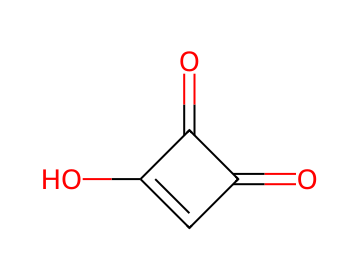
IDENTITY
COMPUTED
GHS
Danger
H301 (100%): Toxic if swallowed [Danger Acute toxicity, oral]
P264, P270, P301+P316, P321, P330, P405, and P501 (click each P-code to see the statement)
Aggregated GHS information provided per 41 reports by companies from 2 notifications to the ECHA C&L Inventory.;Information may vary between notifications depending on impurities, additives, and other factors. The percentage value in parenthesis indicates the notified classification ratio from companies that provide hazard codes. Only hazard codes with percentage values above 10% are shown. For more detailed information, please visit ECHA C&L website.
HAZARDS
Regulation (EC) No 178/2002 (amended)
Acute Tox. 3 (100%)
Acute Tox. 2 (100%);Skin Irrit. 2 (100%);Eye Irrit. 2A (100%);STOT SE 3 (100%)
TOXICITY
Kashin-Beck disease cannot be cured but can be treated with physical therapy and corrective surgery. Natamycin ophthalmic suspension is the drug of choice for filamentous fungal infections such as mycotic keratitis. (L1964, L1828)
Moniliformin is believed to be a cause of Kashin-Beck disease, which causes joint destruction and deformity. It may also have immunosuppressive properties and can cause fungal infections such as mycotic keratitis. (A3021, A3075, A3076, L1970)
Oral, dermal, inhalation, and parenteral (contaminated drugs). (A3101)
Moniliformin reversibly inhibits the enzymes pyruvate dehydrogenase and alpha-ketoglutarate dehydrogenase by competing for the binding site of pyruvate. This interferes with the tricarboxylic acid cycle by preventing the necessary incorporation of pyruvate and oxidation of the alpha-ketoglutarate intermediate. Moniliformin has also been shown to interfere with carbohydrate metabolism by inhibiting transketolase and aldose reductase. Moniliformin causes the necrosis of human chondrocytes in cartilage. It does so by increasing the expression of matrix catabolic enzymes, such as MMP-1 and MMP-13, and decreasing the syntheses of extracellular matrix components such as aggrecan and type II collage. This accelerates the catabolism of the extracellular matrix in articular cartilages, inducing a loss of cartilage function and eventually leading to cartilage degradation. Moniliformin is also known to cause DNA damage, inducing chromatid breaks, chromosome breaks, and chromatid exchanges. (A3075, A3076, A3077)
The main symptoms of acute moniliformin toxication in animals are muscular weakness, respiratory stress, myocardial degeneration, as well as some histopathological changes in organs such as the kidneys, the lungs and the pancreas, followed by coma and death. Kashin-Beck disease is characterized by joint pain, with restriction of movement and joint enlargement. (A3077)
No indication of carcinogenicity to humans (not listed by IARC).
REGULATORY
Regulation (EC) No 178/2002 (amended)
USES
Moniliformin is a mycotoxin produced by a number of fungi of the Fusarium species. It can by found in contaminated cereal crops. (L1969, A3075)
ALIASES
REACTIONS
uspto-grants-1978_05 · 10.6084/m9.figshare.5104873.v1 · US04092146
查看