
uspto-grants-1998_03 · 10.6084/m9.figshare.5104873.v1 · US05726315
查看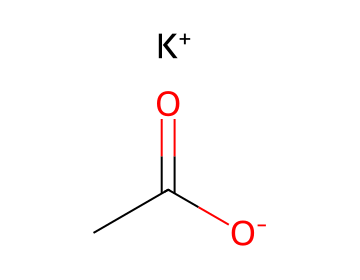
IDENTITY
COMPUTED
PROPERTIES
7,5-9,0 (5 % aqueous solution)
1.6 g/cm³
1.57 @25 °C
Solubility in water, g/100ml at 20 °C: 256
292 °C
309 °C
CBI; Large Crystals; Dry Powder; Liquid; Dry Powder; Large Crystals
Colourless, deliquescent crystals or a white crystalline powder, odourless or with a faint acetic odour
Lustrous colorless or white solid; Rapidly deliquescent; [Merck Index] White crystalline solid; [Aldrich MSDS]
WHITE FLAKES OR CRYSTALLINE POWDER.
GHS
This chemical does not meet GHS hazard criteria for 87.3% (418 of 479) of all reports.
Warning
H315 (11.5%): Causes skin irritation [Warning Skin corrosion/irritation];H319 (12.7%): Causes serious eye irritation [Warning Serious eye damage/eye irritation];H335 (11.5%): May cause respiratory irritation [Warning Specific target organ toxicity, single exposure; Respiratory tract irritation]
P261, P264, P264+P265, P271, P280, P302+P352, P304+P340, P305+P351+P338, P319, P321, P332+P317, P337+P317, P362+P364, P403+P233, P405, and P501 (click each P-code to see the statement)
Aggregated GHS information provided per 479 reports by companies from 11 notifications to the ECHA C&L Inventory. Each notification may be associated with multiple companies.;Reported as not meeting GHS hazard criteria per 418 of 479 reports by companies.;There are 9 notifications provided by 61 of 479 reports by companies with hazard statement code(s).;Information may vary between notifications depending on impurities, additives, and other factors. The percentage value in parenthesis indicates the notified classification ratio from companies that provide hazard codes. Only hazard codes with percentage values above 10% are shown. For more detailed information, please visit ECHA C&L website.
HAZARDS
Chemical: Acetic acid, potassium salt
Acetic acid, potassium salt (1:1) is listed on the EPA's Chemical Data Reporting (CDR) system. Manufacturers and importers of Acetic acid, potassium salt (1:1) are required to report information about their production and use of this chemical to the EPA under the Toxic Substances Control Act (TSCA). (40 eCFR Part 711)
Status: Active Update: 21-04-2023 https://echa.europa.eu/registration-dossier/-/registered-dossier/15104
Potassium acetate: Non hazardous
IMAP assessments - Acetic acid, potassium salt: Human health tier I assessment
Combustible.
A mild skin and eye irritant; [ICSC] Not irritating to eyes of rabbits; [IUCLID] Allowable daily intake (ADI) of not limited [JECFA] May cause irritation; [Aldrich MSDS]
Chemical: Potassium acetate; Green circle - The chemical has been verified to be of low concern based on experimental and modeled data.
Decomposes on heating and on contact with strong acids. This produces acetic acid fumes. Reacts violently with strong oxidants. The solution in water is a weak base.
Skin Irrit. 2 (11.5%);Eye Irrit. 2 (12.7%);STOT SE 3 (11.5%)
Not Classified
SAFETY
Use water spray, foam, powder, carbon dioxide.
Fresh air, rest.
Rinse and then wash skin with water and soap.
First rinse with plenty of water for several minutes (remove contact lenses if easily possible), then refer for medical attention.
Rest.
Separated from strong acids and strong oxidants.
Personal protection: particulate filter respirator adapted to the airborne concentration of the substance. Sweep spilled substance into covered containers. If appropriate, moisten first to prevent dusting. Wash away remainder with plenty of water.
Wear safety goggles.
NO open flames.
No indication can be given about the rate at which a harmful concentration of this substance in the air is reached.
Protective gloves.
Do not eat, drink, or smoke during work.
Use local exhaust.
The substance is mildly irritating to the eyes and skin.
9.8 [mg/m3]
110 [mg/m3]
640 [mg/m3]
TOXICITY
The substance can be absorbed into the body by ingestion.
Safe in the present practices of use and concentration. Ingredient, concentration, and use information are available in documents discoverable at https://cir-reports.cir-safety.org
Redness.
Redness.
REGULATORY
Chemical: Acetic acid, potassium salt
Acetic acid, potassium salt (1:1) is listed on the EPA's Chemical Data Reporting (CDR) system. Manufacturers and importers of Acetic acid, potassium salt (1:1) are required to report information about their production and use of this chemical to the EPA under the Toxic Substances Control Act (TSCA). (40 eCFR Part 711)
Status: Active Update: 21-04-2023 https://echa.europa.eu/registration-dossier/-/registered-dossier/15104
Potassium acetate: Non hazardous
PHARMACOLOGY
B - Blood and blood forming organs;B05 - Blood substitutes and perfusion solutions;B05X - I.v. solution additives;B05XA - Electrolyte solutions;B05XA17 - Potassium acetate
QB - Blood and blood forming organs;QB05 - Blood substitutes and perfusion solutions;QB05X - I.v. solution additives;QB05XA - Electrolyte solutions;QB05XA17 - Potassium acetate
Potassium is the major cation (positive ion) inside animal cells, while sodium is the major cation outside animal cells. The concentration differences of these charged particles causes a difference in electric potential between the inside and outside of cells, known as the membrane potential. The balance between potassium and sodium is maintained by ion pumps in the cell membrane. The cell membrane potential created by potassium and sodium ions allows the cell generate an action potential—a "spike" of electrical discharge. The ability of cells to produce electrical discharge is critical for body functions such as neurotransmission, muscle contraction, and heart function. Potassium is also an essential mineral needed to regulate water balance, blood pressure and levels of acidity.
KALI ACETICUM
Inhibition Large Intestine Fluid/Electrolyte Absorption [PE]; Osmotic Activity [MoA]; Increased Large Intestinal Motility [PE]; Potassium Salt [EPC]; Potassium Compounds [CS]; Osmotic Laxative [EPC]
POTASSIUM ACETATE
Potassium Compounds [CS]; Osmotic Laxative [EPC]; Increased Large Intestinal Motility [PE]; Potassium Salt [EPC]; Inhibition Large Intestine Fluid/Electrolyte Absorption [PE]; Osmotic Activity [MoA]
Mostly urine but also skin and feces.
USES
CIR ingredient: Potassium Acetate
Used as a potassium supplement; [Merck Index] Used in the chemical industry (synthesis), textile processing industry, anti-freeze agents, foods (permitted additive in the UK), and pharmaceuticals; Also used as a pH regulator and industrial de-icer; [IUCLID] Used in foods as a buffer and antimicrobial preservative; [JECFA] Used as a dehydrating agent and in crystal glass; [Hawley]
Textiles (Fiber & Fabric Manufacturing) [Category: Industry];Glass Manufacturing [Category: Industry]
2023: 250,000,000 - <400,000,000 lb;2022: 250,000,000 - <400,000,000 lb;2021: 250,000,000 - <400,000,000 lb;2020: 100,000,000 - <250,000,000 lb
Anti-scaling agent;Not Known or Reasonably Ascertainable;Soil amendments (fertilizers);Preservative;Flame retardant;Lubricating agent;Other;Anti-freeze agent
Chemical reaction regulator;pH regulating agent;Other;Lubricating agent;Anti-freeze agent;Defoamer;Laboratory chemicals;Intermediate;Preservative;Soil amendments (fertilizers);Catalyst;Corrosion inhibitor;Not Known or Reasonably Ascertainable;Flame retardant
Information on 3 consumer products that contain Potassium Acetate in the following categories is provided:;• Inside the Home
EPA Safer Chemical Functional Use Classes -> Processing Aids and Additives
Safer Chemical Classes -> Green circle - The chemical has been verified to be of low concern
Food additives
Food Additives -> ACIDITY_REGULATOR; PRESERVATIVE -> JECFA Functional Classes
Cosmetics -> Film forming
Pesticide, Fertilizer, and Other Agricultural Chemical Manufacturing;Soap, Cleaning Compound, and Toilet Preparation Manufacturing;Wholesale and Retail Trade;Agriculture, Forestry, Fishing and Hunting;Plastics Material and Resin Manufacturing;Not Known or Reasonably Ascertainable;Construction;All Other Chemical Product and Preparation Manufacturing;Miscellaneous Manufacturing;Food, beverage, and tobacco product manufacturing;All Other Basic Organic Chemical Manufacturing
Acetic acid, potassium salt (1:1): ACTIVE
ALIASES
REACTIONS
uspto-grants-1998_03 · 10.6084/m9.figshare.5104873.v1 · US05726315
查看
uspto-grants-1998_03 · 10.6084/m9.figshare.5104873.v1 · US05726315
查看
uspto-grants-1998_03 · 10.6084/m9.figshare.5104873.v1 · US05726315
查看
uspto-grants-1998_03 · 10.6084/m9.figshare.5104873.v1 · US05726315
查看
uspto-grants-1998_03 · 10.6084/m9.figshare.5104873.v1 · US05726315
查看
uspto-grants-1998_03 · 10.6084/m9.figshare.5104873.v1 · US05726315
查看
uspto-grants-1998_03 · 10.6084/m9.figshare.5104873.v1 · US05726315
查看
uspto-grants-1998_03 · 10.6084/m9.figshare.5104873.v1 · US05733913
查看