
uspto-grants-1995_05 · 10.6084/m9.figshare.5104873.v1 · US05415870
查看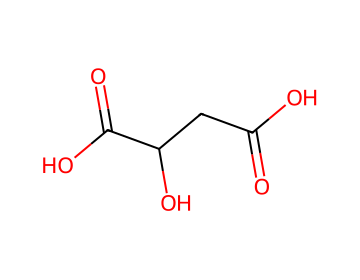
IDENTITY
COMPUTED
PROPERTIES
pH of a 0.001% aqueous solution is 3.80, that of 0.1% solution is 2.80, and that of a 1.0% solution is 2.34
log Kow = -1.26
Characteristic
Smoothly tart
Sour taste
1.601 g/ cu cm at 20 °C
1.25 @25 °C
6.5 mPa.s (= cP) 50% aqueous solution at 25 °C
Colorless crystals
White, crystalline triclinic crystals
In water, 55.8 g/100 g water at 20 °C
In water, 592,000 mg/L at 25 °C
Solubility in g/100 g solvent at 20 °C: methanol 82.70; diethyl ether 0.84; ethanol 45.53; acetone 17-75; dioxane 22.70
It is highly soluble in methanol, ethanol, acetone, ether, and other polar solvents
soluble in water and alcohol; 1 gm in 0.8 ml water
1 g in 1.4 ml alcohol (in ethanol)
Decomposes at >225 °C and <235 °C (BP not determinable) /OECD Guideline 103 (Boiling point/boiling range)/
When heated to decomposition it emits acrid smoke and irritating fumes.
127-132 °C
130.97 °C /OECD Guideline 102 (Melting point / Melting Range)/
Crystals; MP: 101 °C /D(+)-Form/
0.00000293 [mmHg]
3.28X10⁻⁸ mm Hg at 25 °C (extrapolated)
GHS
This chemical does not meet GHS hazard criteria for 0.3% (7 of 2124) of reports.
Danger
H315 (74.2%): Causes skin irritation [Warning Skin corrosion/irritation];H318 (10.5%): Causes serious eye damage [Danger Serious eye damage/eye irritation];H319 (89.2%): Causes serious eye irritation [Warning Serious eye damage/eye irritation]
P264, P264+P265, P280, P302+P352, P305+P351+P338, P305+P354+P338, P317, P321, P332+P317, P337+P317, and P362+P364 (click each P-code to see the statement)
Aggregated GHS information provided per 2124 reports by companies from 22 notifications to the ECHA C&L Inventory. Each notification may be associated with multiple companies.;Reported as not meeting GHS hazard criteria per 7 of 2124 reports by companies.;There are 21 notifications provided by 2117 of 2124 reports by companies with hazard statement code(s).;Information may vary between notifications depending on impurities, additives, and other factors. The percentage value in parenthesis indicates the notified classification ratio from companies that provide hazard codes. Only hazard codes with percentage values above 10% are shown. For more detailed information, please visit ECHA C&L website.
HAZARDS
Chemical: Butanedioic acid, hydroxy-, (S)-
Chemical: Butanedioic acid, 2-hydroxy-
Regulation (EC) No 1831/2003 (amended)
Butanedioic acid, 2-hydroxy- is listed on the EPA's Chemical Data Reporting (CDR) system. Manufacturers and importers of Butanedioic acid, 2-hydroxy- are required to report information about their production and use of this chemical to the EPA under the Toxic Substances Control Act (TSCA). (40 eCFR Part 711)
Status: Active Update: 08-03-2023 https://echa.europa.eu/registration-dossier/-/registered-dossier/14420
Status: Active Update: 29-10-2020 https://echa.europa.eu/registration-dossier/-/registered-dossier/11511
Irritating to skin and eyes; Emergency medical treatment: acids; [HSDB] No evidence of animal reproductive toxicity in unpublished reports; [REPROTOX] Daily consumption in fruits and vegetables estimated at 1.5 -3 grams; [JECFA] A severe eye and moderate skin irritant; [RTECS] An irritant; May cause serious eye injury; Harmful by ingestion; [Sigma-Aldrich MSDS]
Malic acid is an indirect food additive for use only as a component of adhesives.
Substance added directly to human food affirmed as generally recognized as safe (GRAS).
Malic acid used as a general purpose food additive in animal drugs, feeds, and related products is generally recognized as safe when used in accordance with good manufacturing or feeding practice.
Synthetic flavoring substances and adjuvants /for animal drugs, feeds, and related products/ that are generally recognized as safe for their intended use, within the meaning of section 409 of the Act. 1-Malic acid is included on this list.
Fuime MZ; Final report on the safety assessment of Malic Acid and Sodium Malate. Int J Toxicol 20 (Suppl 1): 47-55 (2001)[Fuime MZ; Int J Toxicol 20 (Suppl 1): 47-55 (2001)]
Chemical: Malic acid; Green circle - The chemical has been verified to be of low concern based on experimental and modeled data.
As the federal pesticide law FIFRA directs, EPA is conducting a comprehensive review of older pesticides to consider their health and environmental effects and make decisions about their continued use. Under this pesticide reregistration program, EPA examines newer health and safety data for pesticide active ingredients initially registered before November 1, 1984, and determines whether the use of the pesticide does not pose unreasonable risk in accordance to newer safety standards, such as those described in the Food Quality Protection Act of 1996. Pesticides for which EPA had not issued Registration Standards prior to the effective date of FIFRA '88 were divided into three lists based upon their potential for human exposure and other factors, with List B containing pesticides of greater concern than those on List C, and with List C containing pesticides of greater concern than those on List D. Malic acid is found on List D. Case No: 4062; Case Status: No products containing the pesticide are actively registered ... The case /is characterized/ as "cancelled." Under FIFRA, pesticide producers may voluntarily cancel their registered products. EPA also may cancel pesticide registrations if registrants fail to pay required fees or make/meet certain reregistration commitments, or if EPA reaches findings of unreasonable adverse effects.; Active ingredient (AI): Malic acid; AI Status: The active ingredient is no longer contained in any registered products ... "cancelled."
This action promulgates standards of performance for equipment leaks of Volatile Organic Compounds (VOC) in the Synthetic Organic Chemical Manufacturing Industry (SOCMI). The intended effect of these standards is to require all newly constructed, modified, and reconstructed SOCMI process units to use the best demonstrated system of continuous emission reduction for equipment leaks of VOC, considering costs, non air quality health and environmental impact and energy requirements. Malic acid is produced, as an intermediate or a final product, by process units covered under this subpart.
/Conditions to avoid/ Heat.
Carbon oxides
Skin Irrit. 2 (74.2%);Eye Dam. 1 (10.5%);Eye Irrit. 2 (89.2%)
Acute Tox. 4 (10.5%);Skin Irrit. 2 (38%);Eye Dam. 1 (13.4%);Eye Irrit. 2 (86.6%);STOT SE 3 (10.5%)
Skin corrosion/irritation - Category 2;Serious eye damage/eye irritation - Category 2A
A skin and eye irritant
Bases, oxidizing agents, reducing agents, alkali metals.
SAFETY
Wear self-contained breathing apparatus for firefighting if necessary.
Use water spray, alcohol-resistant foam, dry chemical or carbon dioxide
Keep container tightly closed in a dry and well-ventilated place. Storage class (TRGS 510): Non Combustible Solids.
Pick up and arrange disposal without creating dust. Sweep up and shovel. Keep in suitable, closed containers for disposal.
Do not let product enter drains.
ACCIDENTAL RELEASE MEASURES /Personal precautions, protective equipment and emergency procedures/ Use personal protective equipment. Avoid dust formation. Avoid breathing vapors, mist or gas. Ensure adequate ventilation. Evacuate personnel to safe areas. Avoid breathing dust.
SRP: Recycle any unused portion of the material for its approved use or return it to the manufacturer or supplier. Ultimate disposal of the chemical must consider: the material's impact on air quality; potential migration in air, soil or water; effects on animal, aquatic and plant life; and conformance with environmental and public health regulations. If it is possible or reasonable use an alternative chemical product with less inherent propensity for occupational harm/injury/toxicity or environmental contamination.
/Product/ Offer surplus and non-recyclable solutions to a licensed disposal company. Contact a licensed professional waste disposal service to dispose of this material. Dissolve or mix the material with a combustible solvent and burn in a chemical incinerator equipped with an afterburner and scrubber. /Contaminated packaging/ Dispose of as unused product.
Avoid contact with skin and eyes. Avoid formation of dust and aerosols. Further processing of solid materials may result in the formation of combustible dusts. The potential for combustible dust formation should be taken into consideration before additional processing occurs. Provide appropriate exhaust ventilation at places where dust is formed.
SRP: Local exhaust ventilation should be applied wherever there is an incidence of point source emissions or dispersion of regulated contaminants in the work area. Ventilation control of the contaminant as close to its point of generation is both the most economical and safest method to minimize personnel exposure to airborne contaminants. Ensure that the local ventilation moves the contaminant away from the worker.
SRP: The scientific literature for the use of contact lenses by industrial workers is inconsistent. The benefits or detrimental effects of wearing contact lenses depend not only upon the substance, but also on factors including the form of the substance, characteristics and duration of the exposure, the uses of other eye protection equipment, and the hygiene of the lenses. However, there may be individual substances whose irritating or corrosive properties are such that the wearing of contact lenses would be harmful to the eye. In those specific cases, contact lenses should not be worn. In any event, the usual eye protection equipment should be worn even when contact lenses are in place.
Handle in accordance with good industrial hygiene and safety practice. Wash hands before breaks and at the end of workday.
Gloves must be inspected prior to use. Use proper glove removal technique (without touching glove's outer surface) to avoid skin contact with this product. Dispose of contaminated gloves after use in accordance with applicable laws and good laboratory practices. Wash and dry hands.
2.6 [mg/m3]
29 [mg/m3]
170 [mg/m3]
/Skin protection/ Handle with gloves.
/Eye/face protection/ Face shield and safety glasses Use equipment for eye protection tested and approved under appropriate government standards such as NIOSH (US) or EN 166(EU).
/Respiratory protection/ Where risk assessment shows air-purifying respirators are appropriate use a full-face particle respirator type N100 (US) or type P3 (EN 143) respirator cartridges as a backup to engineering controls. If the respirator is the sole means of protection, use a full-face supplied air respirator. Use respirators and components tested and approved under appropriate government standards such as NIOSH (US) or CEN (EU).
/Body Protection/ Complete suit protecting against chemicals, The type of protective equipment must be selected according to the concentration and amount of the dangerous substance at the specific workplace.
TOXICITY
The influence of some frequent dietary constituents on gastrointestinal absorption of aluminum from drinking water and diet was investigated in mice. Eight groups of male mice received lactic (57.6 mg/kg/day), tartaric (96 mg/kg/day), gluconic (125.4 mg/kg/day), malic (85.8 mg/kg/day), succinic (75.6 mg/kg/day), ascorbic (112.6 mg/kg/day), citric (124 mg/kg/day), and oxalic (80.6 mg/kg/day) acids in the drinking water for one month. At the end of this period, animals were killed and aluminum concentrations in liver, spleen, kidney, brain, and bone were determined. All the dietary constituents significantly increased the aluminum levels in bone, whereas brain aluminum concentrations were also raised by the intake of lactic, gluconic, malic, citric, and oxalic acids. The levels of aluminum found in spleen were significantly increased by gluconic and ascorbic acids, whereas gluconic and oxalic acids also raised the concentrations of aluminum found in kidneys.
The interactions of aqueous solutions of chlorine with some fruit acids (citric acid, DL-malic acid, and L-tartaric acid) different pH values were studied diethyl ether extraction followed by GC/MS analysis indicated that a number of mutagens certain chlorinated propanones and chloral hydrate) are present as major products in some of these samples. A number of fruit juices (orange, grape, apple, pineapple, and grapefruit) were also treated with aqueous solutions of chlorine at their pH values. The products were analyzed by GC/MS. The same mutagens that were formed by the pure acids (citric acid and DL-malic acid) were identified as major products in ether extracts of these samples. All of the major products observed in the chlorination of all five fruit juices are potentially derived from reactions aqueous solutions of chlorine with citric or malic acid and with trace amounts of acetaldehyde and acetone in the juices.
The relative efficacy of citric, malic, malonic, oxalic and succinic acids, and deferoxamine mesylate (DFOA) on the toxicity, distribution and excretion in mice exposed to aluminum were compared. To determine the effect of the various chelators on the toxicity of aluminum various doses of aluminum nitrate (938-3l88 mg/kg) were administered intraperitoneally, followed by one of the chelators. Survival was recorded at the end of 14 days. Malic and succinic acids were the most effective. Malic and succinic acids were the most effective in increasing the urinary excretion of aluminum.
Eight groups of female Sprague-Dawley rats were treated with 281 mg aluminum hydroxide/kg/day by gastric intubation five times a week for fives weeks. Concurrently, animals in seven groups received ascorbic acid (56.3 mg/kg/day), citric acid (62 mg/kg/day), gluconic acid (62.7 mg/kg/day), lactic acid (28.8 mg/kg/day), malic acid (42.9 mg/kg/day), oxalic acid (28.8 mq/kg/day), and tartaric acid (48 mg/kg/day) in the drinking water. The eighth group did not receive any dietary constituent in the water and was designated as the control group. Animals were placed in plastic metabolic cages and urine was collected during the treatment period. The liver, spleen, kidney, brain and bone aluminum levels of each rat were measured, as well as the total amount of aluminun excreted into urine. All the dietary constituents significantly increased the aluminum concentrations in most of the tissues, with ascorbic and citric acids showing the highest rate of aluminum accumulation.
TERRESTRIAL FATE: Based on a classification scheme(1), an estimated Koc value of 1(SRC), determined from a structure estimation method(2), indicates that malic acid is expected to have very high mobility in soil(SRC). The pKa values of malic acid are 3.51 and 5.03(3), indicating that this compound will exist partially in the anion form in the environment and anions generally do not adsorb more strongly to soils containing organic carbon and clay than their neutral counterparts(4). Volatilization of malic acid from moist soil surfaces is not expected to be an important fate process(SRC) given an estimated Henry's Law constant of 8.4X10⁻¹³ atm-cu m/mole(SRC), using a fragment constant estimation method(2). Malic acid is not expected to volatilize from dry soil surfaces(SRC) based upon an extrapolated vapor pressure of 3.28X10⁻⁸ mm Hg at 25 °C(5). A 73% of theoretical BOD in 2 weeks using activated sludge in the Japanese MITI test indicates that malic acid is readily biodegradable(6). Results of other screening studies also indicate that malic acid biodegrades readily(7,8). Using C14-radio-labeled malic acid and a 1-hr incubation period, a 6.7% CO2 evolution was observed in a natural soil degradation study(9) demonstrating that biodegradation is expected to be an important fate process in soil(SRC).
AQUATIC FATE: Based on a classification scheme(1), an estimated Koc value of 1(SRC), determined from a structure estimation method(2), indicates that malic acid is not expected to adsorb to suspended solids and sediment(SRC). Volatilization from water surfaces is not expected(3) based upon an estimated Henry's Law constant of 8.4X10⁻¹³ atm-cu m/mole(SRC), developed using a fragment constant estimation method(2). According to a classification scheme(4), an estimated BCF of 3(SRC), from its log Kow of -1.26(5) and a regression-derived equation(2), suggests the potential for bioconcentration in aquatic organisms is low(SRC). A 73% of theoretical BOD in 2 weeks using activated sludge in the Japanese MITI test indicates that malic acid is readily biodegradable(6). Results of other screening studies also indicate that malic acid biodegrades readily(7,8). Malic acid is not expected to undergo hydrolysis in the environment due to the lack of functional groups that hydrolyze under environmental conditions(3).
ATMOSPHERIC FATE: According to a model of gas/particle partitioning of semivolatile organic compounds in the atmosphere(1), malic acid, which has an extrapolated vapor pressure of 3.28X10⁻⁸ mm Hg at 25 °C(2), will exist in both the vapor and particulate phases in the ambient atmosphere. Vapor-phase malic acid is degraded in the atmosphere by reaction with photochemically-produced hydroxyl radicals(SRC); the half-life for this reaction in air is estimated to be 2 days(SRC), calculated from its rate constant of 8.3X10⁻¹² cu cm/molecule-sec at 25 °C(SRC) that was derived using a structure estimation method(3). Particulate-phase malic acid may be removed from the air by wet and dry deposition(SRC). Malic acid has been detected in atmospheric particulate matter and in rain and snow(4,5). Malic acid does not absorb at wavelengths >290 nm(6) and, therefore, is not expected to be susceptible to direct photolysis by sunlight(SRC).
Malic acid has been found in apples and many other fruits and plants(1). An analysis of Caribbean cassava vegetables found a 0.2% constituent of malic acid(2). Malic acid was detected in six wild edible mushroom species (Amanita caesarea, Boletus edulis, Gyroporus castaneus, Lactarius delicious, Suillus collinitus and Xerocomus chrysenteron)(3). Malic acid occurs in fruits and edible plants such as apricot, mango, rose, plum, elderberry, strawberry, pineapple, papaya, orange, tangerine, potato, grape, soybean, grapefruit, lettuce, onion, celery, oats, cauliflower, cabbage, brussel sprouts, carrot, olive, sunflower, tomato, ginseng, poppy, pea, raspberry, sage, and corn(4).
Reported food use categories for malic acid include baked goods, frozen dairy, nonalcoholic beverages and soft candy(1). Malic acid occurs in maple sap, apple, melon, papaya, beer, grape wine, cocoa, sake, kiwifruit and chicory root(1).
On the basis of the animal and clinical data included in this report, the CIR Expert Panel concludes that Malic Acid and Sodium Malate are safe for use as pH adjusters in cosmetic formulations. The Expert Panel determined that the data are insufficient to determine the safety of these ingredients for any other functions.
Safe for use in cosmetics, with qualifications
IDENTIFICATION AND USE: Malic acid forms colorless crystals with a characteristic sour taste. It is used as a cosmetic and food ingredient. Malic acid has been tested as experimental therapy for various conditions. HUMAN EXPOSURE AND TOXICITY: Malic acid and its salts are considered as strongly irritant to the skin and mucosa and as a particular risk to the eyes. Exposure via inhalation for those handling the additives is also considered to present a risk. Malic acid was irritating in clinical tests, with less irritation seen as pH of the applied material increased. Patients patch tested with malic acid, placed on a diet that avoided foods containing malic or citric acid, and then challenged with a diet high in malic and citric acid had both immediate urticarial and delayed contact dermatitis reactions. In the absence of data on inhalation toxicity, inhalation of the malate additive should be considered as hazardous. Because of the particle size distribution of the additives and the high dusting potential of the malate salts, it is likely that handling the additives could result in a production of respirable dust that could present a risk to unprotected workers. ANIMAL STUDIES: Malic acid is a component of the Kreb's cycle. Malic acid was relatively nontoxic in acute toxicity studies using animals. In a chronic oral study, feeding malic acid to rats resulted only in weight gain changes and changes in feed consumption. Malic acid did not cause reproductive toxicity in mice, rats, or rabbits. Malic acid was a moderate to strong skin irritatant in animal tests, and was a strong ocular irritant. Malic acid was not mutagenic across a range of genotoxicity tests.
Malic acid occurs in apples and many other fruits and plants(1). An analysis of Caribbean cassava vegetables found a 0.2% constituent of malic acid(2). Malic acid was detected in six wild edible mushroom species (Amanita caesarea, Boletus edulis, Gyroporus castaneus, Lactarius delicious, Suillus collinitus and Xerocomus chrysenteron)(3). Malic acid has been identified as occurring in tobacco(4). Malic acid was detected in pumpkin(5) and pomegrante fruit(6).
The top forty plants containing malic acid(1).[Table#2984]
EPA has released the first beta version (version 0.5) of the Interactive Chemical Safety for Sustainability (iCSS) Dashboard. The beta version of the iCSS Dashboard provides an interactive tool to explore rapid, automated (or in vitro high-throughput) chemical screening data generated by the Toxicity Forecaster (ToxCast) project and the federal Toxicity Testing in the 21st century (Tox21) collaboration. /The title compound was tested by ToxCast and/or Tox21 assays; Click on the "Chemical Explorer" button on the tool bar to see the data./[USEPA; ICSS Dashboard Application; Available from, as of December 8, 2014: http://actor.epa.gov/dashboard/]
Aerosol samples collected from a Hong Kong roadway tunnel during 2003-2004 monitoring contained malic acid levels of 2.2-9.1 ng/cu m(1); apparent occurrence of malic acid was reported as not detected to 6.63 ug/vehicle-km(1).
Using a structure estimation method based on molecular connectivity indices(1), the Koc of malic acid can be estimated to be 1(SRC). According to a classification scheme(2), this estimated Koc value suggests that malic acid is expected to have very high mobility in soil. The pKa values of malic acid are 3.51 and 5.03(3), indicating that this compound will exist partially in anion form in the environment and anions generally do not adsorb more strongly to soils containing organic carbon and clay than their neutral counterparts(4).
Malic acid occurs in apples and many other fruits and plants(1). Malic acid occurs in plants such as apricot, mango, rose, plum, elderberry, buckwheat, strawberry, pineapple, papaya, orange, tangerine, potato, grape, soybean, grapefruit, lettuce, onion, celery, oats, cauliflower, cabbage, brussel sprouts, tobacco, carrot, olive, sunflower, tomato, ginseng, opium poppy, pea, raspberry, sage, and corn(2). Malic acid may occur in atmospheric samples as a result of volatilization from naturally occurring sources or from the atmospheric oxidation of precursor aldehydes(3). Malic acid and other dicarboxylic acids are probably formed in the atmosphere via photooxidation of organic compounds that occur in the atmosphere(4,5).
URBAN/SUBURBAN: In a monitoring study sampling the atmospheric aerosol in the atmosphere of urban Tokyo, Japan during 1988 and 1989, malic acid was detected at concentrations ranging from 3.2 to 100 ng/cu m with an average concentration of 23 ng/cu m(1). Ambient aerosol monitoring conducted throughout 1982 in the Los Angeles, CA area found respective annual ambient average malic acid concentrations of 7.8, 14.3, 16.0, 22.1 and <0.02 ng/cu m at West Los Angeles, downtown Los Angeles, Pasadena, Rubidoux and San Nicolas Island, respectively(2). Aerosol samples (PM2.5) collected in Nanjing China between July 2004 and January 2005 contained mean maleic acid concentrations of 1.89-31.6 ng/cu m during daytime and 1.18-18.1 ng/cu during nightime(3). Aerosol samples collected in Tokyo Japan in 1992 contained malic acid concentrations of 21-33 ng/cu m(4).
RURAL/REMOTE: Fine aerosol samples collected at the Great Smoky Mountain National Park, Tennessee between July 15 to August 25, 1995 contained malic acid in 9 of 21 daytime samples (2.5-38.5 ng/cu m) and 2 of 10 nighttime samples (4.7-14 ng/cu m)(1). Arctic aerosol samples collected from Alert, Canada during 1987-1988 contained a mean malic acid concentration of 0.026 ng/cu m with a range of <0.003-0.14 ng/cu m(2); elevated diacid levels occurred during extended sunlight times, as opposed to dark periods, suggesting the presence of the diacids (such as malic acid) was due to photooxidation generation from other atmospheric compounds(2). Aerosol samples collected at a forest area in Hungary between June 4 and July 10, 2003 contained a mean malic acid concentration of 40 ng/cu m (range of 16.5-78 ng/cu m)(3).
/HUMAN EXPOSURE STUDIES/ The effect of malic acid on cell renewal was assessed using the dansyl chloride method. Two mg/sq cm of 1 M malic acid in a simple liquid vehicle (15% ethanol [SD 40], 5% ethoxydiglycol, and 5% butylene glycol) was applied to the volar forearm which was stained with dansyl chloride twice daily until all the stain was removed. An 18%, 10%, and 5% increase in cell renewal was observed at pH 3, 5, and 7, respectively.
/HUMAN EXPOSURE STUDIES/ Thirty-four patients with atopic dermatitis were tested to determine their sensitivity to foods containing malic (and citric) acid. The patients were first patch tested with malic (and citric) acid applied as a 10% aqueous solution under occlusive patches for 48 hours. For 2 weeks, the patients followed a diet that avoided processed foods in which malic (and citric) Acid were used, and then challenged themselves with a diet high in malic (and citric) acid the during the third week. Eighteen patients reacted to both malic and citric acid and 6 patients reacted to only malic acid. Both immediate reactions (seasonal allergic rhinitis and urticaria) and delayed reactions (contact dermatitis) were present. Patch-test results were reliable in predicting results of the challenge with diet.
/HUMAN EXPOSURE STUDIES/ The subjective skin irritation potential of malic acid was evaluated by applying 2 mg/sq cm of 1 M malic acid in vehicle (15% ethanol [SD40], 5% ethoxydiglycol, and 5% butylene glycol) to the nasal fold area of at least 10 subjects. Irritation was graded on a scale of 0 to 4 everyminute for 15 minutes. The irritation scores, as an average of the summation of each individual irritation score over the 15-minute test period, were 39.4, 37.1, and 23.1 for pH 3, 5, and 7, respectively.
/SIGNS AND SYMPTOMS/ Malic acid and its salts are considered as strongly irritant to the skin and mucosa and as a particular risk to the eyes. Exposure via inhalation for those handling the additives is also considered to present a risk.
For more Human Toxicity Excerpts (Complete) data for MALIC ACID (6 total), please visit the HSDB record page.
Malic acid's production and use as a chemical intermediate in the synthesis of esters, salts and compounds, as a chelating and buffering agent and as a flavoring agent and acidulant in foods(1,2) may result in its release to the environment through various waste streams(SRC). Malic acid's identification as a chemical component of tobacco smoke(2) will result in its direct release to the environment(SRC).
REGULATORY
Chemical: Butanedioic acid, hydroxy-, (S)-
Chemical: Butanedioic acid, 2-hydroxy-
Regulation (EC) No 1831/2003 (amended)
Butanedioic acid, 2-hydroxy- is listed on the EPA's Chemical Data Reporting (CDR) system. Manufacturers and importers of Butanedioic acid, 2-hydroxy- are required to report information about their production and use of this chemical to the EPA under the Toxic Substances Control Act (TSCA). (40 eCFR Part 711)
Status: Active Update: 08-03-2023 https://echa.europa.eu/registration-dossier/-/registered-dossier/14420
Status: Active Update: 29-10-2020 https://echa.europa.eu/registration-dossier/-/registered-dossier/11511
Malic acid is an indirect food additive for use only as a component of adhesives.
Substance added directly to human food affirmed as generally recognized as safe (GRAS).
Malic acid used as a general purpose food additive in animal drugs, feeds, and related products is generally recognized as safe when used in accordance with good manufacturing or feeding practice.
Synthetic flavoring substances and adjuvants /for animal drugs, feeds, and related products/ that are generally recognized as safe for their intended use, within the meaning of section 409 of the Act. 1-Malic acid is included on this list.
As the federal pesticide law FIFRA directs, EPA is conducting a comprehensive review of older pesticides to consider their health and environmental effects and make decisions about their continued use. Under this pesticide reregistration program, EPA examines newer health and safety data for pesticide active ingredients initially registered before November 1, 1984, and determines whether the use of the pesticide does not pose unreasonable risk in accordance to newer safety standards, such as those described in the Food Quality Protection Act of 1996. Pesticides for which EPA had not issued Registration Standards prior to the effective date of FIFRA '88 were divided into three lists based upon their potential for human exposure and other factors, with List B containing pesticides of greater concern than those on List C, and with List C containing pesticides of greater concern than those on List D. Malic acid is found on List D. Case No: 4062; Case Status: No products containing the pesticide are actively registered ... The case /is characterized/ as "cancelled." Under FIFRA, pesticide producers may voluntarily cancel their registered products. EPA also may cancel pesticide registrations if registrants fail to pay required fees or make/meet certain reregistration commitments, or if EPA reaches findings of unreasonable adverse effects.; Active ingredient (AI): Malic acid; AI Status: The active ingredient is no longer contained in any registered products ... "cancelled."
This action promulgates standards of performance for equipment leaks of Volatile Organic Compounds (VOC) in the Synthetic Organic Chemical Manufacturing Industry (SOCMI). The intended effect of these standards is to require all newly constructed, modified, and reconstructed SOCMI process units to use the best demonstrated system of continuous emission reduction for equipment leaks of VOC, considering costs, non air quality health and environmental impact and energy requirements. Malic acid is produced, as an intermediate or a final product, by process units covered under this subpart.
PHARMACOLOGY
Malic acid is an intermediate in the citric acid cycle. It is formed from fumaric acid and is oxidized to oxaloacetic acid. It is also metabolized to pyruvic acid by malic enzyme which is present in many biologic systems, including bacteria and plants. L-Malic and dl-malic acid are both rapidly metabolized in the rat. Orally or ip administered l- or dl-malic acid was extensively eliminated as carbon dioxide (83 to 92%). No differences between the two forms were found in the rates (90 to 95% in 24 hr) or routes of excretion.
Malate occurs in all living organisms as an intermediate in the citric acid cycle. It occurs in relatively high amounts in many fruits and vegetables. Malic acid has two stereoisomeric forms (L- and D-enantiomers), although only the L-isomer exists naturally.
Acidulents. Like l-(14)C4 malic acid, dl-(14)C4 malic acid, when admin ip or orally to rats was extensively metabolized; 90-95% of (14)C was excreted through lungs as (14)CO2. ... Metabolized at same rate irrespective of route admin ... . /L- & dl-malic acid/
Malic acid is an intermediate in the citric acid cycle. It is formed from fumaric acid and is oxidized to oxaloacetic acid. It is also metabolized to pyruvic acid by malic enzyme which is present in many biologic systems, including bacteria and plants. L-Malic and dl-malic acid are both rapidly metabolized in the rat. Orally or ip administered l- or dl-malic acid was extensively eliminated as carbon dioxide (83 to 92%). No differences between the two forms were found in the rates (90 to 95% in 24 hr) or routes of excretion.
Malates are normal constituents of the diet of humans and animals and, when ingested, are rapidly and completely metabolized to CO2. /Malates/
... Both enantiomers of malic acid are readily metabolised by laboratory animals and humans and that there was no reason to distinguish between L-malic acid and DL-malic acid when considering their safe use in food.
Upon oral and IP administration of radioactive Malic Acid to rats, most of the radioactivity was excreted as carbon dioxide.
Upon oral and IP administration of radioactive malic acid to rats, most of the radioactivity was excreted as carbon dioxide.
USES
CIR ingredient: Malic Acid
Found in unripe apples and other fruit; [Hawley] Used to make wine, stucco (plaster), cosmetics, pharmaceuticals, dentifrices, and coumarin derivatives; Also used as a chelating agent, metal cleaner, electroplating chemical, acidulant, discoloration inhibitor, food flavor, and antioxidant for fats and oils; [HSDB] Naturally occurring biochemical that can be converted into citric acid in the citric acid cycle; [REPROTOX] Used as a preservative in animal feeds; [ExPub: EFSA - FEEDAP] Used as a flavoring agent and acidity regulator in food; [JECFA] Permitted for use as an inert ingredient in non-food pesticide products; [EPA]
Acid and Alkali Cleaning of Metals [Category: Clean];Electroplating [Category: Plate];Farming (Feed Additives) [Category: Industry]
For malic acid (USEPA/OPP Pesticide Code: 051101) there are 0 labels match. /SRP: Not registered for current use in the U.S., but approved pesticide uses may change periodically and so federal, state and local authorities must be consulted for currently approved uses./
The active ingredient is no longer contained in any registered pesticide product ... "cancelled."
Intermediate in chemical synthesis. Chelating and buffering agent. Flavoring agent, flavor enhancer and acidulant in foods.
... contents of fumaric and maleic acids are ... 7.5 and <500 ppm, respectively.
2023: 10,000,000 - <50,000,000 lb;2022: 10,000,000 - <50,000,000 lb;2021: 10,000,000 - <50,000,000 lb;2020: 10,000,000 - <50,000,000 lb
Butanedioic acid, hydroxy- is listed as a High Production Volume (HPV) chemical (65FR81686). Chemicals listed as HPV were produced in or imported into the U.S. in >1 million pounds in 1990 and/or 1994. The HPV list is based on the 1990 Inventory Update Rule. (IUR) (40 CFR part 710 subpart B; 51FR21438).
Production volume for non-confidential chemicals reported under the 2006 Inventory Update Rule. Chemical: Butanedioic acid, 2-hydroxy-. Aggregated National Production Volume: 1 to < 10 million pounds.
Non-confidential 2012 Chemical Data Reporting (CDR) information on the production and use of chemicals manufactured or imported into the United States. Chemical: Butanedioic acid, 2-hydroxy-. National Production Volume: Withheld.
Dry beverage powders 50%; carbonated & still beverages, 25%; food & candy, 15%; metal cleaning & finishing, 5%; miscellaneous, 5% (1983)
Flavoring and nutrient;Not Known or Reasonably Ascertainable
Not Known or Reasonably Ascertainable;Intermediate;Chelating agent;Etching agent;Other;Flavoring and nutrient;pH regulating agent;Plating agent
dl-Malic acid is mfr by hydrating maleic and fumaric acids in presence of suitable catalysts & separating malic acid from equilibrium product mixture. In US ... continuous process which is much more economical than older batch type. /dl-Malic acid/
By hydration of maleic acid; by fermentation from sugars. /l-Malic acid/
Microbial production of l-form
Made synthetically by catalytic oxidation of benzene to maleic acid, which is converted to malic acid by heating with steam under pressure.
For more Methods of Manufacturing (Complete) data for MALIC ACID (10 total), please visit the HSDB record page.
Uva ursi, this is volatile oil containing a glucoside, arbutin, tannin, & gallic & malic acids.
Grades: Technical, active and inactive; Food Chemical Codex. The natural material is levorotatory, but the synthetic material is /optically/ inactive.
Information on 94 consumer products that contain Malic acid in the following categories is provided:;• Commercial / Institutional;• Inside the Home;• Personal Care;• Pet Care
Information on 4 consumer products that contain Malic acid in the following categories is provided:;• Inside the Home
EPA Safer Chemical Functional Use Classes -> Processing Aids and Additives
Safer Chemical Classes -> Green circle - The chemical has been verified to be of low concern
Food additives
Fragrance Ingredients
Flavouring Agent -> FLAVOURING_AGENTFood Additives -> ACIDITY_REGULATOR -> JECFA Functional Classes
Flavoring Agents -> JECFA Flavorings Index
Pharmaceutical and Medicine Manufacturing;Primary Metal Manufacturing;Transportation Equipment Manufacturing;Soap, Cleaning Compound, and Toilet Preparation Manufacturing;Wholesale and Retail Trade;Adhesive Manufacturing;Not Known or Reasonably Ascertainable;All Other Chemical Product and Preparation Manufacturing;Food, beverage, and tobacco product manufacturing;All Other Basic Organic Chemical Manufacturing
Butanedioic acid, 2-hydroxy-: ACTIVE
Malic acid [6915-15-7] (hydroxysuccinic acid, hydroxybutanedioic acid, or 1-hydroxy-1,2-ethanedicarboxylic acid), C4H6O5, is a white, crystalline material. The levorotatory isomer, S(-)-malic acid [97-67-6] (l-malic acid), is a natural constituent and common metabolite of plants and animals. The racemic compound, R,S-malic acid [617-48-1] (dl-malic acid), is a widely used food acidulant. This material is also used in some industrial applications as a sequestrant and as a buffer for pH control. R(+)-Malic acid [636-61-3] (d-malic acid) is available only as a laboratory chemical.
In the United States, Canada, and Europe, only the synthetic R,S-malic acid is produced commercially, whereas both the S and R,S forms are produced in Japan.
Although its degree of ionization in water ... is same as citric acid, it has much stronger apparent acidic taste. ... Smaller amt are usually required to obtain same taste effect. It does not have as strong an apparent taste ... as fumaric acid.
... One of ingredients specified by internal revenue service for rendering volatile fruit-flavored concn nonpotable when they contain 6 to 15% alcohol & have to be transferred from place of mfr to winery.
ALIASES
REACTIONS
uspto-grants-1995_05 · 10.6084/m9.figshare.5104873.v1 · US05415870
查看
uspto-grants-1995_05 · 10.6084/m9.figshare.5104873.v1 · US05415870
查看
uspto-grants-1995_05 · 10.6084/m9.figshare.5104873.v1 · US05415870
查看
uspto-grants-2013_09 · 10.6084/m9.figshare.5104873.v1 · US08541416B2
查看
uspto-grants-2004_03 · 10.6084/m9.figshare.5104873.v1 · US06706904B1
查看
uspto-grants-2004_03 · 10.6084/m9.figshare.5104873.v1 · US06706904B1
查看
uspto-grants-2004_03 · 10.6084/m9.figshare.5104873.v1 · US06706904B1
查看
uspto-grants-2004_03 · 10.6084/m9.figshare.5104873.v1 · US06706904B1
查看