
uspto-grants-1998_03 · 10.6084/m9.figshare.5104873.v1 · US05734048
查看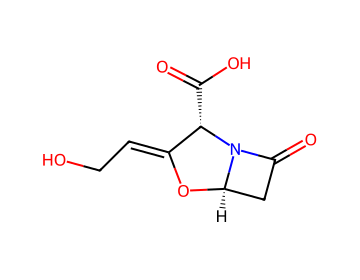
IDENTITY
COMPUTED
PROPERTIES
-2.3
-1.5
0.23
3.37e+02 g/L
545.8
117.5-118
117.5 - 118 °C
Solid
2.7
HAZARDS
Clavulanic acid: Does not have an individual approval but may be used as a component in a product covered by a group standard. It is not approved for use as a chemical in its own right.
TOXICITY
Clavulanic acid, when administered with amoxicillin, can cause some mild gastrointestinal adverse effects. These include vomiting, nausea, loose stools, and discomfort. Antibiotic-associated diarrhea due to amoxicillin-clavulanic acid treatment is the most common adverse effect. There is a higher incidence of diarrhea when clavulanic acid is added to amoxicillin compared to amoxicillin alone. Diarrhea is more common in those taking a high dose of the extended-release form of clavulanic acid and amoxicillin. Drug-induced pancreatitis from clavulanic acid and amoxicillin has occurred in a few cases.;When used for the treatment of urinary tract infections, this drug combination can cause candida vaginitis. Amoxicillin, in conjunction with clavulanic acid, is the most common cause of idiosyncratic drug-induced injury, specifically cholestatic liver injury, and this can lead to an increase in alkaline phosphatase and bilirubin levels. Since clavulanic acid administration is always in conjunction with amoxicillin, it is important to consider the adverse effects of amoxicillin alone as well. Hypersensitivity reactions to this drug combination, usually due to amoxicillin, can occur and result in dermatological reactions. Still, none of these allergic reactions are known to be due to clavulanic acid alone.
The toxicity of clavulanic acid alone is unknown. However, the toxic effects of amoxicillin/clavulanate have been reported. The most common toxic effect is an idiosyncratic drug-induced hepatic injury which leads to a mixed hepatocellular-cholestatic injury, and it is more common in older men. Amoxicillin-clavulanic acid is the most common cause of idiosyncratic drug-induced hepatic injury. Risk factors for hepatic injury include sex, cytochrome P450, and genetic polymorphisms. These risk factors should be examined before administering amoxicillin/clavulanate to reduce the risk of toxic and adverse effects. In addition to early diagnosis and discontinuation of the drug, N-acetylcysteine can be administered to minimize damage. Additionally, steroids can be given to decrease the time it takes to return hepatic enzymes and bilirubin levels to normal. Liver failure is also a rare but possible toxic effect of amoxicillin-clavulanic acid.
REGULATORY
Clavulanic acid: Does not have an individual approval but may be used as a component in a product covered by a group standard. It is not approved for use as a chemical in its own right.
PHARMACOLOGY
The plasma protein binding of amoxicillin is about 25%.
Clavulanic acid inactivates some beta-lactamase enzymes that are produced by bacteria, therefore preventing enzymatic destruction of amoxicillin. This helps to treat a variety of bacterial infections which would otherwise be resistant to antibiotics without the addition of clavulanic acid.
Clavulanic acid contains a beta-lactam ring in its structure that binds in an irreversible fashion to beta-lactamases, preventing them from inactivating certain beta-lactam antibiotics, with efficacy in treating susceptible gram-positive and gram-negative infections.
The half-life of clavulanic acid is reported to be similar to amoxicillin, and last 45-90 minutes. A study of radiolabeled clavulanic acid administered to 4 healthy volunteers determined a half-life of 0.8 h.
Clavulanic acid is heavily metabolized to form the metabolites 2,5-dihydro-4-(2- hydroxyethyl)-5-oxo-1H-pyrrole-3-carboxylic acid and 1-amino-4-hydroxy-butan-2-one. The first metabolite was found to account for 15.6% of the dose while the second metabolite was reported to account for 8.8% of the dose in one pharmacokinetic study.
23521W1S24
CLAVULANIC ACID
Established Pharmacologic Class [EPC] - beta Lactamase Inhibitor
Mechanisms of Action [MoA] - beta Lactamase Inhibitors
Clavulanic acid is a beta Lactamase Inhibitor. The mechanism of action of clavulanic acid is as a beta Lactamase Inhibitor.
Endogenous substances and drugs that inhibit or block the activity of BETA-LACTAMASES.
Clavulanic acid, when taken orally, is well absorbed in the gastrointestinal tract. After administration of radiolabeled clavulanic acid to four human subjects, a minimum of 73% absorption and the average absolute bioavailability was calculated at 64%. The mean Cmax in a group of 8 healthy research volunteers was 2.098 ± 0.441 micrograms/ml in a pharmacokinetic study. The same study reported a mean Tmax of 1.042 ± 0.80 hours. Tmax is reported to be 40-120 minutes according to another pharmacokinetic study.
About 40 to 65% of the clavulanic acid is excreted as unchanged drug in urine during the first 6 hours following ingestion. The metabolites of clavulanic acid are found to be excreted in the urine and feces and as carbon dioxide in expired air. Clavulanate is cleared by both renal and non-renal processes. About 17% of radiolabeled dose of clavulanic acid was found to be exhaled in expired air and 8% of a dose was found to be excreted in the feces.
A study in 4 healthy volunteers administered a radiolabeled dose of clavulanic acid determined a volume of distribution of 12L.Clavulanic acid is distributed to various tissues and interstitial fluid. Clinically significant concentrations have been measured in the gallbladder, abdomen, skin, fat, and muscle tissues. Bile, pus, synovial and peritoneal fluids are also found to have therapeutic concentrations of clavulanic acid. Studies of animals have demonstrated that clavulanic crosses the placenta.
The clearance of clavulanic acid in a pharmacokinetic study of 4 healthy volunteers administered a radiolabeled dose of clavulanic acid was 0.21 l/min. Another resource indicates the average clearance of clavulanic acid is 12.20 liters/h/70 kg. Dose adjustments may be required in patients with renal failure.
USES
Use (kg) in Switzerland (2009): >2500;Use (kg; approx.) in Germany (2009): >2500;Use (kg) in USA (2002): 102000;Use (kg) in France (2004): 22699;Consumption (g per capita) in Switzerland (2009): 0.32;Consumption (g per capita; approx.) in Germany (2009): 0.031;Consumption (g per capita) in the USA (2002): 0.36;Consumption (g per capita) in France (2004): 0.38;Excretion rate: 0.525;Calculated removal (%): 92.1
Pharmaceuticals
ALIASES
REACTIONS
uspto-grants-1998_03 · 10.6084/m9.figshare.5104873.v1 · US05734048
查看
uspto-grants-1981_03 · 10.6084/m9.figshare.5104873.v1 · US04255332
查看
uspto-grants-2001_04 · 10.6084/m9.figshare.5104873.v1 · US06218380B1
查看
uspto-grants-2001_04 · 10.6084/m9.figshare.5104873.v1 · US06218380B1
查看
uspto-grants-2001_04 · 10.6084/m9.figshare.5104873.v1 · US06218380B1
查看
uspto-grants-1999_01 · 10.6084/m9.figshare.5104873.v1 · US05859238
查看
uspto-grants-2000_10 · 10.6084/m9.figshare.5104873.v1 · US06133441
查看
uspto-grants-1985_07 · 10.6084/m9.figshare.5104873.v1 · US04526783
查看