
uspto-grants-2006_08 · 10.6084/m9.figshare.5104873.v1 · US07091378B2
查看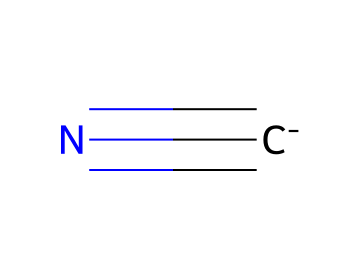
IDENTITY
COMPUTED
PROPERTIES
Aqueous solutions with a faint odor of bitter almonds. Toxic by skin absorption, by ingestion, and inhalation of the hydrogen cyanide from the decomposition of the material. Toxic oxides of nitrogen are produced in fires involving this material. Obtain the technical name of the material from the shipping papers and contact CHEMTREC, 800-424-9300 for specific response information.
Generally white crystals or powders but possibly colored Toxic by skin absorption through open wounds, by ingestion, and inhalation of the hydrogen cyanide from the decomposition of the material. Toxic oxides of nitrogen are produced in fires. Obtain the technical name of the material form the shipping papers and contact CHEMTREC, 800-424-9300 for specific response information.
Varies; See specific cyanide salt;
HAZARDS
Regulation (EC) No 178/2002 (amended)
Cyanide: Does not have an individual approval but may be used as a component in a product covered by a group standard. It is not approved for use as a chemical in its own right.
The New Jersey Worker and Community Right to Know Act requires public and private employers to provide information about hazardous substances at their workplaces. (N.J.S.A. 34:5A-1 et. seq.)
Poison
Poison
Excerpt from ERG Guide 157 [Substances - Toxic and/or Corrosive (Non-Combustible / Water-Sensitive)]:;Non-combustible, substance itself does not burn but may decompose upon heating to produce corrosive and/or toxic fumes. UN1802, UN2032, UN3084, UN3093, UN1796 (above 50%), UN1826 (above 50%), and UN2031 (above 65%) may act as oxidizers. Also consult ERG Guide 140. Vapors may accumulate in confined areas (basement, tanks, hopper/tank cars, etc.). Substance may react with water (some violently), releasing corrosive and/or toxic gases and runoff. Corrosives in contact with metals may evolve flammable hydrogen gas. Containers may explode when heated or if contaminated with water. (ERG, 2024)
Excerpt from ERG Guide 157 [Substances - Toxic and/or Corrosive (Non-Combustible / Water-Sensitive)]:;Non-combustible, substance itself does not burn but may decompose upon heating to produce corrosive and/or toxic fumes. UN1802, UN2032, UN3084, UN3093, UN1796 (above 50%), UN1826 (above 50%), and UN2031 (above 65%) may act as oxidizers. Also consult ERG Guide 140. Vapors may accumulate in confined areas (basement, tanks, hopper/tank cars, etc.). Substance may react with water (some violently), releasing corrosive and/or toxic gases and runoff. Corrosives in contact with metals may evolve flammable hydrogen gas. Containers may explode when heated or if contaminated with water. (ERG, 2024)
Excerpt from ERG Guide 157 [Substances - Toxic and/or Corrosive (Non-Combustible / Water-Sensitive)]:;TOXIC and/or CORROSIVE; inhalation, ingestion or contact (skin, eyes) with vapors, dusts or substance may cause severe injury, burns or death. Reaction with water or moist air may release toxic, corrosive or flammable gases. Reaction with water may generate much heat that will increase the concentration of fumes in the air. Fire will produce irritating, corrosive and/or toxic gases. Runoff from fire control or dilution water may be corrosive and/or toxic and cause environmental contamination. (ERG, 2024)
Excerpt from ERG Guide 157 [Substances - Toxic and/or Corrosive (Non-Combustible / Water-Sensitive)]:;TOXIC and/or CORROSIVE; inhalation, ingestion or contact (skin, eyes) with vapors, dusts or substance may cause severe injury, burns or death. Reaction with water or moist air may release toxic, corrosive or flammable gases. Reaction with water may generate much heat that will increase the concentration of fumes in the air. Fire will produce irritating, corrosive and/or toxic gases. Runoff from fire control or dilution water may be corrosive and/or toxic and cause environmental contamination. (ERG, 2024)
Cyanide is used in a number of industries and is found at low levels in air from car exhaust. Cyanide is extremely toxic to humans. Chronic (long-term) inhalation exposure of humans to cyanide results primarily in effects on the central nervous system (CNS). Other effects in humans include cardiovascular and respiratory effects, an enlarged thyroid gland, and irritation to the eyes and skin. No data are available on the carcinogenic effects of cyanide in humans via inhalation. Animal studies have suggested that oral exposure to cassava (a cyanide-containing vegetable) may be associated with malformations in the fetus and low fetal body weights. EPA has classified cyanide as a Group D, not classifiable as to human carcinogenicity.
A fatal inhalation dose of hydrogen cyanide is 600 to 700 ppm for 5 minutes or 200 ppm for 30 minutes. In victims overcome by smoke inhalation, hypoxia from carbon monoxide is initially indistinguishable from that caused by cyanide. Smokers have elevated whole blood cyanide levels up to 0.4 ug/ml. In poisoning cases, victims are agitated at levels above 1.0 ug/ml and comatose at levels above 2.5 ug/ml. Acrylonitrile, acetonitrile, and other aliphatic nitriles can cause cyanide poisoning after absorption and hepatic transformation. [ATSDR Case Studies # 15] Symptoms of cyanide toxicity can occur within seconds of inhalation of hydrogen cyanide or within minutes of ingestion of cyanide salts. Onset may be delayed up to 12 h after ingestion of cyanogenic glycosides, nitriles, or thiocyanates. [INCHEM: CICAD 61] Cyanide is detoxified in the body when it is combined with sulfur to form thiocyanate. [Ford, p. 705] Urine thiocyanate levels are <0.11 mg/24h without occupational exposure. The no-adverse-effect-level is 6.5 mg/24h. Smokers have higher levels. [LaDou, 4th edition, p. 633] In nitroprusside poisoning cases, the half-life of thiocyanate is 2.7 days (normal renal function). [Ford, p. 410] Thiocyanate levels correlate with thiocyanate toxicity, not with degree of cyanide poisoning. Thiocyanate toxicity occurs when thiocyanate levels exceed 100 mg/L. [Haddad, p. 985] Chronic exposure to cyanide causes tobacco amblyopia (from cigarette smoking) and tropical ataxic neuropathy (from eating improperly processed cassava). Both conditions are associated with low B12 levels. Thiocyanate can competitively inhibit the entry of iodide into the thyroid gland and cause hypothyroidism and goiters. [Goldfrank, p. 1680] Handle all cyanide compounds with care. HCN may be released from relatively stable compounds like ferro- and ferricyanides in the presence of strong acids. Even weak acids can cause a slow release of cyanide. [Ullmann] Workers exposed to HCN for seven years at 4.
Causes tremor, convulsions, and dyspnea in intraperitoneal lethal-dose studies of mice (LD50 = 3 mg/kg); [RTECS] Aqueous solutions slowly evolve hydrogen cyanide; [CAMEO] Free cyanide (as HCN or CN-) is the most toxic form of cyanide; [EPA: Exposure Risk Assessment] See CYANIDES.
Cyanides, Inorganic;Water and Aqueous Solutions
Cyanides, Inorganic
CYANIDE SOLUTIONS slowly evolve hydrogen cyanide, a flammable and poisonous gas. Acids cause the rapid evolution of HCN. Carbon dioxide from the air is sufficiently acidic to liberate HCN from solutions of cyanides. Incompatible with isocyanates, nitrides, and peroxides. Mayinitiate polymerization reactions of epoxides. May react exothermically with metal salts to produce explosive products or evolve gaseous hydrogen.
CYANIDES, INORGANIC, SOLID, N.O.S. react slowly with water to evolve gaseous hydrogen cyanide (HCN). Acids cause the rapid evolution of HCN; carbon dioxide from the air is sufficiently acidic to liberate HCN from solutions of inorganic cyanides. Incompatible with isocyanates, nitrides, and peroxides. May initiate polymerization reactions of epoxides. Form compounds with metal salt in exothermic reactions that may produce flammable hydrogen. Some inorganic cyanides can detonate when shocked, heated or rubbed.
Water soluble. Inorganic cyanides react slowly with water to evolve gaseous hydrogen cyanide (HCN).
Water soluble. Slowly decomposed by water to give off hydrogen cyanide, a flammable poison gas.
SAFETY
Excerpt from ERG Guide 157 [Substances - Toxic and/or Corrosive (Non-Combustible / Water-Sensitive)]:;Note: Some foams will react with the material and release corrosive/toxic gases.;SMALL FIRE: CO2 (except for Cyanides), dry chemical, dry sand, alcohol-resistant foam.;LARGE FIRE: Water spray, fog or alcohol-resistant foam. If it can be done safely, move undamaged containers away from the area around the fire. Avoid aiming straight or solid streams directly onto the product. Dike runoff from fire control for later disposal.;FIRE INVOLVING TANKS, RAIL TANK CARS OR HIGHWAY TANKS: Fight fire from maximum distance or use unmanned master stream devices or monitor nozzles. Do not get water inside containers. Cool containers with flooding quantities of water until well after fire is out. Withdraw immediately in case of rising sound from venting safety devices or discoloration of tank. ALWAYS stay away from tanks in direct contact with flames. (ERG, 2024)
Excerpt from ERG Guide 157 [Substances - Toxic and/or Corrosive (Non-Combustible / Water-Sensitive)]:;Note: Some foams will react with the material and release corrosive/toxic gases.;SMALL FIRE: CO2 (except for Cyanides), dry chemical, dry sand, alcohol-resistant foam.;LARGE FIRE: Water spray, fog or alcohol-resistant foam. If it can be done safely, move undamaged containers away from the area around the fire. Avoid aiming straight or solid streams directly onto the product. Dike runoff from fire control for later disposal.;FIRE INVOLVING TANKS, RAIL TANK CARS OR HIGHWAY TANKS: Fight fire from maximum distance or use unmanned master stream devices or monitor nozzles. Do not get water inside containers. Cool containers with flooding quantities of water until well after fire is out. Withdraw immediately in case of rising sound from venting safety devices or discoloration of tank. ALWAYS stay away from tanks in direct contact with flames. (ERG, 2024)
Excerpt from ERG Guide 157 [Substances - Toxic and/or Corrosive (Non-Combustible / Water-Sensitive)]:;Refer to the "General First Aid" section. Specific First Aid: For corrosives, in case of contact, immediately flush skin or eyes with running water for at least 30 minutes. Additional flushing may be required. In case of skin contact with Hydrofluoric acid (UN1790), if calcium gluconate gel is available, rinse 5 minutes, then apply gel. Otherwise, continue rinsing until medical treatment is available. (ERG, 2024)
Excerpt from ERG Guide 157 [Substances - Toxic and/or Corrosive (Non-Combustible / Water-Sensitive)]:;Refer to the "General First Aid" section. Specific First Aid: For corrosives, in case of contact, immediately flush skin or eyes with running water for at least 30 minutes. Additional flushing may be required. In case of skin contact with Hydrofluoric acid (UN1790), if calcium gluconate gel is available, rinse 5 minutes, then apply gel. Otherwise, continue rinsing until medical treatment is available. (ERG, 2024)
2.0 [mg/m3], as CN, inhalable fraction[German Research Foundation (DFG)]
Excerpt from ERG Guide 157 [Substances - Toxic and/or Corrosive (Non-Combustible / Water-Sensitive)]:;ELIMINATE all ignition sources (no smoking, flares, sparks or flames) from immediate area. All equipment used when handling the product must be grounded. Do not touch damaged containers or spilled material unless wearing appropriate protective clothing. Stop leak if you can do it without risk. A vapor-suppressing foam may be used to reduce vapors. DO NOT GET WATER INSIDE CONTAINERS. Use water spray to reduce vapors or divert vapor cloud drift. Avoid allowing water runoff to contact spilled material. Prevent entry into waterways, sewers, basements or confined areas.;SMALL SPILL: Cover with DRY earth, DRY sand or other non-combustible material followed with plastic sheet to minimize spreading or contact with rain. Use clean, non-sparking tools to collect material and place it into loosely covered plastic containers for later disposal. (ERG, 2024)
Excerpt from ERG Guide 157 [Substances - Toxic and/or Corrosive (Non-Combustible / Water-Sensitive)]:;ELIMINATE all ignition sources (no smoking, flares, sparks or flames) from immediate area. All equipment used when handling the product must be grounded. Do not touch damaged containers or spilled material unless wearing appropriate protective clothing. Stop leak if you can do it without risk. A vapor-suppressing foam may be used to reduce vapors. DO NOT GET WATER INSIDE CONTAINERS. Use water spray to reduce vapors or divert vapor cloud drift. Avoid allowing water runoff to contact spilled material. Prevent entry into waterways, sewers, basements or confined areas.;SMALL SPILL: Cover with DRY earth, DRY sand or other non-combustible material followed with plastic sheet to minimize spreading or contact with rain. Use clean, non-sparking tools to collect material and place it into loosely covered plastic containers for later disposal. (ERG, 2024)
Excerpt from ERG Guide 157 [Substances - Toxic and/or Corrosive (Non-Combustible / Water-Sensitive)]:;IMMEDIATE PRECAUTIONARY MEASURE: Isolate spill or leak area in all directions for at least 50 meters (150 feet) for liquids and at least 25 meters (75 feet) for solids.;SPILL: Increase the immediate precautionary measure distance, in the downwind direction, as necessary.;FIRE: If tank, rail tank car or highway tank is involved in a fire, ISOLATE for 800 meters (1/2 mile) in all directions; also, consider initial evacuation for 800 meters (1/2 mile) in all directions. (ERG, 2024)
Excerpt from ERG Guide 157 [Substances - Toxic and/or Corrosive (Non-Combustible / Water-Sensitive)]:;IMMEDIATE PRECAUTIONARY MEASURE: Isolate spill or leak area in all directions for at least 50 meters (150 feet) for liquids and at least 25 meters (75 feet) for solids.;SPILL: Increase the immediate precautionary measure distance, in the downwind direction, as necessary.;FIRE: If tank, rail tank car or highway tank is involved in a fire, ISOLATE for 800 meters (1/2 mile) in all directions; also, consider initial evacuation for 800 meters (1/2 mile) in all directions. (ERG, 2024)
5.0 [mg/m3], as CN(calcium,hydrogen,sodium,and potassium cyanide)
5.0 [mg/m3],as CN(calcium,sodium,and potassium cyanide), 11 mg/m3(hydrogen cyanide)
0.45 [mg/m3]
5.0 [mg/m3]
25 [mg/m3]
Excerpt from ERG Guide 157 [Substances - Toxic and/or Corrosive (Non-Combustible / Water-Sensitive)]:;Wear positive pressure self-contained breathing apparatus (SCBA). Wear chemical protective clothing that is specifically recommended by the manufacturer when there is NO RISK OF FIRE. Structural firefighters' protective clothing provides thermal protection but only limited chemical protection. (ERG, 2024)
Excerpt from ERG Guide 157 [Substances - Toxic and/or Corrosive (Non-Combustible / Water-Sensitive)]:;Wear positive pressure self-contained breathing apparatus (SCBA). Wear chemical protective clothing that is specifically recommended by the manufacturer when there is NO RISK OF FIRE. Structural firefighters' protective clothing provides thermal protection but only limited chemical protection. (ERG, 2024)
25.0 [mg/m3], as CN(sodium and potassium cyanide), 50 ppm(hydrogen cyanide);Excerpts from Documentation for IDLHs: Basis for original (SCP) IDLH: No useful acute inhalation toxicity data are available on which to base the IDLH for cyanides. For this draft technical standard, therefore, the chosen IDLH is based on an analogy with hydrogen cyanide. According to ACGIH [1971], Patty [1963] reported that hydrogen cyanide at 110 to 135 ppm (120 to 150 mg/m3) might be fatal to man after 0.5 to 1 hour or later, or dangerous to life; 45 to 54 ppm (50 to 60 mg/m3) could be tolerated for 0.5 to 1 hour without immediate or late effects [Flury and Zernik 1931; Dudley et al. 1942]. . . . \\ Human data: Absorption of the alkali cyanides in amounts as low as 50 to 100 mg from a single, instantaneous dose may be followed by immediate collapse and cessation of respiration [Clayton and Clayton 1982]. It has been stated that although the fatal oral dose will vary considerably, depending on whether or not food is present in the stomach, it is probably in the order of 1 to 2 mg/kg [Clayton and Clayton]. [Note: An oral dose of 50 to 100 mg or 1 to 2 mg/kg is equivalent to a 70-kg worker being exposed to about 50 mg/m3 (as CN) for 30 minutes, assuming a breathing rate of 50 liters per minute and 100% absorption.]
TOXICITY
Antidotes to cyanide poisoning include hydroxocobalamin and sodium nitrite, which release the cyanide from the cytochrome system, and rhodanase, which is an enzyme occurring naturally in mammals that combines serum cyanide with thiosulfate, producing comparatively harmless thiocyanate. Oxygen therapy can also be administered. (L97)
Antidotes to cyanide poisoning include hydroxocobalamin and sodium nitrite, which release the cyanide from the cytochrome system, and rhodanase, which is an enzyme occurring naturally in mammals that combines serum cyanide with thiosulfate, producing comparatively harmless thiocyanate. Oxygen therapy can also be administered. (L97)
Reproductive
Exposure to high levels of cyanide for a short time harms the brain and heart and can even cause coma, seizures, apnea, cardiac arrest and death. Chronic inhalation of cyanide causes breathing difficulties, chest pain, vomiting, blood changes, headaches, and enlargement of the thyroid gland. Skin contact with cyanide salts can irritate and produce sores. (L96, L97)
Exposure to high levels of cyanide for a short time harms the brain and heart and can even cause coma, seizures, apnea, cardiac arrest and death. Chronic inhalation of cyanide causes breathing difficulties, chest pain, vomiting, blood changes, headaches, and enlargement of the thyroid gland. Skin contact with cyanide salts can irritate and produce sores. (L96, L97)
Other Poison - Chemical Asphyxiant
Other Poison - Chemical Asphyxiant
Oral (L96) ; inhalation (L96) ; dermal (L96)
Oral (L96) ; inhalation (L96) ; dermal (L96)
Organic nitriles decompose into cyanide ions both in vivo and in vitro. Consequently the primary mechanism of toxicity for organic nitriles is their production of toxic cyanide ions or hydrogen cyanide. Cyanide is an inhibitor of cytochrome c oxidase in the fourth complex of the electron transport chain (found in the membrane of the mitochondria of eukaryotic cells). It complexes with the ferric iron atom in this enzyme. The binding of cyanide to this cytochrome prevents transport of electrons from cytochrome c oxidase to oxygen. As a result, the electron transport chain is disrupted and the cell can no longer aerobically produce ATP for energy. Tissues that mainly depend on aerobic respiration, such as the central nervous system and the heart, are particularly affected. Cyanide is also known produce some of its toxic effects by binding to catalase, glutathione peroxidase, methemoglobin, hydroxocobalamin, phosphatase, tyrosinase, ascorbic acid oxidase, xanthine oxidase, succinic dehydrogenase, and Cu/Zn superoxide dismutase. Cyanide binds to the ferric ion of methemoglobin to form inactive cyanmethemoglobin. (L97)
Organic nitriles decompose into cyanide ions both in vivo and in vitro. Consequently the primary mechanism of toxicity for organic nitriles is their production of toxic cyanide ions or hydrogen cyanide. Cyanide is an inhibitor of cytochrome c oxidase in the fourth complex of the electron transport chain (found in the membrane of the mitochondria of eukaryotic cells). It complexes with the ferric iron atom in this enzyme. The binding of cyanide to this cytochrome prevents transport of electrons from cytochrome c oxidase to oxygen. As a result, the electron transport chain is disrupted and the cell can no longer aerobically produce ATP for energy. Tissues that mainly depend on aerobic respiration, such as the central nervous system and the heart, are particularly affected. Cyanide is also known produce some of its toxic effects by binding to catalase, glutathione peroxidase, methemoglobin, hydroxocobalamin, phosphatase, tyrosinase, ascorbic acid oxidase, xanthine oxidase, succinic dehydrogenase, and Cu/Zn superoxide dismutase. Cyanide binds to the ferric ion of methemoglobin to form inactive cyanmethemoglobin. (L97)
Cyanide poisoning is identified by rapid, deep breathing and shortness of breath, general weakness, giddiness, headaches, vertigo, confusion, convulsions/seizures and eventually loss of consciousness. (L96, L97)
Cyanide poisoning is identified by rapid, deep breathing and shortness of breath, general weakness, giddiness, headaches, vertigo, confusion, convulsions/seizures and eventually loss of consciousness. (L96, L97)
Cyanide, free
Reproductive
6.3 x 10 ^-4 mg/kg-day
No indication of carcinogenicity to humans (not listed by IARC).
No indication of carcinogenicity to humans (not listed by IARC).
LD50: 3700 ug/kg (Subcutaneous, Rat) (N010) LD50: 810 ug/kg (Intravenous, Rat) LD50: 3700 ug/kg (Oral, Mouse) LD50: 2990 ug/kg (Intraperitoneal, Mouse) LC50: 142 ppm over 30 minutes (Inhalation, Rat) (T32)
0.0008
SURROGATE. See Hydrogen Cyanide
0.0006
IRIS Current
0.02
HEAST Current
Cyanide
Major ion
200
Free cyanide
Smith, C.D. and Nowell, L.H., 2024. Health-Based Screening Levels for evaluating water-quality data (3rd ed.). DOI:10.5066/F71C1TWP
REGULATORY
Regulation (EC) No 178/2002 (amended)
Cyanide: Does not have an individual approval but may be used as a component in a product covered by a group standard. It is not approved for use as a chemical in its own right.
The New Jersey Worker and Community Right to Know Act requires public and private employers to provide information about hazardous substances at their workplaces. (N.J.S.A. 34:5A-1 et. seq.)
PHARMACOLOGY
Whole body: 19 hours; [TDR, p. 422]
Organic nitriles are converted into cyanide ions through the action of cytochrome P450 enzymes in the liver. Cyanide is rapidly absorbed and distributed throughout the body. Cyanide is mainly metabolized into thiocyanate by either rhodanese or 3-mercaptopyruvate sulfur transferase. Cyanide metabolites are excreted in the urine. (L96)
Organic nitriles are converted into cyanide ions through the action of cytochrome P450 enzymes in the liver. Cyanide is rapidly absorbed and distributed throughout the body. Cyanide is mainly metabolized into thiocyanate by either rhodanese or 3-mercaptopyruvate sulfur transferase. Cyanide metabolites are excreted in the urine. (L96)
USES
The major uses of hydrogen cyanide are as an intermediate in the production of a number of chemicals and as an insecticide for fumigating enclosed spaces. Hydrogen cyanide has also been used in gas chamber executions.
Used in electroplating, silver and gold extraction, metal cleaning, metal nitriding, ship fumigating, mining processes, cement stabilizing, photo developing, and organic synthesis; Used in the past to fumigate fruit trees, railroad cars, ships, warehouses, rabbit and rat burrows, and termite nests; In tropical countries where the potato-like tubers of the cassava plant are grown, cyanide poisonings due to ingestion of the cassava root have been reported. [ATSDR ToxProfiles] In the past, occupational cyanide poisoning was most common in metal extraction, electroplating, metal hardening, and fumigation; [Sullivan, p. 706] The cyanides of mercury, lead, cobalt, and nickel do not have any major industrial importance. [Ullmann]
Steel Producing [Category: Industry];Acid and Alkali Cleaning of Metals [Category: Clean];Heat Treating [Category: Heat or Machine];Electroplating [Category: Plate];Semiconductor Manufacturing [Category: Industry];Mining [Category: Industry];Firefighting [Category: Other];Photographic Processing [Category: Other];Cement Producing [Category: Industry];Burning Natural Polymers [Category: Burn];Burning Synthetic Polymers [Category: Burn];Toxic Gas from Spilling Chemical in Water [Category: Other];Metal Extraction and Refining [Category: Industry]
Sculpturing plastics [Category: Hobbies];Jewelry making [Category: Hobbies];Smoking cigarettes [Category: Food & Drugs]
Cyanide compounds are used in electroplating, metallurgy, organic chemicals production, photographic developing, manufacture of plastics, fumigation of ships, and some mining processes. (L96)
Hydrogen cyanide is a precursor to many chemical compounds, ranging from polymers to pharmaceuticals. (L101)
Cyanide: ACTIVE
ALIASES
REACTIONS
uspto-grants-2006_08 · 10.6084/m9.figshare.5104873.v1 · US07091378B2
查看
uspto-grants-2006_08 · 10.6084/m9.figshare.5104873.v1 · US07098213B2
查看
uspto-grants-1997_04 · 10.6084/m9.figshare.5104873.v1 · US05616575
查看
uspto-grants-2014_09 · 10.6084/m9.figshare.5104873.v1 · US08822702B2
查看
Training data from https://doi.org/10.1039/C8SC04228D (2/10) · 10.1039/C8SC04228D
查看
Training data from https://doi.org/10.1039/C8SC04228D (2/10) · 10.1039/C8SC04228D
查看
Training data from https://doi.org/10.1039/C8SC04228D (2/10) · 10.1039/C8SC04228D
查看
Training data from https://doi.org/10.1039/C8SC04228D (2/10) · 10.1039/C8SC04228D
查看