
uspto-grants-1988_11 · 10.6084/m9.figshare.5104873.v1 · US04782173
查看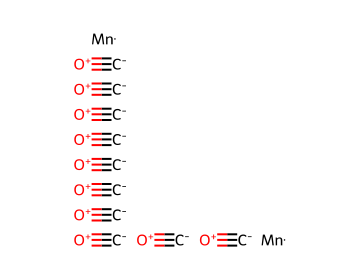
IDENTITY
COMPUTED
PROPERTIES
Golden-yellow crystals; [Merck Index] Insoluble in water; Flammable but not an explosive hazard; [MSDSonline]
GHS
Danger
H301 (97.8%): Toxic if swallowed [Danger Acute toxicity, oral];H311 (86.7%): Toxic in contact with skin [Danger Acute toxicity, dermal];H331 (100%): Toxic if inhaled [Danger Acute toxicity, inhalation]
P261, P262, P264, P270, P271, P280, P301+P316, P302+P352, P304+P340, P316, P321, P330, P361+P364, P403+P233, P405, and P501 (click each P-code to see the statement)
Aggregated GHS information provided per 45 reports by companies from 4 notifications to the ECHA C&L Inventory. Each notification may be associated with multiple companies.;Information may vary between notifications depending on impurities, additives, and other factors. The percentage value in parenthesis indicates the notified classification ratio from companies that provide hazard codes. Only hazard codes with percentage values above 10% are shown. For more detailed information, please visit ECHA C&L website.
HAZARDS
Manganese, decacarbonyldi-, (Mn-Mn): Does not have an individual approval but may be used under an appropriate group standard
Toxic by inhalation and ingestion; A skin, eye, and respiratory tract irritant; Decomposition of carbonyl compounds can yield carbon monoxide; [MSDSonline] See Manganese and linked occupational diseases.
Acute Tox. 3 (97.8%);Acute Tox. 3 (86.7%);Acute Tox. 3 (100%)
SAFETY
Chronic Inhalation: 0.0003 mg/m3 (L134)
TOXICITY
Manganese mainly affects the nervous system and may cause behavioral changes and other nervous system effects, which include movements that may become slow and clumsy. This combination of symptoms when sufficiently severe is referred to as “manganism”. (L228)
Neurotoxin - Parkinsonism
Oral (L228) ; inhalation (L228)
Manganese is a cellular toxicant that can impair transport systems, enzyme activities, and receptor functions. It primarily targets the central nervous system, particularily the globus pallidus of the basal ganglia. It is believed that the manganese ion, Mn(II), enhances the autoxidation or turnover of various intracellular catecholamines, leading to increased production of free radicals, reactive oxygen species, and other cytotoxic metabolites, along with a depletion of cellular antioxidant defense mechanisms, leading to oxidative damage and selective destruction of dopaminergic neurons. In addition to dopamine, manganese is thought to perturbations other neurotransmitters, such as GABA and glutamate. In order to produce oxidative damage, manganese must first overwhelm the antioxidant enzyme manganese superoxide dismutase. The neurotoxicity of Mn(II) has also been linked to its ability to substitute for Ca(II) under physiological conditions. It can enter mitochondria via the calcium uniporter and inhibit mitochondrial oxidative phosphorylation. It may also inhibit the efflux of Ca(II), which can result in a loss of mitochondrial membrane integrity. Mn(II) has been shown to inhibit mitochondrial aconitase activity to a significant level, altering amino acid metabolism and cellular iron homeostasis. (L228)
Manganese mainly affects the nervous system and may cause behavioral changes and other nervous system effects, which include movements that may become slow and clumsy. This combination of symptoms when sufficiently severe is referred to as “manganism”. (L228)
No indication of carcinogenicity to humans (not listed by IARC).
REGULATORY
Manganese, decacarbonyldi-, (Mn-Mn): Does not have an individual approval but may be used under an appropriate group standard
PHARMACOLOGY
Manganese is absorbed mainly via ingestion, but can also be inhaled. It binds to alpha-2-macroglobulin, albumin, or transferrin in the plasma and is distributed to the brain and all other mammalian tissues, though it tends to accumulate more in the liver, pancreas, and kidney. Manganese is capable of existing in a number of oxidation states and is believed to undergo changes in oxidation state within the body. Manganese oxidation state can influence tissue toxicokinetic behavior, and possibly toxicity. Manganese is excreted primarily in the faeces. (L228)
USES
Catalyst; antiknock additive; [Merck Index]
Dimanganese decacarbonyl is used as a reagent in organic synthesis. (L230)
Manganese, decacarbonyldi-, (Mn-Mn): ACTIVE
ALIASES
REACTIONS
uspto-grants-1988_11 · 10.6084/m9.figshare.5104873.v1 · US04782173
查看