
uspto-grants-1998_03 · 10.6084/m9.figshare.5104873.v1 · US05728835
查看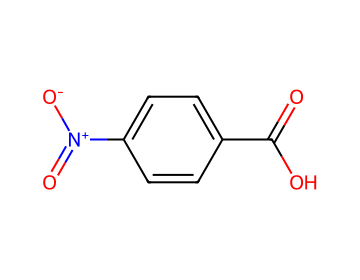
IDENTITY
COMPUTED
PROPERTIES
pH = 2.80
log Kow = 1.89
1.89
1.55 at 90 °F (NTP, 1992) - Denser than water; will sink
1.5997
1.61 g/cm³
Monoclinic leaf from water crystallization
Monoclinic leaflets, plates from benzene crystallization
Colorless crystals
Yellow-white crystals
less than 1 mg/mL at 79 °F (NTP, 1992)
SOL IN ALCOHOL, HOT WATER
Insoluble in cold water
One gram dissolves in 2380 mL water, 110 mL alcohol, 12 mL methanol, 150 mL chloroform, 45 mL ether, 20 mL acetone; slightly soluble in benzene, carbon disulfide; insol in petroleum ether.
In water, 200 mg/L at 25 °C
Solubility in water, g/100ml at 25 °C: 0.03 (poor)
396 °F (NTP, 1992)
202 °C
201 °C c.c.
Sublimes (NTP, 1992)
When heat to decomposition it emits toxic fumes of /nitrogen oxides/.
350 °C
468 °F (NTP, 1992)
Sublimes
242 °C
0.00000253 [mmHg]
Vapor pressure, Pa at 50 °C: 1
3881 kJ/mol
P-nitrobenzoic acid appears as odorless pale yellow crystals. (NTP, 1992)
Large Crystals
Yellowish-white solid; [Hawley] Yellow crystalline powder; [MSDSonline]
WHITE-TO-YELLOW CRYSTALS.
GHS
This chemical does not meet GHS hazard criteria for 0.3% (1 of 386) of reports.
Warning
H302 (99.7%): Harmful if swallowed [Warning Acute toxicity, oral];H319 (81.1%): Causes serious eye irritation [Warning Serious eye damage/eye irritation];H332 (18.1%): Harmful if inhaled [Warning Acute toxicity, inhalation];H335 (16.3%): May cause respiratory irritation [Warning Specific target organ toxicity, single exposure; Respiratory tract irritation]
P261, P264, P264+P265, P270, P271, P280, P301+P317, P304+P340, P305+P351+P338, P317, P319, P330, P337+P317, P403+P233, P405, and P501 (click each P-code to see the statement)
Aggregated GHS information provided per 386 reports by companies from 15 notifications to the ECHA C&L Inventory. Each notification may be associated with multiple companies.;Reported as not meeting GHS hazard criteria per 1 of 386 reports by companies.;There are 14 notifications provided by 385 of 386 reports by companies with hazard statement code(s).;Information may vary between notifications depending on impurities, additives, and other factors. The percentage value in parenthesis indicates the notified classification ratio from companies that provide hazard codes. Only hazard codes with percentage values above 10% are shown. For more detailed information, please visit ECHA C&L website.
HAZARDS
Chemical: Benzoic acid, 4-nitro-
Benzoic acid, 4-nitro- is listed on the EPA's Chemical Data Reporting (CDR) system. Manufacturers and importers of Benzoic acid, 4-nitro- are required to report information about their production and use of this chemical to the EPA under the Toxic Substances Control Act (TSCA). (40 eCFR Part 711)
Status: Active Update: 17-06-2019 https://echa.europa.eu/registration-dossier/-/registered-dossier/29494;Status: Active Update: 24-01-2023 https://echa.europa.eu/registration-dossier/-/registered-dossier/13844;Status: Active Update: 21-12-2012 https://echa.europa.eu/registration-dossier/-/registered-dossier/7213
4-Nitrobenzoic acid: Does not have an individual approval but may be used under an appropriate group standard
This chemical is combustible. (NTP, 1992)
Combustible. Gives off irritating or toxic fumes (or gases) in a fire. Risk of explosion on contact with potassium hydroxide.
Combustible
SYMPTOMS: Symptoms of exposure to this compound include irritation of the skin, eyes, mucous membranes and upper respiratory tract.;ACUTE/CHRONIC HAZARDS: This compound may be harmful by inhalation, ingestion or skin absorption. It is an irritant of the skin, eyes, mucous membranes and upper respiratory tract. When heated to decomposition it emits toxic fumes of carbon monoxide, carbon dioxide and nitrogen oxides. (NTP, 1992)
A skin, eye, mucous membrane, and upper respiratory tract irritant; [CAMEO] No significant increase in tumors in animal feeding studies; [NTP] An irritant; Effects in high-dose animal studies include convulsions, methemoglobinemia, and acute tubular necrosis; [MSDSonline]
Acids, Carboxylic;Nitro, Nitroso, Nitrate, and Nitrite Compounds, Organic
European Chemicals Bureau; IUCLID Dataset, 4-Nitrobenzoic Acid (CAS # 62-23-7) (2000 CD-ROM edition). Available from the Database Query page at: http://ecb.jrc.it/esis/esis.php as of December 27, 2007.
DHHS/NTP; Toxicology and Carcinogenesis Studies of p-Nitrobenzoic Acid in F344/N Rats and B6C3F1 Mice (Feed Studies) Technical Report Series # 442 (1994) NIH Pub #94-3358
P-NITROBENZOIC ACID is incompatible with strong oxidizers. It is also incompatible with strong bases (potassium hydroxide). It may react with cyanides. (NTP, 1992)
This action promulgates standards of performance for equipment leaks of Volatile Organic Compounds (VOC) in the Synthetic Organic Chemical Manufacturing Industry (SOCMI). The intended effect of these standards is to require all newly constructed, modified, and reconstructed SOCMI process units to use the best demonstrated system of continuous emission reduction for equipment leaks of VOC, considering costs, non air quality health and environmental impact and energy requirements. 4-Nitrobenzoic acid is produced, as an intermediate or a final product, by process units covered under this subpart.
Reacts with bases, reducing agents and strong oxidants. Decomposes on heating and on burning. This produces toxic fumes including nitrogen oxides.
Dust explosion possible if in powder or granular form, mixed with air. If dry, it can be charged electrostatically by swirling, pneumatic transport, pouring, etc.
Insoluble in water.
SAFETY
Fires involving this material can be controlled with a dry chemical, carbon dioxide or Halon extinguisher. A water spray may also be used. (NTP, 1992)
Use foam, dry powder, carbon dioxide.
Fresh air, rest.
Remove contaminated clothes. Rinse and then wash skin with water and soap.
Rinse with plenty of water (remove contact lenses if easily possible).
Rinse mouth. Refer for medical attention .
EYES: First check the victim for contact lenses and remove if present. Flush victim's eyes with water or normal saline solution for 20 to 30 minutes while simultaneously calling a hospital or poison control center. Do not put any ointments, oils, or medication in the victim's eyes without specific instructions from a physician. IMMEDIATELY transport the victim after flushing eyes to a hospital even if no symptoms (such as redness or irritation) develop.;SKIN: IMMEDIATELY flood affected skin with water while removing and isolating all contaminated clothing. Gently wash all affected skin areas thoroughly with soap and water. If symptoms such as redness or irritation develop, IMMEDIATELY call a physician and be prepared to transport the victim to a hospital for treatment.;INHALATION: IMMEDIATELY leave the contaminated area; take deep breaths of fresh air. If symptoms (such as wheezing, coughing, shortness of breath, or burning in the mouth, throat, or chest) develop, call a physician and be prepared to transport the victim to a hospital. Provide proper respiratory protection to rescuers entering an unknown atmosphere. Whenever possible, Self-Contained Breathing Apparatus (SCBA) should be used; if not available, use a level of protection greater than or equal to that advised under Protective Clothing.;INGESTION: DO NOT INDUCE VOMITING. If the victim is conscious and not convulsing, give 1 or 2 glasses of water to dilute the chemical and IMMEDIATELY call a hospital or poison control center. Be prepared to transport the victim to a hospital if advised by a physician. If the victim is convulsing or unconscious, do not give anything by mouth, ensure that the victim's airway is open and lay the victim on his/her side with the head lower than the body. DO NOT INDUCE VOMITING. IMMEDIATELY transport the victim to a hospital. (NTP, 1992)
Separated from strong oxidants, bases and strong reducing agents.
1.0 [mg/m3], inhalable fraction[German Research Foundation (DFG)]
SMALL SPILLS AND LEAKAGE: If a spill of this chemical occurs, FIRST REMOVE ALL SOURCES OF IGNITION, then you should dampen the solid spill material with acetone and transfer the dampened material to a suitable container. Use absorbent paper dampened with acetone to pick up any remaining material. Seal your contaminated clothing and the absorbent paper in a vapor-tight plastic bag for eventual disposal. Solvent wash all contaminated surfaces with acetone followed by washing with a soap and water solution. Do not reenter the contaminated area until the Safety Officer (or other responsible person) has verified that the area has been properly cleaned.;STORAGE PRECAUTIONS: You should store this chemical under ambient temperatures, and keep it away from oxidizing materials. (NTP, 1992)
SRP: The most favorable course of action is to use an alternative chemical product with less inherent propensity for occupational exposure or environmental contamination. Recycle any unused portion of the material for its approved use or return it to the manufacturer or supplier. Ultimate disposal of the chemical must consider: the material's impact on air quality; potential migration in soil or water; effects on animal, aquatic, and plant life; and conformance with environmental and public health regulations.
Personal protection: particulate filter respirator adapted to the airborne concentration of the substance. Sweep spilled substance into covered containers.
Wear safety spectacles.
NO open flames.
A nuisance-causing concentration of airborne particles can be reached quickly when dispersed, especially if powdered.
Protective gloves.
TOXICITY
LC50 Brachydanio rerio (Zebrafish) >500 mg/L/48-hr; static bioassay (OECD guideline 203)
LC50 Brachydanio rerio (Zebrafish) >500 mg/L/96 hr; static bioassay (OECD guideline 203)
TERRESTRIAL FATE: Based on a classification scheme(1), an estimated Koc value of 250(SRC), determined from a log Kow of 1.89(2) and a regression-derived equation(3), indicates that 4-nitrobenzoic acid is expected to have moderate mobility in soil(SRC). The pKa of 4-nitrobenzoic acid is 3.44(4), indicating that this compound will exist almost entirely in the anion form in the environment and anions generally do not adsorb more strongly to soils containing organic carbon and clay than their neutral counterparts(5). Volatilization of 4-nitrobenzoic acid from moist soil surfaces is not expected to be an important fate process(SRC) given an estimated Henry's Law constant of 3.8X10⁻¹⁰ atm-cu m/mole(SRC), using a fragment constant estimation method(6). 4-Nitrobenzoic acid is not expected to volatilize from dry soil surfaces(SRC) based upon an estimated vapor pressure of 2.5X10⁻⁶ mm Hg(SRC), determined from a fragment constant method(7). 4-Nitrobenzoic acid may biodegrade in soil(SRC) based on 62% degradation after 2 weeks in activated sludge inoculum during a Japanese MITI test(8), however, it took more than 64 days to decompose in a soil microflora inoculum with mineral salts medium(9).
AQUATIC FATE: Based on a classification scheme(1), an estimated Koc value of 250(SRC), determined from a log Kow of 1.89(2) and a regression-derived equation(3), indicates that 4-nitrobenzoic acid is not expected to adsorb to suspended solids and sediment(SRC). Volatilization from water surfaces is not expected(3) based upon an estimated Henry's Law constant of 3.8X10⁻¹⁰ atm-cu m/mole(SRC), developed using a fragment constant estimation method(4). A pKa of 3.44(5) indicates 4-nitrobenzoic acid will exist almost entirely in the anion form at pH values of 5 to 9 and therefore volatilization from water surfaces is not expected to be an important fate process(6). According to a classification scheme(7), an estimated BCF of 3.2(SRC), from its log Kow(2) and a regression-derived equation(8), suggests the potential for bioconcentration in aquatic organisms is low(SRC). 4-Nitrobenzoic acid is expected to biodegrade in water(SRC) based on 62% degradation after 2 weeks in activated sludge inoculum during a Japanese MITI test(9) and where it reached 52% of its BOD in river water collected from the Songhua River, China after 5 days(10).
ATMOSPHERIC FATE: According to a model of gas/particle partitioning of semivolatile organic compounds in the atmosphere(1), 4-nitrobenzoic acid, which has an estimated vapor pressure of 2.5X10⁻⁶ mm Hg at 25 °C (SRC), determined from a fragment constant method(2), will exist in both the vapor and particulate phases in the ambient atmosphere. Vapor-phase 4-nitrobenzoic acid is degraded in the atmosphere by reaction with photochemically-produced hydroxyl radicals(SRC); the half-life for this reaction in air is estimated to be 27 days(SRC), calculated from its rate constant of 5.9X10⁻¹³ cu cm/molecule-sec at 25 °C(SRC) that was derived using a structure estimation method(3). Particulate-phase 4-nitrobenzoic acid may be removed from the air by wet or dry deposition(SRC). 4-Nitrobenzoic acid, in isopropanol, was reduced at a wavelength of 316 nm to 4-aminobenzoic(4). Therefore, 4-nitrobenzoic is expected to undergo direct photolysis(SRC). The C6H4COOH radical was generated by photolysis of 4-nitrobenzoic acid using spin-trapping of photolysis products(5).
Methemoglobinemia - The presence of increased methemoglobin in the blood; the compound is classified as secondary toxic effect
The substance can be absorbed into the body by ingestion.
/AQUATIC SPECIES/ The importance of nitroaromatic compounds as aquatic contaminants and the association of superoxide (O2-) mediated toxicity with the mammalian metabolism of a number of these compounds has led our laboratory to conduct an in vitro investigation of nitroaromatic-stimulated O2- production by freshwater fish. Utilizing cytochrome c reduction and cyanide-insensitive oxygen consumption assays for O2-, channel catfish (Ictalurus punctatus), largemouth bass (Micropterus salmoides) and rainbow trout (Salmo gairdneri) hepatic microsomes were exposed to nitrofurantoin (NF), p-nitrobenzoic acid (PNBA) and m-dinitrobenzene (MDNB). NF and PNBA were chosen for study as model nitroaromatic compounds, known to stimulate microsomal O2- generation in mammals; MDNB was chosen because it frequently contaminates aquatic systems. The results demonstrated that each of the three nitroaromatics is capable of significantly enhancing superoxide dismutase (SOD) inhibitable cytochrome c reduction and oxygen consumption, providing specific evidence of stimulated microsomal production of O2- by the fish species examined. The results also indicated chemical- and species-specific differences in stimulated O2- production. In both assay systems, enhancement by NF exceeded that produced by MDNB and, more pronouncedly, PNBA. Furthermore, although similar responses to all nitroaromatics were observed in microsomes isolated from catfish and bass, the assays employing trout microsomes demonstrated the greatest enhancement in NF and MDNB exposures. These findings suggest that the stimulation of O2- production may be an important mode of action for these common aquatic pollutants that merits further ecotoxicological assessment.
Cough.
Redness.
Redness.
Nausea. Vomiting.
The following link will take the user to the National Toxicology Program (NTP) Test Agent Search Results page, which tabulates all of the "Standard Toxicology & Carcinogenesis Studies", "Developmental Studies", and "Genetic Toxicity Studies" performed with this chemical. Clicking on the "Testing Status" link will take the user to the status (i.e., in review, in progress, in preparation, on test, completed, etc.) and results of all the studies that the NTP has done on this chemical. [http://ntp-apps.niehs.nih.gov/ntp_tox/index.cfm?fuseaction=ntpsearch.searchresults&searchterm=62-23-7]
4-Nitrobenzoic acid was qualitatively found at an advance waste treatment facility in Seattle, Washington on November 5, 1976(1). 4-Nitrobenzoic acid was not detected in the wastewater of an ammunition plant in Stadtallendorf, Germany(2).
The Koc of 4-nitrobenzoic acid is estimated as 250(SRC), using a log Kow of 1.89(1) and a regression-derived equation(2). According to a classification scheme(3), this estimated Koc value suggests that 4-nitrobenzoic acid is expected to have moderate mobility in soil. The pKa of 4-nitrobenzoic acid is 3.44(4), indicating that this compound will exist almost entirely in the anion form in the environment and anions generally do not adsorb more strongly to soils containing organic carbon and clay than their neutral counterparts(5).
4-Nitrobenzoic acid's production and use in manufacturing intermediates and as a reagent for alkaloids and thorium(1) may result in its release to the environment through various waste streams(SRC).
AEROBIC: Decomposition of nitrobenzoic acid took greater than 64 days by a soil microflora innoculum in mineral salts medium(1). After 180 minutes, little oxygen consumption by phenol adapted biological cultures occurred with 4-nitrobenzoic acid(2). The amounts of oxygen consumed after the 180 minute test time are 55 uL (endogenous), 64 uL (cells plus 100 mg/L 3-nitrobenzoic acid), and 346 uL (cells plus phenol - after 90 minutes) which results in a ratio of only 1.2 endogenous to 4-nitrobenzoic acid oxygen consumption(2). In a 2 week Japanese MITI test using 100 mg/L 4-nitrobenzoic acid and 30 mg/L sludge, 4-nitrobenzoic had a theoretical BOD of 62%(3). 4-Nitrobenzene reached 50.2% of its BOD in river water collected from Songhua River, China after 5 days. The river water samples contained about 8.0 mg/L dissolved oxygen, 800-3000/mL bacteria counts, pH 6.8-7.0, and temperatures of 15-20 °C(4).
AEROBIC: 4-Nitrobenzoic acid was deemed well degraded in the following tests: coupled units test, Zahn-Wellens test, MITI test, Sturm test, OECD Screen test with DOC removal at least 77 % in 28 days or less; but not in a closed bottle test where a theoretical BOD of 48% was obtained(1). In the AFNOR test, 4-nitrobenzoic acid gave 96 and 97 percent removal of DOC in 28 and 42 days, respectively, with no inhibition(2). The UV absorbency of the mononitrobenzoic acid compounds disappeared in 7 days when incubated with sewage effluent in the presence of oxygen, suggesting ring cleavage and possible mineralization(3). The lag time for the degradation of 16 mg/L of 4-nitrobenzoic acid was 3-5 days by wastewater and soil(4). The degradation of 4-nitrobenzoate by domestic sewage was inhibited by benzoate(5). According to the Japanese MITI test, 4-nitrobenzoic acid is considered to be readily biodegradable(6). Three moles of hydrogen are required to reduce the nitro group to an amino group in microbial transformations with the para nitro group being more readily reduced than the ortho group for nitrobenzoic acids(7).
AEROBIC: Based upon COD, 92% 4-nitrobenzoic acid was removed at a rate of 19.7 mg COD/g hour in adapted activated sludge(1). 4-Nitrobenzoic acid, as the sole source of carbon and nitrogen, gave rise to full growth of Nocardia V. at a concentration of 0.05% (w/v) after a lag of 4 days(2). The probable metabolic pathway for the breakdown of 4-nitrobenzoate in activated sludge is 4-nitrobenzoic acid to p-aminobenzoic acid to p-hydroxybenzoic acid to protocatechuic acid to beta-ketoadipic acid to succinic acid(3). 4-Nitrobenzoic acid biodegraded after a lag of 60-65 hours at a rate of 0.042-0.060 per hour which corresponds to a half-life of 140-170 hours using an electrolytic respirometer(4).
ANAEROBIC: Nitroaromatics are readily degraded to aromatic amines under anaerobic conditions by different kinds of microorganisms including intestinal microflora of some mammals(1). 4-Nitrobenzoic acid was stoichiometrically transformed to 4-aminobenzoic acid and was completely mineralized after prolonged exposure in a laboratory-scale 160 mL anaerobic sludge bed reactor(2). 4-Nitrobenzoic acid was inhibitory to biodegradation in diluted anaerobic primary digesting sludge with a lag period greater than 80 days(3). Under anaerobiosis, nitrobenzoic acids were transformed to aromatic amines, such as 4-aminobenzoic acid(4).
PURE CULTURE: A strain of Pseudomonas fluorescens is capable of using 4-nitrobenzoic acid as a sole source of organic carbon and nitrogen for aerobic growth(1). 4-Nitrobenzoic acid was able to support the growth of Nocardia erythropolis but was inhibitory to growth of N. opaca(2). Nocardia erythropolis and N. opaca oxidize 4-nitrobenzoate to carbon dioxide and ammonia(3).
SEDIMENT: 4-Nitrobenzoic acid was detected at 2 of 27 surface sediment sampling sites in the Havel and Spree Rivers, Germany(1).
REGULATORY
Chemical: Benzoic acid, 4-nitro-
Benzoic acid, 4-nitro- is listed on the EPA's Chemical Data Reporting (CDR) system. Manufacturers and importers of Benzoic acid, 4-nitro- are required to report information about their production and use of this chemical to the EPA under the Toxic Substances Control Act (TSCA). (40 eCFR Part 711)
Status: Active Update: 17-06-2019 https://echa.europa.eu/registration-dossier/-/registered-dossier/29494;Status: Active Update: 24-01-2023 https://echa.europa.eu/registration-dossier/-/registered-dossier/13844;Status: Active Update: 21-12-2012 https://echa.europa.eu/registration-dossier/-/registered-dossier/7213
4-Nitrobenzoic acid: Does not have an individual approval but may be used under an appropriate group standard
This action promulgates standards of performance for equipment leaks of Volatile Organic Compounds (VOC) in the Synthetic Organic Chemical Manufacturing Industry (SOCMI). The intended effect of these standards is to require all newly constructed, modified, and reconstructed SOCMI process units to use the best demonstrated system of continuous emission reduction for equipment leaks of VOC, considering costs, non air quality health and environmental impact and energy requirements. 4-Nitrobenzoic acid is produced, as an intermediate or a final product, by process units covered under this subpart.
PHARMACOLOGY
THE NITRO GROUP OF P-NITROBENZOIC ACID IS REDUCED BY LIVER MICROSOMAL ENZYMES TO P-AMINOBENZOIC ACID. /FROM TABLE/
Eleven strains of Pseudomonas were isolated by selective enrichment on 4-nitrotoluene. They an utilized 4-nitrotoluene, 4-nitrobenzyl alcohol or 4-nitrobenzoate as sole sources of carbon and nitrogen. One strain, TW3, was used for more detailed studies. 4-Nitrotoluene-grown cells of TW3 take up O2 when incubated in the presence of 4-nitrobenzyl alcohol, 4-nitrobenzaldehyde and 4-nitrobenzoate. PHLC analysis of culture supernatants showed that 4-nitrobenzaldehyde and 4-nitrobenzoate were formed when 4-nitrotoluene-grown cells were incubated with 4-nitrobenzyl alcohol, whereas only 4-nitrobenzoate was found when they were incubated with 4-nitrobenzaldehyde. ... It is proposed that the pathway for 4-nitrotoluene catabolism proceeds via 4-nitrobenzyl alcohol, 4-nitrobenzaldehyde and 4-nitrobenzoate and ultimately to protocatechuate with release of the nitro group as ammonium.
The metabolism of the nitrotoluenes was compared in hepatocytes isolated from male Fischer 344 rats. ... Metabolites were separated by reverse phase HPLC and identified by coelution with standards on HPLC, specific enzyme hydrolysis and GC-MS analysis. 4-Nitrotoluene was metabolized to s-(4-nitrobenzyl) glutathione (68%), 4-nitrobenzyl alcohol (12%), sulfate and glucuronide conjugates of 4-nitrobenzyl alcohol (6%) and 4-nitrobenzoic acid (2%) (expressed as percentage of total metabolism).
POSSIBLE ABSORPTION FROM SKIN OF GUINEA PIG. /FROM TABLE/
EXCRETED PRINCIPALLY UNCHANGED, ABOUT 10-20% REDUCED TO P-AMINOBENZOIC ACID AND ACETYLATED. /FROM TABLE/
USES
Used as a reagent for alkaloids and thorium and in the production of pharmaceuticals and dyes; [HSDB] Used for organic synthesis; [Hawley]
Manufacturing intermediates. Also as a reagent for alkaloids and thorium.
Intermediate for 4-aminobenzoic acid.
Primarily in the manufacture of dyes.
Organic synthesis
2023: <75,000 lb;2022: <75,000 lb;2021: <75,000 lb;2020: 75,000 - <500,000 lb
Production volumes for non-confidential chemicals reported under the Inventory Update Rule. [Table#3874]
4-Nitrobenzoic acid is listed as a High Production Volume (HPV) chemical (65FR81686). Chemicals listed as HPV were produced in or imported into the U.S. in >1 million pounds in 1990 and/or 1994. The HPV list is based on the 1990 Inventory Update Rule. (IUR) (40 CFR part 710 subpart B; 51FR21438).
Intermediate
Intermediate;Lubricating agent
4-Nitrobenzoic acid is produced commercially by the oxidation of 4-nitrotoluene with molecular oxygen. Oxidation with 15% nitric acid at 175 °C produces the acid in 88.5% yield. ... /Another/ method involves the nitration and subsequent oxidation of polystyrene. This method uses the steric hindrance of the polymer chain to improve the para to ortho ratio of the product.
Oxidation of p-nitrotoluene with hot chromic acid mixture.
By oxidizing p-nitrotoluene by potassium hexacyanoferrate(III) in alkaline solution, potassium permanganate, or potassium dichromate.
Petroleum Lubricating Oil and Grease Manufacturing;Synthetic Dye and Pigment Manufacturing;All Other Basic Organic Chemical Manufacturing
Benzoic acid, 4-nitro-: ACTIVE
Has bactericidal action against Staphylococci and Streptococci.
ALIASES
REACTIONS
uspto-grants-1998_03 · 10.6084/m9.figshare.5104873.v1 · US05728835
查看
uspto-grants-1998_03 · 10.6084/m9.figshare.5104873.v1 · US05728835
查看
uspto-grants-1998_03 · 10.6084/m9.figshare.5104873.v1 · US05728835
查看
uspto-grants-1998_03 · 10.6084/m9.figshare.5104873.v1 · US05728835
查看
uspto-grants-1998_03 · 10.6084/m9.figshare.5104873.v1 · US05728835
查看
uspto-grants-1998_03 · 10.6084/m9.figshare.5104873.v1 · US05728835
查看
uspto-grants-1998_03 · 10.6084/m9.figshare.5104873.v1 · US05728835
查看
uspto-grants-1998_03 · 10.6084/m9.figshare.5104873.v1 · US05728835
查看