
uspto-grants-2000_10 · 10.6084/m9.figshare.5104873.v1 · US06129902
查看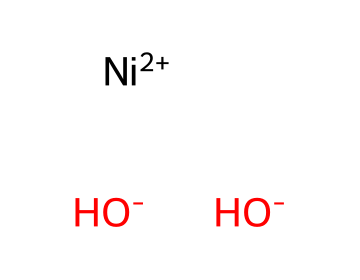
IDENTITY
COMPUTED
PROPERTIES
4.1 at 68 °F (USCG, 1999) - Denser than water; will sink
4.1
4.1 @25 °C
Black powder
Green crystals, hexagonal
Light green microcrystalline powder
SOL IN DIL ACIDS, IN AMMONIA
SOL IN AMMONIUM HYDROXIDE, ACIDS
0.013 G/100 CC COLD WATER
Ignites in air at about 752.0 °F (USCG, 1999)
752 °F
DECOMP ABOVE 200 °C TO FORM NICKEL OXIDE & WATER.
Toxic gases and vapors (such as nickel carbonyl) may be released ... in the decomp of nickel cmpd. /Nickel & sol nickel cmpd/
446 °F (USCG, 1999)
Decomposes at 230 °C
Nickel hydroxide appears as a fine green powder. Slightly soluble in water and denser than water. Primary hazard is threat to the environment. Immediate steps should be taken to limit spread to the environment.
Dry Powder; Other Solid; Wet Solid; CBI
Green crystals; [HSDB] Water insoluble; [ACGIH]
752 °F (USCG, 1999)
Ignites in air at about 400 °C.
It decomp into nickel oxide and water when heated at 230 °C
Apple-green powder, decomposes above 200 °C to form nickel oxide and water. Insoluble in water; soluble in dilute acids and ammonia. /Monohydrate/
GHS
Danger
H302: Harmful if swallowed [Warning Acute toxicity, oral];H315: Causes skin irritation [Warning Skin corrosion/irritation];H317: May cause an allergic skin reaction [Warning Sensitization, Skin];H332: Harmful if inhaled [Warning Acute toxicity, inhalation];H334: May cause allergy or asthma symptoms or breathing difficulties if inhaled [Danger Sensitization, respiratory];H341: Suspected of causing genetic defects [Warning Germ cell mutagenicity];H350i: May cause cancer by inhalation [Danger Carcinogenicity];H360D ***: May damage the unborn child [Danger Reproductive toxicity];H372 **: Causes damage to organs through prolonged or repeated exposure [Danger Specific target organ toxicity, repeated exposure];H400: Very toxic to aquatic life [Warning Hazardous to the aquatic environment, acute hazard];H410: Very toxic to aquatic life with long lasting effects [Warning Hazardous to the aquatic environment, long-term hazard]
P203, P233, P260, P261, P264, P270, P271, P272, P273, P280, P284, P301+P317, P302+P352, P304+P340, P317, P318, P319, P321, P330, P332+P317, P333+P317, P342+P316, P362+P364, P391, P403, P405, and P501 (click each P-code to see the statement)
Danger
HAZARDS
Chemical: Nickel hydroxide (Ni(OH)2)
Hazard Traits - Carcinogenicity; Reproductive Toxicity; Respiratory Toxicity;Authoritative List - EC Annex VI CMRs - Cat. 1A; EC Annex VI CMRs - Cat. 1B; EC Annex VI Resp. Sens. - Cat. 1;Report - if used as a fragrance or flavor ingredient
Hazard Traits - Carcinogenicity; Reproductive Toxicity; Respiratory Toxicity;Authoritative List - EC Annex VI CMRs - Cat. 1A; EC Annex VI CMRs - Cat. 1B; EC Annex VI Resp. Sens. - Cat. 1;Report - if used as a fragrance or flavor ingredient
Nickel hydroxide (Ni(OH)2) is listed on the EPA's Chemical Data Reporting (CDR) system. Manufacturers and importers of Nickel hydroxide (Ni(OH)2) are required to report information about their production and use of this chemical to the EPA under the Toxic Substances Control Act (TSCA). (40 eCFR Part 711)
Status: Active Update: 10-11-2022 https://echa.europa.eu/registration-dossier/-/registered-dossier/15359;Status: Cease Manufacture Update: 22-01-2013 https://echa.europa.eu/registration-dossier/-/registered-dossier/1686;Status: Cease Manufacture Update: 27-05-2018 https://echa.europa.eu/registration-dossier/-/registered-dossier/25346
Restricted substance: Nickel dihydroxide;EC: 235-008-5;Restriction condition document: PDF link
IMAP assessments - Nickel hydroxide (Ni(OH)2): Human health tier II assessment
Class 9
Special Hazards of Combustion Products: None known;Behavior in Fire: Converts to black nickelic oxide (Ni 2 O 3 ). (USCG, 1999)
Does not readily ignite.
INHALATION: Irritant to mucous membrane of upper respiratory tract. EYES: Irritant to conjunctiva. SKIN: May cause sensitization. Sensation of burning or itching, followed by erythema and nodular eruption-fingers, wrists, and forearms. (USCG, 1999)
An eye, nose, and throat irritant; [HSDB] May cause skin sensitization; [ESIS] Danger of skin and airway sensitization; [MAK] See Nickel and linked occupational diseases.
Non-Redox-Active Inorganic Compounds
Vacated 1989 OSHA PEL TWA 0.1 mg/cu m is still enforced in some states. /Nickel soluble compounds, as Ni/
Permissible Exposure Limit: Table Z-1 8-hr Time Weighted Avg: 1 mg/cu m. /Nickel, soluble cmpd, as Ni/
NICKEL HYDROXIDE is a light-green crystalline material, moderately toxic, carcinogenic. When heated to decomposition it emits toxic fumes of metallic nickel [M. K.].
Listed as a hazardous air pollutant (HAP) generally known or suspected to cause serious health problems. The Clean Air Act, as amended in 1990, directs EPA to set standards requiring major sources to sharply reduce routine emissions of toxic pollutants. EPA is required to establish and phase in specific performance based standards for all air emission sources that emit one or more of the listed pollutants. Nickel hydroxide is included on this list.
Slightly soluble in water.
SAFETY
Excerpt from ERG Guide 171 [Substances (Low to Moderate Hazard)]:;CAUTION: Fire involving Safety devices (UN3268) and Fire suppressant dispersing devices (UN3559) may have a delayed activation and a risk of hazardous projectiles. Extinguish the fire at a safe distance.;SMALL FIRE: Dry chemical, CO2, water spray or regular foam.;LARGE FIRE: Water spray, fog or regular foam. Do not scatter spilled material with high-pressure water streams. If it can be done safely, move undamaged containers away from the area around the fire. Dike runoff from fire control for later disposal.;FIRE INVOLVING TANKS: Cool containers with flooding quantities of water until well after fire is out. Withdraw immediately in case of rising sound from venting safety devices or discoloration of tank. ALWAYS stay away from tanks in direct contact with flames. (ERG, 2024)
Consult a physician.;INHALATION: Remove from source.;EYES: Wash with copious amounts of water and get medical attention.;SKIN: Wash with soap and water.;INGESTION: Give 2 to 3 glasses of water and induce vomiting. Consult physician. (USCG, 1999)
Use agent based on the substance that is burning since nickel hydroxide itself does not burn or burns with difficulty.
If material involved in fire: Extinguish fire using agent suitable for type of surrounding fire. Material itself does not burn or burns with difficulty. If material not involved in fire: Keep material out of water and sewers. Build dikes to contain flow as necessary; Personnel protection: Keep upwind; wear appropriate chemical protective gloves, boots and goggles; avoid breathing vapors or dusts; wash away any material which may have contacted the body with copious amt of water or soap and water.
PRECAUTIONS FOR "CARCINOGENS": Storage site should be as close as practical to lab in which carcinogens are to be used, so that only small quantities required for ... expt need to be carried. Carcinogens should be kept in only one section of cupboard, an explosion-proof refrigerator or freezer (depending on chemicophysical properties ...) that bears appropriate label. An inventory ... should be kept, showing quantity of carcinogen & date it was acquired ... Facilities for dispensing ... should be contiguous to storage area. /Chemical Carcinogens/
Environmental considerations- Land spill: Dig a pit, pond, lagoon, holding area to contain liquid or solid material /SRP: If time permits, pits, ponds, lagoons, soak holes, or holding areas should be sealed with an impermeable flexible membrane liner./ Cover solids with a plastic sheet to prevent dissolving in rain or fire fighting water; Environmental considerations- Water spill: Neutralize with agricultural lime (CaO), crushed limestone (CaCO3), or sodium bicarbonate (NaHCO3); adjust pH to neutral (pH= 7); use mechanical dredges or lifts to remove immobilized masses of pollutants and precipitates
PRECAUTIONS FOR "CARCINOGENS": A high-efficiency particulate arrestor (HEPA) or charcoal filters can be used to minimize amt of carcinogen in exhausted air ventilated safety cabinets, lab hoods, glove boxes or animal rooms ... Filter housing that is designed so that used filters can be transferred into plastic bag without contaminating maintenance staff is avail commercially. Filters should be placed in plastic bags immediately after removal ... The plastic bag should be sealed immediately ... The sealed bag should be labelled properly ... Waste liquids ... should be placed or collected in proper containers for disposal. The lid should be secured & the bottles properly labelled. Once filled, bottles should be placed in plastic bag, so that outer surface ... is not contaminated ... The plastic bag should also be sealed & labelled. ... Broken glassware ... should be decontaminated by solvent extraction, by chemical destruction, or in specially designed incinerators. /Chemical Carcinogens/
Excerpt from ERG Guide 171 [Substances (Low to Moderate Hazard)]:;Do not touch or walk through spilled material. Stop leak if you can do it without risk. Prevent dust cloud. For Asbestos, avoid inhalation of dust. Cover spill with plastic sheet or tarp to minimize spreading. Do not clean up or dispose of, except under supervision of a specialist.;SMALL DRY SPILL: With clean shovel, place material into clean, dry container and cover loosely; move containers from spill area.;SMALL SPILL: Pick up with sand or other non-combustible absorbent material and place into containers for later disposal.;LARGE SPILL: Dike far ahead of liquid spill for later disposal. Cover powder spill with plastic sheet or tarp to minimize spreading. Prevent entry into waterways, sewers, basements or confined areas. (ERG, 2024)
SRP: At the time of review, criteria for land treatment or burial (sanitary landfill) disposal practices are subject to significant revision. Prior to implementing land disposal of waste residue (including waste sludge), consult with environmental regulatory agencies for guidance on acceptable disposal practices.
WASTEWATERS FROM ELECTROPLATING AND RELATED METAL PROCESSES ARE TREATED BY PRECIPITATION OF NICKEL AS HYDROXIDE. THE NICKEL HYDROXIDES ARE REMOVED FROM THE LIQ STREAM BY GRAVITATIONAL SETTLING IN CLARIFIERS AND THICKENERS. THIS SETTLING RATE WAS TRANSLATED INTO SOLIDS FLUX AND A FAMILY OF CURVES DEVELOPED FOR VARIOUS SLURRIES.
EFFECTS OF FREEZING ON NICKEL HYDROXIDE WERE EXAMINED AS A MODEL FOR THE TREATMENT OF PLATING SLUDGE. A MIN SEDIMENTATION VOL WAS ATTAINED AT -30 DEG, SHOWING THE HIGHEST SEDIMENTATION VELOCITY. THE FREEZING TREATMENT MADE THE HYDROXIDES POROUS AND INCREASED THEIR WATER ADSORPTION CAPACITY BY 1.5 TIMES.
An industrial company in Maryland has found a way to treat landfilled wastes in situ. Chemical analyses of their onsite waste showed nickel hydroxide to be the main hazardous chemical found in significant concentrations. In order to comply with state regulations and prevent soil leaching, they discovered that if nickel hydroxide was ... soluble, leaching would not occur, and their waste would be in compliance with the regulations.
For more Disposal Methods (Complete) data for NICKEL HYDROXIDE (9 total), please visit the HSDB record page.
SRP: Contaminated protective clothing should be segregated in such a manner so that there is no direct personal contact by personnel who handle, dispose, or clean the clothing. Quality assurance to ascertain the completeness of the cleaning procedures should be implemented before the decontaminated protective clothing is returned for reuse by the workers. All contaminated clothing should not be taken home at end of shift, but should remain at employee's place of work for cleaning.
SRP: The scientific literature for the use of contact lenses in industry is conflicting. The benefit or detrimental effects of wearing contact lenses depend not only upon the substance, but also on factors including the form of the substance, characteristics and duration of the exposure, the uses of other eye protection equipment, and the hygiene of the lenses. However, there may be individual substances whose irritating or corrosive properties are such that the wearing of contact lenses would be harmful to the eye. In those specific cases, contact lenses should not be worn. In any event, the usual eye protection equipment should be worn even when contact lenses are in place.
PRECAUTIONS FOR "CARCINOGENS": Smoking, drinking, eating, storage of food or of food & beverage containers or utensils, & the application of cosmetics should be prohibited in any laboratory. All personnel should remove gloves, if worn, after completion of procedures in which carcinogens have been used. They should ... wash ... hands, preferably using dispensers of liq detergent, & rinse ... thoroughly. Consideration should be given to appropriate methods for cleaning the skin, depending on nature of the contaminant. No standard procedure can be recommended, but the use of organic solvents should be avoided. Safety pipettes should be used for all pipetting. /Chemical Carcinogens/
PRECAUTIONS FOR "CARCINOGENS": In animal laboratory, personnel should remove their outdoor clothes & wear protective suits (preferably disposable, one-piece & close-fitting at ankles & wrists), gloves, hair covering & overshoes. ... Clothing should be changed daily but ... discarded immediately if obvious contamination occurs ... /also,/ workers should shower immediately. In chemical laboratory, gloves & gowns should always be worn ... however, gloves should not be assumed to provide full protection. Carefully fitted masks or respirators may be necessary when working with particulates or gases, & disposable plastic aprons might provide addnl protection. If gowns are of distinctive color, this is a reminder that they should not be worn outside of lab. /Chemical Carcinogens/
For more Preventive Measures (Complete) data for NICKEL HYDROXIDE (11 total), please visit the HSDB record page.
Excerpt from ERG Guide 171 [Substances (Low to Moderate Hazard)]:;IMMEDIATE PRECAUTIONARY MEASURE: Isolate spill or leak area in all directions for at least 50 meters (150 feet) for liquids and at least 25 meters (75 feet) for solids.;SPILL: Increase the immediate precautionary measure distance, in the downwind direction, as necessary.;FIRE: If tank, rail tank car or highway tank is involved in a fire, ISOLATE for 800 meters (1/2 mile) in all directions; also, consider initial evacuation for 800 meters (1/2 mile) in all directions. (ERG, 2024)
Intermediate Inhalation: 0.0002 mg/m3 (L134) Chronic Inhalation: 0.00009 mg/m3 (L134)
0.2 [mg/m3], inhalable fraction, as Ni
8 hr Time Weighted Avg (TWA) 0.2 mg/cu m (inhalable fraction). /Nickel, insoluble inorganic compounds (NOS), as Ni/
Excursion Limit Recommendation: Excursions in worker exposure levels may exceed 3 times the TLV-TWA for no more than a total of 30 minutes during a work day, and under no circumstances should they exceed 5 times the TLV-TWA, provided that the TLV-TWA is not exceeded. /Nickel, insoluble inorganic compounds (NOS), as Ni/
A1: Confirmed human carcinogen. /Nickel, insoluble inorganic compounds (NOS), as Ni/
1.0 [mg/m3], as Ni
TOXICITY
Excess exposure to nickel is usually handled by preventing further exposure and symptomatic treatment. Nickel poisoning may also be treated using chelation therapy with sodium diethyldithiocarbamate. (L42)
The most common harmful health effect of nickel in humans is an allergic reaction. This usually manifests as a skin rash, although some people experience asthma attacks. Long term inhahation of nickel causes chronic bronchitis and reduced lung function, as well as damage to the naval cavity. Ingestion of excess nickel results in damage to the stomach, blood, liver, kidneys, and immune system, as well as having adverse effects on reproduction and development. (L41)
Skin Sensitizer - An agent that can induce an allergic reaction in the skin.;Asthma - Reversible bronchoconstriction (narrowing of bronchioles) initiated by the inhalation of irritating or allergenic agents.;IARC Carcinogen - Class 1: International Agency for Research on Cancer classifies chemicals as established human carcinogens.;NTP Carcinogen - Known to be a human carcinogen.
Inhalation (L41) ; oral (L41) ; dermal (L41)
Nickel is known to substitute for other essential elements in certain enzmes, such as calcineurin. It is genotoxic, and some nickel compounds have been shown to promote cell proliferation. Nickel has a high affinity for chromatin proteins, particularly histones and protamines. The complexing of nickel ions with heterochromatin results in a number of alterations including condensation, DNA hypermethylation, gene silencing, and inhibition of histone acetylation, which have been shown to disturb gene expression. Nickel has also been shown to alter several transcription factors, including hypoxia-inducible transcription factor, activating transcription factor, and NF-KB transcription factor. There is also evidence that nickel ions inhibit DNA repair, either by directly inhibiting DNA repair enzymes or competing with zinc ions for binding to zinc-finger DNA binding proteins, resulting in structural changes in DNA that prevent repair enzymes from binding. Nickel ions can also complex with a number of cellular ligands including amino acids, peptides, and proteins resulting in the generation of oxygen radicals, which induce base damage, DNA strand breaks, and DNA protein crosslinks. (L41, A40)
Symptoms of nickel poisoning include headache, nausea, vomiting, dizziness, irritability, and difficulty sleeping, followed by chest pains, sweating, rapid heart beat, and a dry cough. (L42)
PRECAUTIONS FOR "CARCINOGENS": Whenever medical surveillance is indicated, in particular when exposure to a carcinogen has occurred, ad hoc decisions should be taken concerning ... /cytogenetic and/or other/ tests that might become useful or mandatory. /Chemical Carcinogens/
1, carcinogenic to humans. (L135)
... INDUCTION OF RHABDOMYOSARCOMAS ... & FIBROSARCOMAS ... AT SITE OF IMPLANTATION IN ... 19/40 WISTAR RATS GIVEN NICKEL HYDROXIDE ...
RATS INJECTED WITH 12 MG COLLOIDAL NICKEL HYDROXIDE (NI(OH)2) SHOWED KIDNEY INJURY AND FRANK HEMATURIA, BUT NO TUMOR. RATS INJECTED WITH AIR-DRIED NI(OH)2 BEGAN DEVELOPING TUMORS AFTER 6 MONTHS. CRYSTAL NI(OH)2 CAUSED TUMORS IN THE 5TH MONTH AFTER INJECTION. THE TUMORS WERE REJECTED 2-3 WK AFTER DEVELOPMENT.
Local sarcomas were induced in rats with repeated intramuscular injections of crystalline nickel hydroxide, but not with colloidal nickel hydroxide or nickel sulfate, under similar experimental conditions ... .
A1: Confirmed human carcinogen. /Nickel, insoluble inorganic compounds (NOS), as Ni/
Evaluation: There is sufficient evidence in humans for the carcinogenicity of nickel sulfate, and of the combinations of nickel sulfides and oxides encountered in the nickel refining industry. There is inadequate evidence in humans for the carcinogenicity of metallic nickel and nickel alloys. There is sufficient evidence in experimental animals for the carcinogenicity of metallic nickel, nickel monoxides, nickel hydroxides and crystalline nickel sulfides. There is limited evidence in experimental animals for the carcinogenicity of nickel alloys, nickelocene, nickel carbonyl, nickel salts, nickel arsenides, nickel antimonide, nickel selenides and nickel telluride. There is inadequate evidence in experimental animals for the carcinogenicity of nickel trioxide, amorphous nickel sulfide and nickel titanate. The Working Group made the overall evaluation on nickel compounds as a group on the basis of the combined results of epidemiological studies, carcinogenicity studies in experimental animals, and several types of other relevant data, supported by the underlying concept that nickel compounds can generate nickel ions at critical sites in their target cells. Overall evaluation: Nickel compounds are carcinogenic to humans (Group 1). Metallic nickel is possibly carcinogenic to humans (Group 2B). /Nickel compounds/
Basic treatment: Establish a patent airway. Suction if necessary. Watch for signs of respiratory insufficiency and assist ventilation if necessary. Administer oxygen by nonrebreather mask at 10 t0 15 L/min. Monitor for shock and treat if necessary ... . Monitor for pulmonary edema and treat if necessary ... . For eye contamination, flush eyes immediately with water. Irrigate each eye continuously with normal saline during transport ... . Do not use emetics. For ingestion, rinse mouth and administer 5 ml/kg up to 200 ml of water for dilution if the patient can swallow, has a strong gag reflex, and does not drool ... . /Nickel and related compounds/
Advanced treatment: Consider orotracheal or nasotracheal intubation for airway control in the patient who is unconscious. Positive pressure ventilation techniques with a bag valve mask device may be beneficial. Monitor cardiac rhythm and treat arrhythmias if necessary ... . Consider drug therapy for pulmonary edema ... . Start an IV with D5W /SRP: "To keep open", minimal flow rate/. Use lactated Ringer's if signs of hypovolemia are present. For hypotension with signs of hypovolemia, administer fluid cautiously. Consider vasopressors for hypotension with a normal fluid volume. Watch for signs of fluid overload ... . Use proparacaine hydrochloride to assist eye irrigation ... . /Nickel and related compounds/
LC50 (rat) = 1,200 mg/m3/4h
LD50: 60 mg/kg (Subcutaneous, Mouse) (L509)
REGULATORY
Chemical: Nickel hydroxide (Ni(OH)2)
Hazard Traits - Carcinogenicity; Reproductive Toxicity; Respiratory Toxicity;Authoritative List - EC Annex VI CMRs - Cat. 1A; EC Annex VI CMRs - Cat. 1B; EC Annex VI Resp. Sens. - Cat. 1;Report - if used as a fragrance or flavor ingredient
Hazard Traits - Carcinogenicity; Reproductive Toxicity; Respiratory Toxicity;Authoritative List - EC Annex VI CMRs - Cat. 1A; EC Annex VI CMRs - Cat. 1B; EC Annex VI Resp. Sens. - Cat. 1;Report - if used as a fragrance or flavor ingredient
Nickel hydroxide (Ni(OH)2) is listed on the EPA's Chemical Data Reporting (CDR) system. Manufacturers and importers of Nickel hydroxide (Ni(OH)2) are required to report information about their production and use of this chemical to the EPA under the Toxic Substances Control Act (TSCA). (40 eCFR Part 711)
Status: Active Update: 10-11-2022 https://echa.europa.eu/registration-dossier/-/registered-dossier/15359;Status: Cease Manufacture Update: 22-01-2013 https://echa.europa.eu/registration-dossier/-/registered-dossier/1686;Status: Cease Manufacture Update: 27-05-2018 https://echa.europa.eu/registration-dossier/-/registered-dossier/25346
Restricted substance: Nickel dihydroxide;EC: 235-008-5;Restriction condition document: PDF link
Listed as a hazardous air pollutant (HAP) generally known or suspected to cause serious health problems. The Clean Air Act, as amended in 1990, directs EPA to set standards requiring major sources to sharply reduce routine emissions of toxic pollutants. EPA is required to establish and phase in specific performance based standards for all air emission sources that emit one or more of the listed pollutants. Nickel hydroxide is included on this list.
Persons in charge of vessels or facilities are required to notify the National Response Center (NRC) immediately, when there is a release of this designated hazardous substance, in an amount equal to or greater than its reportable quantity of 100 lb or 45.4 kg. The toll free number of the NRC is (800) 424-8802; In the Washington D.C. metropolitan area (202) 426-2675. The rule for determining when notification is required is stated in 40 CFR 302.4 (section IV. D.3.b).
Nickel hydroxide is designated as a hazardous substance under section 311(b)(2)(A) of the Federal Water Pollution Control Act and further regulated by the Clean Water Act Amendments of 1977 and 1978. These regulations apply to discharges of this substance. This designation includes any isomers and hydrates, as well as any solutions and mixtures containing this substance.
Toxic pollutant designated pursuant to section 307(a)(1) of the Clean Water Act and is subject to effluent limitations. /Nickel and compounds/
(CA) CALIFORNIA 100 ug/L /Nickel/
(CT) CONNECTICUT 100 ug/L /Nickel/
(DE) DELEWARE 100 ug/L /Nickel/
(FL) FLORIDA 100 ug/L /Nickel/
(WI) WISCONSIN 100 ug/L /Nickel/
(AZ) ARIZONA 150 ug/L /Nickel/
(MA) MASSACHUSETTS 100 ug/L /Nickel/
(ME) MAINE 140 ug/L /Nickel/
(MN) MINNESOTA 100 ug/L /Nickel/
EPA 100 ug/L /Nickel/
PHARMACOLOGY
Nickel is absorbed mainly through the lungs and gastrointestinal tract. Once in the body it enters the bloodstream, where it binds to albumin, L-histidine, and _2-macroglobulin. Nickel tends to accumulate in the lungs, thyroid, kidney, heart, and liver. Absorbed nickel is excreted in the urine, wherease unabsorbed nickel is excreted in the faeces. (L41)
USES
Used to make nickel-cadmium batteries and catalysts; [HSDB]
Battery Manufacturing [Category: Industry]
Mfr of nickel salts
USED IN NICKEL-CADMIUM BATTERIES
HYDROGENATION OF FINELY POWDERED NEWSPAPER WITH NICKEL HYDROXIDE CATALYST PRODUCES CONVERSION IN HIGH YIELDS OF CELLULOSIC FEED MATERIALS TO LIQ HYDROCARBON FUELS.
CHEM INT FOR NICKEL CATALYSTS & NICKEL SALTS
2023: 1,000,000 - <2,500,000 lb;2022: 1,000,000 - <5,000,000 lb;2021: 1,000,000 - <5,000,000 lb;2020: 1,000,000 - <5,000,000 lb
(1977) AT LEAST 6.45X10+7 G-INCL CAPTIVE PRODN
Catalyst;Other
Catalyst;Intermediate;Other;Alloys;Conductive agent
By adding a hypochlorite to a soln of nickelous salt.
... MAY BE PREPARED FROM SOLN OF NICKEL SALTS BY PRECIPITATION WITH ALKALINE HYDROXIDES, BUT PRODUCT IS USUALLY CONTAMINATED BY OCCLUDED OR ABSORBED FOREIGN SALTS. PURE NICKEL HYDROXIDE CAN BE PREPARED BY ELECTROLYTIC PRECIPITATION USING NICKEL ANODES (ANTONSEN & SPRINGER, 1967).
High purity crystalline nickel hydroxide can be made from nickel nitrate soln and potassium hydroxide by subsequent extraction of the gelatinous precipitate with hot alcohol.
Nickel sulfate treated with sodium hydroxide yields the gelatinous nickel hydroxide which, when neutralized, forms a fine precipitate that can be filtered
Industrial route for the manufacture of nickel hydroxide is by electro-deposition at an inert cathode using metallic nickel as the anode and nickel nitrate as the electrolyte
Cosmetics product ingredient: Nickel hydroxide
Cosmetics product ingredient: Nickel dihydroxide (Nickel hydroxide)
Plastics Product Manufacturing;Primary Metal Manufacturing;Electrical Equipment, Appliance, and Component Manufacturing;Wholesale and Retail Trade;All Other Basic Inorganic Chemical Manufacturing;Miscellaneous Manufacturing;Other (requires additional information);Services;All Other Chemical Product and Preparation Manufacturing
Nickel hydroxide (Ni(OH)2): ACTIVE
ALIASES
REACTIONS
uspto-grants-2000_10 · 10.6084/m9.figshare.5104873.v1 · US06129902
查看
uspto-grants-2000_10 · 10.6084/m9.figshare.5104873.v1 · US06129902
查看
uspto-grants-2014_01 · 10.6084/m9.figshare.5104873.v1 · US08636967B2
查看
uspto-grants-2016_03 · 10.6084/m9.figshare.5104873.v1 · US09273377B2
查看
uspto-grants-2002_09 · 10.6084/m9.figshare.5104873.v1 · US06444363B1
查看
uspto-grants-2001_09 · 10.6084/m9.figshare.5104873.v1 · US06284215B1
查看
uspto-grants-2001_09 · 10.6084/m9.figshare.5104873.v1 · US06284215B1
查看
uspto-grants-2002_08 · 10.6084/m9.figshare.5104873.v1 · US06432580B1
查看