
uspto-grants-1998_03 · 10.6084/m9.figshare.5104873.v1 · US05726306
查看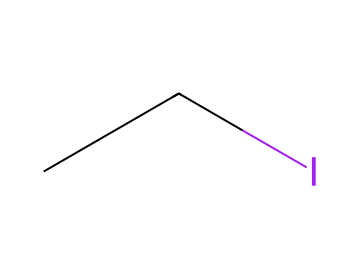
IDENTITY
COMPUTED
PROPERTIES
2.0
Relative density (water = 1): 1.936
1.948 @ 15°C
Solubility in water, g/100ml at 20 °C: 0.4
61 °C c.c.
72 °C
72.4 °C @760 [mm Hg]
-108 °C
-108 °C
Relative vapor density (air = 1): 5.4 (calculated)
136.0 [mmHg]
Vapor pressure, kPa at 18 °C: 13.3
100 [mm Hg] @18 °C
Gas Vapor; Liquid
Highly refractive liquid with an ethereal odor; Colorless when fresh, turns red on exposure to light and air; [Merck Index]
COLOURLESS LIQUID WITH CHARACTERISTIC ODOUR. TURNS DARK ON EXPOSURE TO LIGHT.
602;607;614;621;601;600;601;602;600.4
616;586;617.6;638.9;591;598;609;621;616.3
881;896.49;899.84;901.65;892;876;892;880
GHS
Danger
H226 (18.5%): Flammable liquid and vapor [Warning Flammable liquids];H302 (98.5%): Harmful if swallowed [Warning Acute toxicity, oral];H315 (91.5%): Causes skin irritation [Warning Skin corrosion/irritation];H317 (88.5%): May cause an allergic skin reaction [Warning Sensitization, Skin];H319 (86.9%): Causes serious eye irritation [Warning Serious eye damage/eye irritation];H332 (12.3%): Harmful if inhaled [Warning Acute toxicity, inhalation];H334 (84.6%): May cause allergy or asthma symptoms or breathing difficulties if inhaled [Danger Sensitization, respiratory];H335 (90.8%): May cause respiratory irritation [Warning Specific target organ toxicity, single exposure; Respiratory tract irritation];H341 (10%): Suspected of causing genetic defects [Warning Germ cell mutagenicity]
P203, P210, P233, P240, P241, P242, P243, P260, P261, P264, P264+P265, P270, P271, P272, P280, P284, P301+P317, P302+P352, P303+P361+P353, P304+P340, P305+P351+P338, P317, P318, P319, P321, P330, P332+P317, P333+P317, P337+P317, P342+P316, P362+P364, P370+P378, P403, P403+P233, P403+P235, P405, and P501 (click each P-code to see the statement)
Aggregated GHS information provided per 130 reports by companies from 21 notifications to the ECHA C&L Inventory. Each notification may be associated with multiple companies.;Information may vary between notifications depending on impurities, additives, and other factors. The percentage value in parenthesis indicates the notified classification ratio from companies that provide hazard codes. Only hazard codes with percentage values above 10% are shown. For more detailed information, please visit ECHA C&L website.
HAZARDS
Chemical: Ethane, iodo-
Ethane, iodo- is listed on the EPA's Chemical Data Reporting (CDR) system. Manufacturers and importers of Ethane, iodo- are required to report information about their production and use of this chemical to the EPA under the Toxic Substances Control Act (TSCA). (40 eCFR Part 711)
Status: Active Update: 27-02-2020 https://echa.europa.eu/registration-dossier/-/registered-dossier/24183
Iodoethane: Does not have an individual approval but may be used under an appropriate group standard
Flammable. Above 61 °C explosive vapour/air mixtures may be formed.
Causes lung changes and flaccid paralysis without anesthesia in subcutaneous lethal-dose studies of mice; [RTECS] A skin, eye, and respiratory tract irritant; May have CNS effects (lowering of consciousness); Can be absorbed through skin; [ICSC] An irritant that may cause serious eye injury; May cause skin sensitization; Harmful by ingestion, inhalation, and skin absorption; [Alfa Aesar MSDS] See Ethyl chloride and Ethyl bromide,
Decomposes on burning. This produces iodine and hydrogen iodide. Reacts with strong bases and strong oxidants.
The vapour is heavier than air.
Flam. Liq. 3 (18.5%);Acute Tox. 4 (98.5%);Skin Irrit. 2 (91.5%);Skin Sens. 1 (88.5%);Eye Irrit. 2 (86.9%);Acute Tox. 4 (12.3%);Resp. Sens. 1 (84.6%);STOT SE 3 (90.8%);Muta. 2 (10%)
SAFETY
Use water spray, powder, foam, carbon dioxide. In case of fire: keep drums, etc., cool by spraying with water.
Fresh air, rest. Half-upright position. Artificial respiration may be needed. Refer for medical attention.
Rinse skin with plenty of water or shower. Refer for medical attention .
First rinse with plenty of water for several minutes (remove contact lenses if easily possible), then refer for medical attention.
Rinse mouth. Do NOT induce vomiting. Give one or two glasses of water to drink. Refer for medical attention .
Fireproof. Separated from strong bases and strong oxidants.
Personal protection: filter respirator for organic gases and vapours adapted to the airborne concentration of the substance. Remove all ignition sources. Collect leaking and spilled liquid in covered containers as far as possible. Absorb remaining liquid in sand or inert absorbent. Then store and dispose of according to local regulations.
Wear safety goggles, face shield or eye protection in combination with breathing protection.
NO open flames, NO sparks and NO smoking. Above 61 °C use a closed system, ventilation and explosion-proof electrical equipment.
No indication can be given about the rate at which a harmful concentration of this substance in the air is reached on evaporation at 20 °C.
Protective gloves. Protective clothing.
Do not eat, drink, or smoke during work.
Use ventilation, local exhaust or breathing protection.
0.01 ppm as TWA; A4 (not classifiable as a human carcinogen).
The substance is irritating to the eyes, skin and respiratory tract. The substance may cause effects on the central nervous system. This may result in lowering of consciousness.
TOXICITY
Neurotoxin - Acute solvent syndrome
The substance can be absorbed into the body by inhalation of its vapour, through the skin and by ingestion.
Confusion. Cough. Drowsiness. Dizziness. Shortness of breath. Sore throat. Unconsciousness.
Redness. Pain.
Redness. Pain.
Abdominal pain. Confusion. Dizziness. Drowsiness. Unconsciousness.
LC50 (rat) = 65,000 mg/m3/30min
REGULATORY
Chemical: Ethane, iodo-
Ethane, iodo- is listed on the EPA's Chemical Data Reporting (CDR) system. Manufacturers and importers of Ethane, iodo- are required to report information about their production and use of this chemical to the EPA under the Toxic Substances Control Act (TSCA). (40 eCFR Part 711)
Status: Active Update: 27-02-2020 https://echa.europa.eu/registration-dossier/-/registered-dossier/24183
Iodoethane: Does not have an individual approval but may be used under an appropriate group standard
PHARMACOLOGY
1-iodoethane has known human metabolites that include ethylglutathione.
USES
Has been used for the determination of cardiac output; [REPROTOX]
2023: 31,870 lb;2022: 57,239 lb;2021: 54,564 lb;2020: 55,208 lb
Catalyst
Plastics Material and Resin Manufacturing
Ethane, iodo-: ACTIVE
ALIASES
REACTIONS
uspto-grants-1998_03 · 10.6084/m9.figshare.5104873.v1 · US05726306
查看
uspto-grants-1998_03 · 10.6084/m9.figshare.5104873.v1 · US05726182
查看
uspto-grants-1998_03 · 10.6084/m9.figshare.5104873.v1 · US05726182
查看
uspto-grants-1998_03 · 10.6084/m9.figshare.5104873.v1 · US05726182
查看
uspto-grants-1998_03 · 10.6084/m9.figshare.5104873.v1 · US05728686
查看
uspto-grants-1998_03 · 10.6084/m9.figshare.5104873.v1 · US05728686
查看
uspto-grants-1998_03 · 10.6084/m9.figshare.5104873.v1 · US05731336
查看
uspto-grants-1998_03 · 10.6084/m9.figshare.5104873.v1 · US05733914
查看