
uspto-grants-1998_03 · 10.6084/m9.figshare.5104873.v1 · US05723462
查看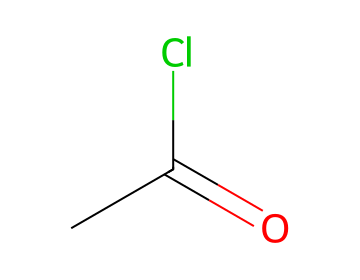
IDENTITY
COMPUTED
PROPERTIES
-0.47
Pungent odor
Sharp odor
1.1039 at 69.8 °F (USCG, 1999) - Denser than water; will sink
1.1051g/cu cm at 20 °C
Saturated liquid density: 68.849 Lb/cu ft at 70 °F
Saturated vapor density: 0.06130 Lb/cu ft at 70 °F
Relative density (water = 1): 1.11
1.1051 @ 20°C
Liquid
Colorless fuming liquid
Reaction (NTP, 1992)
Decomposed violently by water or alcohol
Miscible with benzene, chloroform, ether, glacial acetic acid, petroleum ether
Miscible with ether, acetone, benzene, chloroform; soluble in carbon tetrachloride
Soluble in ether, acetone, acetic acid
Solubility in water: reaction
Corrosive
Corrosive to metals and tissue
40 °F (NTP, 1992)
4 °C
5 °C (41 °F) - closed cup
4 °C (40 °F) - closed cup
5 °C c.c.
123.6 °F at 760 mmHg (NTP, 1992)
51 °C
51 °C
50.7 °C @760 [mm Hg]
Hazardous decomposition products formed under fire conditions - Carbon oxides, hydrogen chloride gas.
May decompose during preparation. ... When heated to decomposition it emits highly toxic fumes of phosgene and /chloride/.
-170 °F (NTP, 1992)
-112.7 °C
-112 °C
-112.8 °C
2.7 2.1 at 100 °F (NTP, 1992) - Heavier than air; will sink (Relative to Air)
2.70 (Air = 1)
Relative vapor density (air = 1): 2.7
135 mmHg at 45.5 °F (NTP, 1992)
287.0 [mmHg]
287 mm Hg at 25 °C
Vapor pressure, kPa at 20 °C: 32
287 [mm Hg] @25 °C
GHS
Danger
H225: Highly Flammable liquid and vapor [Danger Flammable liquids];H314: Causes severe skin burns and eye damage [Danger Skin corrosion/irritation]
P210, P233, P240, P241, P242, P243, P260, P264, P280, P301+P330+P331, P302+P361+P354, P303+P361+P353, P304+P340, P305+P354+P338, P316, P321, P363, P370+P378, P403+P235, P405, and P501 (click each P-code to see the statement)
Danger
HAZARDS
Water-reactive material (WR)
Chemical: Acetyl chloride
Acetyl chloride is listed on the EPA's Chemical Data Reporting (CDR) system. Manufacturers and importers of Acetyl chloride are required to report information about their production and use of this chemical to the EPA under the Toxic Substances Control Act (TSCA). (40 eCFR Part 711)
Status: Active Update: 02-03-2021 https://echa.europa.eu/registration-dossier/-/registered-dossier/13323
Acetyl chloride: HSNO Approval: HSR001073 Approved with controls
The New Jersey Worker and Community Right to Know Act requires public and private employers to provide information about hazardous substances at their workplaces. (N.J.S.A. 34:5A-1 et. seq.)
Flammable Liquid Corrosive
Special Hazards of Combustion Products: When heated to decomposition, hydrogen chloride and phosgene, extremely poisonous gases, are evolved.;Behavior in Fire: Vapor is heavier than air and may travel a considerable distance to a source of ignition and flash back. (USCG, 1999)
· HIGHLY FLAMMABLE: Will be easily ignited by heat, sparks or flames.;· Vapors form explosive mixtures with air: indoors, outdoors and sewers explosion hazards.;· Most vapors are heavier than air. They will spread along the ground and collect in low or confined areas (sewers, basements, tanks, etc.).;· Vapors may travel to source of ignition and flash back.;· Those substances designated with a (P) may polymerize explosively when heated or involved in a fire.;· Substance will react with water (some violently) releasing flammable, toxic or corrosive gases and runoff.;· Corrosives in contact with metals may evolve flammable hydrogen gas.;· Containers may explode when heated or if contaminated with water.
Highly flammable. Many reactions may cause fire or explosion. Gives off irritating or toxic fumes (or gases) in a fire. Vapour/air mixtures are explosive.
Dangerous fire hazard when exposed to heat or flame.
Flammable.
Vapor irritates mucous membranes. Ingestion of liquid or contact with eyes or skin causes severe irritation. (USCG, 1999)
· TOXIC and/or CORROSIVE; inhalation, ingestion or contact (skin, eyes) with vapors, dusts or substance may cause severe injury, burns or death.;· Bromoacetates and chloroacetates are extremely irritating/lachrymators (cause eye irritation and flow of tears).;· Reaction with water or moist air may release toxic, corrosive or flammable gases.;· Reaction with water may generate much heat that will increase the concentration of fumes in the air.;· Fire will produce irritating, corrosive and/or toxic gases.;· Runoff from fire control or dilution water may be corrosive and/or toxic and cause environmental contamination.
Corrosive to skin; [Quick CPC] A corrosive substance that can cause pulmonary edema; [ICSC] Reacts violently with water; Can cause severe burns; [Merck Index] Human inhalation of 2 ppm for 1 minute causes other changes in olfaction and lungs, thorax, or respiration; Causes spastic paralysis, excitement, and other changes in lungs, thorax, or respiration in oral lethal-dose studies of rats; [RTECS] See the Process, Toxic Gas from Spilling Chemical in Water.
1717 155
Acyl Halides, Sulfonyl Halides, and Chloroformates
UN Hazard Class: 3; UN Subsidiary Risks: 8; UN Pack Group: II
U006; As stipulated in 40 CFR 261.33, when acetyl chloride, as a commercial chemical product or manufacturing chemical intermediate or an off-specification commercial chemical product or a manufacturing chemical intermediate, becomes a waste, it must be managed according to Federal and/or State hazardous waste regulations. Also defined as a hazardous waste is any residue, contaminated soil, water, or other debris resulting from the cleanup of a spill, into water or on dry land, of this waste. Generators of small quantities of this waste may qualify for partial exclusion from hazardous waste regulations (40 CFR 261.5).
Highly Flammable;Water-Reactive;Air-Reactive
SAFETY
Excerpt from ERG Guide 155 [Substances - Toxic and/or Corrosive (Flammable / Water-Sensitive)]:;Note: Most foams will react with the material and release corrosive/toxic gases. CAUTION: For Acetyl chloride (UN1717), use CO2 or dry chemical only.;SMALL FIRE: CO2, dry chemical, dry sand, alcohol-resistant foam.;LARGE FIRE: Water spray, fog or alcohol-resistant foam. FOR CHLOROSILANES, DO NOT USE WATER; use alcohol-resistant foam. If it can be done safely, move undamaged containers away from the area around the fire. Avoid aiming straight or solid streams directly onto the product.;FIRE INVOLVING TANKS, RAIL TANK CARS OR HIGHWAY TANKS: Fight fire from maximum distance or use unmanned master stream devices or monitor nozzles. Do not get water inside containers. Cool containers with flooding quantities of water until well after fire is out. Withdraw immediately in case of rising sound from venting safety devices or discoloration of tank. ALWAYS stay away from tanks in direct contact with flames. (ERG, 2024)
Use powder, carbon dioxide. NO hydrous agents, water. In case of fire: keep drums, etc., cool by spraying with water. NO direct contact with water.
Fresh air, rest. Half-upright position. Artificial respiration may be needed. Refer immediately for medical attention.
Wear protective gloves when administering first aid. First rinse with plenty of water for at least 15 minutes, then remove contaminated clothes and rinse again. Refer immediately for medical attention.
Rinse with plenty of water (remove contact lenses if easily possible). Refer immediately for medical attention.
Rinse mouth. Do NOT induce vomiting. Give nothing to drink. Refer immediately for medical attention.
· CALL 911. Then call emergency response telephone number on shipping paper. If shipping paper not available or no answer, refer to appropriate telephone number listed on the inside back cover.;· Keep unauthorized personnel away.;· Stay upwind, uphill and/or upstream.;· Ventilate closed spaces before entering, but only if properly trained and equipped.
· ELIMINATE all ignition sources (no smoking, flares, sparks or flames) from immediate area.;· All equipment used when handling the product must be grounded.;· Do not touch damaged containers or spilled material unless wearing appropriate protective clothing.;· Stop leak if you can do it without risk.;· A vapor-suppressing foam may be used to reduce vapors.;· FOR CHLOROSILANES, use alcohol-resistant foam to reduce vapors.;· DO NOT GET WATER on spilled substance or inside containers.;· Use water spray to reduce vapors or divert vapor cloud drift. Avoid allowing water runoff to contact spilled material.;· Prevent entry into waterways, sewers, basements or confined areas.;Small Spill;· Cover with DRY earth, DRY sand or other non-combustible material followed with plastic sheet to minimize spreading or contact with rain.;· Use clean, non-sparking tools to collect material and place it into loosely covered plastic containers for later disposal.
EYES: First check the victim for contact lenses and remove if present. Flush victim's eyes with water or normal saline solution for 20 to 30 minutes while simultaneously calling a hospital or poison control center. Do not put any ointments, oils, or medication in the victim's eyes without specific instructions from a physician. IMMEDIATELY transport the victim after flushing eyes to a hospital even if no symptoms (such as redness or irritation) develop.;SKIN: IMMEDIATELY flood affected skin with water while removing and isolating all contaminated clothing. Gently wash all affected skin areas thoroughly with soap and water. IMMEDIATELY call a hospital or poison control center even if no symptoms (such as redness or irritation) develop. IMMEDIATELY transport the victim to a hospital for treatment after washing the affected areas.;INHALATION: IMMEDIATELY leave the contaminated area; take deep breaths of fresh air. If symptoms (such as wheezing, coughing, shortness of breath, or burning in the mouth, throat, or chest) develop, call a physician and be prepared to transport the victim to a hospital. Provide proper respiratory protection to rescuers entering an unknown atmosphere. Whenever possible, Self-Contained Breathing Apparatus (SCBA) should be used; if not available, use a level of protection greater than or equal to that advised under Protective Clothing.;INGESTION: DO NOT INDUCE VOMITING. Corrosive chemicals will destroy the membranes of the mouth, throat, and esophagus and volatile chemicals have a high risk of being aspirated into the victim's lungs during vomiting. Thus, the risk of increasing the medical problems by inducing vomiting of a volatile corrosive chemical is very high. If the victim is conscious and not convulsing, give 1 or 2 glasses of water to dilute the chemical and IMMEDIATELY call a hospital or poison control center. IMMEDIATELY transport the victim to a hospital. If the victim is convulsing or unconscious, do not give anything by mouth, ensure that the victim's airway is open and lay the victim on his/her side with the head lower than the body. DO NOT INDUCE VOMITING. IMMEDIATELY transport the victim to a hospital. (NTP, 1992)
General First Aid:;· Call 911 or emergency medical service.;· Ensure that medical personnel are aware of the material(s) involved, take precautions to protect themselves and avoid contamination.;· Move victim to fresh air if it can be done safely.;· Administer oxygen if breathing is difficult.;· If victim is not breathing:;-- DO NOT perform mouth-to-mouth resuscitation; the victim may have ingested or inhaled the substance.;-- If equipped and pulse detected, wash face and mouth, then give artificial respiration using a proper respiratory medical device (bag-valve mask, pocket mask equipped with a one-way valve or other device).;-- If no pulse detected or no respiratory medical device available, provide continuous compressions. Conduct a pulse check every two minutes or monitor for any signs of spontaneous respirations.;· Remove and isolate contaminated clothing and shoes.;· For minor skin contact, avoid spreading material on unaffected skin.;· In case of contact with substance, remove immediately by flushing skin or eyes with running water for at least 20 minutes.;· For severe burns, immediate medical attention is required.;· Effects of exposure (inhalation, ingestion, or skin contact) to substance may be delayed.;· Keep victim calm and warm.;· Keep victim under observation.;· For further assistance, contact your local Poison Control Center.;· Note: Basic Life Support (BLS) and Advanced Life Support (ALS) should be done by trained professionals.;Specific First Aid:;· For corrosives, in case of contact, immediately flush skin or eyes with running water for at least 30 minutes. Additional flushing may be required.
Fireproof. Store in an area without drain or sewer access. Separated from incompatible materials. See Chemical Dangers. Dry. Well closed.
Varpors are heavier than air and may travel to a source of ignition and flash back. ... Closed containers may rupture violently when heated.
· Wear positive pressure self-contained breathing apparatus (SCBA).;· Wear chemical protective clothing that is specifically recommended by the manufacturer when there is NO RISK OF FIRE.;· Structural firefighters' protective clothing provides thermal protection but only limited chemical protection.
TIH (Toxic Inhalation Hazard) - Term used to describe gases and volatile liquids that are toxic when inhaled. Some are TIH materials themselves, e.g., chlorine, and some release TIH gases when spilled in water, e.g., chlorosilanes. [ERG 2016].
Suitable extinguishing media: Dry powder, dry sand. Unsuitable extinguishing media: Do NOT use water jet.
Advice for firefighters: Wear self-contained breathing apparatus for firefighting if necessary.
To fight fire, use /carbon dioxide/ or dry chemical.
If material on fire or involved in fire: Use dry chemical or carbon dioxide. Do not use water on material itself. If large quantities of combustibles are involved, use water in flooding quantities as spray and fog. Use water spray to knock-down vapors. Cool all affected containers with flooding quantities of water. Apply water from as far a distance as possible.
For more Fire Fighting Procedures (Complete) data for Acetyl chloride (6 total), please visit the HSDB record page.
Keep container tightly closed in a dry and well-ventilated place. Containers which are opened must be carefully resealed and kept upright to prevent leakage. Keep away from water. Never allow product to get in contact with water during storage. Hydrolyzes readily. Handle and store under inert gas.
Separate from alcohols, alkalies, amines, and strong oxidizing materials. Store in a cool, dry well-ventilated location. Outside or detached storage is preferred. Inside storage should be in a standard flammable liquids storage warehouse, room, or cabinet.
ACCIDENTAL RELEASE MEASURES: Personal precautions, protective equipment and emergency procedures: Use personal protective equipment. Avoid breathing vapors, mist or gas. Ensure adequate ventilation. Remove all sources of ignition. Evacuate personnel to safe areas. Beware of vapors accumulating to form explosive concentrations. Vapors can accumulate in low areas. Environmental precautions: Prevent further leakage or spillage if safe to do so. Do not let product enter drains. Discharge into the environment must be avoided. Methods and materials for containment and cleaning up: Contain spillage, and then collect with non-combustible absorbent material, (e.g. sand, earth, diatomaceous earth, vermiculite) and place in container for disposal according to local/national regulations. Do not flush with water.
Wear special protective clothing and positive pressure self-contained breathing apparatus. Eliminate all ignition sources. Stop or control the leak, if this can be done without undue risk. Approach release from upwind. Control runoff and isolate discharged material for proper disposal.
Environmental considerations - Land spill: Dig a pit, pond, lagoon, holding area to contain liquid or solid material. /SRP: If time permits, pits, ponds, lagoons, soak holes, or holding areas should be sealed with an impermeable flexible membrane liner./ Dike surface flow using soil, sand bags, foamed polyurethane, or foamed concrete. Absorb bulk liquid with fly ash, cement powder, or commercial sorbents. Neutralize with agricultural lime (CaO), crushed limestone (CaCO3) or sodium bicarbonate (NaHCO3). Apply "universal" gelling agent to immobilize spill.
Environmental considerations - Water spill: Neutralize with agricultural lime (CaO), crushed limestone (CaCO3), or sodium bicarbonate (NaHCO3). Use mechanical dredges or lifts to remove immobilized masses of pollutants and precipitates.
Environmental considerations - Air spill: Apply water spray or mist to knock down vapors. Vapor knockdown water is corrosive or toxic and should be diked for containment.
Excerpt from ERG Guide 155 [Substances - Toxic and/or Corrosive (Flammable / Water-Sensitive)]:;ELIMINATE all ignition sources (no smoking, flares, sparks or flames) from immediate area. All equipment used when handling the product must be grounded. Do not touch damaged containers or spilled material unless wearing appropriate protective clothing. Stop leak if you can do it without risk. A vapor-suppressing foam may be used to reduce vapors. FOR CHLOROSILANES, use alcohol-resistant foam to reduce vapors. DO NOT GET WATER on spilled substance or inside containers. Use water spray to reduce vapors or divert vapor cloud drift. Avoid allowing water runoff to contact spilled material. Prevent entry into waterways, sewers, basements or confined areas.;SMALL SPILL: Cover with DRY earth, DRY sand or other non-combustible material followed with plastic sheet to minimize spreading or contact with rain. Use clean, non-sparking tools to collect material and place it into loosely covered plastic containers for later disposal. (ERG, 2024)
Generators of waste (equal to or greater than 100 kg/mo) containing this contaminant, EPA hazardous waste number U006, must conform with USEPA regulations in storage, transportation, treatment and disposal of waste.
Product: Offer surplus and non-recyclable solutions to a licensed disposal company. Burn in a chemical incinerator equipped with an afterburner and scrubber but exert extra care in igniting as this material is highly flammable. Contact a licensed professional waste disposal service to dispose of this material; Contaminated packaging: Dispose of as unused product.
Acetyl chloride is a waste chemical stream constituent which may be subjected to ultimate disposal by controlled incineration.
A potential candidate for liquid injection incineration at a temperture range of 650 to 1,600 °C and a residence time 0.1 to 2 seconds. A potential candidate for rotary kiln incineration at a temperature range of 820 to 1,600 °C and residence times of seconds for liquids and gases, and hours for solids. A potential candidate for fluidized bed incineration at a temperature range of 450 to 980 °C and residence times of seconds for liquids and gases, and longer for solids.
TOXICITY
LC50; Species: Pimephales promelas (Fathead minnow); Conditions: freshwater, static; Concentration: 42 mg/L for 96 hr (95% confidence interval: 25.2-70 mg/L)
TERRESTRIAL FATE: Based on a classification scheme(1), an estimated Koc value of 1(SRC), determined from a structure estimation method(2), indicates that acetyl chloride is expected to have very high mobility in soil(SRC). In view of its violent decomposition in the presence of water(3) and the high reactivity of structurally-similar compounds with active hydrogen groups that occur in soil(4), it is unlikely that acetyl chloride would persist for long in moist soils(SRC). Acetyl chloride is expected to volatilize from dry soil surfaces(SRC) based upon a vapor pressure of 287 mm Hg at 25 °C(5). Biodegradation data in soil were not available(SRC, 2018).
AQUATIC FATE: Acetyl chloride decomposes violently in the presence of water(1) and, therefore, will not persist in the aquatic environment(SRC). Adsorption to sediment, volatilization, bioconcentration in aquatic species or biodegradation are not expected because of the very short lifetime of this compound in water(SRC).
ATMOSPHERIC FATE: According to a model of gas/particle partitioning of semivolatile organic compounds in the atmosphere(1), acetyl chloride, which has a vapor pressure of 287 mm Hg at 25 °C(2), is expected to exist solely as a vapor in the ambient atmosphere. Vapor-phase acetyl chloride may be degraded in the atmosphere by reaction with photochemically-produced hydroxyl radicals(SRC); the half-life for this reaction in air is estimated to be 5 years(SRC), calculated from its rate constant of 9.1X10⁻¹⁵ cu cm/molecule-sec at 25 °C(3). However, acetyl chloride decomposes violently in the presence of water(4) and fumes in the presence of moist air(5). Acetyl chloride contains chromophores that absorb at wavelengths >290 nm(6) and, therefore, may be susceptible to direct photolysis by sunlight(SRC).
Dermatotoxin - Skin burns.;Toxic Pneumonitis - Inflammation of the lungs induced by inhalation of metal fumes or toxic gases and vapors.
Serious local effects by all routes of exposure.
IDENTIFICATION AND USE: Acetyl chloride is a colorless fuming liquid. It is used as an acetylating agent, reagent in testing for cholesterol, and for determination of water in organic liquids. HUMAN STUDIES: There are no data available. ANIMAL STUDIES: In the Ames test using Salmonella culture strains TA97 TA100 TA1535 TA1537 acetyl chloride was not mutagenic with or without exogenous metabolic activation. Genotoxic activity of acetyl chloride was investigated in both somatic and germ cells of Drosophila melanogaster. Only marginal genotoxic activities were observed in these cells.
Cough. Sore throat. Burning sensation. Shortness of breath.
Redness. Pain. Burning sensation. Blisters. Serious skin burns.
Redness. Pain. Severe burns.
Cough. Sore throat. Burning sensation behind the breastbone. Abdominal pain. Shortness of breath.
The following link will take the user to the National Toxicology Program (NTP) Test Status of Agents Search page, which tabulates the results and current status of tests such as "Short-Term Toxicity Studies", "Long-term Carcinogenicity Studies", "Developmental Studies", "Genetic Toxicology Studies", etc., performed with this chemical. Testing status for acetyl chloride is available.[Available from, as of February 1, 2019: https://ntpsearch.niehs.nih.gov/?e=True&ContentType=Testing+Status]
The substance is harmful to aquatic organisms.
Acetyl chloride
Using a structure estimation method based on molecular connectivity indices(1), the Koc of acetyl chloride can be estimated to be 1(SRC). According to a classification scheme(2), this estimated Koc value suggests that acetyl chloride is expected to have very high mobility in soil(SRC). However, in view of its violent decomposition in the presence of water(3) and the high reactivity of this compound towards molecules with active hydrogen groups such as natural products containing amine, phenol, and alcohol functional groups that occur in soil(4), it is unlikely that acetyl chloride would persist for long in moist soils(SRC).
Acetyl chloride's production and use in chemical synthesis (acetylating agent), particularly in the manufacture of pharmaceuticals and dyestuffs(1,2), in testing for cholesterol, and determination of water in organic liquids(2) may result in its release to the environment through various waste streams(SRC).
Acetyl chloride will decompose violently in water(1) forming acetic acid and hydrochloric acid(2). Because of its short half-life in water, bioconcentration of acetyl chloride in aquatic organisms is very unlikely(SRC).
REGULATORY
Chemical: Acetyl chloride
Acetyl chloride is listed on the EPA's Chemical Data Reporting (CDR) system. Manufacturers and importers of Acetyl chloride are required to report information about their production and use of this chemical to the EPA under the Toxic Substances Control Act (TSCA). (40 eCFR Part 711)
Status: Active Update: 02-03-2021 https://echa.europa.eu/registration-dossier/-/registered-dossier/13323
Acetyl chloride: HSNO Approval: HSR001073 Approved with controls
The New Jersey Worker and Community Right to Know Act requires public and private employers to provide information about hazardous substances at their workplaces. (N.J.S.A. 34:5A-1 et. seq.)
U006; As stipulated in 40 CFR 261.33, when acetyl chloride, as a commercial chemical product or manufacturing chemical intermediate or an off-specification commercial chemical product or a manufacturing chemical intermediate, becomes a waste, it must be managed according to Federal and/or State hazardous waste regulations. Also defined as a hazardous waste is any residue, contaminated soil, water, or other debris resulting from the cleanup of a spill, into water or on dry land, of this waste. Generators of small quantities of this waste may qualify for partial exclusion from hazardous waste regulations (40 CFR 261.5).
This action promulgates standards of performance for equipment leaks of Volatile Organic Compounds (VOC) in the Synthetic Organic Chemical Manufacturing Industry (SOCMI). The intended effect of these standards is to require all newly constructed, modified, and reconstructed SOCMI process units to use the best demonstrated system of continuous emission reduction for equipment leaks of VOC, considering costs, non air quality health and environmental impact and energy requirements. Acetyl chloride is produced, as an intermediate or a final product, by process units covered under this subpart.
Persons in charge of vessels or facilities are required to notify the National Response Center (NRC) immediately, when there is a release of this designated hazardous substance, in an amount equal to or greater than its reportable quantity of 5000 lb or 2270 kg. The toll free number of the NRC is (800) 424-8802. The rule for determining when notification is required is stated in 40 CFR 302.4 (section IV. D.3.b).
Acetyl chloride is designated as a hazardous substance under section 311(b)(2)(A) of the Federal Water Pollution Control Act and further regulated by the Clean Water Act Amendments of 1977 and 1978. These regulations apply to discharges of this substance. This designation includes any isomers and hydrates, as well as any solutions and mixtures containing this substance.
Acetyl chloride
A Commercial Grade
A Placarded Amount
Chemical or material that can be mixed with readily available materials.
USES
Used in chemical production and assays; [HSDB]
Toxic Gas from Spilling Chemical in Water [Category: Other]
Acetylating agent; in testing for cholesterol, determination of water in organic liquids.
Organic preparations (acetylating agent); dyestuffs; pharmaceuticals.
Acetyl chloride is an efficient acetylating agent for alcohols and amines to produce esters and amides. It is important in the synthesis of dyes and pharmaceuticals. Acetyl chloride is used in the Friedel-Craft acylation of benzene to yield acetophenone.
Acetyl chloride is a powerful acetylating agent. It is used in the manufacture of aspirin, acetaminophen, acetanilide, and acetophenone. Liquid crystal compositions for optical display and memory devices frequently require acetyl chloride.
Acetyl chloride frequently contains 1-2% by weight of acetic acid or hydrochloric acid. Phosphorus or sulfur-containing acids may also be present in the commercial material.
2023: 50,000 - <250,000 lb;2022: <50,000 lb;2021: <50,000 lb;2020: <50,000 lb
(1972) LESS THAN 4.54X10+5 GRAMS
(1975) PROBABLY LESS THAN 4.54X10+5 GRAMS
The total U.S. market may amount to only 500 metric ton annually.
Non-confidential 2016 Chemical Data Reporting (CDR) information on the production and use of chemicals manufactured or imported into the United States. Chemical: Acetyl chloride:;Table: National Aggregate Production Volume (pounds) [Table#1916]
Intermediate
Intermediate
Prepared from acetic acid and chlorine in the presence of phosphorus; from acetic acid and salts of chlorosulfonic acid; from sodium acetate and sulfuryl chloride. ... Lab preparation from acetic anhydride and calcium chloride.
By mixing glacial acetic acid and phosphorus trichloride in the cold and heating a short time to drive off hydrochloric acid. The acetyl chloride is then distilled.
The normal industrial method involves reaction of acetic anhydride with anhydrous hydrogen chloride. On the laboratory scale, it can be produced from acetic acid and reagents such as thionyl chloride, phosphorus trichloride, or phosphorus pentachloride.
Acetyl chloride was formerly manufactured by the action of thionyl chloride, Cl2OS, on gray acetate of lime, but this route has been largely supplanted by the reaction of sodium acetate or acetic acid and phosphorus trichloride.
Other acetyl chloride preparations include: the reaction of acetic acid and chlorinated ethylenes in the presence of ferric chloride; a combination of benzyl chloride and acetic acid at 85% yield; conversion of ethylidene dichloride, in 91% yield; and decomposition of ethyl acetate by the action of phosgene ... .
Pharmaceutical and Medicine Manufacturing
Acetyl chloride: ACTIVE
Acetyl chloride is normally consumed at the site of generation since transportation and storage are difficult.
ALIASES
REACTIONS
uspto-grants-1998_03 · 10.6084/m9.figshare.5104873.v1 · US05723462
查看
uspto-grants-1998_03 · 10.6084/m9.figshare.5104873.v1 · US05723485
查看
uspto-grants-1998_03 · 10.6084/m9.figshare.5104873.v1 · US05726126
查看
uspto-grants-1998_03 · 10.6084/m9.figshare.5104873.v1 · US05728688
查看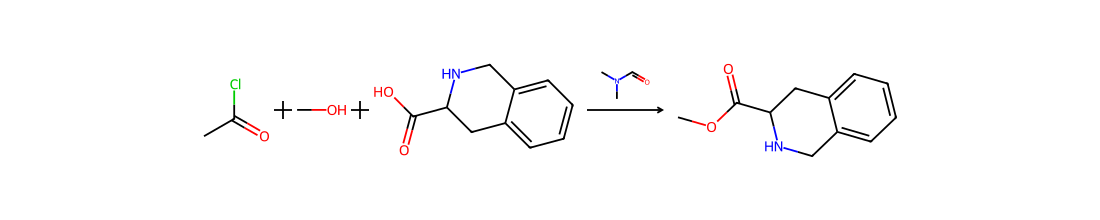
uspto-grants-1998_03 · 10.6084/m9.figshare.5104873.v1 · US05728712
查看
uspto-grants-1998_03 · 10.6084/m9.figshare.5104873.v1 · US05728701
查看
uspto-grants-1998_03 · 10.6084/m9.figshare.5104873.v1 · US05728867
查看
uspto-grants-1998_03 · 10.6084/m9.figshare.5104873.v1 · US05731352
查看