
uspto-grants-1995_05 · 10.6084/m9.figshare.5104873.v1 · US05420275
查看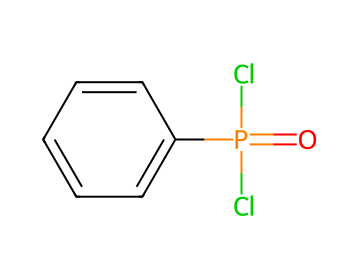
IDENTITY
COMPUTED
PROPERTIES
Benzene phosphorus oxydichloride appears as a colorless reactive liquid. Severely irritates skin, eyes, and mucous membranes.
Colorless to yellow liquid; [Alfa Aesar MSDS]
GHS
This chemical does not meet GHS hazard criteria for 0.4% (1 of 268) of reports.
Danger
H290 (44%): May be corrosive to metals [Warning Corrosive to Metals];H302 (55.2%): Harmful if swallowed [Warning Acute toxicity, oral];H314 (98.9%): Causes severe skin burns and eye damage [Danger Skin corrosion/irritation];H318 (41%): Causes serious eye damage [Danger Serious eye damage/eye irritation];H335 (48.1%): May cause respiratory irritation [Warning Specific target organ toxicity, single exposure; Respiratory tract irritation]
P234, P260, P261, P264, P264+P265, P270, P271, P280, P301+P317, P301+P330+P331, P302+P361+P354, P304+P340, P305+P354+P338, P316, P317, P319, P321, P330, P363, P390, P403+P233, P405, P406, and P501 (click each P-code to see the statement)
Aggregated GHS information provided per 268 reports by companies from 20 notifications to the ECHA C&L Inventory. Each notification may be associated with multiple companies.;Reported as not meeting GHS hazard criteria per 1 of 268 reports by companies.;There are 19 notifications provided by 267 of 268 reports by companies with hazard statement code(s).;Information may vary between notifications depending on impurities, additives, and other factors. The percentage value in parenthesis indicates the notified classification ratio from companies that provide hazard codes. Only hazard codes with percentage values above 10% are shown. For more detailed information, please visit ECHA C&L website.
HAZARDS
Chemical: Phosphonic dichloride, phenyl-
Status: Active Update: 18-11-2019 https://echa.europa.eu/registration-dossier/-/registered-dossier/23307
Dichlorophenylphosphine oxide: Does not have an individual approval but may be used under an appropriate group standard
Corrosive
Excerpt from ERG Guide 154 [Substances - Toxic and/or Corrosive (Non-Combustible)]:;Non-combustible, substance itself does not burn but may decompose upon heating to produce corrosive and/or toxic fumes. Some are oxidizers and may ignite combustibles (wood, paper, oil, clothing, etc.). Corrosives in contact with metals may evolve flammable hydrogen gas. Containers may explode when heated. For electric vehicles or equipment, ERG Guide 147 (lithium ion or sodium ion batteries) or ERG Guide 138 (sodium batteries) should also be consulted. (ERG, 2024)
Excerpt from ERG Guide 154 [Substances - Toxic and/or Corrosive (Non-Combustible)]:;TOXIC and/or CORROSIVE; inhalation, ingestion or skin contact with material may cause severe injury or death. Contact with molten substance may cause severe burns to skin and eyes. Avoid any skin contact. Fire may produce irritating, corrosive and/or toxic gases. Runoff from fire control or dilution water may be corrosive and/or toxic and cause environmental contamination. (ERG, 2024)
Reacts violently with water; Causes burns; Toxic by ingestion; [Alfa Aesar MSDS]
Acyl Halides, Sulfonyl Halides, and Chloroformates;Halogenating Agents
Water-Reactive
Organophosphates are susceptible to formation of highly toxic and flammable phosphine gas in the presence of strong reducing agents such as hydrides. Partial oxidation by oxidizing agents may result in the release of toxic phosphorus oxides. Strong halogenating agents force the addition of one or more halogen atoms to the compound with which they are reacting.
Denser than water and will decompose vigorously in water. Hydrogen chloride fumes and phosphoric acid are produced upon decomposition.
Met. Corr. 1 (44%);Acute Tox. 4 (55.2%);Skin Corr. 1B (98.9%);Eye Dam. 1 (41%);STOT SE 3 (48.1%)
SAFETY
Excerpt from ERG Guide 154 [Substances - Toxic and/or Corrosive (Non-Combustible)]:;SMALL FIRE: Dry chemical, CO2 or water spray.;LARGE FIRE: Dry chemical, CO2, alcohol-resistant foam or water spray. If it can be done safely, move undamaged containers away from the area around the fire. Dike runoff from fire control for later disposal.;FIRE INVOLVING TANKS, RAIL TANK CARS OR HIGHWAY TANKS: Fight fire from maximum distance or use unmanned master stream devices or monitor nozzles. Do not get water inside containers. Cool containers with flooding quantities of water until well after fire is out. Withdraw immediately in case of rising sound from venting safety devices or discoloration of tank. ALWAYS stay away from tanks in direct contact with flames. (ERG, 2024)
Excerpt from ERG Guide 154 [Substances - Toxic and/or Corrosive (Non-Combustible)]:;Refer to the "General First Aid" section. Specific First Aid: For corrosives, in case of contact, immediately flush skin or eyes with running water for at least 30 minutes. Additional flushing may be required. (ERG, 2024)
Excerpt from ERG Guide 154 [Substances - Toxic and/or Corrosive (Non-Combustible)]:;ELIMINATE all ignition sources (no smoking, flares, sparks or flames) from immediate area. Do not touch damaged containers or spilled material unless wearing appropriate protective clothing. Stop leak if you can do it without risk. Prevent entry into waterways, sewers, basements or confined areas. Absorb or cover with dry earth, sand or other non-combustible material and transfer to containers. DO NOT GET WATER INSIDE CONTAINERS. (ERG, 2024)
Excerpt from ERG Guide 154 [Substances - Toxic and/or Corrosive (Non-Combustible)]:;IMMEDIATE PRECAUTIONARY MEASURE: Isolate spill or leak area in all directions for at least 50 meters (150 feet) for liquids and at least 25 meters (75 feet) for solids.;SPILL: Increase the immediate precautionary measure distance, in the downwind direction, as necessary.;FIRE: If tank, rail tank car or highway tank is involved in a fire, ISOLATE for 800 meters (1/2 mile) in all directions; also, consider initial evacuation for 800 meters (1/2 mile) in all directions. (ERG, 2024)
Excerpt from ERG Guide 154 [Substances - Toxic and/or Corrosive (Non-Combustible)]:;Wear positive pressure self-contained breathing apparatus (SCBA). Wear chemical protective clothing that is specifically recommended by the manufacturer when there is NO RISK OF FIRE. Structural firefighters' protective clothing provides thermal protection but only limited chemical protection. (ERG, 2024)
TOXICITY
Dermatotoxin - Skin burns.
REGULATORY
Chemical: Phosphonic dichloride, phenyl-
Status: Active Update: 18-11-2019 https://echa.europa.eu/registration-dossier/-/registered-dossier/23307
Dichlorophenylphosphine oxide: Does not have an individual approval but may be used under an appropriate group standard
USES
Phosphonic dichloride, P-phenyl-: ACTIVE
ALIASES
REACTIONS
uspto-grants-1995_05 · 10.6084/m9.figshare.5104873.v1 · US05420275
查看
uspto-grants-1995_05 · 10.6084/m9.figshare.5104873.v1 · US05420275
查看
Training data from https://doi.org/10.1039/C8SC04228D (9/10) · 10.1039/C8SC04228D
查看
Training data from https://doi.org/10.1039/C8SC04228D (9/10) · 10.1039/C8SC04228D
查看
Training data from https://doi.org/10.1039/C8SC04228D (9/10) · 10.1039/C8SC04228D
查看
Training data from https://doi.org/10.1039/C8SC04228D (9/10) · 10.1039/C8SC04228D
查看
Training data from https://doi.org/10.1039/C8SC04228D (6/10) · 10.1039/C8SC04228D
查看
Training data from https://doi.org/10.1039/C8SC04228D (6/10) · 10.1039/C8SC04228D
查看