
uspto-grants-2006_08 · 10.6084/m9.figshare.5104873.v1 · US07091200B2
查看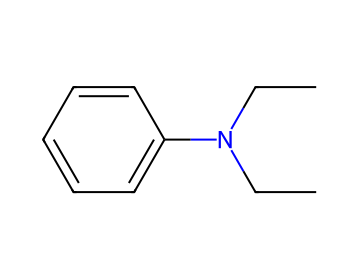
IDENTITY
COMPUTED
PROPERTIES
log Kow= 3.31
3.31
0.906 (USCG, 1999) - Less dense than water; will float
0.9307 @ 20 °C/4 °C
Relative density (water = 1): 0.93
0.9307 @ 20°C
Colorless to yellow liquid
BROWN OILY LIQUID
less than 1 mg/mL at 76.1 °F (NTP, 1992)
1 g dissolves in 70 ml of water at 12 °C; slightly sol in alcohol, chloroform and ether
Sol in acetone
In water, 139 mg/l @ 25 °C
Solubility in water, g/100ml at 25 °C: 0.014
185 °F (NTP, 1992)
185 °F (85 °C) (CLOSED CUP)
79 °C c.c.
419.9 °F at 760 mmHg ; 198 °F at 10 mmHg (NTP, 1992)
216.3 °C
216.3 °C @760 [mm Hg]
When heated to decomposition it emits toxic fumes of nitroxides.
215 °C
-37.8 °F (NTP, 1992)
-38.8 °C
-38 °C
-38.8 °C
1.0 (AIR= 1)
Relative vapor density (air = 1): 5.1
1 mmHg at 121.5 °F (NTP, 1992)
0.13 [mmHg]
0.14 mm Hg @ 25 °C
Vapor pressure, Pa at 20 °C: 19
Index of refraction: 1.5409 @ 20 °C/D
N,n-diethylaniline appears as a colorless to yellow liquid with a fishlike odor, that is strongly corrosive. Irritating to skin, eyes and mucous membranes and moderately toxic by inhalation, absorption and ingestion. Flash point 185 °F. Used in dyes and in the production of organic chemicals.
Liquid
Colorless to yellow liquid; [Merck Index] Light yellow liquid; [MSDSonline]
COLOURLESS-TO-YELLOW LIQUID WITH CHARACTERISTIC ODOUR.
GHS
Danger
H301: Toxic if swallowed [Danger Acute toxicity, oral];H311: Toxic in contact with skin [Danger Acute toxicity, dermal];H331: Toxic if inhaled [Danger Acute toxicity, inhalation];H373 **: May causes damage to organs through prolonged or repeated exposure [Warning Specific target organ toxicity, repeated exposure];H411: Toxic to aquatic life with long lasting effects [Hazardous to the aquatic environment, long-term hazard]
P260, P261, P262, P264, P270, P271, P273, P280, P301+P316, P302+P352, P304+P340, P316, P319, P321, P330, P361+P364, P391, P403+P233, P405, and P501 (click each P-code to see the statement)
This chemical does not meet GHS hazard criteria for 0.2% (1 of 421) of reports.
HAZARDS
Chemical: Benzenamine, N,N-diethyl-
Hazard Traits - Hepatotoxicity and Digestive System Toxicity; Immunotoxicity; Neurotoxicity;Authoritative List - CA TACs;Report - if used as a fragrance or flavor ingredient
Benzenamine, N,N-diethyl- is listed on the EPA's Chemical Data Reporting (CDR) system. Manufacturers and importers of Benzenamine, N,N-diethyl- are required to report information about their production and use of this chemical to the EPA under the Toxic Substances Control Act (TSCA). (40 eCFR Part 711)
Status: Active Update: 21-02-2019 https://echa.europa.eu/registration-dossier/-/registered-dossier/5270;Status: Cease Manufacture Update: 07-11-2017 https://echa.europa.eu/registration-dossier/-/registered-dossier/20925
Diethylaniline: Does not have an individual approval but may be used under an appropriate group standard
The New Jersey Worker and Community Right to Know Act requires public and private employers to provide information about hazardous substances at their workplaces. (N.J.S.A. 34:5A-1 et. seq.)
Poison
Special Hazards of Combustion Products: Emits toxic fumes under fire conditions. (USCG, 1999)
· Combustible material: may burn but does not ignite readily.;· When heated, vapors may form explosive mixtures with air: indoors, outdoors and sewers explosion hazards.;· Those substances designated with a (P) may polymerize explosively when heated or involved in a fire.;· Corrosives in contact with metals may evolve flammable hydrogen gas.;· Containers may explode when heated.;· Runoff may pollute waterways.;· Substance may be transported in a molten form.
Combustible. Gives off irritating or toxic fumes (or gases) in a fire. Above 79 °C explosive vapour/air mixtures may be formed.
May be fatal if inhaled, swallowed or absorbed through the skin. Vapor or mist is irritant to the eyes, mucous membranes, upper respiratory tract; causes skin irritation. Absorption into the body leads to the formation of methemoglobin which, in sufficient concentration, may cause cyanosis. Onset may be delayed 2-4 hours or longer. Exposure can cause nausea, dizziness, headache, damage to the eyes, and blood effects. (USCG, 1999)
· TOXIC and/or CORROSIVE; inhalation, ingestion or skin contact with material may cause severe injury or death.;· Methyl bromoacetate (UN2643) is an eye irritant/lachrymator (causes flow of tears).;· Contact with molten substance may cause severe burns to skin and eyes.;· Avoid any skin contact.;· Fire may produce irritating, corrosive and/or toxic gases.;· Runoff from fire control or dilution water may be corrosive and/or toxic and cause environmental contamination.
A skin and eye irritant; May be absorbed through skin; Can induce methemoglobinemia; May cause anemia; [ICSC] A skin, eye, mucous membrane, and upper respiratory tract irritant; Can induce methemoglobinemia; [CAMEO] An irritant; [MSDSonline] See Aniline.
2432 153
Amines, Aromatic
Symbol: T, N; R: 23/24/25-33-51/53; S: (1/2)-28-37-45-61
UN Hazard Class: 6.1; UN Pack Group: III
N,N-DIETHYLANILINE neutralizes acids in exothermic reactions to form salts plus water. May be incompatible with isocyanates, halogenated organics, peroxides, phenols (acidic), epoxides, anhydrides, and acid halides. Flammable gaseous hydrogen may be generated in combination with strong reducing agents, such as hydrides.
Decomposes on heating. This produces toxic fumes including nitrogen oxides.
Do not transport with food and feedstuffs.
SAFETY
Excerpt from ERG Guide 153 [Substances - Toxic and/or Corrosive (Combustible)]:;SMALL FIRE: Dry chemical, CO2 or water spray.;LARGE FIRE: Dry chemical, CO2, alcohol-resistant foam or water spray. If it can be done safely, move undamaged containers away from the area around the fire. Dike runoff from fire control for later disposal.;FIRE INVOLVING TANKS, RAIL TANK CARS OR HIGHWAY TANKS: Fight fire from maximum distance or use unmanned master stream devices or monitor nozzles. Do not get water inside containers. Cool containers with flooding quantities of water until well after fire is out. Withdraw immediately in case of rising sound from venting safety devices or discoloration of tank. ALWAYS stay away from tanks in direct contact with flames. (ERG, 2024)
Use water spray, foam, powder, carbon dioxide.
Fresh air, rest. Refer for medical attention.
Remove contaminated clothes. Rinse and then wash skin with water and soap. Refer for medical attention .
First rinse with plenty of water for several minutes (remove contact lenses if easily possible), then refer for medical attention.
Rinse mouth. Give one or two glasses of water to drink. Give a slurry of activated charcoal in water to drink. Refer for medical attention .
· CALL 911. Then call emergency response telephone number on shipping paper. If shipping paper not available or no answer, refer to appropriate telephone number listed on the inside back cover.;· Keep unauthorized personnel away.;· Stay upwind, uphill and/or upstream.;· Ventilate closed spaces before entering, but only if properly trained and equipped.
· ELIMINATE all ignition sources (no smoking, flares, sparks or flames) from immediate area.;· Do not touch damaged containers or spilled material unless wearing appropriate protective clothing.;· Stop leak if you can do it without risk.;· Prevent entry into waterways, sewers, basements or confined areas.;· Absorb or cover with dry earth, sand or other non-combustible material and transfer to containers.;· DO NOT GET WATER INSIDE CONTAINERS.
EYES: First check the victim for contact lenses and remove if present. Flush victim's eyes with water or normal saline solution for 20 to 30 minutes while simultaneously calling a hospital or poison control center. Do not put any ointments, oils, or medication in the victim's eyes without specific instructions from a physician. IMMEDIATELY transport the victim after flushing eyes to a hospital even if no symptoms (such as redness or irritation) develop.;SKIN: IMMEDIATELY flood affected skin with water while removing and isolating all contaminated clothing. Gently wash all affected skin areas thoroughly with soap and water. If symptoms such as redness or irritation develop, IMMEDIATELY call a physician and be prepared to transport the victim to a hospital for treatment.;INHALATION: IMMEDIATELY leave the contaminated area; take deep breaths of fresh air. If symptoms (such as wheezing, coughing, shortness of breath, or burning in the mouth, throat, or chest) develop, call a physician and be prepared to transport the victim to a hospital. Provide proper respiratory protection to rescuers entering an unknown atmosphere. Whenever possible, Self-Contained Breathing Apparatus (SCBA) should be used; if not available, use a level of protection greater than or equal to that advised under Protective Clothing.;INGESTION: DO NOT INDUCE VOMITING. If the victim is conscious and not convulsing, give 1 or 2 glasses of water to dilute the chemical and IMMEDIATELY call a hospital or poison control center. Be prepared to transport the victim to a hospital if advised by a physician. If the victim is convulsing or unconscious, do not give anything by mouth, ensure that the victim's airway is open and lay the victim on his/her side with the head lower than the body. DO NOT INDUCE VOMITING. IMMEDIATELY transport the victim to a hospital. (NTP, 1992)
General First Aid:;· Call 911 or emergency medical service.;· Ensure that medical personnel are aware of the material(s) involved, take precautions to protect themselves and avoid contamination.;· Move victim to fresh air if it can be done safely.;· Administer oxygen if breathing is difficult.;· If victim is not breathing:;-- DO NOT perform mouth-to-mouth resuscitation; the victim may have ingested or inhaled the substance.;-- If equipped and pulse detected, wash face and mouth, then give artificial respiration using a proper respiratory medical device (bag-valve mask, pocket mask equipped with a one-way valve or other device).;-- If no pulse detected or no respiratory medical device available, provide continuous compressions. Conduct a pulse check every two minutes or monitor for any signs of spontaneous respirations.;· Remove and isolate contaminated clothing and shoes.;· For minor skin contact, avoid spreading material on unaffected skin.;· In case of contact with substance, remove immediately by flushing skin or eyes with running water for at least 20 minutes.;· For severe burns, immediate medical attention is required.;· Effects of exposure (inhalation, ingestion, or skin contact) to substance may be delayed.;· Keep victim calm and warm.;· Keep victim under observation.;· For further assistance, contact your local Poison Control Center.;· Note: Basic Life Support (BLS) and Advanced Life Support (ALS) should be done by trained professionals.;Specific First Aid:;· For corrosives, in case of contact, immediately flush skin or eyes with running water for at least 30 minutes. Additional flushing may be required.
Store in an area without drain or sewer access. Well closed. Separated from food and feedstuffs.
· Wear positive pressure self-contained breathing apparatus (SCBA).;· Wear chemical protective clothing that is specifically recommended by the manufacturer when there is NO RISK OF FIRE.;· Structural firefighters' protective clothing provides thermal protection but only limited chemical protection.
If material involved in fire: Extinguish fire using agent suitable for type of surrounding fire. (Material itself does not burn or burns with difficulty.) Keep run-off water out of sewers and water sources.
Excerpt from ERG Guide 153 [Substances - Toxic and/or Corrosive (Combustible)]:;ELIMINATE all ignition sources (no smoking, flares, sparks or flames) from immediate area. Do not touch damaged containers or spilled material unless wearing appropriate protective clothing. Stop leak if you can do it without risk. Prevent entry into waterways, sewers, basements or confined areas. Absorb or cover with dry earth, sand or other non-combustible material and transfer to containers. DO NOT GET WATER INSIDE CONTAINERS. (ERG, 2024)
SRP: At the time of review, criteria for land treatment or burial (sanitary landfill) disposal practices are subject to significant revision. Prior to implementing land disposal of waste residue (including waste sludge), consult with environmental regulatory agencies for guidance on acceptable disposal practices.
Personal protection: complete protective clothing including self-contained breathing apparatus. Do NOT let this chemical enter the environment. Collect leaking and spilled liquid in sealable containers as far as possible. Absorb remaining liquid in sand or inert absorbent. Then store and dispose of according to local regulations.
If material not on fire and not involved in fire: Keep material out of water sources and sewers. Build dikes to contain flow as necessary. Attempt to stop leak if without undue personnel hazard.
Personnel protection: Keep upwind. Avoid breathing vapors. ... Do not handle broken packages unless wearing appropriate personal protective equipment. Avoid bodily contact with the material.
Excerpt from ERG Guide 153 [Substances - Toxic and/or Corrosive (Combustible)]:;IMMEDIATE PRECAUTIONARY MEASURE: Isolate spill or leak area in all directions for at least 50 meters (150 feet) for liquids and at least 25 meters (75 feet) for solids.;SPILL: Increase the immediate precautionary measure distance, in the downwind direction, as necessary.;FIRE: If tank, rail tank car or highway tank is involved in a fire, ISOLATE for 800 meters (1/2 mile) in all directions; also, consider initial evacuation for 800 meters (1/2 mile) in all directions. (ERG, 2024)
Immediate precautionary measure;· Isolate spill or leak area in all directions for at least 50 meters (150 feet) for liquids and at least 25 meters (75 feet) for solids.;Spill;· For highlighted materials: see Table 1 - Initial Isolation and Protective Action Distances.;· For non-highlighted materials: increase the immediate precautionary measure distance, in the downwind direction, as necessary.;Fire;· If tank, rail tank car or highway tank is involved in a fire, ISOLATE for 800 meters (1/2 mile) in all directions; also, consider initial evacuation for 800 meters (1/2 mile) in all directions.
TOXICITY
TERRESTRIAL FATE: Based on a classification scheme(1), an estimated Koc value of 1,500(SRC), determined from a log Kow of 3.31(2) and a regression-derived equation(3), indicates that N,N-diethylaniline is expected to have low mobility in soil(SRC). A pKa value of 6.57(4) suggests that N,N-diethylaniline will exist partially in the protonated form in moist soils and the protonated form of N,N-diethylaniline is expected to bind strongly to soil surfaces(SRC). Volatilization of N,N-diethylaniline from moist soil surfaces is expected to be an important fate process for the neutral species(SRC) given an estimated Henry's Law constant of 1.9X10⁻⁴ atm-cu m/mole(SRC), derived from its vapor pressure of 0.14 mm Hg(5) and water solubility of 139 mg/l(6) at 25 °C. N,N-Diethylaniline is not expected to volatilize from dry soil surfaces(SRC) based upon its vapor pressure(5). N,N-Diethylaniline achieved 0% of the theoretical BOD in a sewage sludge test during a 5 day incubation period and was considered persistent(7).
AQUATIC FATE: Based on a classification scheme(1), an estimated Koc value of 1,500(SRC), determined from a log Kow of 3.31(2) and a regression-derived equation(3), indicates that N,N-diethylaniline is expected to adsorb to suspended solids and sediment(SRC). Volatilization from water surfaces is expected(3) based upon an estimated Henry's Law constant of 1.9X10⁻⁴ atm-cu m/mole(SRC), derived from its vapor pressure of 0.14 mm Hg(4) and water solubility of 139 mg/l(5) at 25 °C. Using this Henry's Law constant and an estimation method(3), volatilization half-lives for a model river and model lake are 5 hours and 6.5 days, respectively(SRC). A pKa of 6.57(6) suggests that N,N-diethylaniline will exist partially in the protonated form in aqueous environments and the protonated form of N,N-diethylaniline is not expected to volatilize from water. According to a classification scheme(7), BCF values of 17-161 measured in carp(8) suggest bioconcentration in aquatic organisms is low to high. N,N-Diethylaniline achieved 0% of the theoretical BOD in a sewage sludge during a 5 day incubation period and was considered persistent(9). Using the Japanese MITI test, N,N-diethylaniline achieved 0% of theoretical BOD in an acclimated study during a 4 week incubation(8).
ATMOSPHERIC FATE: According to a model of gas/particle partitioning of semivolatile organic compounds in the atmosphere(1), N,N-diethylaniline, which has a vapor pressure of 0.14 mm Hg at 25 °C(2), is expected to exist solely as a vapor in the ambient atmosphere. Vapor-phase N,N-diethylaniline is degraded in the atmosphere by reaction with photochemically-produced hydroxyl radicals(SRC); the half-life for this reaction in air is estimated to be 2 hours(SRC), calculated from its estimated rate constant of 1.6X10⁻¹⁰ cu cm/molecule-sec at 25 °C(3) determined using a structure estimation method(3).
Methemoglobinemia - The presence of increased methemoglobin in the blood; the compound is classified as secondary toxic effect
The substance can be absorbed into the body by inhalation of its vapour, by ingestion and through the skin.
Blue lips, fingernails and skin. Convulsions. Dizziness. Laboured breathing. Vomiting. Symptoms may be delayed.
Redness. MAY BE ABSORBED! Further see Inhalation.
Redness. Pain.
See Inhalation.
N,N-Diethylaniline was detected in the effluent of a publicly owned treatment works in NJ at a concn of 3 ppb(1) and at 2 mg/l in the retort water fraction from a shale oil facility(2).
The substance is toxic to aquatic organisms. Bioaccumulation of this chemical may occur along the food chain. It is strongly advised not to let the chemical enter into the environment. The substance may cause long-term effects in the aquatic environment.
A pKa value of 6.57(1) suggests that N,N-diethylaniline will exist partially in the protonated form in moist soils and the protonated form of N,N-diethylaniline is expected to bind strongly to soil surfaces(SRC). The Koc of N,N-diethylaniline is estimated as 1,500(SRC), using a log Kow of 3.31(2) and a regression-derived equation(3). According to a classification scheme(4), this estimated Koc value suggests that N,N-diethylaniline is expected to have low mobility in soil.
Developmental toxicity of diethylaniline was evaluated in groups of 24 pregnant CD rats fed dose levels of 0, 50, 250, or 500 mg/kg bw/day, by gavage, on gestation days 6-15, followed by fetal examination on gestation day 20. The treatment killed 0, 0, and 5 rats in the low-, mid-, and high-dose groups, respectively. Symptoms of maternal toxicity that were observed in all dose groups included decreased body weight gain and food consumption, and excessive salivation; rats in the mid- and high- dose groups also had excessive lacrimation and staining of the skin/fur in the ano-genital region. The treatment was fetotoxic (reduced fetal weight gain and retarded sternebral ossification), but not embryotoxic or teratogenic, at the high-dose level. The treatment was not embryotoxic, fetotoxic, or teratogenic at the low- and mid-dose levels.
Developmental toxicity of diethylaniline was evaluated in groups of 5 pregnant Sprague-Dawley CD rats fed dose levels of 0, 100, 250, 500, 750, 1000, 1500, or 2000 mg/kg bw/day, by gavage, on gestation days 6-15, followed by fetal examination on gestation day 20. The treatment killed 0, 0, 0, and 4 rats in the 100, 250, 500, and 750 mg/kg dose groups, respectively. All rats in the 1000, 1500, and 2000 mg/kg dose groups died by gestation day 7, after receiving 1-2 treatments; embryotoxic, fetotoxic, and teratogenic effects could not be evaluated in those groups. Symptoms of maternal toxicity in surviving dams included decreased body weight gain and food consumption (100, 250, 500, and 750 mg/kg), and staining of the fur in the ano-genital region (250, 500, and 750 mg/kg). Gross necropsy revealed discolored lungs in some dams at all dose levels. The treatment was not embryotoxic (rate of uterine implantation was normal) or teratogenic at any dose level, but was fetotoxic (reduced fetal weight gain) at 500 and 750 mg/kg.
POISONING MAY ... OCCUR THROUGH INHALATION OF VAPORS. ... HAZARDS MAY BE CONSIDERED AS SIMILAR TO THOSE OF ANILINE.
N,N-Diethylaniline's production and use in the synthesis of dyes(1) may result in its release to the environment through various waste streams(SRC).
N,N-Diethylaniline, present at 100 mg/l, reached 0% of its theoretical BOD in 4 weeks using an activated sludge inoculum at 30 mg/l and the Japanese MITI test(1). N,N-Diethylaniline achieved 0% of the theoretical BOD in a sewage sludge during a 5 day incubation period and was considered persistent(2).
BCF values of 44-161 were measured for carp exposed to 0.2 mg/l of N,N-diethylaniline for 8 weeks and BCF values of 17-125 were measured for carp exposed to 0.02 mg/l(1). According to a classification scheme(2), this BCF data suggests the potential for bioconcentration in aquatic organisms is low to high.
REGULATORY
Chemical: Benzenamine, N,N-diethyl-
Hazard Traits - Hepatotoxicity and Digestive System Toxicity; Immunotoxicity; Neurotoxicity;Authoritative List - CA TACs;Report - if used as a fragrance or flavor ingredient
Benzenamine, N,N-diethyl- is listed on the EPA's Chemical Data Reporting (CDR) system. Manufacturers and importers of Benzenamine, N,N-diethyl- are required to report information about their production and use of this chemical to the EPA under the Toxic Substances Control Act (TSCA). (40 eCFR Part 711)
Status: Active Update: 21-02-2019 https://echa.europa.eu/registration-dossier/-/registered-dossier/5270;Status: Cease Manufacture Update: 07-11-2017 https://echa.europa.eu/registration-dossier/-/registered-dossier/20925
Diethylaniline: Does not have an individual approval but may be used under an appropriate group standard
The New Jersey Worker and Community Right to Know Act requires public and private employers to provide information about hazardous substances at their workplaces. (N.J.S.A. 34:5A-1 et. seq.)
Persons in charge of vessels or facilities are required to notify the National Response Center (NRC) immediately, when there is a release of this designated hazardous substance, in an amount equal to or greater than its reportable quantity of 1000 lb or 454 kg. The toll free number of the NRC is (800) 424-8802; In the Washington D.C. metropolitan area (202) 426-2675. The rule for determining when notification is required is stated in 40 CFR 302.4 (section IV. D.3.b).
PHARMACOLOGY
IN RAT LIVER MICROSOMES N-DEALKYLATION OCCURRED DURING MICROSOMAL METABOLISM OF N,N-DIALKYLANILINES. N-OXIDATION WAS FOUND WITH N,N-DIETHYLANILINE ONLY.
IT IS READILY ABSORBED THROUGH INTACT SKIN ...
... Readily absorbed ... by inhalation of vapors.
USES
Used to make pharmaceuticals and dyes; [HSDB]
USED IN SYNTH OF PHARMACEUTICALS
Chem int for dyes and for other organic syntheses
(1977) 1.50X10+8 GRAMS (PRINCPL CUSTMS DISTS)
(1979) 2.11X10+8 GRAMS (PRINCPL CUSTMS DISTS)
2023: 220,460 lb;2022: 454,941 lb;2021: 507,940 lb;2020: 436,848 lb
(1977) 9.62X10+8 GRAMS
(1979) 1.16X10+9 GRAMS
Intermediate
REACTION OF ANILINE WITH ETHANOL AT HIGH PRESSURE WITH AN ACID CATALYST
...by ethylation of aniline: Whitman, US patent 2,501,556 (1950 to Du Pont); Voltz, J Org Chem 22, 48 (1957). Closson et al, J Org Chem 22, 646 (1957); Horyna, Cerny, Coll Czech Chem Commun 21, 906 (1956); from bromobenzene, sodium azide plus diethylamine: Bunnett, Brotherton, J Org Chem 22, 832 (1957).
Grade: Technical
Miscellaneous Manufacturing
Benzenamine, N,N-diethyl-: ACTIVE
INSECT REPELLING SUBSTANCE, N,N-DIETHYLANILINE WAS WORKED UP WITH POLYETHYLENE GLYCOL, POLYVINYL ALCOHOL, ETHOXYLATED ALCOHOLS, & CELLULOSE DERIVATIVES TO LOTIONS OR OINTMENTS APPLICABLE TO SKIN. THE COMPOSITION IS READILY WASHED OFF AFTER USE.
ALIASES
REACTIONS
uspto-grants-2006_08 · 10.6084/m9.figshare.5104873.v1 · US07091200B2
查看
uspto-grants-2006_08 · 10.6084/m9.figshare.5104873.v1 · US07094778B2
查看
uspto-grants-2006_08 · 10.6084/m9.figshare.5104873.v1 · US07094782B1
查看
uspto-grants-2010_06 · 10.6084/m9.figshare.5104873.v1 · US07737153B2
查看
uspto-grants-1979_04 · 10.6084/m9.figshare.5104873.v1 · US04147863
查看
uspto-grants-1980_09 · 10.6084/m9.figshare.5104873.v1 · US04220357
查看
uspto-grants-1980_09 · 10.6084/m9.figshare.5104873.v1 · US04220644
查看
uspto-grants-1988_08 · 10.6084/m9.figshare.5104873.v1 · US04761475
查看