
uspto-grants-2010_06 · 10.6084/m9.figshare.5104873.v1 · US07728131B2
查看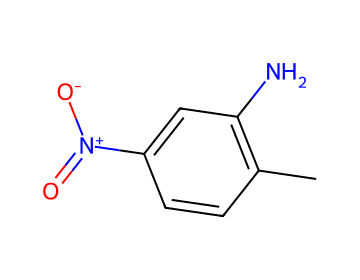
IDENTITY
COMPUTED
PROPERTIES
log Kow = 1.87
1.365 deg 15 C/deg 4 C
Yellow monoclinic prisms
less than 1 mg/mL at 66 °F (NTP, 1992)
Soluble in acetone, benzene, ether, ethanol, chloroform
In water, 1 g/100 mL at 19 °C
13.5 [ug/mL] (The mean of the results at pH 7.4)
When heated to decomposition it emits toxic fumes of /nitrogen oxides/.
Decomposes exothermically when heated to 150 °C
219 to 225 °F (NTP, 1992)
105.5 °C
107 °C
0.000975 [mmHg]
0.000013 [mm Hg] @20 °C
5-nitro-o-toluidine is a bright yellow powder. (NTP, 1992)
Dry Powder
Yellow crystals; [ACGIH]
pKa = 2.345 (conjugate acid)
272.14;272.81
GHS
Danger
H301: Toxic if swallowed [Danger Acute toxicity, oral];H311: Toxic in contact with skin [Danger Acute toxicity, dermal];H331: Toxic if inhaled [Danger Acute toxicity, inhalation];H351: Suspected of causing cancer [Warning Carcinogenicity];H412: Harmful to aquatic life with long lasting effects [Hazardous to the aquatic environment, long-term hazard]
P203, P261, P262, P264, P270, P271, P273, P280, P301+P316, P302+P352, P304+P340, P316, P318, P321, P330, P361+P364, P403+P233, P405, and P501 (click each P-code to see the statement)
Danger
HAZARDS
Chemical: Benzenamine, 2-methyl-5-nitro-
Benzenamine, 2-methyl-5-nitro- is listed on the EPA's Chemical Data Reporting (CDR) system. Manufacturers and importers of Benzenamine, 2-methyl-5-nitro- are required to report information about their production and use of this chemical to the EPA under the Toxic Substances Control Act (TSCA). (40 eCFR Part 711)
Status: Active Update: 19-12-2017 https://echa.europa.eu/registration-dossier/-/registered-dossier/10372
The New Jersey Worker and Community Right to Know Act requires public and private employers to provide information about hazardous substances at their workplaces. (N.J.S.A. 34:5A-1 et. seq.)
IMAP assessments - Benzenamine, 2-methyl-5-nitro-: Human health tier II assessment;IMAP assessments - Benzenamine, 2-methyl-5-nitro-: Environment tier I assessment
Poison
Flash point data for this chemical are not available; however, it is probably combustible. (NTP, 1992)
SYMPTOMS: Symptoms of exposure to this chemical include methemoglobinemia and respiratory distress.;ACUTE/CHRONIC HAZARDS: This compound is an irritant and an experimental carcinogen. It may be absorbed through the skin. When heated to decomposition this compound emits toxic fumes of carbon monoxide, carbon dioxide and nitrogen oxides. (NTP, 1992)
Several Japanese workers were admitted to the hospital with severe liver damage after handling repeatedly (12-20 times) 5-nitro-o-toluidine for 4-5 hours at a time. Workers had scooped the powder by hand while wearing respirators. [Gut 2002 Feb;50(2):266-70] Methemoglobinemia is a potential adverse effect after exposure to this agent. [HSDB]
The major hazards encountered in the use and handling of 5-nitro-o-toluidine stem from its toxicologic properties. Dermal or inhalation exposure to this yellow, crystalline substance may occur from its production, handling, or use as a chemical intermediate for dyes and pigments. The EPA has designated 5-nitro-o-toluidine as a Group C carcinogen, ie, it is considered to be possibly carcinogenic to humans. If contact with this substance should occur, irrigate exposed eyes with copious amounts of tepid water for at least 15 minutes, and wash exposed skin thoroughly with soap and water. This substance is a candidate for rotary kiln and fluidized bed forms of incineration.
Nitro, Nitroso, Nitrate, and Nitrite Compounds, Organic;Amines, Aromatic
USEPA; Health and Environmental Effects Profile for 2-Methyl-5-nitroaniline EPA/600/X-87/091 (1989).
Bioassay of 5-Nitro-o-toluidine for Possible Carcinogenicity (1978) Technical Rpt Series No. 107 DHEW Pub No. (NIH) 78-1357, U.S. Department of Health Education and Welfare, National Cancer Institute, Bethesda, MD 20014
U181; As stipulated in 40 CFR 261.33, when 5-nitro-o-toluidine, as a commercial chemical product or manufacturing chemical intermediate or an off-specification commercial chemical product or a manufacturing chemical intermediate, becomes a waste, it must be managed according to Federal and/or State hazardous waste regulations. Also defined as a hazardous waste is any residue, contaminated soil, water, or other debris resulting from the cleanup of a spill, into water or on dry land, of this waste. Generators of small quantities of this waste may qualify for partial exclusion from hazardous waste regulations (40 CFR 261.5).
5-NITRO-O-TOLUIDINE is incompatible with strong oxidizing agents, acids, acid chlorides, acid anhydrides and chloroformates. (NTP, 1992)
/GUIDE 153: SUBSTANCES - TOXIC AND/OR CORROSIVE (COMBUSTIBLE)/ Health: TOXIC; inhalation, ingestion, or skin contact with material may cause severe injury or death. Contact with molten substance may cause severe burns to skin and eyes. Avoid any skin contact. Effects of contact or inhalation may be delayed. Fire may produce irritating, corrosive and/or toxic gases. Runoff from fire control or dilution water may be corrosive and/or toxic and cause pollution. /Mononitrotoluidines; Nitrotoluidines (mono)/
/GUIDE 153: SUBSTANCES - TOXIC AND/OR CORROSIVE (COMBUSTIBLE)/ Fire or Explosion: Combustible material: may burn but does not ignite readily. When heated, vapors may form explosive mixtures with air: indoors, outdoors, and sewers explosion hazards. Those substances designated with a "P" may polymerize explosively when heated or involved in a fire. Contact with metals may evolve flammable hydrogen gas. Containers may explode when heated. Runoff may pollute waterways. Substance may be transported in a molten form. /Mononitrotoluidines; Nitrotoluidines (mono)/
/GUIDE 153: SUBSTANCES - TOXIC AND/OR CORROSIVE (COMBUSTIBLE)/ Public Safety: CALL Emergency Response Telephone Number ... . As an immediate precautionary measure, isolate spill or leak area in all directions for at least 50 meters (150 feet) for liquids and at least 25 meters (75 feet) for solids. Keep unauthorized personnel away. Stay upwind. Keep out of low areas. Ventilate enclosed areas. /Mononitrotoluidines; Nitrotoluidines (mono)/
/GUIDE 153: SUBSTANCES - TOXIC AND/OR CORROSIVE (COMBUSTIBLE)/ Protective Clothing: Wear positive pressure self-contained breathing apparatus (SCBA). Wear chemical protective clothing that is specifically recommended by the manufacturer. It may provide little or no thermal protection. Structural firefighters' protective clothing provides limited protection in fire situations ONLY; it is not effective in spill situations where direct contact with the substance is possible. /Mononitrotoluidines; Nitrotoluidines (mono)/
For more DOT Emergency Guidelines (Complete) data for 5-NITRO-O-TOLUIDINE (8 total), please visit the HSDB record page.
Insoluble in water. This compound is sensitive to moisture, light, or prolonged exposure to air.
SAFETY
Fires involving this material should be controlled using a dry chemical, carbon dioxide or Halon extinguisher. (NTP, 1992)
EYES: First check the victim for contact lenses and remove if present. Flush victim's eyes with water or normal saline solution for 20 to 30 minutes while simultaneously calling a hospital or poison control center. Do not put any ointments, oils, or medication in the victim's eyes without specific instructions from a physician. IMMEDIATELY transport the victim after flushing eyes to a hospital even if no symptoms (such as redness or irritation) develop.;SKIN: IMMEDIATELY flood affected skin with water while removing and isolating all contaminated clothing. Gently wash all affected skin areas thoroughly with soap and water. If symptoms such as redness or irritation develop, IMMEDIATELY call a physician and be prepared to transport the victim to a hospital for treatment.;INHALATION: IMMEDIATELY leave the contaminated area; take deep breaths of fresh air. IMMEDIATELY call a physician and be prepared to transport the victim to a hospital even if no symptoms (such as wheezing, coughing, shortness of breath, or burning in the mouth, throat, or chest) develop. Provide proper respiratory protection to rescuers entering an unknown atmosphere. Whenever possible, Self-Contained Breathing Apparatus (SCBA) should be used; if not available, use a level of protection greater than or equal to that advised under Protective Clothing.;INGESTION: DO NOT INDUCE VOMITING. If the victim is conscious and not convulsing, give 1 or 2 glasses of water to dilute the chemical and IMMEDIATELY call a hospital or poison control center. Be prepared to transport the victim to a hospital if advised by a physician. If the victim is convulsing or unconscious, do not give anything by mouth, ensure that the victim's airway is open and lay the victim on his/her side with the head lower than the body. DO NOT INDUCE VOMITING. IMMEDIATELY transport the victim to a hospital.;OTHER: Since this chemical is a known or suspected carcinogen you should contact a physician for advice regarding the possible long term health effects and potential recommendation for medical monitoring. Recommendations from the physician will depend upon the specific compound, its chemical, physical and toxicity properties, the exposure level, length of exposure, and the route of exposure. (NTP, 1992)
This chemical may burn but does not easily ignite. Use dry chemical, carbon dioxide, water spray, or alcohol or polymer foam extinguishers. Poisonous gases including nitrogen oxides are produced in fire. If materials or contaminated runoff enters waterways, notify downstream users of potentially contaminated waters. Notify local health and fire officials and pollution control agencies. From a secure, explosion-proof location, use water spray to cool exposed containers. If cooling streams are ineffective (venting sound increases in volume and pitch, tank discolors, or shows any signs of deforming), withdraw immediately to a secure position. If employees are expected to fight fires, they must be trained and equipped.
Prior to working with this chemical you should be trained on its proper handling and storage. Store in tightly closed containers in a cool, well ventilated area away from oxidizers, strong acids, acid cholrides, acid anhydrides, chloroformates. Where possible, automatically pump liquid from drums or other storage containers to process containers. Sources of ignition such as smoking and open flames are prohibited where this chemical is handled, used, or stored. Metal containers involving the transfer of 5 gallons or more of this chemical should be grounded and bonded. Drums must be equipped with self-closing valves, pressure vacuum bungs, and flame arresters. Use only non-sparking tools and equipment, especially when opening and closing containers of this chemical. Wherever this chemical is used, handled, manufactured, or stored, use explosion-proof electrical equipment and fittings.
Evacuate persons not wearing protective equipment from area of spill or leak until cleanup is complete. Remove all ignition sources. Use HEPA vacuum or wet method to reduce dust during clean-up. Do not dry sweep. Collect powdered material in the most convenient and safe manner and deposit in sealed containers. Ventilate area of spill or leak after clean-up is complete. It may be necessary to contain and dispose of this chemical as a hazardous waste. If material or contaminated runoff enters waterways, notify downstream users of potentially contaminated waters. Contact your Department of Environmental Protection or your regional office of the federal EPA for specific recommendations. If employees are required to clean-up spills, they must be properly trained and equipped.
SMALL SPILLS AND LEAKAGE: Should a spill occur while you are handling this chemical, FIRST REMOVE ALL SOURCES OF IGNITION, then you should dampen the solid spill material with 60-70% ethanol and transfer the dampened material to a suitable container. Use absorbent paper dampened with 60-70% ethanol to pick up any remaining material. Seal the absorbent paper, and any of your clothes, which may be contaminated, in a vapor-tight plastic bag for eventual disposal. Solvent wash all contaminated surfaces with 60-70% ethanol followed by washing with a soap and water solution. Do not reenter the contaminated area until the Safety Officer (or other responsible person) has verified that the area has been properly cleaned.;STORAGE PRECAUTIONS: You should protect this chemical from exposure to light. Keep the container tightly closed under an inert atmosphere, and store under refrigerated temperatures. (NTP, 1992)
[40 CFR 240-280, 300-306, 702-799 (7/1/2006)] Generators of waste (equal to or greater than 100 kg/mo) containing this contaminant, EPA hazardous waste number U181, must conform with USEPA regulations in storage, transportation, treatment and disposal of waste.
Consult with environmental regulatory agencies for guidance on acceptable disposal practices. Generators of waste containing this contaiminant (>/= 100 kg/mo) must conform with EPA regulations governing storage, transportation, treatment, and waste disposal.
A potential candidate for rotary kiln incineration at a temperature range of 820 to 1,600 °C and residence times of seconds for liquids and gases, and hours for solids. A potential candidate for fluidized bed incineration at a temperature range of 450 to 980 °C and residence times of seconds for liquids and gases, and longer for solids.
Wear protective gloves and clothing to prevent any reasonable probability of skin contact. Safety equipment suppliers/manufacturers can provide recommendations on the most protective glove/clothing material for your operation. All protective clothing (suits, gloves, footwear, headgear) should be clean, available each day, and put on before work. Contact lenses should not be worn when working with this chemical. Wear dust-proof chemical goggles and face shield unless full facepiece respiratory protection is worn. Employees should wash immediately with soap when skin is wet or contaminated. Provide emergency showers and eyewash.
SRP: Contaminated protective clothing should be segregated in such a manner so that there is no direct personal contact by personnel who handle, dispose, or clean the clothing. Quality assurance to ascertain the completeness of the cleaning procedures should be implemented before the decontaminated protective clothing is returned for reuse by the workers. Contaminated clothing should not be taken home at end of shift, but should remain at employee's place of work for cleaning.
SRP: The scientific literature for the use of contact lenses in industry is conflicting. The benefit or detrimental effects of wearing contact lenses depend not only upon the substance, but also on factors including the form of the substance, characteristics and duration of the exposure, the uses of other eye protection equipment, and the hygiene of the lenses. However, there may be individual substances whose irritating or corrosive properties are such that the wearing of contact lenses would be harmful to the eye. In those specific cases, contact lenses should not be worn. In any event, the usual eye protection equipment should be worn even when contact lenses are in place.
Excerpt from ERG Guide 153 [Substances - Toxic and/or Corrosive (Combustible)]:;IMMEDIATE PRECAUTIONARY MEASURE: Isolate spill or leak area in all directions for at least 50 meters (150 feet) for liquids and at least 25 meters (75 feet) for solids.;SPILL: Increase the immediate precautionary measure distance, in the downwind direction, as necessary.;FIRE: If tank, rail tank car or highway tank is involved in a fire, ISOLATE for 800 meters (1/2 mile) in all directions; also, consider initial evacuation for 800 meters (1/2 mile) in all directions. (ERG, 2024)
1.0 [mg/m3], inhalable fraction and vapor
8 hr Time Weighted Avg (TWA): 1 mg/cu m (inhalable fraction)
Excursion Limit Recommendation: Excursions in worker exposure levels may exceed 3 times the TLV-TWA for no more than a total of 30 minutes during a work day, and under no circumstances should they exceed 5 times the TLV-TWA, provided that the TLV-TWA is not exceeded.
A3: Confirmed animal carcinogen with unknown relevance to humans.
3.0 [mg/m3]
19 [mg/m3]
110 [mg/m3]
RECOMMENDED RESPIRATOR: Where the neat test chemical is weighed and diluted, wear a NIOSH-approved half face respirator equipped with a combination filter cartridge, i.e. organic vapor/acid gas/HEPA (specific for organic vapors, HCl, acid gas, SO2 and a high efficiency particulate filter). (NTP, 1992)
Where the potential for exposure to this chemical, use a MSHA/NIOSH approved supplied-air-respirator with a full facepiece operated in the positive pressure mode or with a full facepiece, hood, or helmet in the continuous flow mode, or use a MSHA/NIOSH approved self-contained breathing apparatus operated in a pressure-demand or other positive-pressure mode).
TOXICITY
EC50; Species: Pseudokirchneriella subcapitata (Green algae, log growth phase); Conditions: freshwater, static, 25 °C, pH 6.0-7.5; Concentration: 101.5 uM for 96 hr (95% confidence interval: 59.4-175.5 uM); Effect: decreased population abundance /formulated product/
EC50; Species: Daphnia magna (Water flea, first instar larvae); Conditions: freshwater, static, 20 °C, pH 7.2-8.6, hardness 26 mg/L CaCO3, alkalinity 45 mg/L CaCO3, dissolved oxygen 8.7 mg/L (8.6-8.8 mg/L); Concentration: 22500 ug/L for 48 hr; Effect: intoxication, immobilization /formulated product/
LC50; Species: Pimephales promelas (Fathead minnow, juvenile, length 2.4 cm, weight 0.28 g); Conditions: freshwater, static, 20.3 °C (19.5-22.0 °C), pH 7.6 (6.0-9.2), hardness 29.6 mg/L CaCO3 (12.0-43.0 mg/L), alkalinity 31.0 mg/L CaCO3 (15.0-60.0 mg/L), dissolved oxygen 7.2 mg/L (2.8-9.4 mg/L); Concentration: 68800 ug/L for 96 hr (95% confidence interval: 64200-74200 ug/L) /95-99% purity/
LC50; Species: Pimephales promelas (Fathead minnow, juvenile, weight 0.09 g, length 1.9 cm); Conditions: freshwater, static, 20 °C, pH 7.2-8.6, hardness 26 mg/L CaCO3, alkalinity 45 mg/L CaCO3, dissolved oxygen 8.2 mg/L (8.2-8.3 mg/L); Concentration: 71300 ug/L for 96 hr /formulated product/
TERRESTRIAL FATE: Based on a classification scheme(1), Koc values of 690 and 810 reported in sewage sludge(2), indicates that 5-nitro-o-toluidine is expected to have low mobility in soil(SRC). Volatilization of 5-nitro-o-toluidine from moist soil surfaces is not expected to be an important fate process(SRC) given an estimated Henry's Law constant of 8.3X10⁻⁹ atm-cu m/mole(SRC), using a fragment constant estimation method(3). 5-Nitro-o-toluidine is not expected to volatilize from dry soil surfaces(SRC) based upon an estimated vapor pressure of 9.8X10⁻⁴ mm Hg(SRC), determined from a fragment constant method(4). 5-Nitro-o-toluidine was reported to degrade 100% after 104 days in studies using activated sludge from a wastewater treatment plant with no previous exposure to nitroaromatic compounds, as well as in studies using inoculum from a plant that routinely treats dinitrotoluene-contaminated wastewater(5). Degradation products identified were 2,4-diaminotoluene, 4-nitrotoluene, and 6-nitroindazole(5).
AQUATIC FATE: Based on a classification scheme(1), Koc values of 690 and 810 reported in sewage sludge(2), indicates that 5-nitro-o-toluidine is expected to adsorb to suspended solids and sediment(SRC). Volatilization from water surfaces is not expected(3) based upon an estimated Henry's Law constant of 8.3X10⁻⁹ atm-cu m/mole(SRC), developed using a fragment constant estimation method(4) According to a classification scheme(5), an estimated BCF of 5.5(SRC), from its log Kow of 1.87(6) and a regression-derived equation(7), suggests the potential for bioconcentration in aquatic organisms is low(SRC). 5-Nitro-o-toluidine is not expected to undergo hydrolysis in the environment due to the lack of functional groups that hydrolyze under environmental conditions(3). 5-Nitro-o-toluidine was reported to degrade 100% after 104 days in studies using activated sludge from a wastewater treatment plant with no previous exposure to nitroaromatic compounds, as well as in studies using inoculum from a plant that routinely treats dinitrotoluene-contaminated wastewater(8). Degradation products identified were 2,4-diaminotoluene, 4-nitrotoluene, and 6-nitroindazole(8).
ATMOSPHERIC FATE: According to a model of gas/particle partitioning of semivolatile organic compounds in the atmosphere(1), 5-nitro-o-toluidine, which has an estimated vapor pressure of 9.8X10⁻⁴ mm Hg at 25 °C(SRC), determined from a fragment constant method(2), is expected to exist solely as a vapor in the ambient atmosphere. Vapor-phase 5-nitro-o-toluidine is degraded in the atmosphere by reaction with photochemically-produced hydroxyl radicals(SRC); the half-life for this reaction in air is estimated to be 1.4 days(SRC), calculated from its rate constant of 1.2X10⁻¹¹ cu cm/molecule-sec at 25 °C(SRC) that was derived using a structure estimation method(3). 2-Methyl-5-nitrobenzenamine does not contain chromophores that absorb at wavelengths >290 nm(4) and therefore is not expected to be susceptible to direct photolysis by sunlight(SRC).
5-Nitro-o-toluidine was detected not quantified as a volatile flavor component of Idaho Russet Burbank baked potatoes(1).
Occupational hepatotoxin - Primary hepatotoxins: the toxic effect to the liver is the principal adverse effect of the chemical.;Methemoglobinemia - The presence of increased methemoglobin in the blood; the compound is classified as secondary toxic effect;ACGIH Carcinogen - Confirmed Animal.
The following link will take the user to the National Toxicology Program (NTP) Test Agent Search Results page, which tabulates all of the "Standard Toxicology & Carcinogenesis Studies", "Developmental Studies", and "Genetic Toxicity Studies" performed with this chemical. Clicking on the "Testing Status" link will take the user to the status (i.e., in review, in progress, in preparation, on test, completed, etc.) and results of all the studies that the NTP has done on this chemical.[Available from: http://ntp-apps.niehs.nih.gov/ntp_tox/index.cfm?fuseaction=ntpsearch.searchresults&searchterm=99-55-8]
5-Nitro-o-toluidinehas been detected at levels ranging from 0.0020 to 0.10 mg/L in waste water effluent from a plant manufacturing 2,4,6-trinitrotoluene(1).
Blood methemoglobin levels. Complete blood count (LBC). Liver function disease.
Koc values of 690 and 810 were reported for 5-nitro-o-toluidine in sewage sludge(1). According to a classification scheme(2), these Koc values suggest that 5-nitro-o-toluidine is expected to have low mobility in soil.
/SIGNS AND SYMPTOMS/ Methemoglobinemia is the major toxic effect observed following excessive absorption of 5-nitro-o-toluidine.. Symptoms of exposure include bluish lips and/or fingernails, headache, nausea, and fatigue
/SIGNS AND SYMPTOMS/ Methemoglobinemia ... is also the major toxic effect observed in workers following excessive exposure. In addition, upon dermal contact the compounds may irritate the skin and cause dermatitis.
/CASE REPORTS/ Of 15 workers in the same factory who handled 5-nitro-o-toluidine, three were hospitalized with symptoms of acute liver dysfunction. Suspecting a link between liver dysfunction and working conditions, ... workplace factors /were correlated/ with clinical findings in all 15 workers. ... Blood biochemistry tests indicated liver damage in seven of 15 study subjects. Workers who handled 5-nitro-o-toluidine and nitrosyl sulfuric acid often loosened their respiratory protective equipment shortly after 5-nitro-o-toluidine powder had been dispersed into the air of the room. No potential hepatotoxins were present except for 5-nitro-o-toluidine. Six of the affected workers had handled 5-nitro-o-toluidine 12 to 20 times; the seventh worker had handled the powder three times; and the other eight workers without liver dysfunction had handled the material once or twice. No other significant differences in background were evident between the affected and unaffected workers, such as age, sex, or protective measures. Histological findings during recovery from liver damage were similar to those of acute viral hepatitis. None of the 15 subjects has demonstrated liver damage since the factory was closed. ...
5-Nitro-o-toluidine's production and use in the synthesis of dye pigments(1) may result in its release to the environment through various waste streams(SRC).
AEROBIC: 5-Nitro-o-toluidine was readily consumed in enrichment cultures using an inoculum from a munitions wastewater treatment plant(1). 5-Nitro-o-toluidine was reported to degrade 100% after 104 days in studies using activated sludge from a wastewater treatment plant with no previous exposure to nitroaromatic compounds, as well as in studies using inoculum from a plant that routinely treats dinitrotoluene-contaminated wastewater(2). Degradation products identified were 2,4-diaminotoluene, 4-nitrotoluene, and 6-nitroindazole(2).
5-Nitro-ortho-toluidine
Group 3: Not classifiable as to its carcinogenicity to humans
Volume 48: (1990) Some Flame Retardants and Textile Chemicals, and Exposures in the Textile Manufacturing Industry
1990
1989
5-Nitro-o-toluidine
REGULATORY
Chemical: Benzenamine, 2-methyl-5-nitro-
Benzenamine, 2-methyl-5-nitro- is listed on the EPA's Chemical Data Reporting (CDR) system. Manufacturers and importers of Benzenamine, 2-methyl-5-nitro- are required to report information about their production and use of this chemical to the EPA under the Toxic Substances Control Act (TSCA). (40 eCFR Part 711)
Status: Active Update: 19-12-2017 https://echa.europa.eu/registration-dossier/-/registered-dossier/10372
The New Jersey Worker and Community Right to Know Act requires public and private employers to provide information about hazardous substances at their workplaces. (N.J.S.A. 34:5A-1 et. seq.)
U181; As stipulated in 40 CFR 261.33, when 5-nitro-o-toluidine, as a commercial chemical product or manufacturing chemical intermediate or an off-specification commercial chemical product or a manufacturing chemical intermediate, becomes a waste, it must be managed according to Federal and/or State hazardous waste regulations. Also defined as a hazardous waste is any residue, contaminated soil, water, or other debris resulting from the cleanup of a spill, into water or on dry land, of this waste. Generators of small quantities of this waste may qualify for partial exclusion from hazardous waste regulations (40 CFR 261.5).
Persons in charge of vessels or facilities are required to notify the National Response Center (NRC) immediately, when there is a release of this designated hazardous substance, in an amount equal to or greater than its reportable quantity of 100 lb or 45.4 kg. The toll free number of the NRC is (800) 424-8802. The rule for determining when notification is required is stated in 40 CFR 302.4 (section IV. D.3.b).
PHARMACOLOGY
5-Nitro-ortho-toluidine was identified as a product of the microbial transformation by Mucrosporium sp. of 2,4-dinitrotoluene, a compound common in water discharges and effluents from ammunition plants, ammunition loading facilities and sites for the destruction of stockpiled weapons ... . 5-Nitro-ortho-toluidine was identified as an intermediate in the anaerobic biotransformation of 2,4-dinitrotoluene added to a sample of municipal activated sludge ... . 5-Nitro-ortho-toluidine is formed enzymatically from 2,4-dinitrotoluene by liver and lung microsomal fractions from mice ... by liver microsomal and cytosolic fractions from rats ... and by intestinal microorganisms from rats and mice ... . 5-Nitro-ortho-toluidine and its N-acetyl derivative were identified as minor metabolites of 2,4-(14)C-dinitrotoluene when this compound was administered orally to male and female Fischer 344 rats at doses of 35, 63 or 100 mg/kg bw ... . Human intestinal microflora catalyse the reductive metabolism of 2,4-dinitrotoluene to 5-nitro-ortho-toluidine and 4-amino-2-nitrotoluene via nitroso intermediates ... .
USES
Workers are exposed during production or handling of more than 35 commercial dyes (orange or red) of which 5-nitro-o-toluidine is the major component; [ACGIH]
4-Nitro-o-toluidine is used as a diazo component.
CHEM INT FOR PIGMENTS-EG, CI PIGMENT RED 22 & DYES-EG, AZOIC DIAZO COMPONENT.
5-Nitro-ortho-toluidine has been used as an intermediate in the synthesis of Pigment Red 17 and Pigment Red 22. It has also been used as a precursor in the synthesis of a wide assortment of azo dyes of various red, yellow, orange, violet and brown hues ... . As an azoic diazo component, 5-nitro-ortho-toluidine is used with naphthol derivatives to form azo dyes in situ on fabric and yarns. Dyeing with naphthol dyes takes place in two phases: the textile is first immersed in a solution of azoic coupling component, naphthol, and then allowed to react with an azoic diazonium component consisting of an aromatic amine converted first to a diazonium derivative ... .
Substance listed with specific concentration in tattoo ink and/or permanent make up according to EU Commission Regulation 2020/2081. The concentration limit (by weight) is 0.0005%.
5-Nitro-ortho-toluidine is available commercially with a purity of 99% ... .
(1977) 7.10X10+6 G (PRINCPL CUSTMS DISTS)
(1982) 2.48X10+7 G (PRINCPL CUSTMS DISTS)
2023: 50,000 - <250,000 lb;2022: 50,000 - <250,000 lb;2021: 50,000 - <250,000 lb;2020: 50,000 - <250,000 lb
(1978) PROBABLY GREATER THAN 9.08X10+6 G
(1982) PROBABLY GREATER THAN 2.27X10+6 G
Production volumes for non-confidential chemicals reported under the Inventory Update Rule. [Table#4830]
ESSENTIALLY 100% AS CHEM INT FOR PIGMENTS & DYES.
Intermediate
o-Toluidine is nitrated at -10 °C by slow addition of nitric acid to a solution of the amine in 98% sulfuric acid. On quenching the nitration mixture in water and allowing the temperature to rise, a solution is obtained from which the sulfate of the product crystallizes on cooling, leaving most of the 6-nitro-o-toluidine byproduct in solution.
REACTION OF O-ACETOTOLUIDIDE WITH NITRIC ACID IN CONCENTRATED SULFURIC ACID AND SUBSEQUENT SAPONIFICATION.
Several processes have been reported for the preparation of nitrotoluidines, including 5-nitro-ortho-toluidine. These include the reaction of nitrocresol with aqueous ammonia, the catalytic hydrogenation of aromatic nitro compounds in the presence of Raney copper, reacting aromatic nitro compounds with hydrogen sulfide in the presence of ammonia dissolved in dioxane, reacting 2,4-dinitrotoluene with hydrogen sulfide in a pyridine solution, and reacting 2,4-dinitrotoluene with carbon monoxide in the presence of cupric oxide and manganese dioxide... . 5-Nitro-ortho-toluidine has also been synthesized by the nitration of ortho-toluidine and the monoreduction of 2,4-dinitrotoluene with alcoholic ammonium sulfide ... . It can be prepared by the electrolytic reduction of ortho-nitrotoluene to orthotoluidine sulfate and subsequent nitration
Trade Names: Amarthol Fast Scarlet G Base; Amarthol Fast Scarlet G Salt; Azoene Fast Scarlet GC Base; Azoene Fast Scarlet GC Salt; Azofix Scarlet G Salt; Azogene Fast Scarlet G; Dainichi Fast Scarlet G Base; Daito Scarlet Base G; Devol Scarlet B; Devol Scarlet G Salt; Diabase Scarlet G; Diazo Fast Scarlet G; Fast Red SG Base; Fast Scarlet G; Fast Scarlet G Base; Fast Scarlet GC Base; Fast Scarlet G Salt; Fast Scarlet J Base; Fast Scarlet J Salt; Fast Scarlet M 4NT Base; Fast Scarlet T Base; Hiltonil Fast Scarlet G Base; Hiltonil Fast Scarlet GC Base; Hiltonil Fast Scarlet G Salt; Kayaku Scarlet G Base; Lake Scarlet G Base; Lithosol Orange R Base; Mitsui Scarlet G Base; Naphthanil Scarlet G Base; Naphtoelan Fast Scarlet G Base; Naphtoelan Fast Scarlet G Salt; Scarlet Base Ciba II; Scarlet Base Irga II; Scarlet Base NSP; Scarlet G Base; Sugai Fast Scarlet G Base; Symulon Scarlet G Base.
Synthetic Dye and Pigment Manufacturing
Benzenamine, 2-methyl-5-nitro-: ACTIVE
ALIASES
REACTIONS
uspto-grants-2010_06 · 10.6084/m9.figshare.5104873.v1 · US07728131B2
查看
uspto-grants-2010_06 · 10.6084/m9.figshare.5104873.v1 · US07728131B2
查看
uspto-grants-2014_09 · 10.6084/m9.figshare.5104873.v1 · US08822685B2
查看
uspto-grants-2014_09 · 10.6084/m9.figshare.5104873.v1 · US08829204B2
查看
uspto-grants-2014_09 · 10.6084/m9.figshare.5104873.v1 · US08835430B2
查看
Training data from https://doi.org/10.1039/C8SC04228D (2/10) · 10.1039/C8SC04228D
查看
Training data from https://doi.org/10.1039/C8SC04228D (9/10) · 10.1039/C8SC04228D
查看
Training data from https://doi.org/10.1039/C8SC04228D (6/10) · 10.1039/C8SC04228D
查看