
uspto-grants-2004_03 · 10.6084/m9.figshare.5104873.v1 · US06699877B2
查看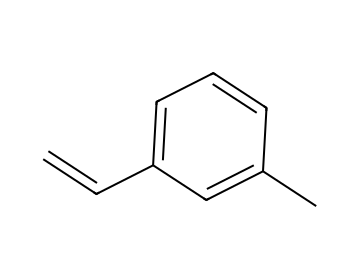
IDENTITY
COMPUTED
PROPERTIES
3.580
0.9076 g/cu cm at 25 °C
0.91 g/cm³
Relative density of the vapour/air-mixture at 20 °C (air = 1): 1.00
Liquid
In water, 89.0 mg/L at 25 °C
Insoluble in water
Soluble in ethanol, ether, benzene
Solubility in water, mg/l at 25 °C: 89 (practically insoluble)
51 °C c.c.
170 °C
164 °C
When heated to decomposition it emits acrid smoke and irritating vapors.
-86.3 °C
-86 °C
Relative vapor density (air = 1): 4.1
The odor threshold for vinyl toluene (55-70% meta and 30-45% para isomer) was reported to be similar to that for styrene, ie 50 ppm [240 mg/cu m].
Vinyl toluene is a reactive monomer which polymerizes to form a clear, colorless polymer.
1.70 mm Hg at 25 °C
Vapor pressure, kPa at 20 °C: 0.23
GHS
Danger
H226 (100%): Flammable liquid and vapor [Warning Flammable liquids];H304 (97.4%): May be fatal if swallowed and enters airways [Danger Aspiration hazard];H315 (98%): Causes skin irritation [Warning Skin corrosion/irritation];H319 (97.4%): Causes serious eye irritation [Warning Serious eye damage/eye irritation];H332 (96.7%): Harmful if inhaled [Warning Acute toxicity, inhalation];H335 (31.4%): May cause respiratory irritation [Warning Specific target organ toxicity, single exposure; Respiratory tract irritation];H400 (68%): Very toxic to aquatic life [Warning Hazardous to the aquatic environment, acute hazard];H410 (68%): Very toxic to aquatic life with long lasting effects [Warning Hazardous to the aquatic environment, long-term hazard]
P210, P233, P240, P241, P242, P243, P261, P264, P264+P265, P271, P273, P280, P301+P316, P302+P352, P303+P361+P353, P304+P340, P305+P351+P338, P317, P319, P321, P331, P332+P317, P337+P317, P362+P364, P370+P378, P391, P403+P233, P403+P235, P405, and P501 (click each P-code to see the statement)
Aggregated GHS information provided per 153 reports by companies from 8 notifications to the ECHA C&L Inventory. Each notification may be associated with multiple companies.;Information may vary between notifications depending on impurities, additives, and other factors. The percentage value in parenthesis indicates the notified classification ratio from companies that provide hazard codes. Only hazard codes with percentage values above 10% are shown. For more detailed information, please visit ECHA C&L website.
HAZARDS
Chemical: Benzene, 1-ethenyl-3-methyl-
Flammable. Above 51 °C explosive vapour/air mixtures may be formed.
May polymerize if heated; A skin, eye, and respiratory tract irritant; Inhalation of high concentrations may cause CNS effects; Repeated or prolonged exposure may cause kidney and liver injury; [ICSC] Stabilized with 4-tert-butylcatechol (CAS# 98-29-3); An irritant; Harmful by ingestion (may cause lung damage by aspiration); [Alfa Aesar MSDS] See 4-Vinyltoluene. Vinyltoluenes, stabilized (UN2618) has warning of explosive polymerization; [ERG 2016] See Vinyl toluene.
UN Hazard Class: 3; UN Pack Group: III
The substance may polymerize if it is not stabilized. This generates fire or explosion hazard. Reacts violently with strong oxidants and strong acids.
Vapours are uninhibited and may polymerize, causing blockage of vents.
Marine pollutant.
/GUIDE 130P FLAMMABLE LIQUIDS (Water-Immiscible/Noxious)/ Fire or Explosion: HIGHLY FLAMMABLE: Will be easily ignited by heat, sparks or flames. Vapors may form explosive mixtures with air. Vapors may travel to source of ignition and flash back. Most vapors are heavier than air. They will spread along ground and collect in low or confined areas (sewers, basements, tanks). Vapor explosion hazard indoors, outdoors or in sewers. Those substances designated with a (P) may polymerize explosively when heated or involved in a fire. Runoff to sewer may create fire or explosion hazard. Containers may explode when heated. Many liquids are lighter than water. /Vinyltoluenes, stabilized/
/GUIDE 130P FLAMMABLE LIQUIDS (Water-Immiscible/Noxious)/ Health: May cause toxic effects if inhaled or absorbed through skin. Inhalation or contact with material may irritate or burn skin and eyes. Fire will produce irritating, corrosive and/or toxic gases. Vapors may cause dizziness or suffocation. Runoff from fire control or dilution water may cause pollution. /Vinyltoluenes, stabilized/
/GUIDE 130P FLAMMABLE LIQUIDS (Water-Immiscible/Noxious)/ Public Safety: CALL Emergency Response Telephone Number on Shipping Paper first. If Shipping Paper not available or no answer, refer to appropriate telephone number listed on the inside back cover. As an immediate precautionary measure, isolate spill or leak area for at least 50 meters (150 feet) in all directions. Keep unauthorized personnel away. Stay upwind, uphill and/or upstream. Ventilate closed spaces before entering. /Vinyltoluenes, stabilized/
/GUIDE 130P FLAMMABLE LIQUIDS (Water-Immiscible/Noxious)/ Protective Clothing: Wear positive pressure self-contained breathing apparatus (SCBA). Structural firefighters' protective clothing will only provide limited protection. /Vinyltoluenes, stabilized/
For more DOT Emergency Guidelines (Complete) data for 3-Vinyltoluene (8 total), please visit the HSDB record page.
Recommended Exposure Limit: 10 Hour Time-Weighted Average: 100 ppm (480 mg/cu m). /Vinyl toluene/
Flam. Liq. 3 (100%);Asp. Tox. 1 (97.4%);Skin Irrit. 2 (98%);Eye Irrit. 2 (97.4%);Acute Tox. 4 (96.7%);STOT SE 3 (31.4%);Aquatic Acute 1 (68%);Aquatic Chronic 1 (68%)
No person may /transport,/ offer or accept a hazardous material for transportation in commerce unless that person is registered in conformance ... and the hazardous material is properly classed, described, packaged, marked, labeled, and in condition for shipment as required or authorized by ... /the hazardous materials regulations (49 CFR 171-177)./
The International Air Transport Association (IATA) Dangerous Goods Regulations are published by the IATA Dangerous Goods Board pursuant to IATA Resolutions 618 and 619 and constitute a manual of industry carrier regulations to be followed by all IATA Member airlines when transporting hazardous materials. Vinyltoluenes, stabilized are is included on the dangerous goods list. /Vinyltoluenes, stabilized/
The International Maritime Dangerous Goods Code lays down basic principles for transporting hazardous chemicals. Detailed recommendations for individual substances and a number of recommendations for good practice are included in the classes dealing with such substances. A general index of technical names has also been compiled. This index should always be consulted when attempting to locate the appropriate procedures to be used when shipping any substance or article. Vinyltoluenes, stabilized are included on the dangerous goods list. /Vinyltoluenes, stabilized/
UN 2618; Vinyltoluenes, stabilized
IMO 3; Vinyltoluenes, stabilized
SAFETY
Use water spray, foam, powder, carbon dioxide. In case of fire: keep drums, etc., cool by spraying with water.
Fresh air, rest. Refer for medical attention.
Remove contaminated clothes. Rinse and then wash skin with water and soap. Refer for medical attention .
First rinse with plenty of water for several minutes (remove contact lenses if easily possible), then refer for medical attention.
Rinse mouth. Do NOT induce vomiting. Refer for medical attention .
Fireproof. Separated from strong oxidants and strong acids. Well closed. Store only if stabilized. Provision to contain effluent from fire extinguishing. Store in an area without drain or sewer access.
Special hazards arising from the substance or mixture: Carbon oxides
Suitable extinguishing media: Use water spray, alcohol-resistant foam, dry chemical or carbon dioxide. Advice for firefighters: Wear self-contained breathing apparatus for firefighting if necessary. Further information: Use water spray to cool unopened containers.
Keep container tightly closed in a dry and well-ventilated place. Containers which are opened must be carefully resealed and kept upright to prevent leakage. Storage class (TRGS 510): Flammable liquids
ACCIDENTAL RELEASE MEASURES; Personal precautions, protective equipment and emergency procedures: Use personal protective equipment. Avoid breathing vapors, mist or gas. Ensure adequate ventilation. Remove all sources of ignition. Evacuate personnel to safe areas. Beware of vapors accumulating to form explosive concentrations. Vapors can accumulate in low areas. Environmental precautions: Prevent further leakage or spillage if safe to do so. Do not let product enter drains. Methods and materials for containment and cleaning up: Contain spillage, and then collect with an electrically protected vacuum cleaner or by wet-brushing and place in container for disposal according to local regulations
SRP: Recycle any unused portion of the material for its approved use or return it to the manufacturer or supplier. Ultimate disposal of the chemical must consider: the material's impact on air quality; potential migration in air, soil or water; effects on animal, aquatic and plant life; and conformance with environmental and public health regulations. If it is possible or reasonable use an alternative chemical product with less inherent propensity for occupational harm/injury/toxicity or environmental contamination.
Product: Burn in a chemical incinerator equipped with an afterburner and scrubber but exert extra care in igniting as this material is highly flammable. Offer surplus and non-recyclable solutions to a licensed disposal company. Contact a licensed professional waste disposal service to dispose of this material. Contaminated packaging: Dispose of as unused product.
Remove all ignition sources. Personal protection: filter respirator for organic gases and vapours adapted to the airborne concentration of the substance, protective clothing and protective gloves. Do NOT let this chemical enter the environment. Collect leaking and spilled liquid in sealable containers as far as possible. Absorb remaining liquid in sand or inert absorbent. Then store and dispose of according to local regulations. Do NOT wash away into sewer.
Gloves must be inspected prior to use. Use proper glove removal technique (without touching glove's outer surface) to avoid skin contact with this product. Dispose of contaminated gloves after use in accordance with applicable laws and good laboratory practices. Wash and dry hands.
Handle in accordance with good industrial hygiene and safety practice. Wash hands before breaks and at the end of workday.
Avoid contact with skin and eyes. Avoid inhalation of vapor or mist. Keep away from sources of ignition - No smoking. Take measures to prevent the build up of electrostatic charge.
ACCIDENTAL RELEASE MEASURES; Personal precautions, protective equipment and emergency procedures: Use personal protective equipment. Avoid breathing vapors, mist or gas. Ensure adequate ventilation. Remove all sources of ignition. Evacuate personnel to safe areas. Beware of vapors accumulating to form explosive concentrations. Vapors can accumulate in low areas. Environmental precautions: Prevent further leakage or spillage if safe to do so. Do not let product enter drains.
For more Preventive Measures (Complete) data for 3-Vinyltoluene (7 total), please visit the HSDB record page.
Wear safety spectacles.
NO open flames, NO sparks and NO smoking. Above 51 °C use a closed system, ventilation and explosion-proof electrical equipment.
TOXICITY
TERRESTRIAL FATE: Based on a classification scheme(1), an estimated Koc value of 720(SRC), determined from a structure estimation method(2), indicates that 3-vinyltoluene is expected to have low mobility in soil(SRC). Volatilization of 3-vinyltoluene from moist soil surfaces is expected(SRC) given an estimated Henry's Law constant of 3.0X10⁻³ atm-cu m/mole(SRC) based upon its vapor pressure, 1.7 mm Hg(3), and water solubility, 89 mg/L(4). 3-Vinyltoluene is expected to volatilize from dry soil surfaces(SRC) based upon its vapor pressure(3). Biodegradation data in soil were not available(SRC, 2018).
AQUATIC FATE: Based on a classification scheme(1), an estimated Koc value of 720(SRC), determined from a structure estimation method(2), indicates that 3-vinyltoluene is expected to adsorb to suspended solids and sediment(SRC). Volatilization from water surfaces is expected(3) based upon an estimated Henry's Law constant of 3.0X10⁻³ atm-cu m/mole(SRC) derived from its vapor pressure, 1.7 mm Hg(4), and water solubility, 89 mg/L(5). Using this Henry's Law constant and an estimation method(3), volatilization half-lives for a model river and model lake are 3.5 hours and 4.4 days, respectively(SRC). 3-Vinyltoluene is not expected to undergo hydrolysis in the environment due to the lack of functional groups that hydrolyze under environmental conditions(3). According to a classification scheme(6), a BCF of 35 measured in goldfish(7), suggests bioconcentration in aquatic organisms is moderate. Biodegradation data in water were not available(SRC, 2018).
ATMOSPHERIC FATE: According to a model of gas/particle partitioning of semivolatile organic compounds in the atmosphere(1), 3-vinyltoluene, which has a vapor pressure of 1.7 mm Hg at 25 °C(2), is expected to exist solely as a vapor in the ambient atmosphere. Vapor-phase 3-vinyltoluene is degraded in the atmosphere by reaction with photochemically-produced hydroxyl radicals and ozone(SRC); the half-lives for these reactions in air are estimated to be 12 and 13 hours(SRC), calculated from its estimated rate constants of 3.1X10⁻¹¹ and 2.1X10⁻¹⁷ cu cm/molecule-sec, respectively(3). 3-Vinyltoluene absorbs at wavelengths >290 nm(4) and, therefore, may be susceptible to direct photolysis by sunlight(SRC).
Neurotoxin - Acute solvent syndrome;Occupational hepatotoxin - Secondary hepatotoxins: the potential for toxic effect in the occupational setting is based on cases of poisoning by human ingestion or animal experimentation.
The substance can be absorbed into the body by inhalation and by ingestion.
IDENTIFICATION AND USE: 3-Vinyltoluene is a monomer of vinyltoluene. Vinyl toluene is used in the coatings industry as a modifier for drying oils and oil-modified alkyds. It is also used as a replacement for styrene in unsaturated polyester resins where high-temperature cures and little shrinkage are desired. HUMAN STUDIES: Central nervous system effects, such as depression, poor memory, slow visuomotor performance and electrophysiological changes, have often been associated with heavy occupational exposure to vinyl toluenes. Contact allergy to styrene related compounds was studied in a human subject. A patient known from previous studies to be sensitive to styrene was patch tested with styrene and 18 compounds structurally related to styrene. Positive results were obtained with 3-methylstyrene. Vinyl toluene induces sister chromatid exchange and chromosomal aberrations in cultured human lymphocytes. ANIMAL STUDIES: Specific depletion of brain dopamine levels has been described in rabbits. In male rats exposed by inhalation to up to 300 ppm vinyl toluene (60-70% meta and 30-70% para isomer) for a maximum of 15 weeks, decreased motor conductivity velocity was observed within 12 weeks. In 2-year inhalation studies (mixed isomers: 65%-71% meta and 32%-35% para), there was no evidence of carcinogenic activity for male or female rats exposed to 100 or 300 ppm vinyl toluene and no evidence of carcinogenic activity for male or female mice exposed to 10 or 25 ppm. There was evidence of chemical-related toxicity to the nasal passage in both rats and mice. Vinyl toluene did not induce gene mutations in S. typhimurium strains TA98, TA100, TA1535, or TA1537 with or without exogenous metabolic activation. Vinyl toluene was positive in the mouse lymphoma assay for induction of trifluorothymidine resistance in L5178Y/TK cells in the absence of metabolic activation. Vinyl toluene did not induce sister chromatid exchanges or chromosomal aberrations in CHO cells with or without meta
Sore throat. Cough. Dizziness. Headache. Drowsiness. Vomiting. Lethargy.
Dry skin. Redness.
Redness. Pain.
Aspiration hazard! Abdominal pain. Nausea. Vomiting.
EPA has released the Interactive Chemical Safety for Sustainability (iCSS) Dashboard. The iCSS Dashboard provides an interactive tool to explore rapid, automated (or in vitro high-throughput) chemical screening data generated by the Toxicity Forecaster (ToxCast) project and the federal Toxicity Testing in the 21st century (Tox21) collaboration. /The title compound was tested by ToxCast and/or Tox21 assays/[USEPA; ICSS Dashboard Application; Available from, as of February 4, 2019: http://actor.epa.gov/dashboard/]
Motorboats emitted 3-vinyltoluene to canal water; concentrations were not reported(1). Use of unleaded gasoline by a four-stroke outboard motor emitted 3-vinyltoluene to test water at 6.2 mg/10 min(2). 3-Vinyltoluene was detected in the leachate plume of Norman, OK landfill sampled Nov 1995 and Apr 1996(3).
The substance is toxic to aquatic organisms. Bioaccumulation of this chemical may occur in the environment. It is strongly advised not to let the chemical enter into the environment.
Using a structure estimation method based on molecular connectivity indices(1), the Koc of 3-vinyltoluene can be estimated to be 720(SRC). According to a classification scheme(2), this estimated Koc value suggests that 3-vinyltoluene is expected to have low mobility in soil(SRC).
/HUMAN EXPOSURE STUDIES/ Contact allergy to styrene related compounds was studied in a human subject. A patient known from previous studies to be sensitive to styrene was patch tested with styrene and 18 compounds structurally related to styrene. Positive results were obtained with 2-methylstyrene, 3-methylstyrene, 4-methylstyrene, styrene-epoxide, and 4-hydroxystyrene. The reaction to styrene-epoxide was stronger than that obtained by patch testing with an equimolar concentration of styrene, 0.1 percent weight per volume in ethanol. Twenty one comparisons were subsequently patch tested with styrene-epoxide. All responses were negative. The authors note that the stronger reaction to styrene-epoxide, as compared to an equimolar concentration of styrene, may indicate that styrene-epoxide is the hapten and styrene is the prohapten, which has to be oxidized in the skin in order to be converted into styrene-epoxide. Styrene-epoxide can be formed from styrene by enzymatic transformation by aryl-hydrocarbon-hydroxylase in the skin. They conclude that it is important to patch test with chemically related substances in order to evaluate the total sensitivity pattern of a patient.
/SIGNS AND SYMPTOMS/ Central nervous system effects, such as depression, poor memory, slow visuomotor performance and electrophysiological changes, have often been associated with heavy occupational exposures to vinyl toluenes. Information is not available on human exposure to vinyl toluene alone. /Vinyl toluenes/
/GENOTOXICITY/ ... In human lymphocytes exposed in whole blood cultures, vinyl toluene induced both sister chromatid exchange and chromosomal aberrations in a dose-dependent manner, in the absence of exogenous metabolic activation. The induction of sister chromatid exchange was dependent on the number of erythrocytes present. Significant increases in the frequencies of sister chromatid exchange were observed in human lymphocytes exposed in whole blood cultures to ortho, meta and para isomer. The strongest responses were seen with the meta and para isomers, which are the dominant species in vinyl toluene.
3-Vinyltoluene's production and use as a laboratory chemical(1) may result in its release to the environment through various waste streams(SRC).
A BCF of 35 was measured for 3-vinyltoluene in goldfish(1). According to a classification scheme(2), this BCF suggests the potential for bioconcentration in aquatic organisms is moderate(SRC).
REGULATORY
Chemical: Benzene, 1-ethenyl-3-methyl-
PHARMACOLOGY
o-Vinyltoluene, m-vinyltoluene and p-vinyltoluene were given i.p. to rats and urine was analyzed for acidic metabolites by gas chromatography mass spectrometry. Different derivatives were prepared and used to identify the structure of the metabolites. Different types (11) of metabolites were found, although all metabolites were not produced from each vinyltoluene isomer. The metabolites identified were: methylphenylethylene glycol, methylmandelic acid, methylphenylglyoxylic acid, hydroxymethylphenylethylene glycol, carboxyphenylethylene glycol, hydroxymethylphenylglyoxylic acid, methylbenzoylglycine, methylphenylacetylglycine, vinylbenzoylglycine, N-acetylcysteine conjugate of methylphenylethanol and glucuronide of methylphenylethylene glycol. Metabolites (> 90%) recovered were excreted during the 1st 24 hr. For the sum of all metabolites, there was an approximately linear relation between given dose and recovered amount of metabolites. Repeated daily administration was not followed by any appreciable increase in metabolite excretion and no enzyme induction phenomenon was apparent.
USES
Used in mixtures with the para isomer (4-vinyltoluene) as a reactive monomer for polymer and coating production; [IARC]
Use in mixtures with other vinyltoluene isomers (3-vinyltoluene) as monomers for producing poly(vinyltoluene)
Contains the following stabilizer(s): 3,5-Di-tert-butylpyrocatechol (0.1 %)
Commercial vinyl toluene is primarily a mixture of meta- and para-vinyl toluene, usually with 56-60% meta, 40-45% para and 1% ortho. It is available as a commercial product with the following characteristics: purity, 99.2 wt% minimum; polymer, 25 ppm maximum; and para-tert-butylcatechol (inhibitor), 10-15 ppm or 45-55 ppm.
Information on 1 consumer products that contain 1-Ethenyl-3-methylbenzene in the following categories is provided:;• Home Maintenance
Benzene, 1-ethenyl-3-methyl-: ACTIVE
ALIASES
REACTIONS
uspto-grants-2004_03 · 10.6084/m9.figshare.5104873.v1 · US06699877B2
查看
Training data from https://doi.org/10.1039/C8SC04228D (6/10) · 10.1039/C8SC04228D
查看
uspto-grants-2001_11 · 10.6084/m9.figshare.5104873.v1 · US06313297B1
查看
uspto-grants-1999_09 · 10.6084/m9.figshare.5104873.v1 · US05952369
查看
uspto-grants-1998_01 · 10.6084/m9.figshare.5104873.v1 · US05705499
查看
Test data from https://doi.org/10.1039/C8SC04228D · 10.1039/C8SC04228D
查看
uspto-grants-2011_07 · 10.6084/m9.figshare.5104873.v1 · US07977481B2
查看
uspto-grants-1999_11 · 10.6084/m9.figshare.5104873.v1 · US05977134
查看