
uspto-grants-2014_10 · 10.6084/m9.figshare.5104873.v1 · US08852900B2
查看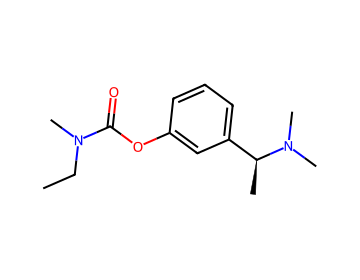
IDENTITY
COMPUTED
PROPERTIES
2.3
2.3
2.04e+00 g/L
Solid
8.8
8.99
165 Ų [M+H]+ [CCS Type: TW; Method: Major Mix IMS/Tof Calibration Kit (Waters)]
GHS
This chemical does not meet GHS hazard criteria for 6.2% (1 of 16) of reports.
Danger
H300 (31.2%): Fatal if swallowed [Danger Acute toxicity, oral];H301 (62.5%): Toxic if swallowed [Danger Acute toxicity, oral];H312 (56.2%): Harmful in contact with skin [Warning Acute toxicity, dermal];H332 (56.2%): Harmful if inhaled [Warning Acute toxicity, inhalation];H411 (62.5%): Toxic to aquatic life with long lasting effects [Hazardous to the aquatic environment, long-term hazard]
P261, P264, P270, P271, P273, P280, P301+P316, P302+P352, P304+P340, P317, P321, P330, P362+P364, P391, P405, and P501 (click each P-code to see the statement)
Aggregated GHS information provided per 16 reports by companies from 6 notifications to the ECHA C&L Inventory. Each notification may be associated with multiple companies.;Reported as not meeting GHS hazard criteria per 1 of 16 reports by companies.;There are 5 notifications provided by 15 of 16 reports by companies with hazard statement code(s).;Information may vary between notifications depending on impurities, additives, and other factors. The percentage value in parenthesis indicates the notified classification ratio from companies that provide hazard codes. Only hazard codes with percentage values above 10% are shown. For more detailed information, please visit ECHA C&L website.
HAZARDS
Acute Tox. 2 (31.2%);Acute Tox. 3 (62.5%);Acute Tox. 4 (56.2%);Acute Tox. 4 (56.2%);Aquatic Chronic 2 (62.5%)
TOXICITY
In large placebo controlled trials, rivastigmine therapy was not associated with an increased rate of serum enzyme elevations compared to placebo treatment and no instances of clinically apparent liver injury with jaundice were reported. Nevertheless, since its introduction into clinical use, rivastigmine (administered by transdermal patch) has been implicated in at least one report of clinically apparent hepatotoxicity with mild jaundice. The time to onset was 2 months and the serum enzyme elevations had a mildly hepatocellular pattern. Mild rash and eosinophilia were also present, but autoimmune features were not. Recovery was complete within 5 weeks of drug discontinuation.;Likelihood score: D (possible, rare cause of clinically apparent drug-induced liver injury).
Adverse effects of rivastigmine have received thorough study as it has been on the market for some time. The main adverse effects associated with the use of rivastigmine are gastrointestinal. The primary symptoms are nausea and vomiting. These acute effects primarily occur during the initial dose-escalation phase of therapy with upward dose titration of the drug to achieve a therapeutic dose. These events can be minimized using a slow titration schedule and taking the medication with food if prescribing an oral formulation. In a study done to analyze the safety and tolerability of cholinesterase inhibitors used to treat Alzheimer dementia, researchers found rivastigmine to be the drug to have the highest rate of gastrointestinal side effects.;Common adverse effects include extrapyramidal symptoms, sleep disturbances, muscle cramps, and weakness. These issues are less frequent during the maintenance phase of therapy when the dose is not adjusted, but when the drug is being taken for an extended period, central nervous system effects can occur. However, these central nervous system effects are rather rare in rivastigmine and are more common with its counterpart drug, donepezil.;Studies have shown that using the transdermal patch to deliver rivastigmine is associated with fewer reports of nausea and vomiting. Rivastigmine also has a rare case of angioedema related to its use, although overall very uncommon. While the transdermal route offers decreased rates of gastrointestinal effects, reactions like contact dermatitis are prevalent. Also, allergic reactions to the transdermal patch can manifest as vesicles and edema beyond the boundaries of the patch.;Long-term use of rivastigmine has also been associated with an increased risk of death compared to patients treated with donepezil.
Toxicity to the drug, while rare, should be carefully monitored. Common toxicity manifestations include severe gastrointestinal reactions, allergic cutaneous reactions, and central nervous system effects. All cutaneous reactions due to usage of the patch should prompt immediate removal of the patch for at least 48 hours before reapplying in a new area. Therapy should be discontinued if symptoms last longer than 48 hours or a severe cutaneous reaction occurs.;In addition to serious manifestations of common side effects, clinical staff members should always look for cholinergic crises whenever prescribing anticholinergic medications. Classic manifestations of a patient in crisis can be remembered by the mnemonic DUMBELS - diarrhea, urination, miosis, bradycardia, excitability, lacrimation, salivation/excessive sweating before treatment. Patients experiencing a cholinergic crisis should have atropine followed by pralidoxime to reverse the anticholinergic effects of rivastigmine. While the usual treatment of the crisis involves giving atropine before pralidoxime, a case study done in 2009 showed a successful reversal of cholinergic crisis with just pralidoxime without atropine pretreatment.
Drug-Induced Liver Injury Severity and Toxicity (DILIst)
rivastigmine
DILI Positive
Oral
DOI:10.1016/j.drudis.2019.09.022
PHARMACOLOGY
N06DA03
N - Nervous system;N06 - Psychoanaleptics;N06D - Anti-dementia drugs;N06DA - Anticholinesterases;N06DA03 - Rivastigmine
QN - Nervous system;QN06 - Psychoanaleptics;QN06D - Anti-dementia drugs;QN06DA - Anticholinesterases;QN06DA03 - Rivastigmine
40%
Rivastigmine is a parasympathomimetic and a reversible cholinesterase inhibitor. An early pathophysiological feature of Alzheimer's disease that is associated with memory loss and cognitive deficits is a deficiency of acetylcholine as a result of selective loss of cholinergic neurons in the cerebral cortex, nucleus basalis, and hippocampus. Tacrine is postulated to exert its therapeutic effect by enhancing cholinergic function. While the precise mechanism of rivastigmine's action is unknown, it is postulated to exert its therapeutic effect by enhancing cholinergic function. This is accomplished by increasing the concentration of acetylcholine through reversible inhibition of its hydrolysis by cholinesterase. If this proposed mechanism is correct, rivastigmine's effect may lessen as the disease progresses and fewer cholinergic neurons remain functionally intact.
Rivastigmine is a carbamate derivative that is structurally related to physostigmine, but not to donepezil and tacrine. The precise mechanism of rivastigmine has not been fully determined, but it is suggested that rivastigmine binds reversibly with and inactivates chlolinesterase (eg. acetylcholinesterase, butyrylcholinesterase), preventing the hydrolysis of acetycholine, and thus leading to an increased concentration of acetylcholine at cholinergic synapses. The anticholinesterase activity of rivastigmine is relatively specific for brain acetylcholinesterase and butyrylcholinesterase compared with those in peripheral tissues.
1.5 hours
Rivastigmine is rapidly metabolized by cholinesterase-mediated hydrolysis.
PKI06M3IW0
RIVASTIGMINE
Established Pharmacologic Class [EPC] - Cholinesterase Inhibitor
Mechanisms of Action [MoA] - Cholinesterase Inhibitors
Rivastigmine is a Cholinesterase Inhibitor. The mechanism of action of rivastigmine is as a Cholinesterase Inhibitor.
RIVASTIGMINE
Drugs that inhibit cholinesterases. The neurotransmitter ACETYLCHOLINE is rapidly hydrolyzed, and thereby inactivated, by cholinesterases. When cholinesterases are inhibited, the action of endogenously released acetylcholine at cholinergic synapses is potentiated. Cholinesterase inhibitors are widely used clinically for their potentiation of cholinergic inputs to the gastrointestinal tract and urinary bladder, the eye, and skeletal muscles; they are also used for their effects on the heart and the central nervous system.
Drugs intended to prevent damage to the brain or spinal cord from ischemia, stroke, convulsions, or trauma. Some must be administered before the event, but others may be effective for some time after. They act by a variety of mechanisms, but often directly or indirectly minimize the damage produced by endogenous excitatory amino acids.
Rivastigmine is extensively metabolized primarily via cholinesterase-mediated hydrolysis to the decarbamylated metabolite NAP226-90. Renal excretion of the metabolites is the major route of elimination. Less than 1% of the administered dose is excreted in the feces.
1.8 to 2.7 L/kg
renal cl=2.1-2.8 L/hr
Cytoplasm;Membrane
USES
Use (kg; approx.) in Germany (2009): >100;Consumption (g per capita; approx.) in Germany (2009): 0.00122;Calculated removal (%): 23.6
ALIASES
REACTIONS

