
uspto-grants-1996_06 · 10.6084/m9.figshare.5104873.v1 · US05523444
查看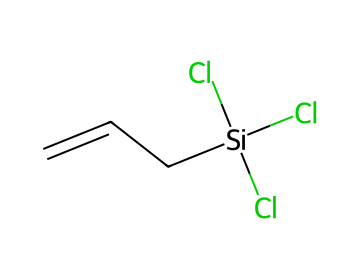
IDENTITY
COMPUTED
PROPERTIES
Pungent, irritating odor
1.215 at 68 °F (USCG, 1999) - Denser than water; will sink
1.2011 g/cu cm at 20 °C
Density: 1.217 at 27 °C
1.348 @25 °C
Colorless liquid
Corrosive
Corrodes metals because of hydrochloric acid formed
95 °F (USCG, 1999)
35 °C
95 °F (35 °C) (open cup)
241 °F at 760 mmHg (USCG, 1999)
117.5 °C
117.5 °C @760 [mm Hg]
The silanes decomp at elevated temp to liberate hydrogen and deposit a high purity silicon, which leads to some of the principal uses of silanes. /Silanes/
Hydrogen chloride and phosgene gases may form; both are toxic and irritating.
When heated to decomposition it emits toxic /chlorine/.
35 °C
-85 °C
6.05 (Air = 1)
Polymerizes easily.
7.066 kPa (53.0 mm Hg) at 47.5 °C
16.5 [mm Hg] @20 °C
Index of refraction = 1.4460 at 20 °C/D
GHS
Danger
H225 (97.7%): Highly Flammable liquid and vapor [Danger Flammable liquids];H314 (100%): Causes severe skin burns and eye damage [Danger Skin corrosion/irritation]
P210, P233, P240, P241, P242, P243, P260, P264, P280, P301+P330+P331, P302+P361+P354, P303+P361+P353, P304+P340, P305+P354+P338, P316, P321, P363, P370+P378, P403+P235, P405, and P501 (click each P-code to see the statement)
Aggregated GHS information provided per 44 reports by companies from 4 notifications to the ECHA C&L Inventory. Each notification may be associated with multiple companies.;Information may vary between notifications depending on impurities, additives, and other factors. The percentage value in parenthesis indicates the notified classification ratio from companies that provide hazard codes. Only hazard codes with percentage values above 10% are shown. For more detailed information, please visit ECHA C&L website.
HAZARDS
Water-reactive material (WR)
Chemical: Silane, trichloro-2-propenyl-
The New Jersey Worker and Community Right to Know Act requires public and private employers to provide information about hazardous substances at their workplaces. (N.J.S.A. 34:5A-1 et. seq.)
Corrosive Flammable Liquid
Special Hazards of Combustion Products: Irritating vapors of hydrogen chloride and phosgene may form.;Behavior in Fire: Difficult to extinguish. Re-ignition may occur. (USCG, 1999)
· HIGHLY FLAMMABLE: Will be easily ignited by heat, sparks or flames.;· Vapors form explosive mixtures with air: indoors, outdoors and sewers explosion hazards.;· Most vapors are heavier than air. They will spread along the ground and collect in low or confined areas (sewers, basements, tanks, etc.).;· Vapors may travel to source of ignition and flash back.;· Those substances designated with a (P) may polymerize explosively when heated or involved in a fire.;· Substance will react with water (some violently) releasing flammable, toxic or corrosive gases and runoff.;· Corrosives in contact with metals may evolve flammable hydrogen gas.;· Containers may explode when heated or if contaminated with water.
Fire hazard.
Self-ignites in air. With a little ammonia, it forms a self-igniting product. /Chlorosilanes/
Certain strong corrosives may, on contact with organic matter or other chemicals, cause fire ... /Corrosive substances/
Inhalation of vapor irritates mucous membranes. Liquid causes severe burns of eyes and skin and severe internal burns if ingested. (USCG, 1999)
· TOXIC and/or CORROSIVE; inhalation, ingestion or contact (skin, eyes) with vapors, dusts or substance may cause severe injury, burns or death.;· Bromoacetates and chloroacetates are extremely irritating/lachrymators (cause eye irritation and flow of tears).;· Reaction with water or moist air may release toxic, corrosive or flammable gases.;· Reaction with water may generate much heat that will increase the concentration of fumes in the air.;· Fire will produce irritating, corrosive and/or toxic gases.;· Runoff from fire control or dilution water may be corrosive and/or toxic and cause environmental contamination.
A corrosive substance; An eye, nose, and throat irritant; [HSDB] May cause severe burns to eyes and skin; [CAMEO] Water reactive--produces HCl when spilled in water; [ERG 2016] Evolves heat and corrosive products in contact with moisture; A corrosive substance that can cause injury to the skin, eyes, and respiratory tract; Inhalation may cause pulmonary edema; [MSDSonline]
1724 155
Hydrocarbons, Aliphatic Unsaturated;Chlorosilanes;Polymerizable Compounds
D003; A solid waste containing allyltrichlorosilane may become characterized as a hazardous waste when subjected to testing for reactivity as stipulated in 40 CFR 261.23, and if so characterized, must be managed as a hazardous waste.
Highly Flammable;Polymerizable;Water-Reactive
Chlorosilanes, such as ALLYLTRICHLOROSILANE, are compounds in which silicon is bonded to from one to four chlorine atoms with other bonds to hydrogen and/or alkyl groups. Chlorosilanes react with water, moist air, or steam to produce heat and toxic, corrosive fumes of hydrogen chloride. They may also produce flammable gaseous H2. They can serve as chlorination agents. Chlorosilanes react vigorously with both organic and inorganic acids and with bases to generate toxic or flammable gases.
SAFETY
Excerpt from ERG Guide 155 [Substances - Toxic and/or Corrosive (Flammable / Water-Sensitive)]:;Note: Most foams will react with the material and release corrosive/toxic gases. CAUTION: For Acetyl chloride (UN1717), use CO2 or dry chemical only.;SMALL FIRE: CO2, dry chemical, dry sand, alcohol-resistant foam.;LARGE FIRE: Water spray, fog or alcohol-resistant foam. FOR CHLOROSILANES, DO NOT USE WATER; use alcohol-resistant foam. If it can be done safely, move undamaged containers away from the area around the fire. Avoid aiming straight or solid streams directly onto the product.;FIRE INVOLVING TANKS, RAIL TANK CARS OR HIGHWAY TANKS: Fight fire from maximum distance or use unmanned master stream devices or monitor nozzles. Do not get water inside containers. Cool containers with flooding quantities of water until well after fire is out. Withdraw immediately in case of rising sound from venting safety devices or discoloration of tank. ALWAYS stay away from tanks in direct contact with flames. (ERG, 2024)
· CALL 911. Then call emergency response telephone number on shipping paper. If shipping paper not available or no answer, refer to appropriate telephone number listed on the inside back cover.;· Keep unauthorized personnel away.;· Stay upwind, uphill and/or upstream.;· Ventilate closed spaces before entering, but only if properly trained and equipped.
· ELIMINATE all ignition sources (no smoking, flares, sparks or flames) from immediate area.;· All equipment used when handling the product must be grounded.;· Do not touch damaged containers or spilled material unless wearing appropriate protective clothing.;· Stop leak if you can do it without risk.;· A vapor-suppressing foam may be used to reduce vapors.;· FOR CHLOROSILANES, use alcohol-resistant foam to reduce vapors.;· DO NOT GET WATER on spilled substance or inside containers.;· Use water spray to reduce vapors or divert vapor cloud drift. Avoid allowing water runoff to contact spilled material.;· Prevent entry into waterways, sewers, basements or confined areas.;Small Spill;· Cover with DRY earth, DRY sand or other non-combustible material followed with plastic sheet to minimize spreading or contact with rain.;· Use clean, non-sparking tools to collect material and place it into loosely covered plastic containers for later disposal.
Get medical attention after all exposures to this compound.;INHALATION: remove from exposure; support respiration.;EYES: flush with water 15 min.;SKIN: flush with water.;INGESTION: do NOT induce vomiting; give water. (USCG, 1999)
General First Aid:;· Call 911 or emergency medical service.;· Ensure that medical personnel are aware of the material(s) involved, take precautions to protect themselves and avoid contamination.;· Move victim to fresh air if it can be done safely.;· Administer oxygen if breathing is difficult.;· If victim is not breathing:;-- DO NOT perform mouth-to-mouth resuscitation; the victim may have ingested or inhaled the substance.;-- If equipped and pulse detected, wash face and mouth, then give artificial respiration using a proper respiratory medical device (bag-valve mask, pocket mask equipped with a one-way valve or other device).;-- If no pulse detected or no respiratory medical device available, provide continuous compressions. Conduct a pulse check every two minutes or monitor for any signs of spontaneous respirations.;· Remove and isolate contaminated clothing and shoes.;· For minor skin contact, avoid spreading material on unaffected skin.;· In case of contact with substance, remove immediately by flushing skin or eyes with running water for at least 20 minutes.;· For severe burns, immediate medical attention is required.;· Effects of exposure (inhalation, ingestion, or skin contact) to substance may be delayed.;· Keep victim calm and warm.;· Keep victim under observation.;· For further assistance, contact your local Poison Control Center.;· Note: Basic Life Support (BLS) and Advanced Life Support (ALS) should be done by trained professionals.;Specific First Aid:;· For corrosives, in case of contact, immediately flush skin or eyes with running water for at least 30 minutes. Additional flushing may be required.
Difficult to extinguish. Re-ignition may occur.
· Wear positive pressure self-contained breathing apparatus (SCBA).;· Wear chemical protective clothing that is specifically recommended by the manufacturer when there is NO RISK OF FIRE.;· Structural firefighters' protective clothing provides thermal protection but only limited chemical protection.
TIH (Toxic Inhalation Hazard) - Term used to describe gases and volatile liquids that are toxic when inhaled. Some are TIH materials themselves, e.g., chlorine, and some release TIH gases when spilled in water, e.g., chlorosilanes. [ERG 2016].
DO NOT use water. Use dry chemical, CO2, or foam extinguishers. Low or medium expansion AFFF foam or dry chemical if available in sufficient amounts (FEMA). Vapors are heavier than air and will collect in low areas. Vapors may travel long distances to ignition sources and flashback. Vapors in confined areas may explode when exposed to fire. If material or contaminated runoff enters waterways, notify downstream users of potentially contaminated waters. Notify local health and fire officials and pollution control agencies. From a secure, explosion-proof location, use water spray to cool exposed containers. If cooling streams are ineffective (venting sound increases in volume and pitch, tank discolors or shows any signs of deforming), withdraw immediately to a secure position.
Wear positive pressure self-contained breathing apparatus ... Wear appropriate chemical protective gloves, goots, and goggles. /Allyltrichlorosilane, stabilized/
Water may be ineffective.
SRP: Operations involving entry into tanks or closed vessels, and emergency situations, require consideration of potentially oxygen deficient, or "immediately dangerous to life and health" IDLH environments. This may necessitate use of a self-contained breathing apparatus (SCBA), or a positive pressure supplied air respirator.
Before entering confined space in which allyltrichlorosilane may be present, check to make sure that an explosive concentration does not exist. Store in tightly closed containers in a cool, well-ventilated area away from water and sources of ignition. Use and store allyltrichlorosilane under nitrogen. Metal containers involving the transfer of this chemical should be grounded and bonded. Where possible, automatically pump liquid from drums or other storage containers to process containers. Drums must be equipped with self-closing valves, pressure vacuum bungs, and flame arresters. Use only nonsparking tools and equipment, especially when opening and closing containers of this chemical. Sources of ignition, such as smoking and open flame, are prohibited where where this chemical is used, handled, or stored in a manner that could create a potential fire or explosion hazard. Where this chemical is used, handled, manufactured, or stored, use explosion-proof electrical equipment and fittings.
All containers, pipes, apparatus, installations, and structures used for manufacture, storage, transport, or use of these substances must be of material resistant to corrosive substances or be protected by suitable coatings ... All containers or receptacles should be clearly labelled to indicate their contents and should bear the danger symbol for corrosives. /Corrosive substances/
SRP: Wastewater from contaminant suppression, cleaning of protective clothing/equipment, or contaminated sites should be contained and evaluated for subject chemical or decomposition product concentrations. Concentrations shall be lower than applicable environmental discharge or disposal criteria. Alternatively, pretreatment and/or discharge to a permitted wastewater treatment facility is acceptable only after review by the governing authority and assurance that "pass through" violations will not occur. Due consideration shall be given to remediation worker exposure (inhalation, dermal and ingestion) as well as fate during treatment, transfer and disposal. If it is not practicable to manage the chemical in this fashion, it must be evaluated in accordance with EPA 40 CFR Part 261, specifically Subpart B, in order to determine the appropriate local, state and federal requirements for disposal.
Evacuate and restrict persons not wearing protective equipment from area of spill or leak until clean-up is complete. Remove all igntion sources. Establish forced ventilation to keep levels below explosive limit. Use foam spray to reduce vapors. Cover with dry lime, dry sand, soda ash, or a similar material and deposit in sealed containers. Collect powdered material in the most convenient and safe manner and deposit in sealed containers. Keep allyltrichlorosilane out of a confined space, such as a sewer, because of the possibility of an explosion, unless the sewer is designed to prevent the build-up of explosive concentrations. It may be necessary to contain and dispose of dodecyl trichlorosilane as a hazardous waste. If material or contaminated runoff enters waterways, notify downstream users of potentially contaminated waters.
Environmental considerations - land spill: dig a pit, pond, lagoon, holding area to contain liquid or solid material /SRP: If time permits, pits, ponds, lagoons, soak holes, or holding areas should be sealed with an impermeable flexible membrane liner/; dike surface flow using soil, sand bags, foamed polyurethane, or foamed concrete; absorb bulk liquid with fly ash, cement powder, or commercial sorbents. /Allyltrichlorosilane, stabilized/
Environmental considerations - water spill: use natural barriers or oil spill control booms to limit spill travel; remove trapped material with suction hoses. /Allyltrichlorosilane, stabilized/
Environmental considerations - air spill: apply water spray or mist to knock down vapors. /Allyltrichlorosilane, stabilized/
Excerpt from ERG Guide 155 [Substances - Toxic and/or Corrosive (Flammable / Water-Sensitive)]:;ELIMINATE all ignition sources (no smoking, flares, sparks or flames) from immediate area. All equipment used when handling the product must be grounded. Do not touch damaged containers or spilled material unless wearing appropriate protective clothing. Stop leak if you can do it without risk. A vapor-suppressing foam may be used to reduce vapors. FOR CHLOROSILANES, use alcohol-resistant foam to reduce vapors. DO NOT GET WATER on spilled substance or inside containers. Use water spray to reduce vapors or divert vapor cloud drift. Avoid allowing water runoff to contact spilled material. Prevent entry into waterways, sewers, basements or confined areas.;SMALL SPILL: Cover with DRY earth, DRY sand or other non-combustible material followed with plastic sheet to minimize spreading or contact with rain. Use clean, non-sparking tools to collect material and place it into loosely covered plastic containers for later disposal. (ERG, 2024)
SRP: The most favorable course of action is to use an alternative chemical product with less inherent propensity for occupational harm/injury/toxicity or environmental contamination. Recycle any unused portion of the material for its approved use or return it to the manufacturer or supplier. Ultimate disposal of the chemical must consider: the material's impact on air quality; potential migration in soil or water; effects on animal and plant life; and conformance with environmental and public health regulations.
SRP: The scientific literature for the use of contact lenses by industrial workers is inconsistent. The benefits or detrimental effects of wearing contact lenses depend not only upon the substance, but also on factors including the form of the substance, characteristics and duration of the exposure, the uses of other eye protection equipment, and the hygiene of the lenses. However, there may be individual substances whose irritating or corrosive properties are such that the wearing of contact lenses would be harmful to the eye. In those specific cases, contact lenses should not be worn. In any event, the usual eye protection equipment should be worn even when contact lenses are in place.
SRP: Contaminated protective clothing should be segregated in a manner that results in no direct personal contact by personnel who handle, dispose of, or clean the clothing. Quality assurance procedures to confirm the efficacy of the cleaning procedures should be implemented prior to the decontaminated protective clothing being returned for reuse by the workers. Contaminated clothing (including shoes/socks) should not be taken home at end of shift, but should remain at employee's place of work for cleaning.
SRP: Local exhaust ventilation should be applied wherever there is an incidence of point source emissions or dispersion of regulated contaminants in the work area. Ventilation control of the contaminant as close to its point of generation is both the most economical and safest method to minimize personnel exposure to airborne contaminants. Ensure that the local ventilation moves the contaminant away from the worker.
Contact lenses should not be worn when working with this chemical.
For more Preventive Measures (Complete) data for Allyltrichlorosilane (8 total), please visit the HSDB record page.
Excerpt from ERG Guide 155 [Substances - Toxic and/or Corrosive (Flammable / Water-Sensitive)]:;IMMEDIATE PRECAUTIONARY MEASURE: Isolate spill or leak area in all directions for at least 50 meters (150 feet) for liquids and at least 25 meters (75 feet) for solids.;SPILL: See ERG Table 1 - Initial Isolation and Protective Action Distances on the UN/NA 1724 datasheet.;FIRE: If tank, rail tank car or highway tank is involved in a fire, ISOLATE for 800 meters (1/2 mile) in all directions; also, consider initial evacuation for 800 meters (1/2 mile) in all directions. (ERG, 2024)
Immediate precautionary measure;· Isolate spill or leak area in all directions for at least 50 meters (150 feet) for liquids and at least 25 meters (75 feet) for solids.;Spill;· For highlighted materials: see Table 1 - Initial Isolation and Protective Action Distances.;· For non-highlighted materials: increase the immediate precautionary measure distance, in the downwind direction, as necessary.;Fire;· If tank, rail tank car or highway tank is involved in a fire, ISOLATE for 800 meters (1/2 mile) in all directions; also, consider initial evacuation for 800 meters (1/2 mile) in all directions.
When spilled in water;Small spill:;- ISOLATE in all directions: 30 m (100 ft);Large spill:;- ISOLATE in all directions: 30 m (100 ft)
When spilled in water;Small spill:;- PROTECT people from downwind during DAY time: 0.1 km (0.1 mi);- PROTECT people from downwind during NIGHT time: 0.1 km (0.1 mi);Large spill:;- PROTECT people from downwind during DAY time: 0.4 km (0.2 mi);- PROTECT people from downwind during NIGHT time: 1.2 km (0.8 mi)
TOXICITY
Dermatotoxin - Skin burns.;Toxic Pneumonitis - Inflammation of the lungs induced by inhalation of metal fumes or toxic gases and vapors.
/SIGNS AND SYMPTOMS/ Acute inhalation exposure may result in sneezing, choking, laryngitis, dyspnea (shortness of breath), respiratory tract irritation, and chest pain. Higher exposure can cause pulmonary edema, a medical emergency that can be delayed for several hours. This can cause death. Bleeding of nose and gums, ulceration of the nasal and oral mucosa, pulmonary edema, chronic bronchitis, and pneumonia may also occur. If the eyes have come in contact with dimethyldichlorosilane, irritation, pain, swelling, corneal erosion, and blindness may result. Dermatitis (red, inflamed skin), severe burns, pain, and shock generally follow dermal exposure. Inhalation irritates mucous membranes. Severe gastrointestinal damage may occur. Vapors cause severe eye and lung injury. Upon short contact, second and third degree burns may occur. Signs and symptoms of acute ingestion of dimethyldichlorosilane may be severe and include increased salivation, intense thirst, difficulty swallowing, chills, pain, and shock. Oral, esophageal, and stomach burns are common. /Dimethyldichlorosilane/
/SIGNS AND SYMPTOMS/ Inhalation irritates mucous membranes. Contact with liq causes severe burns of eyes and skin ... Vapors cause severe irritation of eyes and throat and can cause eye and lung injury. They cannot be tolerated even at low concn. Causes second- and third-degree burns on short contact ...
/SIGNS AND SYMPTOMS/ Causes severe eye and skin burns. Serious health hazard. May be harmful if inhaled. Irritating to eye, skin, and respiratory system. /Dimethylchlorosilane/
/SIGNS AND SYMPTOMS/ Short Term Exposure: allyltrichlorosilane is corrosive and contact can cause severe eye and skin burns. Exposure can irritate the eyes, nose, and respiratory tract. Higher levels can irritate the lungs causing coughing and shortness of breath; still higher exposures can cause pulmonary edema, a medical emergency. This can cause death. Long Term Exposure: corrosives may cause long-term lung problems, although it is not known at this time that this chemical causes lung damage.
For more Human Toxicity Excerpts (Complete) data for Allyltrichlorosilane (6 total), please visit the HSDB record page.
Intermediate for silicones; fibrous glass finishes
/LABORATORY ANIMALS: Acute Exposure /Via inhalation/ they have a corrosive action when brought into contact with mucous membranes. /Chlorosilanes/
/LABORATORY ANIMALS: Acute Exposure/ /When instilled/...into eye of rabbit all these compounds /methyl and ethyl chlorosilanes/, even at very low doses (0.05 mL), caused severe burns of cornea and eyelids ... /When applied/ to skin of rabbit the region attacked by chlorosilanes blanches and blisters appear; action is more marked the damper the surface of the skin. /Chlorosilanes/
/OTHER TOXICITY INFORMATION/ Hydrogen chloride AEGL values were adopted as AEGL values for monochlorosilanes, AEGL values for dichlorosilanes were derived by dividing the hydrogen chloride AEGL values by a molar adjustment factor of two, AEGL values for the title trichlorosilanes were derived by dividing the hydrogen chloride AEGL values by a molar adjustment factor of three, and AEGL values for tetrachlorosilane were derived by dividing the hydrogen chloride AEGL values by a molar adjustment factor of four.
/OTHER TOXICITY INFORMATION/ All these compounds, even in very low doses ... caused severe burns of cornea and eyelids ... /After/ application to the skin of the rabbit the region attacked by chlorosilanes blanches and then blisters appear ... /Chlorosilanes/
/OTHER TOXICITY INFORMATION/ Although chemical-specific data are not available for many of the ... chlorosilanes, acute inhalation data from rat studies are available for structurally-similar chlorosilanes (n-propyltrichlorosilane, methyltrichlorosilane, vinyltrichlorosilane, ethyltrichlorosilane, methylvinyldichlorosilane, methyldichlorosilane, dimethyldichlorosilane, dimethylchlorosilane, trimethylchlorosilane, and tetrachlorosilane). These data suggest that the acute toxicity of chlorosilanes is due to the hydrogen chloride hydrolysis product; acute toxicity of the chlorosilanes is both qualitatively (based on clinical signs) and quantitatively (based on molar equivalents of hydrogen chloride) similar to that of HCl. Complete hydrolysis of one mole of a monochlorosilane would yield a maximum of one mole of hydrogen chloride. Complete hydrolysis of a dichlorosilane would yield a maximum of two moles of hydrogen chloride, complete hydrolysis of a trichlorosilane would yield a maximum of three moles of hydrogen chloride, and complete hydrolysis of tetrachlorosilane would yield a maximum of four moles of hydrogen chloride. /Chorosilanes/
Silane compounds decompose upon contact with water or steam to produce heat and toxic and corrosive fumes of hydrogen chloride. Silane ignites spontaneously in air(1,2). With a little ammonia, it forms a self-igniting product(1). /Chlorosilanes/
Chlorosilane compounds' production and use as intermediates for silicone products may result in their release to the environment through various waste streams. However, these compounds decompose to release hydrogen chloride upon contact with water or steam. Therefore, volatilization, biodegradation, and bioconcentration are not expected to be important environmental fate processes. /Chlorosilanes/ (SRC)
Immediate first aid: Ensure that adequate decontamination has been carried out. If patient is not breathing, start artificial respiration, preferably with a demand-valve resuscitator, bag-valve-mask device, or pocket mask, as trained. Perform CPR as necessary. Immediately flush contaminated eyes with gently flowing water. Do not induce vomiting. If vomiting occurs, lean patient forward or place on left side (head-down position, if possible) to maintain an open airway and prevent aspiration. Keep patient quiet and maintain normal body temperature. Obtain medical attention. /Silane, Chlorosilane, and Related Compounds/
Basic treatment: Establish a patent airway (oropharyngeal or nasopharyngeal airway, if needed). Suction if necessary. Watch for signs of respiratory insufficiency and assist ventilations if necessary. Administer oxygen by nonrebreather mask at 10 to 15 L/min. Monitor for pulmonary edema and treat if necessary ... . Anticipate seizures and treat if necessary ... . Monitor for shock and treat if necessary ... . For eye contamination, flush eyes immediately with water. Irrigate each eye continuously with 0.9% saline (NS) during transport ... . Do not use emetics. For ingestion, rinse mouth and administer 5 ml/kg up to 200 ml of water for dilution if the patient can swallow, has a strong gag reflex, and does not drool. Administer activated charcoal (refer to ingestion protocol in Section Three ... . Cover skin burns with sterile dressings after decontamination ... . /Silane, Chlorosilane, and Related Compounds/
Advanced treatment: Consider orotracheal or nasotracheal intubation for airway control in the patient who is unconscious, has severe pulmonary edema, or is in severe respiratory distress. Early intubation at the first sign of upper airway obstruction may be necessary. Positive-pressure ventilation techniques with a bag-valve-mask device may be beneficial. Consider drug therapy for pulmonary edema ... . Monitor cardiac rhythm and treat arrhythmias if necessary ... . Start IV administration of D5W /SRP: "To keep open", minimal flow rate/. Use 0.9% saline (NS) or lactated Ringer's (LR) if signs of hypovolemia are present. For hypotension with signs of hypovolemia, administer fluid cautiously. Consider vasopressors if patient is hypotensive with a normal fluid volume. Watch for signs of fluid overload ... . Treat seizures with diazepam or lorazepam ... . Use proparacaine hydrochloride to assist eye irrigation ... . /Silane, Chlorosilane, and related compounds/
LD50 Mouse iv 56 mg/kg
REGULATORY
Chemical: Silane, trichloro-2-propenyl-
The New Jersey Worker and Community Right to Know Act requires public and private employers to provide information about hazardous substances at their workplaces. (N.J.S.A. 34:5A-1 et. seq.)
D003; A solid waste containing allyltrichlorosilane may become characterized as a hazardous waste when subjected to testing for reactivity as stipulated in 40 CFR 261.23, and if so characterized, must be managed as a hazardous waste.
Allyltrichlorosilane, stabilized
A Commercial Grade
A Placarded Amount
Chemical or material that can be mixed with readily available materials.
PHARMACOLOGY
... Chlorosilanes will be rapidly hydrolyzed upon contact with tissue fluids to release hydrochloric acid. /Chlorosilanes/
USES
Used as an intermediate for silicones and in finishes for glass fibers; [Hawley]
Toxic Gas from Spilling Chemical in Water [Category: Other]
Intermediate for silicones; fibrous glass finishes
Production volumes for non-confidential chemicals reported under the Inventory Update Rule. [Table#4155]
Reaction of allyl chloride with silicon (copper catalyst).
Grades or Purity: Commercial
Silane, trichloro-2-propen-1-yl-: ACTIVE
ALIASES
REACTIONS
uspto-grants-1996_06 · 10.6084/m9.figshare.5104873.v1 · US05523444
查看
uspto-grants-2014_11 · 10.6084/m9.figshare.5104873.v1 · US08884060B2
查看
uspto-grants-2009_05 · 10.6084/m9.figshare.5104873.v1 · US07534905B2
查看
uspto-grants-2009_05 · 10.6084/m9.figshare.5104873.v1 · US07534905B2
查看
uspto-grants-2009_05 · 10.6084/m9.figshare.5104873.v1 · US07534905B2
查看
uspto-grants-2011_12 · 10.6084/m9.figshare.5104873.v1 · US08076517B2
查看
Training data from https://doi.org/10.1039/C8SC04228D (3/10) · 10.1039/C8SC04228D
查看
Test data from https://doi.org/10.1039/C8SC04228D · 10.1039/C8SC04228D
查看