
uspto-grants-1998_03 · 10.6084/m9.figshare.5104873.v1 · US05728686
查看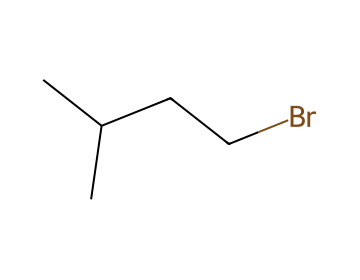
IDENTITY
COMPUTED
PROPERTIES
1.210 g/cu cm at 15 °C
1.207 @25 °C
Colorless liquid
Miscible with alcohol and ether
In water, 196 mg/L at 16.5 °C
-6 °C
120-121 °C
When heated to decomposition it emits toxic fumes of /hydrogen bromide/.
-112 °C
-112 °C
34.6 [mmHg]
34.6 mm Hg at 25 °C
Index of refractive = 1.4433 at 15 °C
Henry's Law constant = 3.46X10⁻² atm-cu m/mol at 25 °C
1-bromo-3-methylbutane appears as a colorless liquid. Slightly soluble in water and denser than water. Vapors are heavier than air.
Colorless liquid; [Merck Index]
837
796;853;856;867;794
1002;1009;991
GHS
Danger
H225 (84.6%): Highly Flammable liquid and vapor [Danger Flammable liquids];H226 (17.3%): Flammable liquid and vapor [Warning Flammable liquids];H302 (78.8%): Harmful if swallowed [Warning Acute toxicity, oral];H315 (94.2%): Causes skin irritation [Warning Skin corrosion/irritation];H319 (17.3%): Causes serious eye irritation [Warning Serious eye damage/eye irritation];H335 (90.4%): May cause respiratory irritation [Warning Specific target organ toxicity, single exposure; Respiratory tract irritation];H411 (19.2%): Toxic to aquatic life with long lasting effects [Hazardous to the aquatic environment, long-term hazard]
P210, P233, P240, P241, P242, P243, P261, P264, P264+P265, P270, P271, P273, P280, P301+P317, P302+P352, P303+P361+P353, P304+P340, P305+P351+P338, P319, P321, P330, P332+P317, P337+P317, P362+P364, P370+P378, P391, P403+P233, P403+P235, P405, and P501 (click each P-code to see the statement)
Aggregated GHS information provided per 52 reports by companies from 10 notifications to the ECHA C&L Inventory. Each notification may be associated with multiple companies.;Information may vary between notifications depending on impurities, additives, and other factors. The percentage value in parenthesis indicates the notified classification ratio from companies that provide hazard codes. Only hazard codes with percentage values above 10% are shown. For more detailed information, please visit ECHA C&L website.
HAZARDS
Chemical: Butane, 1-bromo-3-methyl-
Status: Active Update: 13-04-2018 https://echa.europa.eu/registration-dossier/-/registered-dossier/23940
1-Bromo-3-methylbutane: Does not have an individual approval but may be used under an appropriate group standard
The New Jersey Worker and Community Right to Know Act requires public and private employers to provide information about hazardous substances at their workplaces. (N.J.S.A. 34:5A-1 et. seq.)
Flammable Liquid
Excerpt from ERG Guide 130 [Flammable Liquids (Water-Immiscible / Noxious)]:;HIGHLY FLAMMABLE: Will be easily ignited by heat, sparks or flames. Vapors may form explosive mixtures with air. Vapors may travel to source of ignition and flash back. Most vapors are heavier than air. They will spread along the ground and collect in low or confined areas (sewers, basements, tanks, etc.). Vapor explosion hazard indoors, outdoors or in sewers. Those substances designated with a (P) may polymerize explosively when heated or involved in a fire. Runoff to sewer may create fire or explosion hazard. Containers may explode when heated. Many liquids will float on water. (ERG, 2024)
· HIGHLY FLAMMABLE: Will be easily ignited by heat, sparks or flames.;· Vapors may form explosive mixtures with air.;· Vapors may travel to source of ignition and flash back.;· Most vapors are heavier than air. They will spread along the ground and collect in low or confined areas (sewers, basements, tanks, etc.).;· Vapor explosion hazard indoors, outdoors or in sewers.;· Those substances designated with a (P) may polymerize explosively when heated or involved in a fire.;· Runoff to sewer may create fire or explosion hazard.;· Containers may explode when heated.;· Many liquids will float on water.
Dangerous fire hazard when exposed to heat or flame.
Excerpt from ERG Guide 130 [Flammable Liquids (Water-Immiscible / Noxious)]:;May cause toxic effects if inhaled or absorbed through skin. Inhalation or contact with material may irritate or burn skin and eyes. Fire will produce irritating, corrosive and/or toxic gases. Vapors may cause dizziness or asphyxiation, especially when in closed or confined areas. Runoff from fire control or dilution water may cause environmental contamination. (ERG, 2024)
· May cause toxic effects if inhaled or absorbed through skin.;· Inhalation or contact with material may irritate or burn skin and eyes.;· Fire will produce irritating, corrosive and/or toxic gases.;· Vapors may cause dizziness or asphyxiation, especially when in closed or confined areas.;· Runoff from fire control or dilution water may cause environmental contamination.
Emergency medical treatment: see 1-Bromopropane. [HSDB] May cause irritation or burns to skin and eyes; [CAMEO]
2341 130
Halogenated Organic Compounds
Highly Flammable
Halogenated aliphatic compounds, such as 1-BROMO-3-METHYLBUTANE, are moderately or very reactive. Halogenated organics generally become less reactive as more of their hydrogen atoms are replaced with halogen atoms. Low-molecular-weight haloalkanes are highly flammable and can react with some metals to form dangerous products. Materials in this group are incompatible with strong oxidizing and reducing agents. Also, they are incompatible with many amines, nitrides, azo/diazo compounds, alkali metals, and epoxides. Gives toxic fumes of bromine when burned.
/GUIDE 130: FLAMMABLE LIQUIDS (Non-Polar/Water-Immiscible/Noxious)/ Fire or Explosion: HIGHLY FLAMMABLE: Will be easily ignited by heat, sparks or flames. Vapors may form explosive mixtures with air. Vapors may travel to source of ignition and flash back. Most vapors are heavier than air. They will spread along ground and collect in low or confined areas (sewers, basements, tanks). Vapor explosion hazard indoors, outdoors or in sewers. Those substances designated with a (P) may polymerize explosively when heated or involved in a fire. Runoff to sewer may create fire or explosion hazard. Containers may explode when heated. Many liquids are lighter than water.
/GUIDE 130: FLAMMABLE LIQUIDS (Non-Polar/Water-Immiscible/Noxious)/ Health: May cause toxic effects if inhaled or absorbed through skin. Inhalation or contact with material may irritate or burn skin and eyes. Fire will produce irritating, corrosive and/or toxic gases. Vapors may cause dizziness or suffocation. Runoff from fire control or dilution water may cause pollution.
/GUIDE 130: FLAMMABLE LIQUIDS (Non-Polar/Water-Immiscible/Noxious)/ Public Safety: CALL Emergency Response Telephone Number on Shipping Paper first. If Shipping Paper not available or no answer, refer to appropriate telephone number listed on the inside back cover. As an immediate precautionary measure, isolate spill or leak area for at least 50 meters (150 feet) in all directions. Keep unauthorized personnel away. Stay upwind. Keep out of low areas. Ventilate closed spaces before entering.
/GUIDE 130: FLAMMABLE LIQUIDS (Non-Polar/Water-Immiscible/Noxious)/ Protective Clothing: Wear positive pressure self-contained breathing apparatus (SCBA). Structural firefighters' protective clothing will only provide limited protection.
For more DOT Emergency Guidelines (Complete) data for 1-BROMO-3-METHYLBUTANE (8 total), please visit the HSDB record page.
1-Bromo-3-methylbutane
UN2341
Class 3 Flammable and combustible liquid (49 eCFR § 173.120)
PG III: the degree of danger presented by the material is minor;For more information about the packing group assignment, please visit 49 eCFR § 173
SAFETY
Excerpt from ERG Guide 130 [Flammable Liquids (Water-Immiscible / Noxious)]:;CAUTION: The majority of these products have a very low flash point. Use of water spray when fighting fire may be inefficient.;SMALL FIRE: Dry chemical, CO2, water spray or regular foam. If regular foam is ineffective or unavailable, use alcohol-resistant foam.;LARGE FIRE: Water spray, fog or regular foam. If regular foam is ineffective or unavailable, use alcohol-resistant foam. Avoid aiming straight or solid streams directly onto the product. If it can be done safely, move undamaged containers away from the area around the fire.;FIRE INVOLVING TANKS, RAIL TANK CARS OR HIGHWAY TANKS: Fight fire from maximum distance or use unmanned master stream devices or monitor nozzles. Cool containers with flooding quantities of water until well after fire is out. Withdraw immediately in case of rising sound from venting safety devices or discoloration of tank. ALWAYS stay away from tanks in direct contact with flames. For massive fire, use unmanned master stream devices or monitor nozzles; if this is impossible, withdraw from area and let fire burn. (ERG, 2024)
· CALL 911. Then call emergency response telephone number on shipping paper. If shipping paper not available or no answer, refer to appropriate telephone number listed on the inside back cover.;· Keep unauthorized personnel away.;· Stay upwind, uphill and/or upstream.;· Ventilate closed spaces before entering, but only if properly trained and equipped.
· ELIMINATE all ignition sources (no smoking, flares, sparks or flames) from immediate area.;· All equipment used when handling the product must be grounded.;· Do not touch or walk through spilled material.;· Stop leak if you can do it without risk.;· Prevent entry into waterways, sewers, basements or confined areas.;· A vapor-suppressing foam may be used to reduce vapors.;· Absorb or cover with dry earth, sand or other non-combustible material and transfer to containers.;· Use clean, non-sparking tools to collect absorbed material.;Large Spill;· Dike far ahead of liquid spill for later disposal.;· Water spray may reduce vapor, but may not prevent ignition in closed spaces.
Excerpt from ERG Guide 130 [Flammable Liquids (Water-Immiscible / Noxious)]:;Refer to the "General First Aid" section. Specific First Aid: Wash skin with soap and water. In case of burns, immediately cool affected skin for as long as possible with cold water. Do not remove clothing if adhering to skin. (ERG, 2024)
General First Aid:;· Call 911 or emergency medical service.;· Ensure that medical personnel are aware of the material(s) involved, take precautions to protect themselves and avoid contamination.;· Move victim to fresh air if it can be done safely.;· Administer oxygen if breathing is difficult.;· If victim is not breathing:;-- DO NOT perform mouth-to-mouth resuscitation; the victim may have ingested or inhaled the substance.;-- If equipped and pulse detected, wash face and mouth, then give artificial respiration using a proper respiratory medical device (bag-valve mask, pocket mask equipped with a one-way valve or other device).;-- If no pulse detected or no respiratory medical device available, provide continuous compressions. Conduct a pulse check every two minutes or monitor for any signs of spontaneous respirations.;· Remove and isolate contaminated clothing and shoes.;· For minor skin contact, avoid spreading material on unaffected skin.;· In case of contact with substance, remove immediately by flushing skin or eyes with running water for at least 20 minutes.;· For severe burns, immediate medical attention is required.;· Effects of exposure (inhalation, ingestion, or skin contact) to substance may be delayed.;· Keep victim calm and warm.;· Keep victim under observation.;· For further assistance, contact your local Poison Control Center.;· Note: Basic Life Support (BLS) and Advanced Life Support (ALS) should be done by trained professionals.;Specific First Aid:;· Wash skin with soap and water.
· Wear positive pressure self-contained breathing apparatus (SCBA).;· Structural firefighters' protective clothing provides thermal protection but only limited chemical protection.
Excerpt from ERG Guide 130 [Flammable Liquids (Water-Immiscible / Noxious)]:;ELIMINATE all ignition sources (no smoking, flares, sparks or flames) from immediate area. All equipment used when handling the product must be grounded. Do not touch or walk through spilled material. Stop leak if you can do it without risk. Prevent entry into waterways, sewers, basements or confined areas. A vapor-suppressing foam may be used to reduce vapors. Absorb or cover with dry earth, sand or other non-combustible material and transfer to containers. Use clean, non-sparking tools to collect absorbed material.;LARGE SPILL: Dike far ahead of liquid spill for later disposal. Water spray may reduce vapor, but may not prevent ignition in closed spaces. (ERG, 2024)
Excerpt from ERG Guide 130 [Flammable Liquids (Water-Immiscible / Noxious)]:;IMMEDIATE PRECAUTIONARY MEASURE: Isolate spill or leak area for at least 50 meters (150 feet) in all directions.;LARGE SPILL: Consider initial downwind evacuation for at least 300 meters (1000 feet).;FIRE: If tank, rail tank car or highway tank is involved in a fire, ISOLATE for 800 meters (1/2 mile) in all directions; also, consider initial evacuation for 800 meters (1/2 mile) in all directions. (ERG, 2024)
Immediate precautionary measure;· Isolate spill or leak area for at least 50 meters (150 feet) in all directions.;Large Spill;· Consider initial downwind evacuation for at least 300 meters (1000 feet).;Fire;· If tank, rail tank car or highway tank is involved in a fire, ISOLATE for 800 meters (1/2 mile) in all directions; also, consider initial evacuation for 800 meters (1/2 mile) in all directions.
37 [mg/m3]
410 [mg/m3]
2400 [mg/m3]
Excerpt from ERG Guide 130 [Flammable Liquids (Water-Immiscible / Noxious)]:;Wear positive pressure self-contained breathing apparatus (SCBA). Structural firefighters' protective clothing provides thermal protection but only limited chemical protection. (ERG, 2024)
CAUTION: The majority of these products have a very low flash point. Use of water spray when fighting fire may be inefficient.;Small Fire;· Dry chemical, CO2, water spray or regular foam. If regular foam is ineffective or unavailable, use alcohol-resistant foam.;Large Fire;· Water spray, fog or regular foam. If regular foam is ineffective or unavailable, use alcohol-resistant foam.;· Avoid aiming straight or solid streams directly onto the product.;· If it can be done safely, move undamaged containers away from the area around the fire.;Fire Involving Tanks, Rail Tank Cars or Highway Tanks;· Fight fire from maximum distance or use unmanned master stream devices or monitor nozzles.;· Cool containers with flooding quantities of water until well after fire is out.;· Withdraw immediately in case of rising sound from venting safety devices or discoloration of tank.;· ALWAYS stay away from tanks in direct contact with flames.;· For massive fire, use unmanned master stream devices or monitor nozzles; if this is impossible, withdraw from area and let fire burn.
TOXICITY
TERRESTRIAL FATE: Based on a classification scheme(1), an estimated Koc value of 240(SRC), determined from a measured water solubility of 196 mg/L(2) and a regression derived equation(3), indicates that 1-bromo-3-methylbutane is expected to have moderate mobility in soil(SRC). Volatilization of 1-bromo-3-methylbutane from moist soil surfaces is expected to be an important fate process(SRC) given a Henry's Law constant of 3.46X10⁻² atm-cu m/mole(4). The potential for volatilization of 1-bromo-3-methylbutane from dry soil surfaces exists(SRC) based upon its vapor pressure of 34.6 mm Hg(4). Biodegradation data were not available(SRC, 2005).
AQUATIC FATE: Based on a classification scheme(1), an estimated Koc value of 240(SRC), determined from a measured water solubility of 196 mg/L(2) and a regression derived equation(3), indicates that 1-bromo-3-methylbutane is expected to adsorb to suspended solids and sediment(SRC). Volatilization from water surfaces is expected(3) based upon a Henry's Law constant of 3.46X10⁻² atm-cu m/mole(4). Using this Henry's Law constant and an estimation method(3), volatilization half-lives for a model river and model lake are 1 hour and 5 days, respectively (SRC). According to a classification scheme(5), an estimated BCF of 32(SRC), from its water solubility(2) and a regression-derived equation(3), suggests the potential for bioconcentration in aquatic organisms is moderate(SRC). 1-Bromo-3-methylbutane is an alkyl halide which is susceptible to hydrolysis(6). No measured hydrolysis rates were located for this compound. However, the hydrolysis half-life of an analogous compound, 1-bromopropane, is about 26 days at pH 7(7), which suggests 1-bromo-3-methylbutane may undergo hydrolysis(SRC). Biodegradation data were not available(SRC, 2005).
ATMOSPHERIC FATE: According to a model of gas/particle partitioning of semivolatile organic compounds in the atmosphere(1), 1-bromo-3-methylbutane , which has a vapor pressure of 34.6 mm Hg at 25 °C(2), is expected to exist solely as a vapor in the ambient atmosphere. Vapor-phase 1-bromo-3-methylbutane is degraded in the atmosphere by reaction with photochemically-produced hydroxyl radicals(SRC); the half-life for this reaction in air is estimated to be 5 days(SRC), calculated from its rate constant of 3.6X10⁻¹² cu cm/molecule-sec at 25 °C(SRC) that was derived using a structure estimation method(3).
Neurotoxin - Acute solvent syndrome;Occupational hepatotoxin - Secondary hepatotoxins: the potential for toxic effect in the occupational setting is based on cases of poisoning by human ingestion or animal experimentation.;Dermatotoxin - Skin burns.
The Koc of 1-bromo-3-methylbutane is estimated as 240(SRC), using a measured water solubility of 196 mg/L(1) and a regression-derived equation(2). According to a classification scheme(3), this estimated Koc value suggests that 1-bromo-3-methylbutane is expected to have moderate mobility in soil(SRC).
1-Bromo-3-methylbutane's production and use as an organic synthesis reagent(1) may result in its release to the environment through various waste streams(SRC).
No biodegradation data were located for 1-bromo-3-methylbutane(SRC, 2005). 2-Methylbutane was completely biodegraded in 12 days using an activated sludge, following an initial lag period of 5 days(1), suggesting the potential for biodegradation of 1-bromo-3-methylbutane exists(SRC).
An estimated BCF of 32 was calculated for 1-bromo-3-methylbutane (SRC), using a measured water solubility of 196 mg/L(1) and a regression-derived equation(2). According to a classification scheme(3), this BCF suggests the potential for bioconcentration in aquatic organisms is moderate(SRC).
The Henry's Law constant for 1-bromo-3-methylbutane has been measured as 3.46X10⁻² atm-cu m/mole(1). This Henry's Law constant indicates that 1-bromo-3-methylbutane is expected to volatilize rapidly from water surfaces(2). Based on this Henry's Law constant, the volatilization half-life from a model river (1 m deep, flowing 1 m/sec, wind velocity of 3 m/sec)(2) is estimated as 1 hour(SRC). The volatilization half-life from a model lake (1 m deep, flowing 0.05 m/sec, wind velocity of 0.5 m/sec)(2) is estimated as 5 days(SRC). 1-Bromo-3-methylbutane's Henry's Law constant indicates that volatilization from moist soil surfaces may occur(SRC). The potential for volatilization of 1-bromo-3-methylbutane from dry soil surfaces exists(SRC) based upon its vapor pressure of 34.6 mm Hg at 25 °C(1).
The rate constant for the vapor-phase reaction of 1-bromo-3-methylbutane with photochemically-produced hydroxyl radicals has been estimated as 3.6X10⁻¹² cu cm/molecule-sec at 25 °C(SRC) using a structure estimation method(1). This corresponds to an atmospheric half-life of about 5 days at an atmospheric concentration of 5X10+5 hydroxyl radicals per cu cm(1). 1-Bromo-3-methylbutane is not expected to undergo direct photolysis in the environment since it does not contain functional groups that absorb light in the environmental UV spectrum(SRC). Alkyl halides are susceptible to hydrolysis in the environment(2,3); however, no measured hydrolysis rates were located for this compound. The hydrolysis half-life of an analogous compound, 1-bromopropane, is about 26 days at pH 7(4), which suggests 1-bromo-3-methylbutane may also hydrolyze(SRC).
Occupational exposure to 1-bromo-3-methylbutane may occur through inhalation and dermal contact with this compound at workplaces where 1-bromo-3-methylbutane is produced or used. (SRC)
1-Bromo-3-methylbutane's production and use as an organic synthesis reagent may result in its release to the environment through various waste streams. If released to air, a vapor pressure of 34.6 mm Hg at 25 °C indicates 1-bromo-3-methylbutane will exist solely as a vapor in the ambient atmosphere. Vapor-phase 1-bromo-3-methylbutane will be degraded in the atmosphere by reaction with photochemically-produced hydroxyl radicals; the half-life for this reaction in air is estimated to be 5 days. If released to soil, 1-bromo-3-methylbutane is expected to have moderate mobility based upon an estimated Koc of 240. Volatilization from moist soil surfaces is expected to be an important fate process based upon a Henry's Law constant of 3.46X10⁻² atm-cu m/mole. The potential for volatilization of 1-bromo-3-methylbutane from dry soil surfaces exists based upon its vapor pressure. No biodegradation data were located for 1-bromo-3-methylbutane. If released into water, 1-bromo-3-methylbutane is expected to adsorb to suspended solids and sediment based upon the estimated Koc. Volatilization from water surfaces is expected to be an important fate process based upon this compound's Henry's Law constant. Estimated volatilization half-lives for a model river and model lake are 1 hour and 5 days, respectively. 1-Bromo-3-methylbutane is an alkyl halide which is susceptible to hydrolysis; however the rate of this reaction has not been measured. The hydrolysis half-life of an analogous compound, 1-bromopropane, is about 26 days at pH 7, which suggests 1-bromo-3-methylbutane may undergo hydrolysis. An estimated BCF of 32 suggests the potential for bioconcentration in aquatic organisms is moderate. Occupational exposure to 1-bromo-3-methylbutane may occur through inhalation and dermal contact with this compound at workplaces where 1-bromo-3-methylbutane is produced or used. (SRC)
LC50 (mammal) = 21,300 mg/m3
LD50 Rat ip 6150 mg/kg
LD50 Mouse ip 13750 mg/kg
REGULATORY
Chemical: Butane, 1-bromo-3-methyl-
Status: Active Update: 13-04-2018 https://echa.europa.eu/registration-dossier/-/registered-dossier/23940
1-Bromo-3-methylbutane: Does not have an individual approval but may be used under an appropriate group standard
The New Jersey Worker and Community Right to Know Act requires public and private employers to provide information about hazardous substances at their workplaces. (N.J.S.A. 34:5A-1 et. seq.)
USES
Used in organic synthesis; [Merck Index]
In organic synthesis.
Prepared from isoamyl alcohol, bromine and phosphorous or by refluxing isoamyl alcohol with HBr in presence of H2SO4
Butane, 1-bromo-3-methyl-: ACTIVE
ALIASES
REACTIONS
uspto-grants-1998_03 · 10.6084/m9.figshare.5104873.v1 · US05728686
查看
uspto-grants-1995_06 · 10.6084/m9.figshare.5104873.v1 · US05428062
查看
uspto-grants-2005_02 · 10.6084/m9.figshare.5104873.v1 · US06849713B2
查看
uspto-grants-2008_09 · 10.6084/m9.figshare.5104873.v1 · US07419981B2
查看
uspto-grants-1995_05 · 10.6084/m9.figshare.5104873.v1 · US05414007
查看
uspto-grants-2014_09 · 10.6084/m9.figshare.5104873.v1 · US08822503B2
查看
uspto-grants-2014_09 · 10.6084/m9.figshare.5104873.v1 · US08841291B2
查看
Training data from https://doi.org/10.1039/C8SC04228D (2/10) · 10.1039/C8SC04228D
查看