安徽立兴新材料有限公司
- 联系电话
- 563-+86-0563-8163717 13805622997
IDENTITY
IDENTITY
ALIASES
PROPERTIES
SAFETY
PRICE
REFERENCE
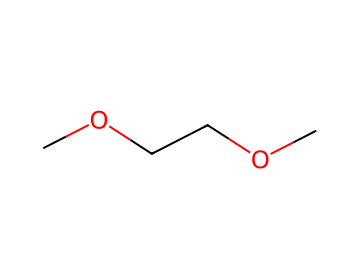
概述乙二醇二甲醚又称1,2-二甲氧基乙烷、二甲基溶纤剂、α,β-二甲氧基乙烷、Glyme,简称GDME。无色液体。有乙醚气味。乙二醇二甲醚是性能优越的非质子极性溶剂,广泛应用于化学工业以及医药抽提剂与有机中间体合成。传统Williamson合成法生产的乙二醇二甲醚,是在乙醇钠相转移催化剂作用下制备的。该工艺由于反应路径长而副产物多,产品分离难,为获得纯净产品需要通过酸中和废弃碱液,整个过程会产生大量工业盐和废水,环境污染严重,且液体酸碱的使用对设备的耐腐蚀性要求高。随着产品升级的需要以及人们环境保护意识的提高,采用环境友好固体酸催化剂工艺成为迫切的需求。
用途主要用作溶剂和有机合成中间体
用途主要用于聚合物化学、电化学、硼化学工艺领域,还用作树脂、硝化纤维素等的溶剂以及医药抽提剂、有机合成中间体。
REFERENCE
化学性质无色液体。熔点-58℃(-71℃),沸点84℃,相对密度0.8665(20/4℃),折光率1.3796,闪点0℃。能与水、醇混溶,溶于烃类溶剂。有强烈醚样气味。
REFERENCE
生产方法由乙二醇单甲醚与金属钠、氯甲烷反应而得。将乙二醇单甲醚与金属钠一起回流,直至金属钠完全反应,降温至45℃,通入氯甲烷。反应毕,进行分馏,收集84-85.5℃馏分,即得成品。
REFERENCE
可燃性危险特性遇明火、高温、氧化剂易燃; 燃烧产生刺激烟雾
储运特性库房通风低温干燥; 与氧化剂分开存放
灭火剂干粉、干砂
REFERENCE
职业标准STEL 10 毫克/ 立方米
UPSTREAM / DOWNSTREAM
SUPPLIERS
1,2-dimethoxyethane appears as a liquid with a sharp odor. Less dense than water. Flash point 34 °F. Mildly toxic by ingestion and inhalation. Severely irritates skin and eyes. Vapors heavier than air. Used to make other chemicals.
COMPUTED
PROPERTIES
Flammable agents - 3rd degree
Pharmaceuticals -> Listed in ZINC15
Solvents -> Glycol Ethers (Glymes)
8.2
Schoenflies notation
Log Kow = -0.21
-0.21
-0.21
SHARP ETHEREAL ODOR
Mild odor
0.868 at 68 °F (USCG, 1999) - Less dense than water; will float
0.86285 @ 20 °C/4 °C
Relative density (water = 1): 0.86
0.86877 @25 °C
WATER-WHITE LIQUID
COLORLESS LIQUID
greater than or equal to 100 mg/mL at 72 °F (NTP, 1992)
MISCIBLE WITH WATER, ALCOHOL; SOL IN HYDROCARBON SOLVENTS
SOL IN CHLOROFORM, ETHER, ACETONE, BENZENE
water solubility = 1.00X10+6 mg/l @ 25 °C
Solubility in water: miscible
32 °F (NTP, 1992)
-2 °C
29 °F(-2 °C) (CLOSED CUP)
-2 °C c.c.
185 °F at 760 mmHg (NTP, 1992)
82-83 °C @ 760 MM HG
82-83 °C
GHS
Danger
H225: Highly Flammable liquid and vapor [Danger Flammable liquids]
P203, P210, P233, P240, P241, P242, P243, P261, P271, P280, P303+P361+P353, P304+P340, P317, P318, P370+P378, P403+P235, P405, and P501 (click each P-code to see the statement)
This chemical does not meet GHS hazard criteria for 0.2% (1 of 640) of reports.
Danger
H225 (99.8%): Highly Flammable liquid and vapor [Danger Flammable liquids]
HAZARDS
Chemical: Ethane, 1,2-dimethoxy-
Hazard Traits - Reproductive Toxicity
Ethane, 1,2-dimethoxy- is listed on the EPA's Chemical Data Reporting (CDR) system. Manufacturers and importers of Ethane, 1,2-dimethoxy- are required to report information about their production and use of this chemical to the EPA under the Toxic Substances Control Act (TSCA). (40 eCFR Part 711)
S - indicates a substance that is identified in a final Significant New Use Rule.
Status: Active Update: 21-06-2022 https://echa.europa.eu/registration-dossier/-/registered-dossier/14829
Substance: 1, 2-dimethoxyethane; ethylene glycol dimethyl ether (EGDME)
IMAP assessments - Ethane, 1,2-dimethoxy-: Environment tier I assessment
Flammable Liquid
Behavior in Fire: Containers may explode in fires. (USCG, 1999)
· HIGHLY FLAMMABLE: Will be easily ignited by heat, sparks or flames.
Highly flammable. Vapour/air mixtures are explosive.
DANGEROUS, WHEN EXPOSED TO HEAT OR FLAME; CAN REACT VIGOROUSLY WITH OXIDIZING MATERIALS
FLAMMABLE, DANGEROUS FIRE RISK
If ingested causes nausea, vomiting, cramps, weakness, coma. (USCG, 1999)
· Inhalation or contact with material may irritate or burn skin and eyes.
TLV Basis is hematologic effect and male reproductive & embryo/fetal damage; [ACGIH] 2-Methoxyethanol is a major metaobolite; The potential health hazard of monoglyme is high based on the results of repeated-dose (blood, thymus, adrenal gland, and testicular degeneration) and developmental (increased fetal death and skeletal effects and decreased fetal body weight) toxicity studies at relatively low doses in animal studies. [EPA: Initial Risk-Based Prioritization of HPV Chemicals: Monoglyme] Reproductive toxin in animal tests; [ICSC] Labeled as May impair fertility and May cause harm to the unborn child by EU regulations; [Glycol Ethers Online] Inhalation of vapor may cause dizziness or difficulty breathing; [HSDB] A severe skin and eye irritant; [CAMEO] Reproductive toxin and highly flammable; [MSDSonline] See GLYCOL ETHERS. See 2-Methoxyethanol.
2252 127
Ethers
Symbol: F, T; R: 60-61-11-19-20; S: 53-45
UN Hazard Class: 3; UN Pack Group: II
Highly Flammable
SAFETY
Excerpt from ERG Guide 127 [Flammable Liquids (Water-Miscible)]:
Use water spray, foam, powder, carbon dioxide. In case of fire: keep drums, etc., cool by spraying with water.
Fresh air, rest.
Remove contaminated clothes. Rinse skin with plenty of water or shower.
First rinse with plenty of water for several minutes (remove contact lenses if easily possible), then refer for medical attention.
Rinse mouth. Give one or two glasses of water to drink.
· CALL 911. Then call emergency response telephone number on shipping paper. If shipping paper not available or no answer, refer to appropriate telephone number listed on the inside back cover.
· ELIMINATE all ignition sources (no smoking, flares, sparks or flames) from immediate area.
EYES: First check the victim for contact lenses and remove if present. Flush victim's eyes with water or normal saline solution for 20 to 30 minutes while simultaneously calling a hospital or poison control center. Do not put any ointments, oils, or medication in the victim's eyes without specific instructions from a physician. IMMEDIATELY transport the victim after flushing eyes to a hospital even if no symptoms (such as redness or irritation) develop.
General First Aid:
Cool. Fireproof. Separated from strong oxidants.
· Wear positive pressure self-contained breathing apparatus (SCBA).
EXTINGUISH WITH CHEMICAL, ALCOHOL FOAM, OR CARBON DIOXIDE. COOL EXPOSED CONTAINERS WITH WATER. CONTAINERS MAY EXPLODE IN FIRE.
If material on fire or involved in fire: Do not extinguish fire unless flow can be stopped or safely confined. Use water in flooding quantities as fog. Solid streams of water may be ineffective. Cool all affected containers with flooding quantities of water. Use "alcohol" foam, dry chemical or carbon dioxide. Keep run-off water out of sewers and water sources.
Excerpt from ERG Guide 127 [Flammable Liquids (Water-Miscible)]:
SRP: At the time of review, criteria for land treatment or burial (sanitary landfill) disposal practices are subject to significant revision. Prior to implementing land disposal of waste residue (including waste sludge), consult with environmental regulatory agencies for guidance on acceptable disposal practices.
Personal protection: filter respirator for organic gases and vapours adapted to the airborne concentration of the substance. Remove all ignition sources. Ventilation. Collect leaking and spilled liquid in sealable containers as far as possible.
If material not on fire and not involved in fire: Keep sparks, flames, and other sources of ignition away. Keep material out of water sources and sewers. Build dikes to contain flow as necessary. Attempt to stop leak if without undue personnel hazard. Use water spray to knock-down vapors.
Personnel protection: Avoid breathing vapors. Keep upwind. ... Do not handle broken packages unless wearing appropriate personal protective equipment. If contact with the material anticipated, wear appropriate chemical protective clothing.
Excerpt from ERG Guide 127 [Flammable Liquids (Water-Miscible)]:
Immediate precautionary measure
TOXICITY
TERRESTRIAL FATE: Based on a recommended classification scheme(1), an estimated Koc value of 18(SRC), determined from a measured log Kow(2) and a recommended regression-derived equation(3), indicates that 1,2-dimethoxyethane will have very high mobility in soil(SRC). Limited data, based on pure culture studies(4), suggest that this compound may be resistant to biodegradation(SRC). Volatilization of 1,2-dimethoxyethane may be important from dry soil surfaces(SRC) based on a measured vapor pressure of 48 mm Hg(5), but not from moist soil surfaces(SRC) given an estimated Henry's Law constant of 1.1X10⁻⁶ atm-cu m/mole(6,SRC).
AQUATIC FATE: Based on a recommended classification scheme(1), an estimated Koc value of 18(SRC), determined from a measured log Kow(2) and a recommended regression-derived equation(3), indicates that 1,2-dimethoxyethane should not adsorb to suspended solids and sediment(SRC) in the water. Limited data, from pure culture studies(4), suggest that this compound may be resistant to biodegradation(SRC). 1,2-Dimethoxyethane may volatilize slowly from water surfaces based on an estimated Henry's Law constant of 1.1X10⁻⁶ atm-cu m/mole(SRC), developed using a fragment constant estimation method(5). Estimated half-lives for a model river and model lake are 33 and 240 days, respectively(3,SRC). According to a recommended classification scheme(6), an estimated BCF value of 0.4(3,SRC), from a measured log Kow(2), suggests that bioconcentration of 1,2-dimethoxyethane will be low in aquatic organisms(SRC).
ATMOSPHERIC FATE: According to a suggested classification scheme(1), a measured vapor pressure of 48 mm Hg at 20 °C(2) indicates that 1,2-dimethoxyethane will mainly exist in the vapor phase in the ambient atmosphere. Vapor-phase 1,2-dimethoxyethane is degraded in the atmosphere by reaction with photochemically produced hydroxyl radicals(SRC); the half-life for this reaction in air is estimated to be about 25 hours(3,SRC).
Neurotoxin - Acute solvent syndrome
The substance can be absorbed into the body by ingestion, by inhalation and through the skin.
MAY BE ABSORBED!
Redness.
Nausea.
The Koc of 1,2-dimethoxyethane is estimated as approximately 18(SRC), using a measured log Kow of -0.21(1) and a regression-derived equation(2,SRC). According to a recommended classification scheme(3), this estimated Koc value suggests that 1,2-dimethoxyethane has very high mobility in soil(SRC).
...TOXICITY OF ETHYLENE GLYCOL DIMETHYL ETHER MAY BE CONSIDERED TO BE LOW FROM LIMITED REPEATED SHORT EXPOSURES. CARE SHOULD BE EXERCISED, HOWEVER, TO AVOID PROLONGED OR REPEATED INHALATION OF HIGH CONCN OF THE VAPOR.
IF /VAPOR/ INHALED, WILL CAUSE DIZZINESS OR DIFFICULT BREATHING. LIQUID IS NOT IRRITATING TO SKIN. IF SWALLOWED, WILL CAUSE NAUSEA, VOMITING OR LOSS OF CONSCIOUSNESS.
1,2-Dimethoxyethane's production and use as a solvent and solubilizer(1) may result in its release to the environment through various waste streams(SRC).
Four pure cultures of bacteria, isolated from either soil or activated sludge, were unable to utilize 1,2-dimethoxyethane as a carbon source(1).
An estimated BCF value of 0.4 was calculated for 1,2-dimethoxyethane(SRC), using a measured log Kow of -0.21(1) and a recommended regression-derived equation(2). According to a classification scheme(3), this BCF value suggests that bioconcentration in aquatic organisms will be low(SRC).
The Henry's Law constant for 1,2-dimethoxyethane is estimated as 1.1X10⁻⁶ atm-cu m/mole(SRC) using a fragment constant estimation method(1). This value indicates that 1,2-dimethoxyethane will volatilize from slowly moving water surfaces(2,SRC). Based on this Henry's Law constant, the volatilization half-life from a model river (1 m deep, flowing 1 m/sec, wind velocity of 3 m/sec) is estimated as approximately 33 days(2,SRC). The volatilization half-life from a model lake (1 m deep, flowing 0.05 m/sec, wind velocity of 0.5 m/sec) is estimated as approximately 240 days(2,SRC). Volatilization from dry soil surfaces is expected based on an experimental vapor pressure of 48 mm Hg(3). However, volatilization from moist soil surfaces should not be important based on its estimated Henry's Law constant(1,SRC).
/IN FEMALE RATS/...A SINGLE EXPOSURE TO 8000 PPM CAUSED SIGNIFICANT DECR IN AVOIDANCE RESPONSE; HOWEVER...NO EFFECT ON ESCAPE RESPONSE. FURTHER EXPOSURES DECR BOTH RESPONSES, & AFTER 5 DAILY 4 HR EXPOSURES HALF...DIED. ...MASSIVE HEMORRHAGE OF LUNG & GI TRACT. /SEVERAL RATS DIED AFTER 4 HR/4000 PPM/10 EXPOSURES/.
/IN FEMALE RATS, EXPOSED AT 1000 & 2000 PPM 4 HR/DAY, 5 DAYS/WK/...ALL SURVIVED BUT...SHOWED SIGNIFICANT...AVOIDANCE RESPONSE BUT NO ESCAPE RESPONSE. COMPLETE RECOVERY FROM BEHAVIORAL EFFECTS OCCURRED WITHIN A FEW DAYS AFTER CESSATION OF EXPOSURE. ...THERE WAS A DEFINITE REDUCTION IN GROWTH DEPENDING ON CONCN.
1,2-DIMETHOXYETHANE WAS ADMIN TO PREGNANT MICE ON THE 7TH, 8TH, 9TH, & 10TH DAYS OF PREGNANCY. 490 MG/KG WAS ADMIN TO 28 MICE (GROUP A), 350 MG/KG TO 23 MICE (GROUP B) & 250 MG/KG TO 23 MICE (GROUP C). GROUP FETAL MORTALITY RATES: 20% (A), 13.1% (B), & 12.6% (C).
ADMIN ON 7TH, 8TH, 9TH & 10TH DAYS OF PREGNANCY: 490 MG/KG/28 MICE (GROUP A), 350 MG/KG/23 MICE (B) & 250 MG/KG/23 MICE (C). SURFACE DEFORMITY RATES: 19.2% (A), 5.1% (B) & 0.3% (C). EXTERNAL BRAIN, PALPEBRAL PATENCY, CAUDAL DEFECT, PERITONEAL HERNIA, & CLEFT PALATE NOTED.
ADMIN ON 7TH, 8TH, 9TH, & 10TH DAYS OF PREGNANCY: 490 MG/KG/28 MICE (GROUP A), 350 MG/KG/23 MICE (GROUP B), & 250 MG/KG/23 MICE (GROUP C). FETAL CERVICAL VERTEBRAE ABNORMALITIES, SPINAL FUSION, & COSTAL FUSION DEFORMITY RATES INCREASED WITH INCREASING DOSAGE.
The rate constant for the vapor-phase reaction of 1,2-dimethoxyethane with photochemically produced hydroxyl radicals has been estimated as 1.6X10⁻¹¹ cu cm/molecule-sec at 25 °C(SRC) using a structure estimation method(1,SRC). This corresponds to an atmospheric half-life of about 25 hours at an atmospheric concentration of 5X10+5 hydroxyl radicals per cu cm(1,SRC).
USES
Used as a specialty solvent and reagent; [Merck Index] Used in lithium batteries and industrial coatings; [EPA: Initial Risk-Based Prioritization of HPV Chemicals: Monoglyme]
Battery Manufacturing [Category: Industry]
SOLVENT TO FACILITATE FORMATION OF ALKALI METAL-HYDROCARBON ADDUCTS; IN REFORMATSKY REACTION WITH METHYL GAMMA-BROMOCROTONATE
Process solvent/solubilizer
(1972) NEGLIGIBLE
(1976) NEGLIGIBLE
2023: 550,000 - <1,000,000 lb
(1972) PROBABLY GREATER THAN 4.54X10+5 GRAMS
(1975) PROBABLY GREATER THAN 4.5X10+5 GRAMS
Propellants, non-motive (blowing agents)
Solvent
...FROM ETHYLENE GLYCOL MONOMETHYL ETHER, METHYL SULFATE AND METALLIC SODIUM; FROM CHLOROMETHYL METHYL ETHER IN THE PRESENCE OF SODIUM BY WURTZ REACTIONS.
...FROM ETHYLENE GLYCOL MONOMETHYL ETHER, METHYL CHLORIDE AND SODIUM.
Ethylene glycol monomethyl ether + dimethyl sulphate (ether formation)
GRADES: COMMERCIAL
Information on 1 consumer products that contain 1,2-Dimethoxyethane in the following categories is provided:
All Other Basic Organic Chemical Manufacturing
Ethane, 1,2-dimethoxy-: ACTIVE
USED IN DDVP & DTOP PESTICIDE MIXT TO INCR STABILITY IN HIGHLY CONCN FORM UNDER LOW TEMP
ALIASES
REACTIONS