
uspto-grants-1998_03 · 10.6084/m9.figshare.5104873.v1 · US05728752
查看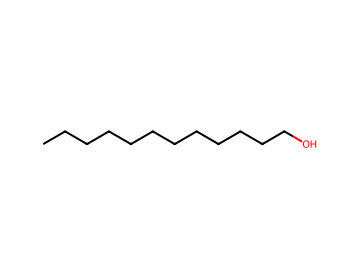
IDENTITY
COMPUTED
PROPERTIES
log Kow = 5.13
5.13
5.4
CHARACTERISTIC FATTY ODOR; UNPLEASANT AT HIGH CONCN BUT DELICATE & FLORAL ON DILUTION
Fatty repulsive odor
FATTY, WAXY FLAVOR
0.831 at 75.2 °F (USCG, 1999) - Less dense than water; will float
0.8309 at 24 °C/4 °C
0.8309 AT 24 °C/4 °C
Density (at 24 °C): 0.83 g/cm³
Relative density of the vapour/air-mixture at 20 °C (air = 1): 1.00
0.830-0.836
18.8 mPa-s at 20 °C
21.7 mm²/s at 20 °C
Leaflets from dilute alcohol
COLORLESS LIQ AT ROOM TEMP; CRYSTALLINE OR FLAKES BELOW 20 °C
Colorless solid
CRYSTALLINE SOLID
In water, 4 mg/L at 25 °C
Soluble in ethanol, ether; slightly soluble in benzene
Soluble in two parts of 70% alcohol
SOL IN ALCOHOL & ETHER; INSOL IN WATER
Insoluble
Solubility in water, g/l at 25 °C: 0.004 (very poor)
260 °F (USCG, 1999)
127 °C
260 °F (127 °C) (Closed cup)
121 °C c.c.
498 °F at 760 mmHg (USCG, 1999)
259 °C at 760 mm Hg
BP: 235.7 °C at 400 mm Hg; 213 °C at 200 mm Hg; 192 °C at 100 mm Hg; 177.8 °C at 60 mm Hg; 167.2 °C at 40 mm Hg; 150 °C at 20 mm Hg; 134.7 °C at 10 mm Hg; 120.2 °C at 5 mm Hg; 91.0 °C at 1.0 mm Hg
259 °C
at 101.3kPa: 250 °C
259 °C
When heated to decomposition it emits acrid smoke and fumes.
75 °F (USCG, 1999)
24 °C
24 °C
24 °C
24 °C
24 °C
6.43 (AIR= 1)
Relative vapor density (air = 1): 6.4
GHS
This chemical does not meet GHS hazard criteria for 2.2% (85 of 3888) of reports.
Warning
H319 (83.8%): Causes serious eye irritation [Warning Serious eye damage/eye irritation];H400 (85.7%): Very toxic to aquatic life [Warning Hazardous to the aquatic environment, acute hazard];H410 (14%): Very toxic to aquatic life with long lasting effects [Warning Hazardous to the aquatic environment, long-term hazard];H411 (24.8%): Toxic to aquatic life with long lasting effects [Hazardous to the aquatic environment, long-term hazard]
P264+P265, P273, P280, P305+P351+P338, P337+P317, P391, and P501 (click each P-code to see the statement)
Aggregated GHS information provided per 3888 reports by companies from 38 notifications to the ECHA C&L Inventory. Each notification may be associated with multiple companies.;Reported as not meeting GHS hazard criteria per 85 of 3888 reports by companies.;There are 37 notifications provided by 3803 of 3888 reports by companies with hazard statement code(s).;Information may vary between notifications depending on impurities, additives, and other factors. The percentage value in parenthesis indicates the notified classification ratio from companies that provide hazard codes. Only hazard codes with percentage values above 10% are shown. For more detailed information, please visit ECHA C&L website.
HAZARDS
Chemical: 1-Dodecanol
1-Dodecanol is listed on the EPA's Chemical Data Reporting (CDR) system. Manufacturers and importers of 1-Dodecanol are required to report information about their production and use of this chemical to the EPA under the Toxic Substances Control Act (TSCA). (40 eCFR Part 711)
2008/127, Reg. (EU) 2017/195, Reg. (EU) 2021/745, Reg. (EU) 2022/1251, Reg. (EU) No 540/2011, Reg. (EU) No 918/2014, Reg. (EU)2020/1160
Status: Active Update: 09-05-2023 https://echa.europa.eu/registration-dossier/-/registered-dossier/15424
1-Dodecanol: Does not have an individual approval but may be used under an appropriate group standard
IMAP assessments - 1-Dodecanol: Human health tier I assessment
Class 9
Excerpt from ERG Guide 171 [Substances (Low to Moderate Hazard)]:;Some may burn but none ignite readily. Containers may explode when heated. Some may be transported hot. For UN3508, Capacitor, asymmetric, be aware of possible short circuiting as this product is transported in a charged state. Polymeric beads, expandable (UN2211) may evolve flammable vapours. (ERG, 2024)
Combustible.
Combustible when it is exposed to heat or flame.
Liquid will cause burning of the eyes and may irritate skin. (USCG, 1999)
Higher alcohols are not highly toxic in the industrial setting; Can cause liver injury, somnolence, and respiratory depression in experimental animals; A skin and eye irritant; [HSDB] Inhalation of high concentrations may cause CNS depression; [CHEMINFO] Safe when used as a flavoring agent in food; [JECFA] Practically nontoxic and generally recognized as safe (GRAS) in food; [Reference #1] Causes general depressed activity after administration onto skin of rabbit; [RTEC] An irritant; [MSDSonline]
Higher alcohols are not highly toxic in the industrial setting; Can cause liver injury, somnolence, and respiratory depression in experimental animals; A rat that died 6 days after a dose of 36 ml/kg had fatty degeneration of the liver; [HSDB]
Lauryl alcohol is a food additive permitted for direct addition to food for human consumption as a synthetic flavoring substance and adjuvant in accordance with the following conditions: a) they are used in the minimum quantity required to produce their intended effect, and otherwise in accordance with all the principles of good manufacturing practice, and b) they consist of one or more of the following, used alone or in combination with flavoring substances and adjuvants generally recognized as safe in food, prior-sanctioned for such use, or regulated by an appropriate section in this part.
Lauryl alcohol is an indirect food additive for use as a component of adhesives.
Alcohols and Polyols
UN Hazard Class: 9; UN Pack Group: III
USEPA/Office of Prevention, Pesticides and Toxic Substances; Reregistration Eligibility Decision Document - Aliphatic Alcohols, EPA 738-R-07-004 (March 2007). The RED summarizes the risk assessment conclusions and outlines any risk reduction measures necessary for the pesticide to continue to be registered in the U.S.[Available from, as of June 2, 2015: http://www.epa.gov/pesticides/reregistration/status.htm]
Chemical: 1-Dodecanol; Green circle - The chemical has been verified to be of low concern based on experimental and modeled data.
SAFETY
Fire Extinguishing Agents Not to Be Used: Water or foam may cause frothing.;Fire Extinguishing Agents: Alcohol foam, carbon dioxide, dry chemical (USCG, 1999)
Use water, dry powder, carbon dioxide, alcohol-resistant foam.
Fresh air, rest. Seek medical attention if you feel unwell.
Remove contaminated clothes. Rinse and then wash skin with water and soap.
Rinse with plenty of water for several minutes (remove contact lenses if easily possible).
Rinse mouth. Rest. Do NOT induce vomiting. Seek medical attention if you feel unwell.
SKIN OR EYES: wash exposed areas with water. (USCG, 1999)
Cool. Well closed. Store in an area without drain or sewer access. Provision to contain effluent from fire extinguishing.
Wear self contained breathing apparatus for fire fighting if necessary.
Alcohol foam, carbon dioxide, dry chemical. Water or foam may cause frothing. Water may be ineffective on fire. Cool exposed containers with water.
Keep tightly closed. Store in a cool dry place.
Accidental Release Measures: ... Prevent further leakage or spillage if safe to do so. Do not let product enter drains. Discharge into the environment must be avoided.
Accidental Release Measures: ... Use protective equipment. Avoid dust formation. Avoid breathing vapors, mist or gas. Ensure adequate ventilation. Evacuate personnel to safe areas. Avoid breathing dust.
Excerpt from ERG Guide 171 [Substances (Low to Moderate Hazard)]:;Do not touch or walk through spilled material. Stop leak if you can do it without risk. Prevent dust cloud. For Asbestos, avoid inhalation of dust. Cover spill with plastic sheet or tarp to minimize spreading. Do not clean up or dispose of, except under supervision of a specialist.;SMALL DRY SPILL: With clean shovel, place material into clean, dry container and cover loosely; move containers from spill area.;SMALL SPILL: Pick up with sand or other non-combustible absorbent material and place into containers for later disposal.;LARGE SPILL: Dike far ahead of liquid spill for later disposal. Cover powder spill with plastic sheet or tarp to minimize spreading. Prevent entry into waterways, sewers, basements or confined areas. (ERG, 2024)
SRP: Recycle any unused portion of the material for its approved use or return it to the manufacturer or supplier. Ultimate disposal of the chemical must consider: the material's impact on air quality; potential migration in air, soil or water; effects on animal, aquatic and plant life; and conformance with environmental and public health regulations. If it is possible or reasonable use an alternative chemical product with less inherent propensity for occupational harm/injury/toxicity or environmental contamination.
Personal protection: filter respirator for organic gases and particulates adapted to the airborne concentration of the substance. Do NOT let this chemical enter the environment. Ventilation. Sweep spilled substance into sealable containers. If liquid: collect leaking liquid in containers. Absorb remaining liquid in inert absorbent. Then store and dispose of according to local regulations.
Precautions for handling: Avoid contact with skin and eyes. Avoid formation of dust and aerosols. Provide appropriate exhaust ventilation at places where dust is formed.
SRP: The scientific literature for the use of contact lenses by industrial workers is inconsistent. The benefits or detrimental effects of wearing contact lenses depend not only upon the substance, but also on factors including the form of the substance, characteristics and duration of the exposure, the uses of other eye protection equipment, and the hygiene of the lenses. However, there may be individual substances whose irritating or corrosive properties are such that the wearing of contact lenses would be harmful to the eye. In those specific cases, contact lenses should not be worn. In any event, the usual eye protection equipment should be worn even when contact lenses are in place.
Excerpt from ERG Guide 171 [Substances (Low to Moderate Hazard)]:;IMMEDIATE PRECAUTIONARY MEASURE: Isolate spill or leak area in all directions for at least 50 meters (150 feet) for liquids and at least 25 meters (75 feet) for solids.;SPILL: Increase the immediate precautionary measure distance, in the downwind direction, as necessary.;FIRE: If tank, rail tank car or highway tank is involved in a fire, ISOLATE for 800 meters (1/2 mile) in all directions; also, consider initial evacuation for 800 meters (1/2 mile) in all directions. (ERG, 2024)
TOXICITY
1-Dodecanol was qualitatively detected in expired air of humans having diabetic conditions(1); it was not detected (detection limit not reported) in expired air of non-diabetic humans(1).
Nutritional encephalomalacia induced by lauryl alcohol could be completely prevented by dietary supplementation of dl-alpha-tocopheryl acetate.
IN PRESENCE OF DODECANOL, DEPRESSION OF AMPLITUDE OF COMPD ACTION POTENTIAL BY BUTANOL (30 MMOL) WAS INCR.
LC50; Species: Pimephales promelas (Fathead minnow) weight 0.12 g; Conditions: flow-through bioassay, water hardness 45.5 mg/L CaCO3, temp: 25 +/- 1 °C, pH 7.5, dissolved oxygen >60% of saturation; Concentration: 1.01 mg/L for 96 hr
LC50; Species: Nitocra spinipes (Harpacticoid copepod); Conditions: static; Concentration: 0.9 mg/L for 96 hr (95% confidence limit: 0.8-1.2 mg/L) /formulated product/
EC50; Species: Brachionus calyciflorus (Rotifer); Conditions: static; Concentration: 810 ug/L for 48 hr (95% confidence limit: 767-1020 ug/L); Effect: decreased distance moved, change in direct movement
EC50; Species: Tetrahymena pyriformis (Ciliate); Conditions: static; Concentration: 1.58 mg/L for 48 hr; Effect: decreased population growth /formulated product/
LC50; Species: Lepomis macrochiris (Bluegill sunfish); Conditions: static bioassay; Concentration: 894 mg/L for 96 hr. /Alcohol mixture containing 66% dodecanol/
TERRESTRIAL FATE: Based on a classification scheme(1), reported Koc values of 2042-3388 in humic acid(2), indicate that 1-dodecanol is expected to have slight mobility in soil(SRC). Volatilization of 1-dodecanol from moist soil surfaces is expected(SRC) given a Henry's Law constant of 5.19X10⁻⁵ atm-cu m/mole(3). However, adsorption to soil is expected to attenuate volatilization(SRC). 1-Dodecanol is not expected to volatilize from dry soil surfaces(SRC) based upon a vapor pressure of 8.48X10⁻⁴ mm Hg at 25 °C(4). Theoretical BOD values using standard 5-day aerobic sewage tests ranged from 20-29.7%(5-7) indicate that biodegradation may be an important environmental fate process in soil(SRC).
AQUATIC FATE: Based on a classification scheme(1), a reported Koc value of 7700 in suspended solids and 2337-11,184 in sediment(2), indicate that 1-dodecanol is expected to adsorb to suspended solids and sediment(SRC). Volatilization from water surfaces is expected(3) based upon a Henry's Law constant of 5.19X10⁻⁵ atm-cu m/mole(4). Using this Henry's Law constant and an estimation method(3), volatilization half-lives for a model river and model lake are 27 hours and 12 days, respectively(SRC). However, volatilization from water surfaces is expected to be attenuated by adsorption to suspended solids and sediment in the water column. The volatilization half-life from a model pond is about 11 months when adsorption is considered(5). 1-Dodecanol is not expected to undergo hydrolysis in the environment due to the lack of functional groups that hydrolyze under environmental conditions(3). According to a classification scheme(6), an estimated BCF of 48(SRC), from its log Kow of 5.13(7) and a regression-derived equation(8), suggests the potential for bioconcentration in aquatic organisms is moderate(SRC). Theoretical BOD values, using standard 5-day aerobic sewage tests ranged from 20-29.7%(9-11), indicate that biodegradation may be an important environmental fate process in water(SRC).
ATMOSPHERIC FATE: According to a model of gas/particle partitioning of semivolatile organic compounds in the atmosphere(1), 1-dodecanol, which has a vapor pressure of 8.48X10⁻⁴ mm Hg at 25 °C(2), is expected to exist solely as a vapor in the ambient atmosphere. Vapor-phase 1-dodecanol is degraded in the atmosphere by reaction with photochemically-produced hydroxyl radicals(SRC); the half-life for this reaction in air is estimated to be 21 hours(SRC), calculated from its rate constant of 1.8X10⁻¹¹ cu cm/molecule-sec at 25 °C(SRC) that was derived using a structure estimation method(3). 1-Dodecanol does not contain chromophores that absorb at wavelengths >290 nm(4) and, therefore, is not expected to be susceptible to direct photolysis by sunlight(SRC).
1-Dodecanol was qualitatively detected as a volatile flavor component of Idaho Russet Burbank baked potatoes(1) and in beef(2). 1-Dodecanol has been detected in beer, wine and spirits(3).
Neurotoxin - Acute solvent syndrome;Occupational hepatotoxin - Secondary hepatotoxins: the potential for toxic effect in the occupational setting is based on cases of poisoning by human ingestion or animal experimentation.
Neurotoxin - Acute solvent syndrome;Occupational hepatotoxin - Secondary hepatotoxins: the potential for toxic effect in the occupational setting is based on cases of poisoning by human ingestion or animal experimentation.
The substance can be absorbed into the body by inhalation, through the skin and by ingestion.
IDENTIFICATION AND USE: 1-Dodecanol is used principally as chemical intermediate for salts of n-dodecyl sulfate and foam stabilizer for alcohol sulfate surfactants. It is also used in synthetic detergents, lube additives, pharmaceuticals, rubber, textiles, perfumes, and as a flavoring agent. The substance is practically non-toxic, and is a permitted food additive (GRAS) in both the U.S. and the EU. It is registered for pesticide use in the U.S. but approved pesticide uses may change periodically and so federal, state and local authorities must be consulted for currently approved uses. HUMAN EXPOSURE AND TOXICITY: Contact for 48 hours with 4% 1-dodecanol in petrolatum was not irritating to 25 human volunteers, but marked skin irritation was noted when 25% 1-dodecanol in mineral oil was given in open contact with scarified skin of 5 to 10 volunteers once a day for 3 days. There was no skin sensitization in 25 human volunteers at a concentration of 4% in petrolatum. ANIMAL STUDIES: Aspiration of 0.2 mL of 1-dodecanol produced death among 9 out of 10 rats. The deaths were caused by pulmonary edema rather than cardiac arrest or respiratory failure as with the C3 to C10 alcohols. The lungs were dark red; seven rats died within 7 to 30 min, and two rats died 5 hr or longer after dosing. 1-Dodecanol did not cause developmental or reproductive toxicities when tested in rats at concentrations of 0, 100, 500, 2000 mg/kg /day for 14 days prior to mating. 1-Dodecanol, in the doses administered, had no effect on fetal weight, weight gain, food consumption, and food efficiency in the parental generation. When tested for carcinogenicity, 1-dodecanol showed weak tumor-promoting activity when applied three times a week for 60 weeks to the skin of mice that had previously received an initiating dose of dimethylbenz[a]anthracene. In another study, in 6-8 week old mice, ip injections of dodecanol in 0.1 mL tricaprylin (12.0 g/kg to 30 animals in high dose group, and 2.4 g/k
/AQUATIC SPECIES/ Although dodecanol exhibits non-polar narcotic toxicity to aquatic organisms of about 1 mg/L, the substance is readily degradable and releases during production, or through diffuse uses of the free alcohol do not give rise to environmental concerns.
/AQUATIC SPECIES/ Five month old Bluegill sunfish (average weight 0.63 grams, length 37 mm) acclimatized to test water for 24 hours prior to testing. Forty-eight hours before initiating the test the fish were taken off feed. Ten fish placed in each test vessel at concentrations of 0, 100, 180, 320, 560 and 1000 mg/L. No mortality was observed at 24, 48, or 96 hour intervals, except in the high dose fish at 96 hours, where mortality was 70%. Behavioral observations made during the test indicated that Bluegill sunfish exposed to 560 mg/L and higher exhibited abnormal surfacing behavior and became quiescent.
1-Dodecanol emission rates from green leaf composite samples and dead leaves were 96 ug/g and 44 ug/g, respectively(1).
1-Dodecanol detections in plants(1).[Table#2805]
Cough. Sore throat.
Redness.
Redness. Pain.
Nausea. Sedation.
EPA has released the first beta version (version 0.5) of the Interactive Chemical Safety for Sustainability (iCSS) Dashboard. The beta version of the iCSS Dashboard provides an interactive tool to explore rapid, automated (or in vitro high-throughput) chemical screening data generated by the Toxicity Forecaster (ToxCast) project and the federal Toxicity Testing in the 21st century (Tox21) collaboration. /The title compound was tested by ToxCast and/or Tox21 assays; Click on the "Chemical Explorer" button on the tool bar to see the data./[USEPA; ICSS Dashboard Application; Available from, as of April 22, 2015: http://actor.epa.gov/dashboard/]
REGULATORY
Chemical: 1-Dodecanol
1-Dodecanol is listed on the EPA's Chemical Data Reporting (CDR) system. Manufacturers and importers of 1-Dodecanol are required to report information about their production and use of this chemical to the EPA under the Toxic Substances Control Act (TSCA). (40 eCFR Part 711)
2008/127, Reg. (EU) 2017/195, Reg. (EU) 2021/745, Reg. (EU) 2022/1251, Reg. (EU) No 540/2011, Reg. (EU) No 918/2014, Reg. (EU)2020/1160
Status: Active Update: 09-05-2023 https://echa.europa.eu/registration-dossier/-/registered-dossier/15424
1-Dodecanol: Does not have an individual approval but may be used under an appropriate group standard
Lauryl alcohol is a food additive permitted for direct addition to food for human consumption as a synthetic flavoring substance and adjuvant in accordance with the following conditions: a) they are used in the minimum quantity required to produce their intended effect, and otherwise in accordance with all the principles of good manufacturing practice, and b) they consist of one or more of the following, used alone or in combination with flavoring substances and adjuvants generally recognized as safe in food, prior-sanctioned for such use, or regulated by an appropriate section in this part.
Lauryl alcohol is an indirect food additive for use as a component of adhesives.
Residues of lauryl alcohol are exempted from the requirement of a tolerance when used in accordance with good agricultural practice as inert (or occasionally active) ingredients in pesticide formulations applied to growing crops or to raw agricultural commodities after harvest. Use: surfactant.
Section 4(g)(2)(A) of FIFRA calls for the Agency to determine, after submission of relevant data concerning an active ingredient, whether or not products containing the active ingredient are eligible for reregistration. The Agency has previously identified and required the submission of the generic (i.e., active ingredient-specific) data required to support reregistration of products containing aliphatic alcohols as an active ingredient. The Agency has completed its review of these generic data, and has determined that the data are sufficient to support reregistration of all products containing aliphatic alcohols (C6 - C16). The Agency has completed its assessment of the human health and ecological risks associated with the use of pesticide products containing aliphatic alcohols (C6 - C16). The Agency has determined that aliphatic alcohol-containing products are eligible for reregistration provided that label amendments are made as outlined in Chapter V. ... The Agency has identified eye-irritation concerns that warrant specific label language concerning personal protective equipment (PPE) and the length of restricted-entry intervals after application for tobacco uses of the aliphatic alcohols (C6 - C16). If all changes outlined in this document are incorporated into the product labels, the eye-irritation concerns will have been mitigated. Should a registrant fail to implement any of the reregistration requirements identified in this document, the Agency may take regulatory action to address these concerns.
New Active Ingredients ... includes pesticide active ingredients initially registered after November 1, 1984, that currently have active product registrations. By law, these newer pesticides are not subject to the reregistration program. They must, however, meet the new safety standard of the FQPA, and will be reviewed on a 15-year cycle under the registration review program. ... Active Ingredient Number: 001509; Type of Pesticide: biological - insect pheromone; Use Site: food use; Year: 1992.
As the federal pesticide law FIFRA directs, EPA is conducting a comprehensive review of older pesticides to consider their health and environmental effects and make decisions about their continued use. Under this pesticide reregistration program, EPA examines newer health and safety data for pesticide active ingredients initially registered before November 1, 1984, and determines whether the use of the pesticide does not pose unreasonable risk in accordance to newer safety standards, such as those described in the Food Quality Protection Act of 1996. Pesticides for which EPA had not issued Registration Standards prior to the effective date of FIFRA '88 were divided into three lists based upon their potential for human exposure and other factors, with List B containing pesticides of greater concern than those on List C, and with List C containing pesticides of greater concern than those on List D. Decanol is found on List D. Case No: 4004; Pesticide type: Insecticide, herbicide; Case Status: OPP is reviewing data from the pesticide's producers regarding its human health and/or environmental effects, or OPP is determining the pesticide's eligibility for reregistration and developing the Reregistration Eligibility Decision (RED) document.; Active ingredient (AI): Decanol; Data Call-in (DCI) Date(s): 10/01/93; AI Status: All products containing this pesticide that were subject to reregistration have been cancelled. However, recently registered products contain this pesticide as a new active ingredient.
PHARMACOLOGY
Frog liver microsomes catalyzed the hydroxylation of 1-dodecanol into the corresponding omega- and (omega-1)-hydroxy derivatives. The hydroxylation rate for 1-dodecanol was much lower than that for lauric acid. Both NADPH and O2 were required for hydroxylation activity. NADH had no effect on the hydroxylation. The hydroxylating system was inhibited 49% by CO at a CO:O2 ratio of 4.0. The formation of omega-hydroxydodecanol was more sharply inhibited by CO than was the formation of (omega-1)-hydroxydodecanol, implying that more than one cytochrome P-450 was involved in the hydroxylation of 1-dodecanol and that CO has a higher affinity for the P-450 catalyzing the omega-hydroxylation. The formation of laurate during the incubation of 1-dodecanol with frog liver microsomes suggests that a fatty alcohol oxidation system is also present in the microsomes. NAD+ was the most effective cofactor for the oxidation of 1-dodecanol and NADP+ had a little effect. Pyrazole (an inhibitor of alcohol dehydrogenase) had a slight inhibitory effect on the oxidation and sodium azide (an inhibitor of catalase) had no effect.
The liver microsomes of the Mongolian gerbil Meriones unguiculatus catalyzed the hydroxylation of various saturated fatty acids (C8-C18), alcohols (C12 and C16) and hydrocarbon (C12) to the corresponding omega- and (omega-1)-hydroxy derivatives. Lauric acid was hydroxylated most effectively among saturated fatty acids and the order of activity as hydroxylation substrates was C12 greater than C14 greater than C13 greater than C16 greater than C10 greater than C18 greater than C8. The specific activity of laurate hydroxylation (5.99 nmol/mg microsomal protein/min) in gerbil liver microsomes was higher than that observed in other species. 1-Dodecanol was also hydroxylated very effectively (4.58 nmol/mg microsomal protein/min) by gerbil liver microsomes, but in general the hydroxylation rates for fatty alcohols were much lower than those for the corresponding acids.
After 24-hr covered contact with the skin of mice, about 95% of a 100-uL dose of 0.5% 1-dodecanol in triethyl citrate remained on the skin. A small proportion, 0.1%, was recovered in the feces and urine, 0.13% was recovered from the body, and 2.61% was excreted in the air. These data indicate a low amount of dermal uptake.
Extracellular;Membrane
USES
Used to manufacture sulfuric acid esters (wetting agents) and in synthetic detergents, lube additives, pharmaceuticals, rubber, textiles, and perfumes; Also used as a flavoring agent and as a foam stabilizer for alcohol sulfate surfactants; [HSDB] Used to make surfactants for detergents, cleaning products, shampoos, cosmetics, lubricants, wetting agents, emulsifiers, dispersing agents, and antioxidants; Also used to make biocides and disinfectants; 1-Dodecanol is used in foam control, aluminum rolling, metalworking, and in the rubber, textiles, cosmetics, and perfume industries; Also used as a froth flotation agent and a flavoring ingredient in non-alcoholic beverages, ice cream, candy, baked goods, chewing gum, and syrups; [CHEMINFO] Used as Lepidoptera pheromone in apple and pear orchards; [EPA]
Aluminum Producing [Category: Industry];Metal Machining [Category: Heat or Machine];Textiles (Fiber & Fabric Manufacturing) [Category: Industry]
Used to make detergents, sulfonic acid esters (wetting agents), thiodipropionate, lauryl chloride, specialty ethoxylates, sulfate defoamers, lube additives, pharmaceuticals, rubbers, textiles, perfumes, and foaming agents; [HSDB]
Textiles (Fiber & Fabric Manufacturing) [Category: Industry]
For 1-dodecanol (USEPA/OPP Pesticide Code: 001509 ) ACTIVE products with label matches. /SRP: Registered for use in the U.S. but approved pesticide uses may change periodically and so federal, state and local authorities must be consulted for currently approved uses./
Manufacture of sulfuric acid esters which are used as wetting agents.
(1986) No Data
(1986) No Data
2023: 50,000,000 - <100,000,000 lb;2022: 100,000,000 - <250,000,000 lb;2021: 100,000,000 - <250,000,000 lb;2020: 70,000,000 - <85,000,000 lb
(1972) 2.2X10+10 G (INCL C10+ LINEAR ALCOHOLS)
(1975) 1.01X10+11 G (INCL HIGHER ALCOHOLS)
(1986) >10 million-50 million pounds
(1990) >50 million-100 million pounds
For more U.S. Production (Complete) data for 1-DODECANOL (12 total), please visit the HSDB record page.
Use as a chemical intermediate for n-dodecyl sulfate salts is believed to consume the largest quantity of 1-dodecanol; production of ethoxylated 1-dodecanol is probably the next largest market (1976)
In the U.S.A. approximately 20,000 lbs/year are used in fragrances, and some typical concentrations reported in personal care products include soaps (0.01 - 0.09%), detergents (0.002 - 0.018%), lotions and creams (0.005 - 0.02%) and perfumes (0.09 - 0.25%).
Lubricating agent;Cleaning agent;Not Known or Reasonably Ascertainable;Emulsifier
Emulsifier;Not Known or Reasonably Ascertainable;Cleaning agent;Intermediate;Lubricating agent;Solvent;Solubility enhancer;Surfactant (surface active agent)
Addition of ethylene to triethylaluminum followed by oxidation of the trialkylaluminum growth product, hydrolysis, and fractional distillation; catalytic hydrogenation of methyl laurate.
Prepared by the reduction of esters of lauric acid with sodium and absolute alcohol ... or by high pressure hydrogenation of the esters using copper chromite catalyst.
Reduction of coconut-oil fatty acids.
In former times prepared solely from natural products...now also mfg from ethylene by the Ziegler process and by the Shell version of the oxo process. /C12 to C18 alcohols/
LAURYL ALCOHOL WAS PREVIOUSLY PREPARED COMMERCIALLY BY REDUCTION OF ETHYL LAURATE (FROM COCONUT OIL) WITH SODIUM & ABSOLUTE ALCOHOL, BUT PRESENTLY IS MFR BY CATALYTIC HYDROGENATION OF COCONUT OIL FATTY ACIDS OR THEIR ESTERS UNDER HIGH PRESSURE.
PREPARED BY THE REDUCTION OF ESTERS OF LAURIC ACID WITH SODIUM AND ABSOLUTE ALCOHOL OR BY HIGH PRESSURE HYDROGENATION OF THE ESTERS USING COPPER CHROMITE CATALYSTS
Grades: Technical, Food Chemical Codex
Royaltac-M (Macdermid Agricultural Solutions, Inc.): Active ingredient: lauryl alcohol 0.3%; 1-octanol 36.2%; 1-decanol 48.2%.
Off-Shoot-T (Macdermid Agricultural Solutions, Inc.): Active ingredient: lauryl alcohol 0.3%; 1-octanol 36.2%; 1-decanol 48.2%.
C8-C10 Fatty Alcohol Technical (Macdermid Agricultural Solutions, Inc.): Active ingredient: lauryl alcohol 0.3%; 1-octanol 42.6%; 1-decanol 56.7%.
For more Formulations/Preparations (Complete) data for 1-DODECANOL (17 total), please visit the HSDB record page.
TECHNICAL & F.C.C
Information on 50 consumer products that contain Lauryl alcohol in the following categories is provided:;• Auto Products;• Commercial / Institutional;• Inside the Home;• Personal Care
EPA Safer Chemical Functional Use Classes -> Solvents
Safer Chemical Classes -> Green circle - The chemical has been verified to be of low concern
Fragrance Ingredients
Flavouring Agent -> FLAVOURING_AGENT -> JECFA Functional Classes
Flavoring Agents -> JECFA Flavorings Index
Flavouring Agent -> FLAVOURING_AGENT -> JECFA Functional Classes
All Other Basic Organic Chemical Manufacturing;Petrochemical Manufacturing;All Other Chemical Product and Preparation Manufacturing;Not Known or Reasonably Ascertainable;Wholesale and Retail Trade;Plastics Product Manufacturing;Soap, Cleaning Compound, and Toilet Preparation Manufacturing;Oil and Gas Drilling, Extraction, and Support activities;Petroleum Lubricating Oil and Grease Manufacturing;Mining (except Oil and Gas) and support activities
1-Dodecanol: ACTIVE
Dodecanol: ACTIVE
... 1-dodecanol (PC code 001509), was first registered for use as a Lepidopteran pheromone/sex attractant in 1993.
ALIASES
REACTIONS
uspto-grants-1998_03 · 10.6084/m9.figshare.5104873.v1 · US05728752
查看
uspto-grants-1993_09 · 10.6084/m9.figshare.5104873.v1 · US05242877
查看
uspto-grants-1993_09 · 10.6084/m9.figshare.5104873.v1 · US05245068
查看
uspto-grants-1993_09 · 10.6084/m9.figshare.5104873.v1 · US05245068
查看
uspto-grants-2010_06 · 10.6084/m9.figshare.5104873.v1 · US07740742B2
查看
uspto-grants-2010_06 · 10.6084/m9.figshare.5104873.v1 · US07741508B2
查看
uspto-grants-1995_06 · 10.6084/m9.figshare.5104873.v1 · USRE034984
查看
uspto-grants-1995_06 · 10.6084/m9.figshare.5104873.v1 · USRE034984
查看