
uspto-grants-2010_06 · 10.6084/m9.figshare.5104873.v1 · US07740742B2
查看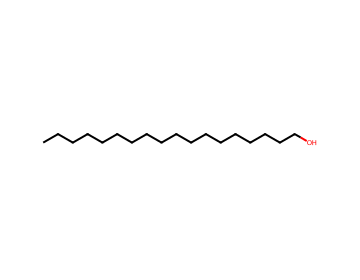
IDENTITY
COMPUTED
PROPERTIES
8.22
Faint
Bland
0.8124 at 59 °C/4 °C
Relative density (water = 1): 0.81 (liquid)
0.8124 @ 59°C
Leaflets from ethanol
Unctuous white flakes or granules
Soluble in alcohol, ether, benzene, acetone
Soluble in chloroform; slightly soluble in acetone, benzene
In water, 1.1X10⁻³ mg/L at 25 °C
1.1e-06 mg/mL at 25 °C
Solubility in water: none
200 °C
392 °F (200 °C) (Closed cup)
170 °C
210.5 °C at 15 mm Hg
336 °C
202 °C @760 [mm Hg]
When heated to decomposition it emits acrid smoke and fumes.
59.5 °C
Heat of fusion at melting point = 7.4057X10+7 J/kmol (for the gamma phase, no selection of the alpha phase, crystal I can be made).
59.5 °C
59.8 °C
58 °C
0.0000027 [mmHg]
Vapor pressure = 0.1 mm Hg @ 125 °C
Vapor pressure, Pa at 150 °C: 133
0.0000026 [mm Hg] @25 °C
Large Crystals; Liquid; Other Solid; Liquid; Other Solid; Dry Powder; Large Crystals
White solid; [Hawley]
Solid
COLOURLESS-TO-WHITE SLIGHTLY WAXY FLAKES OR LEAFLETS.
GHS
This chemical does not meet GHS hazard criteria for 61.7% (1186 of 1921) of all reports.
Warning
H319 (23.1%): Causes serious eye irritation [Warning Serious eye damage/eye irritation];H400 (15%): Very toxic to aquatic life [Warning Hazardous to the aquatic environment, acute hazard];H411 (15.4%): Toxic to aquatic life with long lasting effects [Hazardous to the aquatic environment, long-term hazard];H412 (15%): Harmful to aquatic life with long lasting effects [Hazardous to the aquatic environment, long-term hazard]
P264+P265, P273, P280, P305+P351+P338, P337+P317, P391, and P501 (click each P-code to see the statement)
Aggregated GHS information provided per 1921 reports by companies from 12 notifications to the ECHA C&L Inventory. Each notification may be associated with multiple companies.;Reported as not meeting GHS hazard criteria per 1186 of 1921 reports by companies.;There are 10 notifications provided by 735 of 1921 reports by companies with hazard statement code(s).;Information may vary between notifications depending on impurities, additives, and other factors. The percentage value in parenthesis indicates the notified classification ratio from companies that provide hazard codes. Only hazard codes with percentage values above 10% are shown. For more detailed information, please visit ECHA C&L website.
HAZARDS
Chemical: 1-Octadecanol
Commission Regulation (EC) No 1565/2000 (Repealed by Com. Implementing Reg. (EU) No 872/2012)
1-Octadecanol is listed on the EPA's Chemical Data Reporting (CDR) system. Manufacturers and importers of 1-Octadecanol are required to report information about their production and use of this chemical to the EPA under the Toxic Substances Control Act (TSCA). (40 eCFR Part 711)
Status: Active Update: 06-04-2023 https://echa.europa.eu/registration-dossier/-/registered-dossier/15937;Status: Active Update: 30-05-2013 https://echa.europa.eu/registration-dossier/-/registered-dossier/6245
1-Octadecanol: Does not have an individual approval but may be used under an appropriate group standard
Octadecanol: Does not have an individual approval but may be used under an appropriate group standard
IMAP assessments - 1-Octadecanol: Human health tier I assessment
Combustible.
Flammable when exposed to heat or flame...
Higher alcohols are not highly toxic in the industrial setting; Can cause liver injury, somnolence, and respiratory depression in experimental animals; [HSDB] Causes somnolence in lethal-dose feeding studies of rats; [RTECS] No listed effects of short-term or long-term exposure; Health effects of exposure to the substance have been investigated extensively but none have been found. [ICSC] An irritant; [MSDSonline]
Drug products containing certain active ingredients offered over-the-counter (OTC) for certain uses. A number of active ingredients have been present in OTC drug products for various uses, as described below. However, based on evidence currently available, there are inadequate data to establish general recognition of the safety and effectiveness of these ingredients for the specified uses: Stearyl alcohol is included in skin protectant drug products.
Chemical: 1-Octadecanol; Green circle - The chemical has been verified to be of low concern based on experimental and modeled data.
Reacts with strong acids and strong oxidants.
0 - Materials that, under emergency conditions, would offer no hazard beyond that of ordinary combustible materials.
0 - Materials that will not burn under typical fire conditions, including intrinsically noncombustible materials such as concrete, stone, and sand.
0 - Materials that in themselves are normally stable, even under fire conditions.
Eye Irrit. 2A (23.1%);Aquatic Acute 1 (15%);Aquatic Chronic 2 (15.4%);Aquatic Chronic 3 (15%)
Explosive limits , vol% in air: 1-8
Reacts with strong acids and strong oxidants.
SAFETY
In case of fire in the surroundings, use appropriate extinguishing media.
First rinse with plenty of water for several minutes (remove contact lenses if easily possible), then refer for medical attention.
Rinse mouth.
Separated from strong oxidants and strong acids.
To fight fire use foam, carbon dioxide, dry chemical.
Sweep spilled substance into containers. Carefully collect remainder, then remove to safe place.
SRP: The most favorable course of action is to use an alternative chemical product with less inherent propensity for occupational exposure or environmental contamination. Recycle any unused portion of the material for its approved use or return it to the manufacturer or supplier. Ultimate disposal of the chemical must consider: the material's impact on air quality; potential migration in soil or water; effects on animal, aquatic, and plant life; and conformance with environmental and public health regulations.
Sweep spilled substance into covered containers. Carefully collect remainder. Then store and dispose of according to local regulations.
Wear safety spectacles.
NO open flames.
Do not eat, drink, or smoke during work.
60 [mg/m3]
660 [mg/m3]
4000 [mg/m3]
TOXICITY
TERRESTRIAL FATE: Based on a classification scheme(1), an estimated Koc value of 1.8X10+5(SRC), determined from a water solubility of 1.1X10⁻³ mg/L(2) and a regression-derived equation(3), indicates that 1-octadecanol is expected to be immobile in soil(SRC). Volatilization of 1-octadecanol from moist soil surfaces may be expected to be an important fate process(SRC) given an estimated Henry's Law constant of 8.41X10⁻⁴ atm-cu m/mole(SRC), derived from a vapor pressure of 2.7X10⁻⁶ mm Hg at 25 °C(4), and its water solubility(2). However, adsorption to soil is expected to attenuate volatilization(SRC). 1-Octadecanol is not expected to volatilize from dry soil surfaces(SRC) based upon it's vapor pressure(4). Biodegradation of 1-octadecanol may be an important fate process in soil based on a mixed shake flask culture study(5).
AQUATIC FATE: Based on a classification scheme(1), an estimated Koc value of 1.8X10+5(SRC), determined from a water solubility of 1.1X10⁻³ mg/L(2) and a regression-derived equation(3), indicates that 1-octadecanol is expected to adsorb to suspended solids and sediments(SRC). Volatilization from water surfaces is expected(3) based upon an estimated Henry's Law constant of 8.4X10⁻⁴ atm-cu m/mole(SRC), calculated from its water solubility(2) and vapor pressure, 2.7X10⁻⁶ mm Hg(4), values. Using this Henry's Law constant and an estimation method(3), volatilization half-lives for a model river and model lake are 2.8 hours and 7 days, respectively(SRC). However, volatilization from water surfaces is expected to be attenuated by adsorption to suspended solids and sediment in the water column. The estimated volatilization half-life from a model pond is 140 days if adsorption is considered (5). According to a classification scheme(6), an estimated BCF value of 2.8X10+4(3), from its water solubility(2), suggests the potential for bioconcentration in aquatic organisms is very high(SRC). A percent theoretical oxygen demand value of 0.3 in 24 hrs using a Warburg test(7) suggests that biodegradation may not be an important fate process in water(7).
ATMOSPHERIC FATE: According to a model of gas/particle partitioning of semivolatile organic compounds in the atmosphere(1), 1-octadecanol, which has a vapor pressure of 2.7X10⁻⁶ mm Hg at 25 °C(2), will exist in both the vapor and particulate phases in the ambient atmosphere. Vapor-phase 1-octadecanol is degraded in the atmosphere by reaction with photochemically-produced hydroxyl radicals(SRC); the half-life for this reaction in air is estimated to be about 14 hours(3), calculated from its rate constant of 2.67X10⁻¹¹ cu cm/molecule-sec at 25 °C(SRC), that was derived using a structure estimation method(3). Particulate-phase 1-octadecanol may be removed from the air by wet or dry deposition(SRC).
1-Octadecanol has been qualitatively detected as a volatile component of fried bacon(1) and raw beef(2).
Neurotoxin - Acute solvent syndrome;Occupational hepatotoxin - Secondary hepatotoxins: the potential for toxic effect in the occupational setting is based on cases of poisoning by human ingestion or animal experimentation.
Safe in the present practices of use and concentration. Ingredient, concentration, and use information are available in documents discoverable at https://cir-reports.cir-safety.org
1-Octadecanol emission rates from green leaf composite samples and dead leaves were 28 ug/g and 30 ug/g, respectively(1).
1-Octadecanol has been detected in industrial wastewater from the organics and plastics industry (184 ng/ul extract) and from textile mills (94 ng/ul extract)(1). 1-Octadecanol has been detected in wastewater from a specialty chemicals manufacturing plant at concentrations of 1-4 ppm(2). Emission rates in wood smoke for 1-octadecanol in mg/g of organic carbon were found to be 0.059 for red oak(3), 0.063 for yellow poplar(4), and 0.062 for mockernut hickory(4). 1-Octadecanol emission rates from road dust samples was 4.3 ug/g(5).
The Koc of 1-octadecanol is estimated as 1.8X10+5(SRC), using a water solubility of 1.1X10⁻³ mg/L at 25 °C(1) and a regression-derived equation(2). According to a classification scheme(3), this estimated Koc value suggests that 1-octadecanol is immobile in soil(SRC).
1-Octadecanol emission rates from green leaf composite samples and dead leaves were 28 ug/g and 30 ug/g, respectively(1).
URBAN/SUBURBAN: 1-Octadecanol was found in California at atmospheric concentrations of 2.5 ng/cu m, and 2.9 ng/cu m in Bakersfield and Fresno, respectively(1).
RURAL/REMOTE: 1-Octadecanol was found in California at an atmospheric concentrations of 0.4 ng/cu m in the Kern Wildlife Refuge(1).
/HUMAN EXPOSURE STUDIES/ The results of single-insult clinical patch testing indicate a very low order of skin irritation potential for stearyl alcohol with a sensitization rate of 19 of 3740 (0.51%) individuals.
/HUMAN EXPOSURE STUDIES/ A 24-hour single insult occlusive patch test with 100% stearyl alcohol produced mild irritation in 1 out of 80 human subjects.
/HUMAN EXPOSURE STUDIES/ Of 51 patients allergic to wool wax alcohols, 4 reacted to 20% stearyl alcohol in vaseline. Combined scores at 24, 48, and 72 hours showed reactions graded as ++ (erytheme and papeln or infiltrate) or +++ ( erytheme, infiltrate or rather papulovesicle). The authors concluded that free fatty alcohols play a major part in allergic reactions to wool wax. Stearyl alcohol is less allergic than 1-dodecanol or oleyl alcohol.
/HUMAN EXPOSURE STUDIES/ Patch test with 30% stearyl alcohol in petrolatum was assessed after 48 and 96 hours. The test was conducted during several one-year periods on large numbers of human subjects. In 1975-1976 one-year study out of 172 tested 2 showed allergic reaction (1.2%). In 1976-1977 one-year study out of 446 tested 1 showed allergic reaction (0.22%). In 1978-1979 one year study out of 824 tested 6 showed allergic reaction (0.73%). In 1979-1980 one year study out of 634 tested 6 showed allergic reaction (0.95%). ... According to the authors, the positive results above indicate a very mild sensitization potential.
/CASE REPORTS/ ... A woman who experienced oozing dermatitis on 2 separate occasions 2 yr apart after contact with green canvas being sewn into tents. Patch testing showed sensitivity to stearyl alcohol.
1-Octadecanol's production and use as a substitute for cetyl alcohol in pharmaceutical dispensing, in cosmetic creams, for emulsions, textile oils and finishes, as an antifoam agent, lubricant, chemical raw material(1), in perfumery, cosmetics, as an intermediate, surface active agent, and in resins(2) may result in its release to the environment through various waste streams.
AEROBIC: Using the Warburg test which employs activated sludge, 1-octadecanol gave a theoretical oxygen demand of 0.3, 0.5, and 0.3 percent in 6, 12, and 24 hours(1). However, using an acclimated mixed shake flask culture with incremental substrate addition of 1-octadecanol, biomass yield reached 54.5 percent after seven days(2). Given sufficient time in contact with adapted microbial species under conditions otherwise non-limiting, the complete disappearance of 1-octadecanol as identifiable molecular species will occur(2).
REGULATORY
Chemical: 1-Octadecanol
Commission Regulation (EC) No 1565/2000 (Repealed by Com. Implementing Reg. (EU) No 872/2012)
1-Octadecanol is listed on the EPA's Chemical Data Reporting (CDR) system. Manufacturers and importers of 1-Octadecanol are required to report information about their production and use of this chemical to the EPA under the Toxic Substances Control Act (TSCA). (40 eCFR Part 711)
Status: Active Update: 06-04-2023 https://echa.europa.eu/registration-dossier/-/registered-dossier/15937;Status: Active Update: 30-05-2013 https://echa.europa.eu/registration-dossier/-/registered-dossier/6245
1-Octadecanol: Does not have an individual approval but may be used under an appropriate group standard
Octadecanol: Does not have an individual approval but may be used under an appropriate group standard
Drug products containing certain active ingredients offered over-the-counter (OTC) for certain uses. A number of active ingredients have been present in OTC drug products for various uses, as described below. However, based on evidence currently available, there are inadequate data to establish general recognition of the safety and effectiveness of these ingredients for the specified uses: Stearyl alcohol is included in skin protectant drug products.
PHARMACOLOGY
Stearyl alcohol is found naturally in various mammalian tissues. It is used in the biosynthesis of lipids and other naturally occurring cellular constituents and enters metabolic pathways for energy production.
... Ethanol, 1-propanol, 1-butanol, 1-pentanol and 1-octanol had essentially the same effects on the mitochondrial ultrastructure: a mixed population of small and enlarged mitochondria with poorly developed cristae; 1-dodecanol induced ultrastructural changes of mitochondria of two distinct types: a mixed population of small and enlarged mitochondria with poorly developed cristae in some hepatocytes and remarkably enlarged mitochondria with well-developed cristate in others; and 1-octadecanol induced remarkably enlarged mitochondria in all hepatocytes.
... The reactivity of the fatty alcohols with cetrimide decreased with increasing chain length although branching on the tetradecanol and hexadecanol resulted in a higher reactivity. Adding 1-octadecanol to 1-hexadecanol resulted in an increased reactivity rising to a maximum for mixtures containing 20-40% w/w 1-octadecanol.
... Peak inhibition was recorded with saturated primary alcohols (64 microM) varying in chain length from 16 to 19 carbon atoms. The unsaturated alcohols (oleyl, linoleyl, and linolenyl) and the secondary alcohol (pentadecan-2-ol) were considerably less effective growth inhibitors. Stearic and palmitic acids were also ineffective.
After incubation of stationary phase Leishmania donovani with [1-14C]octadecanol, about 70% of the precursor was taken up within 3 hr. Wax esters and acyl moieties of glycerolipids contained most of the 14C-activity from 3 to 6 hr, because octadecanol was partly oxidized to stearate. Ether moieties were only weakly labeled. After 40 hr, 1-0-alkyl and 1-0-alk-1'-enyl diacylglycerols as well as 1-0-alkyl and 1-0-alk-1'-enyl-2-acyl-sn-glycero-3-phosphoethanolamines contained nearly all of the radioactivity. Most of the label in the neutral ether lipids was located in the alkyl ether side chain, whereas, in the phosphatidylethanolamine fraction, most of the label was found in the alkenyl ether side chain.
Stearyl alcohol ... is used in the biosynthesis of lipids and other naturally occurring cellular constituents and enters metabolic pathways for energy production. This fatty alcohol is readily converted to stearic acid, another common constituent of mammalian tissue.
From the absorbed fraction more than half was metabolized to triglycerides, 6-13% to phospholipids, 2- 8% to cholesterol esters, and 4-10% remained as unchanged octadecanol after 24h period, from dosing.
Stearyl alcohol is found naturally in various mammalian tissues ... Results from several studies indicate that stearyl alcohol is poorly absorbed from the gastrointestinal tract.
Several studies indicate that /1-octadecanol/ is poorly absorbed from the gastrointestinal tract. The entry of 14C-octadecanol into the thoracic lymph duct of the Sprague-Dawley rat was reported. Lymph flows and blood were monitored for radioactivity in different intervals following dosing. Intestinal radioactivity was determined in the intestinal homogenate which showed the percent absorbed radioactivity in the lymph was 56.6 +/- 14.0. Of this, more than half was found in the triglycerides of the lymph, 6 to 13 % in the phospholipids, 2 to 8% as the cholesterol esters, and 4 to 10% unchanged octadecanol. 90% of octadecanol was found in the lipomicrom fraction of the blood. The absorption of the compound appeared to be a function of its lipid solubility.
Adipose Tissue;Bladder;Brain;Epidermis;Eye Lens;Fibroblasts;Intestine;Kidney;Liver;Neuron;Ovary;Pancreas;Placenta;Platelet;Prostate;Skeletal Muscle;Spleen;Testis;Thyroid Gland
Extracellular;Membrane
Plasmalogen Synthesis
USES
CIR ingredient: Stearyl Alcohol
Used as a substitute for cetyl alcohol in pharmaceutical dispensing; in cosmetic creams and perfumery; in textile oils and finishes; as an antifoam agent; and in lubricants, resins, and surface active agents; Synthetic stearyl alcohol has been approved as a direct and indirect food additive ingredient and as an ingredient in over-the-counter drugs; [HSDB]
Textiles (Printing, Dyeing, or Finishing) [Category: Industry]
Substitute for cetyl alcohol in pharmaceutical dispensing, in cosmetic creams, for emulsions, textile oils and finishes; as antifoam agent, lubricant, and chemical raw material.
Perfumery, cosmetics, intermediate, surface active agents, lubricants, resins, antifoam agent.
Antifoam agent /for bioprocesses/
2023: 70,000,000 - <85,000,000 lb;2022: 70,000,000 - <85,000,000 lb;2021: 70,000,000 - <85,000,000 lb;2020: 70,000,000 - <85,000,000 lb
This chemical is listed as a High Production Volume (HPV) (65FR81686). Chemicals listed as HPV were produced in or imported into the U.S. in >1 million pounds in 1990 and/or 1994. The HPV list is based on the 1990 Inventory Update Rule. (IUR) (40 CFR part 710 subpart B; 51FR21438).
(1986) >10 million-50 million pounds
(1990) >10 million-50 million pounds
(1994) >10 million-50 million pounds
For more U.S. Production (Complete) data for 1-OCTADECANOL (6 total), please visit the HSDB record page.
Cleaning agent;Not Known or Reasonably Ascertainable;Emulsifier;Softener and conditioner;Solvent;Other;Binder;Lubricating agent;Surfactant (surface active agent);Fuel
Defoamer;Intermediate;Emulsifier;Not Known or Reasonably Ascertainable;Stabilizing agent;Sealant (barrier);Cleaning agent;Fuel;Antioxidant;Surfactant (surface active agent);Lubricating agent;Other;Binder;Solvent
Preparation from ethyl stearate. ... Preparation of technical grade from sperm whale oil.
/1-Octadecanol is/ prepared commercially via Ziegler aluminum alkyl hydrolysis or the catalytic, high-pressure hydrogenation of stearyl acid, followed by filtration and distillation. It may also be derived from natural fats and oils.
Stearyl alcohol USP...contains not less than 90% of stearyl alcohol, remainder consisting chiefly of cetyl alcohol.
Hydrophilic petrolatum USP /contains/ cholesterol 30 g, stearyl alcohol 30 g, white wax 80 g, & white petrolatum 860 g.
Hydrophilic ointment USP /contains/ methylparaben 0.25 g, propylparaben 0.15 g, sodium lauryl sulfate 10 g, propylene glycol 120 g, stearyl alcohol 250 g, white petrolatum 250 g, purified water 370 g.
Grades: Commercial; technical; USP.
Information on 828 consumer products that contain Stearyl alcohol in the following categories is provided:;• Inside the Home;• Personal Care;• Pet Care
EPA Safer Chemical Functional Use Classes -> Emollients
Safer Chemical Classes -> Green circle - The chemical has been verified to be of low concern
Cosmetics -> Emollient; Emulsion stabilizing; Foam boosting; Opacifying; Refatting; Viscosity controlling
Other (requires additional information);All Other Basic Organic Chemical Manufacturing;Petrochemical Manufacturing;Paper Manufacturing;Machinery Manufacturing;Not Known or Reasonably Ascertainable;All Other Chemical Product and Preparation Manufacturing;Paint and Coating Manufacturing;Wholesale and Retail Trade;Soap, Cleaning Compound, and Toilet Preparation Manufacturing;Oil and Gas Drilling, Extraction, and Support activities;Petroleum Lubricating Oil and Grease Manufacturing;Pesticide, Fertilizer, and Other Agricultural Chemical Manufacturing;Mining (except Oil and Gas) and support activities
1-Octadecanol: ACTIVE
Stenol is a mixture of solid alcohols, principally stearyl alcohol.
/It is/ a surface-active agent used to stabilize emulsions & increase their ability to retain large quantities of water.
ALIASES
REACTIONS
uspto-grants-2010_06 · 10.6084/m9.figshare.5104873.v1 · US07740742B2
查看
uspto-grants-2013_09 · 10.6084/m9.figshare.5104873.v1 · US08529671B2
查看
Training data from https://doi.org/10.1039/C8SC04228D (2/10) · 10.1039/C8SC04228D
查看
Training data from https://doi.org/10.1039/C8SC04228D (2/10) · 10.1039/C8SC04228D
查看
uspto-grants-2008_06 · 10.6084/m9.figshare.5104873.v1 · US07381253B2
查看
Training data from https://doi.org/10.1039/C8SC04228D (9/10) · 10.1039/C8SC04228D
查看
Training data from https://doi.org/10.1039/C8SC04228D (9/10) · 10.1039/C8SC04228D
查看
Training data from https://doi.org/10.1039/C8SC04228D (6/10) · 10.1039/C8SC04228D
查看