
uspto-grants-1979_04 · 10.6084/m9.figshare.5104873.v1 · US04150025
查看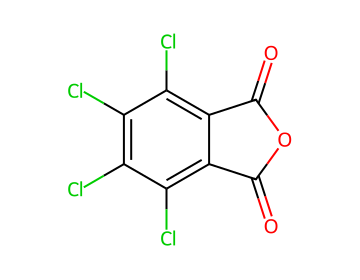
IDENTITY
COMPUTED
PROPERTIES
ODORLESS
1.49 at 527 °F (NTP, 1992) - Denser than water; will sink
PRISMS, NEEDLES FROM SUBLIMATION
WHITE, FREE-FLOWING POWDER
less than 1 mg/mL at 70 °F (NTP, 1992)
SLIGHTLY SOLUBLE IN ETHER
SLIGHTLY SOL IN WATER
Solubility in water, g/100ml at 20 °C: 0.4
362 °C c.c.
700 °F at 760 mmHg (sublimes) (NTP, 1992)
371 °C
SUBLIMES @ BOILING POINT; DECOMP IN HOT WATER
371 °C
491 to 494 °F (NTP, 1992)
255-256.5 °C
255 °C
Tetrachlorophthalic anhydride appears as odorless needle-like crystals or white powder. (NTP, 1992)
Dry Powder
White odorless solid; [Hawley] Light gray crystalline solid; [Aldrich MSDS]
WHITE POWDER.
2029
158.1 Ų [M-H]- [CCS Type: DT; Buffer gas: N2; Ionization: ESI-; Dataset: TOXCAST; Source Identifier: DTXSID7026102]
NONHYGROSCOPIC
GHS
Danger
H317: May cause an allergic skin reaction [Warning Sensitization, Skin];H318: Causes serious eye damage [Danger Serious eye damage/eye irritation];H334: May cause allergy or asthma symptoms or breathing difficulties if inhaled [Danger Sensitization, respiratory];H400: Very toxic to aquatic life [Warning Hazardous to the aquatic environment, acute hazard];H410: Very toxic to aquatic life with long lasting effects [Warning Hazardous to the aquatic environment, long-term hazard]
P233, P260, P261, P264+P265, P271, P272, P273, P280, P284, P302+P352, P304+P340, P305+P354+P338, P317, P321, P333+P317, P342+P316, P362+P364, P391, P403, and P501 (click each P-code to see the statement)
Danger
HAZARDS
Chemical: 1,3-Isobenzofurandione, 4,5,6,7-tetrachloro-
Hazard Traits - Respiratory Toxicity;Authoritative List - CECBP - Priority Chemicals; EC Annex VI Resp. Sens. - Cat. 1;Report - if used as a fragrance or flavor ingredient
1,3-Isobenzofurandione, 4,5,6,7-tetrachloro- is listed on the EPA's Chemical Data Reporting (CDR) system. Manufacturers and importers of 1,3-Isobenzofurandione, 4,5,6,7-tetrachloro- are required to report information about their production and use of this chemical to the EPA under the Toxic Substances Control Act (TSCA). (40 eCFR Part 711)
Status: Active Update: 10-10-2019 https://echa.europa.eu/registration-dossier/-/registered-dossier/21523;Status: Active Update: 23-10-2018 https://echa.europa.eu/registration-dossier/-/registered-dossier/11730;Status: Active Update: 05-01-2010 https://echa.europa.eu/registration-dossier/-/registered-dossier/1179
Tetrachlorophthalic anhydride: Does not have an individual approval but may be used under an appropriate group standard
Class 9
Flash point data for this chemical are not available. It is probably combustible. (NTP, 1992)
Combustible. Gives off irritating or toxic fumes (or gases) in a fire.
SYMPTOMS: Symptoms of exposure to this chemical may include irritation of the skin, eyes and respiratory tract; coughing, sneezing, and dermatitis. Symptoms of chronic exposure may include bronchitis, inflammation of the respiratory tract, and bloody nasal discharge.;ACUTE/CHRONIC HAZARDS: This chemical is an irritant of the skin, eyes and respiratory tract. When heated to decomposition it emits toxic fumes. (NTP, 1992)
Occupational asthma reported in workers manufacturing epoxy resins and plastics; [Malo] Produces the acid on reaction with water; A skin, eye, and respiratory tract irritant; May cause skin sensitization and asthma; [ICSC] Causes kidney and blood changes in gavage studies of rats and lung changes in inhalation studies of rats; [EPA ChAMP] See ACID ANHYDRIDES.
Anhydrides;Aryl Halides
Symbol: Xn, N; R: 41-42/43-50/53; S: (2)-22-24-26-37/39-60-61
DHHS/NTP; NTP Technical Report on Toxicity Studies of Tetrachlorophthalic Anhydride Administered by Gavage to F344/N Rats and B6C3F1 Mice NTP TOX 28 (1993) NIH Pub No. 93-3351
TETRACHLOROPHTHALIC ANHYDRIDE reacts exothermically with water. This reaction is expected to be slow, but can become vigorous if local heating accelerates it. Reaction with water is accelerated by acids. Incompatible with acids, strong oxidizing agents, alcohols, amines, and bases.
Reacts slowly with water. This produces acid.
Sensitive to air and moisture.
THE GENERATION OF SMOKE & TOXIC GASEOUS COMPD FROM BURNING UNSATURATED POLYESTER RESINS & THE EFFECT OF FLAME RETARDANTS WERE EXAMINED. CL-CONTAINING POLYESTERS GENERATED HIGHER LEVELS OF HCL THAN BR-CONTAINING RESINS GENERATED HBR. CARBON MONOXIDE LEVEL IS SLIGHTLY LESS FOR CHLORINATED RESINS THAN FOR BROMINATED RESINS.
SAFETY
Fires involving this material can be controlled with a dry chemical, carbon dioxide or Halon extinguisher. (NTP, 1992)
Use water spray, powder.
Fresh air, rest. Half-upright position. Refer for medical attention.
Remove contaminated clothes. Rinse skin with plenty of water or shower.
First rinse with plenty of water for several minutes (remove contact lenses if easily possible), then refer for medical attention.
Rinse mouth. Do NOT induce vomiting.
EYES: First check the victim for contact lenses and remove if present. Flush victim's eyes with water or normal saline solution for 20 to 30 minutes while simultaneously calling a hospital or poison control center. Do not put any ointments, oils, or medication in the victim's eyes without specific instructions from a physician. IMMEDIATELY transport the victim after flushing eyes to a hospital even if no symptoms (such as redness or irritation) develop.;SKIN: IMMEDIATELY flood affected skin with water while removing and isolating all contaminated clothing. Gently wash all affected skin areas thoroughly with soap and water. If symptoms such as redness or irritation develop, IMMEDIATELY call a physician and be prepared to transport the victim to a hospital for treatment.;INHALATION: IMMEDIATELY leave the contaminated area; take deep breaths of fresh air. If symptoms (such as wheezing, coughing, shortness of breath, or burning in the mouth, throat, or chest) develop, call a physician and be prepared to transport the victim to a hospital. Provide proper respiratory protection to rescuers entering an unknown atmosphere. Whenever possible, Self-Contained Breathing Apparatus (SCBA) should be used; if not available, use a level of protection greater than or equal to that advised under Protective Clothing.;INGESTION: DO NOT INDUCE VOMITING. If the victim is conscious and not convulsing, give 1 or 2 glasses of water to dilute the chemical and IMMEDIATELY call a hospital or poison control center. Be prepared to transport the victim to a hospital if advised by a physician. If the victim is convulsing or unconscious, do not give anything by mouth, ensure that the victim's airway is open and lay the victim on his/her side with the head lower than the body. DO NOT INDUCE VOMITING. IMMEDIATELY transport the victim to a hospital. (NTP, 1992)
Dry. Well closed.
SMALL SPILLS AND LEAKAGE: If you spill this chemical, FIRST REMOVE ALL SOURCES OF IGNITION. You should then dampen the solid spill material with 60-70% methanol, then transfer the dampened material to a suitable container. Use absorbent paper dampened with methanol to pick up any remaining material. Your contaminated clothing and absorbent paper should be sealed in a vapor-tight plastic bag for eventual disposal. Solvent-wash contaminated surfaces with 60-70% methanol followed by washing with a soap and water solution. Do not reenter the contaminated area until the Safety Officer (or other responsible person) has verified that the area has been properly cleaned.;STORAGE PRECAUTIONS: You should keep this material in a tightly closed container under an inert atmosphere, and store it in a refrigerator. (NTP, 1992)
Personal protection: particulate filter respirator adapted to the airborne concentration of the substance. Do NOT let this chemical enter the environment. Sweep spilled substance into covered containers. If appropriate, moisten first to prevent dusting. Carefully collect remainder. Then store and dispose of according to local regulations.
Excerpt from ERG Guide 171 [Substances (Low to Moderate Hazard)]:;IMMEDIATE PRECAUTIONARY MEASURE: Isolate spill or leak area in all directions for at least 50 meters (150 feet) for liquids and at least 25 meters (75 feet) for solids.;SPILL: Increase the immediate precautionary measure distance, in the downwind direction, as necessary.;FIRE: If tank, rail tank car or highway tank is involved in a fire, ISOLATE for 800 meters (1/2 mile) in all directions; also, consider initial evacuation for 800 meters (1/2 mile) in all directions. (ERG, 2024)
Wear safety goggles or eye protection in combination with breathing protection.
NO open flames.
Evaporation at 20 °C is negligible; a harmful concentration of airborne particles can, however, be reached quickly when dispersed.
Protective gloves. Protective clothing.
PREVENT DISPERSION OF DUST!
TOXICITY
Skin Sensitizer - An agent that can induce an allergic reaction in the skin.;Asthma - Reversible bronchoconstriction (narrowing of bronchioles) initiated by the inhalation of irritating or allergenic agents.
The substance can be absorbed into the body by inhalation of its aerosol.
Cough. Sore throat. Wheezing. Shortness of breath.
Redness. Burning sensation.
Redness. Pain. Blurred vision.
Burning sensation.
The following link will take the user to the National Toxicology Program (NTP) Test Agent Search Results page, which tabulates all of the "Standard Toxicology & Carcinogenesis Studies", "Developmental Studies", and "Genetic Toxicity Studies" performed with this chemical. Clicking on the "Testing Status" link will take the user to the status (i.e., in review, in progress, in preparation, on test, completed, etc.) and results of all the studies that the NTP has done on this chemical. [http://ntp-apps.niehs.nih.gov/ntp_tox/index.cfm?fuseaction=ntpsearch.searchresults&searchterm=117-08-8]
THE PLASTICS INDUSTRY UTILIZES A NUMBER OF ORG CHEM WHICH HAVE THE POTENTIAL OF PRODUCING PULMONARY REACTIONS, PARTICULARLY IN SUSCEPTIBLE INDIVIDUALS. 5 WORKERS IN PRODN OF EPOXY RESINS DEVELOPED RECURRENT RESP SYMPTOMS & PHYSIOLOGIC ABNORMALITIES FOLLOWING EXPOSURE TO TETRACHLOROPHTHALIC ANHYDRIDE (TCPA). INHALATION CHALLENGE WITH TCPA REPRODUCED THEIR SYMPTOMS & DEMONSTRATED IMMEDIATE & LATE (4-6 HR) PHYSIOLOGIC RESPONSE.
ASTHMA WAS INDUCED IN 7 WOMEN OCCUPATIONALLY EXPOSED TO TETRACHLOROPHTHALIC ANHYDRIDE. INHALATION TESTS AT ATMOSPHERIC CONCN OF LESS THAN 1/10 OF MFR RECOMMENDED EXPOSURE LIMIT PROVOKED ASTHMATIC REACTIONS IN 4 WOMEN. SKIN PRICK TEST REACTIONS WERE ELICITED IN 7 SUBJECTS BY CONJUGATE OF TCPA WITH HUMAN SERUM ALBUMIN (TCPA-HSA) BUT NOT IN OTHERS TESTED. SPECIFIC IGE ANTIBODY LEVELS TO TCPA-HSA, MEASURED BY RADIOALLERGOSORBENT TEST SCORES, WERE SIGNIFICANTLY ELEVATED IN 7 WOMEN. RESULTS IMPLY THAT OCCUPATIONAL ASTHMA CAUSED BY TCPA IS AN ALLERGIC REACTION MEDIATED BY SPECIFIC IGE ANTIBODY.
LC50 (rat) > 3,600 mg/m3/4hr
REGULATORY
Chemical: 1,3-Isobenzofurandione, 4,5,6,7-tetrachloro-
Hazard Traits - Respiratory Toxicity;Authoritative List - CECBP - Priority Chemicals; EC Annex VI Resp. Sens. - Cat. 1;Report - if used as a fragrance or flavor ingredient
1,3-Isobenzofurandione, 4,5,6,7-tetrachloro- is listed on the EPA's Chemical Data Reporting (CDR) system. Manufacturers and importers of 1,3-Isobenzofurandione, 4,5,6,7-tetrachloro- are required to report information about their production and use of this chemical to the EPA under the Toxic Substances Control Act (TSCA). (40 eCFR Part 711)
Status: Active Update: 10-10-2019 https://echa.europa.eu/registration-dossier/-/registered-dossier/21523;Status: Active Update: 23-10-2018 https://echa.europa.eu/registration-dossier/-/registered-dossier/11730;Status: Active Update: 05-01-2010 https://echa.europa.eu/registration-dossier/-/registered-dossier/1179
Tetrachlorophthalic anhydride: Does not have an individual approval but may be used under an appropriate group standard
USES
Used as flame retardant in unsaturated polyester resins, polyurethane foams, and surface coatings; also used as a chemical intermediate for pigments, drugs, and plasticizers; [HSDB] May contain hexachlorobenzene as an impurity; [ExPub: CPS&Q]
Plastic Composites Manufacturing [Category: Industry]
FLAME RETARDANT IN UNSATURATED POLYESTER RESINS, POLYURETHANE FOAMS & SURFACE COATINGS; CHEM INT FOR PIGMENT GREEN 7, DRUGS & PLASTICIZERS
(1972) No Data
(1975) No Data
(1972) No Data
(1975) No Data
2023: 75,000 - <500,000 lb;2022: 75,000 - <500,000 lb;2021: 75,000 - <500,000 lb;2020: 75,000 - <500,000 lb
(1972) PROBABLY GREATER THAN 4.54X10+5 GRAMS
(1975) PROBABLY GREATER THAN 4.54X10+5 GRAMS
Intermediate;Not Known or Reasonably Ascertainable
CHLORINATION OF PHTHALIC ANHYDRIDE
All Other Basic Organic Chemical Manufacturing;Not Known or Reasonably Ascertainable
1,3-Isobenzofurandione, 4,5,6,7-tetrachloro-: ACTIVE
TETRACHLOROPHTHALIC ANHYDRIDE (1 KG/HA) TOTALLY SUPPRESSED THE PHYTOTOXICITY OF AFALON TO SUNFLOWER.
ALIASES
REACTIONS
uspto-grants-1979_04 · 10.6084/m9.figshare.5104873.v1 · US04150025
查看
uspto-grants-1980_09 · 10.6084/m9.figshare.5104873.v1 · US04220357
查看
uspto-grants-1980_09 · 10.6084/m9.figshare.5104873.v1 · US04220357
查看
uspto-grants-2013_09 · 10.6084/m9.figshare.5104873.v1 · US08530675B2
查看
uspto-grants-2013_09 · 10.6084/m9.figshare.5104873.v1 · US08530675B2
查看
uspto-grants-2013_09 · 10.6084/m9.figshare.5104873.v1 · US08530675B2
查看
Training data from https://doi.org/10.1039/C8SC04228D (2/10) · 10.1039/C8SC04228D
查看
Training data from https://doi.org/10.1039/C8SC04228D (2/10) · 10.1039/C8SC04228D
查看