
Training data from https://doi.org/10.1039/C8SC04228D (9/10) · 10.1039/C8SC04228D
查看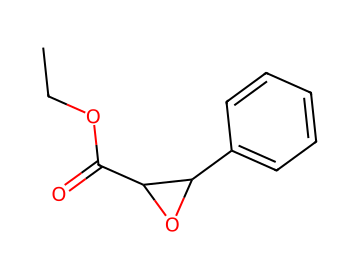
IDENTITY
COMPUTED
PROPERTIES
ACID VALUE: NOT MORE THAN 1.0
STRONG FRUITY ODOR SUGGESTIVE OF STRAWBERRY
SWEET TASTE CORRESPONDING TO FRUITY ODOR
1.122 (NTP, 1992) - Denser than water; will sink
1.120-1.128 @ 25/25 °C
1.120-1.125
COLORLESS TO PALE-YELLOW LIQUID
Slightly soluble (1-10 mg/ml) (NTP, 1992)
1:6 IN 70% ALCOHOL; 1:1 IN 80% ALCOHOL
Insoluble in water; Soluble in ether, oils
Soluble (in ethanol)
greater than 200 °F (NTP, 1992)
100 °C
509 to 518 °F at 760 mmHg (NTP, 1992)
96 °C (0.5 mm Hg)
less than 32 °F (NTP, 1992)
INDEX OF REFRACTION: 1.5190-1.5230 (1.516-1.521) AT 20 °C
1.516-1.521
Ethyl-3-phenylglycidate appears as clear pale yellow or yellow liquid. (NTP, 1992)
Colorless to pale yellow liquid with a strong fruity odor like strawberries; [HSDB]
Clear, Colourless to pale yellow liquid; Strong fruity aroma suggestive of strawberry
1529;1529
GHS
Warning
H317 (99.6%): May cause an allergic skin reaction [Warning Sensitization, Skin]
P261, P272, P280, P302+P352, P321, P333+P317, P362+P364, and P501 (click each P-code to see the statement)
Aggregated GHS information provided per 1593 reports by companies from 6 notifications to the ECHA C&L Inventory.;Information may vary between notifications depending on impurities, additives, and other factors. The percentage value in parenthesis indicates the notified classification ratio from companies that provide hazard codes. Only hazard codes with percentage values above 10% are shown. For more detailed information, please visit ECHA C&L website.
HAZARDS
Chemical: Oxiranecarboxylic acid, 3-phenyl-, ethyl ester
Commission Regulation (EC) No 1565/2000 (Repealed by Com. Implementing Reg. (EU) No 872/2012)
Status: Active Update: 25-01-2018 https://echa.europa.eu/registration-dossier/-/registered-dossier/22103
Oxiranecarboxylic acid, 3-phenyl-, ethyl ester: Does not have an individual approval but may be used under an appropriate group standard
This chemical is probably combustible. (NTP, 1992)
A mutagen; [RTECS] No sensitization reactions in 25 human volunteers; [HSDB] May polymerize in contact with catalysts or heat; [CAMEO] Safe when used as a flavoring agent in food; [JECFA] An irritant; [MSDSonline]
FDA 121.1164
Esters, Sulfate Esters, Phosphate Esters, Thiophosphate Esters, and Borate Esters;Epoxides;Polymerizable Compounds
Polymerizable
Epoxides are highly reactive. They polymerize in the presence of catalysts or when heated. These polymerization reactions can be violent. Compounds in this group react with acids, bases, and oxidizing and reducing agents. They react, possibly violently with water in the presence of acid and other catalysts.
Slightly water soluble.
Skin Sens. 1B (99.6%)
SAFETY
Fires involving this material can be controlled with a dry chemical, carbon dioxide or Halon extinguisher. (NTP, 1992)
EYES: First check the victim for contact lenses and remove if present. Flush victim's eyes with water or normal saline solution for 20 to 30 minutes while simultaneously calling a hospital or poison control center. Do not put any ointments, oils, or medication in the victim's eyes without specific instructions from a physician. IMMEDIATELY transport the victim after flushing eyes to a hospital even if no symptoms (such as redness or irritation) develop.;SKIN: IMMEDIATELY flood affected skin with water while removing and isolating all contaminated clothing. Gently wash all affected skin areas thoroughly with soap and water. If symptoms such as redness or irritation develop, IMMEDIATELY call a physician and be prepared to transport the victim to a hospital for treatment.;INHALATION: IMMEDIATELY leave the contaminated area; take deep breaths of fresh air. If symptoms (such as wheezing, coughing, shortness of breath, or burning in the mouth, throat, or chest) develop, call a physician and be prepared to transport the victim to a hospital. Provide proper respiratory protection to rescuers entering an unknown atmosphere. Whenever possible, Self-Contained Breathing Apparatus (SCBA) should be used; if not available, use a level of protection greater than or equal to that advised under Protective Clothing.;INGESTION: DO NOT INDUCE VOMITING. If the victim is conscious and not convulsing, give 1 or 2 glasses of water to dilute the chemical and IMMEDIATELY call a hospital or poison control center. Be prepared to transport the victim to a hospital if advised by a physician. If the victim is convulsing or unconscious, do not give anything by mouth, ensure that the victim's airway is open and lay the victim on his/her side with the head lower than the body. DO NOT INDUCE VOMITING. IMMEDIATELY transport the victim to a hospital. (NTP, 1992)
SMALL SPILLS AND LEAKAGE: If you spill this chemical, use absorbent paper to pick up all liquid spill material. Your contaminated clothing and absorbent paper should be sealed in a vapor-tight plastic bag for eventual disposal. Solvent wash all contaminated surfaces with alcohol followed by washing with a strong soap and water solution. Do not reenter the contaminated area until the Safety Officer (or other responsible person) has verified that the area has been properly cleaned.;STORAGE PRECAUTIONS: You should store this material in a refrigerator. (NTP, 1992)
RECOMMENDED RESPIRATOR: Where the neat test chemical is weighed and diluted, wear a NIOSH-approved half face respirator equipped with an organic vapor/acid gas cartridge (specific for organic vapors, HCl, acid gas and SO2) with a dust/mist filter. (NTP, 1992)
TOXICITY
TESTED AT 4% IN PETROLATUM, IT PRODUCED NO IRRITATION AFTER A 48-HOUR CLOSED-PATCH TEST IN 25 HUMAN SUBJECTS. A MAXIMIZATION TEST WAS CARRIED OUT ON 25 VOLUNTEERS. THE MATERIAL WAS TESTED AT A CONCENTRATION OF 4% IN PETROLATUM AND PRODUCED NO SENSITIZATION REACTIONS.
ETHYL PHENYLGLYCIDATE APPLIED FULL STRENGTH TO INTACT OR ABRADED RABBIT SKIN UNDER OCCLUSION WAS NOT IRRITATING.
REGULATORY
Chemical: Oxiranecarboxylic acid, 3-phenyl-, ethyl ester
Commission Regulation (EC) No 1565/2000 (Repealed by Com. Implementing Reg. (EU) No 872/2012)
Status: Active Update: 25-01-2018 https://echa.europa.eu/registration-dossier/-/registered-dossier/22103
Oxiranecarboxylic acid, 3-phenyl-, ethyl ester: Does not have an individual approval but may be used under an appropriate group standard
FDA 121.1164
PHARMACOLOGY
Cytoplasm;Extracellular
USES
Used as a flavor ingredient and a fragrance in soaps, detergents, creams, lotions, and perfumes; [HSDB]
AS FRAGRANCE IN SOAPS, DETERGENTS, CREAMS, LOTIONS, PERFUME
IN BERRY & CHERRY FOOD FLAVORINGS
FLAVORING AGENT IN GELATINS, PUDDINGS & BAKED GOODS
FLAVORING AGENT IN CANDY, ICE CREAM & BEVERAGES
(1979) No Data
(1981) No Data
(1980) 6.01X10+5 GRAMS (PRINCPL CUSTMS DISTS)
(1981) 1.82X10+3 GRAMS (PRINCPL CUSTMS DISTS)
(1979) PROBABLY GREATER THAN 4.54X10+5 GRAMS
(1981) PROBABLY GREATER THAN 4.54X10+5 GRAMS
BY THE REACTION OF BENZALDEHYDE AND THE ETHYL ESTER OF MONOCHLORACETIC ACID IN THE PRESENCE OF AN ALKALINE CONDENSING AGENT: BEDOUKIAN PZ, PERFUMERY AND FLAVORING SYNTHETICS 2ND EDITION, 297 (1967), ELSEVIER PUBLISHING COMPANY, NEW YORK.
REACTION OF BENZALDEHYDE WITH ETHYL MONOCHLORACETATE IN PRESENCE OF AN ALKALINE CONDENSING AGENT; REACTION OF THE SILVER SALT OF PHENYL GLYCIDIC ACID WITH ETHYL IODIDE
Information on 3 consumer products that contain Ethyl 3-Phenylglycidate in the following categories is provided:;• Personal Care
Fragrance Ingredients
Flavouring Agent -> FLAVOURING_AGENT -> JECFA Functional Classes
Flavoring Agents -> JECFA Flavorings Index
2-Oxiranecarboxylic acid, 3-phenyl-, ethyl ester: ACTIVE
ASSAY: 99% MIN (98%).
CONCENTRATION IN FINAL PRODUCT (%): SOAP: USUAL 0.01, MAXIMUM 0.1; DETERGENT: USUAL 0.001, MAXIMUM 0.01; CREAMS, LOTIONS: USUAL 0.01, MAXIMUM 0.05; PERFUME: USUAL 0.15, MAXIMUM 0.4.
REPORTED USES: NON-ALCOHOLIC BEVERAGES 4.6 PPM, ICE CREAMS, ICES, ETC 12 PPM, CANDY 18 PPM, BAKED GOODS 20 PPM, GELATINS AND PUDDINGS 10-70 PPM.
THE COUNCIL OF EUROPE (1970) INCLUDED ETHYL PHENYLGLYCIDATE IN ITS LIST OF TEMPORARILY ADMISSIBLE ARTIFICIAL FLAVORING SUBSTANCES.
FEMA 2454
ALIASES
REACTIONS
Training data from https://doi.org/10.1039/C8SC04228D (9/10) · 10.1039/C8SC04228D
查看
uspto-grants-2012_03 · 10.6084/m9.figshare.5104873.v1 · US08143375B2
查看
Training data from https://doi.org/10.1039/C8SC04228D (1/10) · 10.1039/C8SC04228D
查看
Training data from https://doi.org/10.1039/C8SC04228D (1/10) · 10.1039/C8SC04228D
查看
uspto-grants-2007_11 · 10.6084/m9.figshare.5104873.v1 · US07294622B2
查看
uspto-grants-2007_11 · 10.6084/m9.figshare.5104873.v1 · US07294622B2
查看
uspto-grants-2010_12 · 10.6084/m9.figshare.5104873.v1 · US07858776B2
查看
uspto-grants-2010_12 · 10.6084/m9.figshare.5104873.v1 · US07858776B2
查看