
uspto-grants-2016_09 · 10.6084/m9.figshare.5104873.v1 · US09447054B2
查看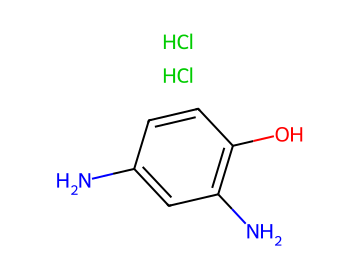
IDENTITY
COMPUTED
PROPERTIES
GRAYISH-WHITE CRYSTALS
NEEDLES
greater than or equal to 100 mg/mL at 74.3 °F (NTP, 1992)
27.5 G/100 ML WATER @ 15 °C; SLIGHTLY SOL IN ALCOHOL
SLIGHTLY SOL IN ETHER
432 °F (decomposes) (NTP, 1992)
205 °C
Grayish-white crystals. (NTP, 1992)
Grayish-white solid; [HSDB] Slightly gray crystalline solid; [MSDSonline]
GHS
Danger
H301 (96.1%): Toxic if swallowed [Danger Acute toxicity, oral];H315 (94.1%): Causes skin irritation [Warning Skin corrosion/irritation];H317 (13.7%): May cause an allergic skin reaction [Warning Sensitization, Skin];H319 (94.1%): Causes serious eye irritation [Warning Serious eye damage/eye irritation];H334 (13.7%): May cause allergy or asthma symptoms or breathing difficulties if inhaled [Danger Sensitization, respiratory];H335 (94.1%): May cause respiratory irritation [Warning Specific target organ toxicity, single exposure; Respiratory tract irritation]
P233, P260, P261, P264, P264+P265, P270, P271, P272, P280, P284, P301+P316, P302+P352, P304+P340, P305+P351+P338, P319, P321, P330, P332+P317, P333+P317, P337+P317, P342+P316, P362+P364, P403, P403+P233, P405, and P501 (click each P-code to see the statement)
Aggregated GHS information provided per 51 reports by companies from 10 notifications to the ECHA C&L Inventory. Each notification may be associated with multiple companies.;Information may vary between notifications depending on impurities, additives, and other factors. The percentage value in parenthesis indicates the notified classification ratio from companies that provide hazard codes. Only hazard codes with percentage values above 10% are shown. For more detailed information, please visit ECHA C&L website.
HAZARDS
Chemical: Phenol, 2,4-diamino-, hydrochloride (1:2)
4-Hydroxy-1,3-phenylenediammonium dichloride: Does not have an individual approval but may be used under an appropriate group standard
IMAP assessments - Phenol, 2,4-diamino-, dihydrochloride: Human health tier II assessment
Poison
Flash point data for this chemical are not available. It is probably combustible. (NTP, 1992)
SYMPTOMS: Symptoms of exposure to this chemical may include hematurea, local irritation, and allergic reactions.;ACUTE/CHRONIC HAZARDS: This compound may cause local irritation on contact. It may also cause allergic reactions in susceptible individuals. (NTP, 1992)
Limited evidence of mutagenicity and carcinogenicity in male mice; No evidence of carcinogenicity in female mice or male and female rats; Emergency treatment: Paraphenylenediamine; In sensitized individuals, paraphenylenediamine may cause allergic contact dermatitis following application as a hair dye and asthma following inhalation; Following ingestion, can cause angioneurotic edema, methemoglobinemia, acute tubular necrosis, and hepatotoxicity; An adult died after ingestion of 3 grams of p-phenylenediamine; Another adult who ingested 1800 mg developed angioneurotic edema and acute renal failure; [HSDB] May cause irritation and allergic reactions; [CAMEO] Causes changes in liver and bladder weight, erythrocyte count, and levels of transaminases in high-dose feeding studies of mice; [RTECS] See p-Phenylenediamine.
Phenols and Cresols;Salts, Acidic
DHHS/NTP; Toxicology & Carcinogenesis Studies of 2,4-Diaminophenol Dihydrochloride in F344/N Rats and B6C3F1 Mice (Gavage Studies) Technical Report Series No. 401 (1992) NIH Publication No. 92-2856
2,4-DIAMINOPHENOL DIHYDROCHLORIDE is an acidic salt, and it may react with chemical bases to release heat.
Water soluble.
Acute Tox. 3 (96.1%);Skin Irrit. 2 (94.1%);Skin Sens. 1 (13.7%);Eye Irrit. 2 (94.1%);Resp. Sens. 1 (13.7%);STOT SE 3 (94.1%)
Acute toxicity (ingestion) - category 4;Specific target organ toxicity (repeated exposure) - category 2
Acute toxicity (Oral) - Category 3;Specific target organ toxicity - Repeated exposure - Category 2 (kidney, hematopoietic system)
SAFETY
Fires involving this material can be controlled with a dry chemical, carbon dioxide or Halon extinguisher. (NTP, 1992)
EYES: First check the victim for contact lenses and remove if present. Flush victim's eyes with water or normal saline solution for 20 to 30 minutes while simultaneously calling a hospital or poison control center. Do not put any ointments, oils, or medication in the victim's eyes without specific instructions from a physician. IMMEDIATELY transport the victim after flushing eyes to a hospital even if no symptoms (such as redness or irritation) develop.;SKIN: IMMEDIATELY flood affected skin with water while removing and isolating all contaminated clothing. Gently wash all affected skin areas thoroughly with soap and water. If symptoms such as redness or irritation develop, IMMEDIATELY call a physician and be prepared to transport the victim to a hospital for treatment.;INHALATION: IMMEDIATELY leave the contaminated area; take deep breaths of fresh air. If symptoms (such as wheezing, coughing, shortness of breath, or burning in the mouth, throat, or chest) develop, call a physician and be prepared to transport the victim to a hospital. Provide proper respiratory protection to rescuers entering an unknown atmosphere. Whenever possible, Self-Contained Breathing Apparatus (SCBA) should be used; if not available, use a level of protection greater than or equal to that advised under Protective Clothing.;INGESTION: DO NOT INDUCE VOMITING. If the victim is conscious and not convulsing, give 1 or 2 glasses of water to dilute the chemical and IMMEDIATELY call a hospital or poison control center. Be prepared to transport the victim to a hospital if advised by a physician. If the victim is convulsing or unconscious, do not give anything by mouth, ensure that the victim's airway is open and lay the victim on his/her side with the head lower than the body. DO NOT INDUCE VOMITING. IMMEDIATELY transport the victim to a hospital. (NTP, 1992)
SMALL SPILLS AND LEAKAGE: If you spill this chemical, you should dampen the solid spill material with water, then transfer the dampened material to a suitable container. Use absorbent paper dampened with water to pick up any remaining material. Seal your contaminated clothing and the absorbent paper in a vapor-tight plastic bag for eventual disposal. Wash all contaminated surfaces with a soap and water solution. Do not reenter the contaminated area until the Safety Officer (or other responsible person) has verified that the area has been properly cleaned.;STORAGE PRECAUTIONS: You should protect this material from exposure to light, and store it in a refrigerator. (NTP, 1992)
Excerpt from ERG Guide 154 [Substances - Toxic and/or Corrosive (Non-Combustible)]:;IMMEDIATE PRECAUTIONARY MEASURE: Isolate spill or leak area in all directions for at least 50 meters (150 feet) for liquids and at least 25 meters (75 feet) for solids.;SPILL: Increase the immediate precautionary measure distance, in the downwind direction, as necessary.;FIRE: If tank, rail tank car or highway tank is involved in a fire, ISOLATE for 800 meters (1/2 mile) in all directions; also, consider initial evacuation for 800 meters (1/2 mile) in all directions. (ERG, 2024)
RECOMMENDED RESPIRATOR: Where the neat test chemical is weighed and diluted, wear a NIOSH-approved half face respirator equipped with an organic vapor/acid gas cartridge (specific for organic vapors, HCl, acid gas and SO2) with a dust/mist filter. (NTP, 1992)
TOXICITY
Occupational hepatotoxin - Secondary hepatotoxins: the potential for toxic effect in the occupational setting is based on cases of poisoning by human ingestion or animal experimentation.;Methemoglobinemia - The presence of increased methemoglobin in the blood; the compound is classified as secondary toxic effect;Skin Sensitizer - An agent that can induce an allergic reaction in the skin.
On the basis of the data included in this report, the CIR Expert Panel concludes that 2,4-Diaminophenol and 2,4-Diaminophenol Dihydrochloride are safe for use in hair dyes at concentrations up to 0.2% (as the free base). 2009 RE-REVIEW - The Expert Panel noted that 2,4-Diaminophenol Dihydrochloride is now termed 2,4-Diaminophenol Hydrochloride.
Safe for use in cosmetics, with qualifications
On the basis of the data included in this report, the CIR Expert Panel concludes that 2,4-Diaminophenol and 2,4-Diaminophenol Dihydrochloride are safe for use in hair dyes at concentrations up to 0.2% (as the free base). 2009 RE-REVIEW - The Expert Panel noted that 2,4-Diaminophenol Dihydrochloride is now termed 2,4-Diaminophenol Hydrochloride.
Safe for use in cosmetics, with qualifications
The following link will take the user to the National Toxicology Program (NTP) Test Agent Search Results page, which tabulates all of the "Standard Toxicology & Carcinogenesis Studies", "Developmental Studies", and "Genetic Toxicity Studies" performed with this chemical. Clicking on the "Testing Status" link will take the user to the status (i.e., in review, in progress, in preparation, on test, completed, etc.) and results of all the studies that the NTP has done on this chemical. [http://ntp-apps.niehs.nih.gov/ntp_tox/index.cfm?fuseaction=ntpsearch.searchresults&searchterm=137-09-7]
SEE PHENYLENEDIAMINE. PRODUCES SEVERE LOCAL REACTIONS & SYSTEMIC EFFECTS FROM PERCUTANEOUS ABSORPTION & FROM INGESTION. LOCAL ACTIONS INCLUDE SEVERE DERMATITIS & URTICARIA; IN THE EYE, CHEMOSIS, LACRIMATION, EXOPHTHALMOS, OPHTHALMIA, & EVEN PERMANENT BLINDNESS. SYSTEMIC ACTIONS INCLUDE ASTHMA, GASTRITIS (REGARDLESS OF PORTAL OF ENTRY), RISE IN BLOOD PRESSURE, TRANSUDATION INTO SEROUS CAVITIES, VERTIGO, TREMORS CONVULSIONS, & COMA. /PHENYLENEDIAMINE/
2,4-Diaminophenol Dihydrochloride
TR-401: NTP Technical Report on the Toxicology and Carcinogenesis Studies of 2,4-Diaminophenol Dihydrochloride (CASRN 137-09-7) in F344/N Rats and B6C3F1 Mice (Gavage Studies) (1992 )
03/11/91
No Evidence
No Evidence
Some Evidence
2,4-DIAMINOPHENOL DIHYDROCHLORIDE HAS BEEN TESTED BY IRRIGATING A RABBIT EYE WITH 0.02 MOLAR (PH 5.3) AQUEOUS SOLUTION FOR 10 MINUTES, AFTER REMOVAL OF THE CORNEAL EPITHELIUM TO FACILITATE PENETRATION. THIS PRODUCED DARK BROWN STAINING OF THE CORNEAL STROMA, PERMANENT CORNEAL OPACIFICATION, & VASCULARIZATION.
2,4-Diaminophenol dihydrochloride was evaluated for its mutagenic potential in the L5178Y TK+/TK- mouse lymphoma forward mutation assay using established procedures. Three experiments were conducted without metabolic activation. The dose levels tested in these experiments ranged from 0-4 ug/ml. Results from one experiment were discarded; however, significant mutagenic responses were obtained in the remaining two. Thus, 2,4-Diaminophenol dihyrochloride was positive in these tests and the lowest effective dose tested was 2 ug/ml.
... Conclusions: Under the conditions of these 2 yr gavage studies, there was no evidence of carcinogenic activity of 2,4-diaminophenol dihydrochloride in male or female F344/N rats that received 12.5 or 25 mg/kg. There was some evidence of carcinogenic activity of 2,4-diaminophenol dihydrochloride in male B6C3F1 mice based on incr incidences of renal tubule adenomas; there was no evidence of carcinogenic activity of 2,4-diaminophenol dihydrochloride in female B6C3F1 mice that received 19 or 38 mg/kg.
... Toxicology and carcinogenesis studies were conducted by administering 2,4-diaminophenol dihydrochloride (greater than 97% pure) in corn oil by gavage to F344/N rats and B6C3F1 mice for ... 2 years. ... 2 Yr Studies: The 2 yr studies were conducted by administering 2,4-diaminophenol dihydrochloride in corn oil by gavage to groups of 60 male and 60 female F344/N rats and B6C3F1 mice. ... Rats received doses of 0, 12.5, or 25 mg/kg; mice received doses of 0, 19, or 38 mg/kg. Conclusions: Under the conditions of these 2 yr gavage studies, there was no evidence of carcinogenic activity of 2,4-diaminophenol dihydrochloride in male or female F344/N rats that received 12.5 or 25 mg/kg. There was some evidence of carcinogenic activity of 2,4-diaminophenol dihydrochloride in male B6C3F1 mice based on incr incidences of renal tubule adenomas; there was no evidence of carcinogenic activity of 2,4-diaminophenol dihydrochloride in female B6C3F1 mice that received 19 or 38 mg/kg.
REGULATORY
Chemical: Phenol, 2,4-diamino-, hydrochloride (1:2)
4-Hydroxy-1,3-phenylenediammonium dichloride: Does not have an individual approval but may be used under an appropriate group standard
USES
CIR ingredient: 2,4-Diaminophenol Dihydrochloride
CIR ingredient: 2,4-Diaminophenol HCl
Used as photographic developer, analytical reagent, and in fur and hair dyeing; [HSDB]
Photographic Processing [Category: Other];Fur Dressing and Dyeing [Category: Industry];Dressing Hair [Category: Other]
AS PHOTOGRAPHIC DEVELOPER; IN FUR & HAIR DYEING; IN TEST FOR FORMALDEHYDE & AMMONIA
ANALYTICAL REAGENT
BY INTERACTION OF DINITROPHENOL WITH IRON & HYDROCHLORIC ACID.
Cosmetics -> Hair dyeing
Phenol, 2,4-diamino-, hydrochloride (1:2): ACTIVE
ALIASES
REACTIONS
uspto-grants-2016_09 · 10.6084/m9.figshare.5104873.v1 · US09447054B2
查看
uspto-grants-2016_09 · 10.6084/m9.figshare.5104873.v1 · US09447054B2
查看
uspto-grants-2016_09 · 10.6084/m9.figshare.5104873.v1 · US09447054B2
查看
uspto-grants-2016_09 · 10.6084/m9.figshare.5104873.v1 · US09447054B2
查看
uspto-grants-2013_08 · 10.6084/m9.figshare.5104873.v1 · US08501713B2
查看
uspto-grants-2013_08 · 10.6084/m9.figshare.5104873.v1 · US08518980B2
查看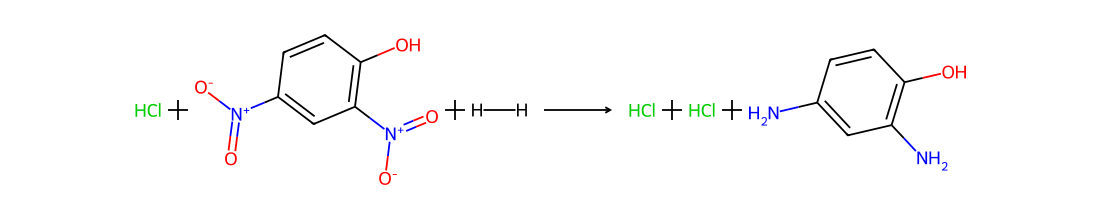
uspto-grants-1982_04 · 10.6084/m9.figshare.5104873.v1 · US04323708
查看