
Training data from https://doi.org/10.1039/C8SC04228D (4/10) · 10.1039/C8SC04228D
查看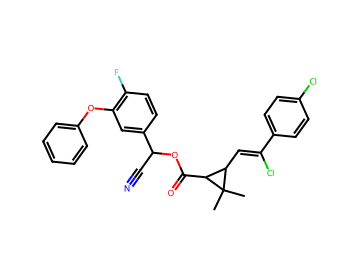
IDENTITY
COMPUTED
GHS
Danger
H300 (34.7%): Fatal if swallowed [Danger Acute toxicity, oral];H301 (65.3%): Toxic if swallowed [Danger Acute toxicity, oral];H310 (34.7%): Fatal in contact with skin [Danger Acute toxicity, dermal];H311 (41.6%): Toxic in contact with skin [Danger Acute toxicity, dermal];H315 (41.6%): Causes skin irritation [Warning Skin corrosion/irritation];H317 (41.6%): May cause an allergic skin reaction [Warning Sensitization, Skin];H319 (76.2%): Causes serious eye irritation [Warning Serious eye damage/eye irritation];H330 (26.7%): Fatal if inhaled [Danger Acute toxicity, inhalation];H331 (38.6%): Toxic if inhaled [Danger Acute toxicity, inhalation];H335 (23.8%): May cause respiratory irritation [Warning Specific target organ toxicity, single exposure; Respiratory tract irritation];H360 (34.7%): May damage fertility or the unborn child [Danger Reproductive toxicity];H370 (34.7%): Causes damage to organs [Danger Specific target organ toxicity, single exposure];H372 (34.7%): Causes damage to organs through prolonged or repeated exposure [Danger Specific target organ toxicity, repeated exposure];H400 (23.8%): Very toxic to aquatic life [Warning Hazardous to the aquatic environment, acute hazard];H410 (58.4%): Very toxic to aquatic life with long lasting effects [Warning Hazardous to the aquatic environment, long-term hazard]
P203, P260, P261, P262, P264, P264+P265, P270, P271, P272, P273, P280, P284, P301+P316, P302+P352, P304+P340, P305+P351+P338, P308+P316, P316, P318, P319, P320, P321, P330, P332+P317, P333+P317, P337+P317, P361+P364, P362+P364, P391, P403+P233, P405, and P501 (click each P-code to see the statement)
Aggregated GHS information provided per 101 reports by companies from 5 notifications to the ECHA C&L Inventory. Each notification may be associated with multiple companies.;Information may vary between notifications depending on impurities, additives, and other factors. The percentage value in parenthesis indicates the notified classification ratio from companies that provide hazard codes. Only hazard codes with percentage values above 10% are shown. For more detailed information, please visit ECHA C&L website.
HAZARDS
Flumethrin: HSNO Approval: HSR003432 Approved with controls
IMAP assessments - Cyclopropanecarboxylic acid, 3-[2-chloro-2-(4-chlorophenyl)ethenyl]-2,2-dimethyl-, cyano(4-fluoro-3-phenoxyphenyl)methyl ester: Environment tier I assessment;IMAP assessments - Cyclopropanecarboxylic acid, 3-[2-chloro-2-(4-chlorophenyl)ethenyl]-2,2-dimethyl-, cyano(4-fluoro-3-phenoxyphenyl)methyl ester: Human health tier I assessment
Acute Tox. 2 (34.7%);Acute Tox. 3 (65.3%);Acute Tox. 1 (34.7%);Acute Tox. 3 (41.6%);Skin Irrit. 2 (41.6%);Skin Sens. 1 (41.6%);Eye Irrit. 2 (76.2%);Acute Tox. 2 (26.7%);Acute Tox. 3 (38.6%);STOT SE 3 (23.8%);Repr. 1B (34.7%);STOT SE 1 (34.7%);STOT RE 1 (34.7%);Aquatic Acute 1 (23.8%);Aquatic Chronic 1 (58.4%)
Acute toxicity - category 3
TOXICITY
Following oral exposure, the treatment is symptomatic and supportive and includes monitoring for the development of hypersensitivity reactions with respiratory distress. Provide adequate airway management when needed. Gastric decontamination is usually not required unless the pyrethrin product is combined with a hydrocarbon. Following inhalation exposure, move patient to fresh air. monitor for respiratory distress. If cough or difficulty breathing develops, evaluate for respiratory tract irritation, bronchitis, or pneumonitis. Administer oxygen and assist ventilation as required. Treat bronchospasm with inhaled beta2 agonist and oral or parenteral corticosteroids. In case of eye exposure, irrigate exposed eyes with copious amounts of room temperature water for at least 15 minutes. If irritation, pain, swelling, lacrimation, or photophobia persist, the patient should be seen in a health care facility. If the contamination occurs through dermal exposure, remove contaminated clothing and wash exposed area thoroughly with soap and water. A physician may need to examine the area if irritation or pain persists. Vitamin E topical application is highly effective in relieving parenthesis. (T36)
At high doses, signs of poisoning attributable to flumethrin include profuse salivation and pulmonary edema, clonic seizures, opisthotonos (i.e., the spine is bent forward such that a supine body rests on its head and heels), coma, and death. At lower doses, commonly observed effects include paresthesia and erythema. (L863)
Inhalation (L857) ; oral (L857) ; dermal (L857) ; eye contact (L857).
Pyrethroids exert their effect by prolonging the open phase of the sodium channel gates when a nerve cell is excited. They appear to bind to the membrane lipid phase in the immediate vicinity of the sodium channel, thus modifying the channel kinetics. This blocks the closing of the sodium gates in the nerves, and thus prolongs the return of the membrane potential to its resting state. The repetitive (sensory, motor) neuronal discharge and a prolonged negative afterpotential produces effects quite similar to those produced by DDT, leading to hyperactivity of the nervous system which can result in paralysis and/or death. Other mechanisms of action of pyrethroids include antagonism of gamma-aminobutyric acid (GABA)-mediated inhibition, modulation of nicotinic cholinergic transmission, enhancement of noradrenaline release, and actions on calcium ions. (T18, L857)
Following dermal exposure to flumethrin, feelings of numbness, itching, burning, stinging, tingling, or warmth may occur, that could last for a few hours. Dizziness, headache, nausea, muscle twitching, reduced energy, and changes in awareness can result from inhalation or ingestion of large amounts of flumethrin. Paralysis can occur after exposure. (L857)
No indication of carcinogenicity to humans (not listed by IARC).
LD50: > 100 mg/kg (Oral, Rat) (L885) LD50: > 2000 mg/kg (Dermal, Rat) (L885) LD50: ~3000 mg/kg (Inhalation, Rat) (L885)
REGULATORY
Flumethrin: HSNO Approval: HSR003432 Approved with controls
PHARMACOLOGY
QP - Antiparasitic products, insecticides and repellents;QP53 - Ectoparasiticides, insecticides and repellents;QP53A - Ectoparasiticides for topical use, incl. insecticides;QP53AC - Pyrethrins and pyrethroids;QP53AC05 - Flumethrin
The highest concentration is found in the liver, but high concentrations were also found in the spleen, kidney, lung, adrenal cortex, cartilage, bone marrow, pineal gland, pituitary, and subcutaneous adipose tissue; the lowest concentrations are found in the central nervous system. Flumethrin is excreted in the urine or the feces as unchanged compound or the metabolite, 3-[2-chloro-2-(4-chlorophenyl)ethenyl]-2,2-dimethylcyclopropanecarboxylic acid, flumethrin acid. 3-(4'-hydroxy-phenoxy)-4-fluorobenzoic acid and 3-phenoxy-4-fluorobenzoic acid can further be found in the urine as well as their glycine conjugates. The phenyl ring may be hydroxylated and, following ester bond hydrolysis, the cyano group is converted to SCN- and carbon dioxide and 3-phenoxybenzaldehyde is oxidized to the carboxylic acid. The resultant acids and phenols can then conjugate with glucuronic acid, sulfate, and/or amino acids. (L885)
USES
Pyrethroids are used as insecticides. (L857)
Information on 3 consumer products that contain Flumethrin in the following categories is provided:;• Pet Care
Veterinary Drug -> INSECTICIDE; Veterinary Drug -> -> JECFA Functional Classes
ALIASES
REACTIONS
Training data from https://doi.org/10.1039/C8SC04228D (4/10) · 10.1039/C8SC04228D
查看