
uspto-grants-2006_08 · 10.6084/m9.figshare.5104873.v1 · US07098331B2
查看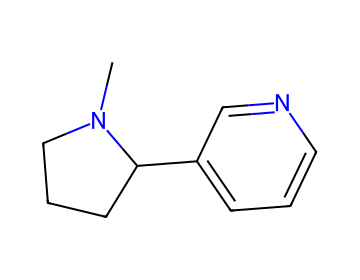
IDENTITY
COMPUTED
PROPERTIES
1358
1884
GHS
Danger
H301 (92.7%): Toxic if swallowed [Danger Acute toxicity, oral];H310 (100%): Fatal in contact with skin [Danger Acute toxicity, dermal];H411 (100%): Toxic to aquatic life with long lasting effects [Hazardous to the aquatic environment, long-term hazard]
P262, P264, P270, P273, P280, P301+P316, P302+P352, P316, P321, P330, P361+P364, P391, P405, and P501 (click each P-code to see the statement)
Aggregated GHS information provided per 41 reports by companies from 4 notifications to the ECHA C&L Inventory. Each notification may be associated with multiple companies.;Information may vary between notifications depending on impurities, additives, and other factors. The percentage value in parenthesis indicates the notified classification ratio from companies that provide hazard codes. Only hazard codes with percentage values above 10% are shown. For more detailed information, please visit ECHA C&L website.
HAZARDS
Acute Tox. 3 (92.7%);Acute Tox. 2 (100%);Aquatic Chronic 2 (100%)
TOXICITY
Other supportive measures include diazepam or barbiturates for seizures, atropine for excessive bronchial secretions or diarrhea, respiratory support for respiratory failure, and vigorous fluid support for hypotension and cardiovascular collapse. (L1712)
Nicotine has mood-altering effects that may include relaxation, sharpness, calmness, and alertness. It may act as a stimulant or sedative/pain killer, depending on the dosage. (L327)
Oral (L327) ; Inhalation (L327) Absorption of nicotine through the buccal mucosa is relatively slow and the high and rapid rise followed by the decline in nicotine arterial plasma concentrations seen with cigarette smoking are not achieved with the inhaler. About 10% of absorbed nicotine is excreted unchanged in urine.
Nicotine is a stimulant drug that acts as an agonist at nicotinic acetylcholine receptors. These are ionotropic receptors composed up of five homomeric or heteromeric subunits. In the brain, nicotine binds to nicotinic acetylcholine receptors on dopaminergic neurons in the cortico-limbic pathways. This causes the channel to open and allow conductance of multiple cations including sodium, calcium, and potassium. This leads to depolarization, which activates voltage-gated calcium channels and allows more calcium to enter the axon terminal. Calcium stimulates vesicle trafficking towards the plasma membrane and the release of dopamine into the synapse. Dopamine binding to its receptors is responsible the euphoric and addictive properties of nicotine. Nicotine also binds to nicotinic acetylcholine receptors on the chromaffin cells in the adrenal medulla. Binding opens the ion channel allowing influx of sodium, causing depolarization of the cell, which activates voltage-gated calcium channels. Calcium triggers the release of epinephrine from intracellular vesicles into the bloodstream, which causes vasoconstriction, increased blood pressure, increased heart rate, and increased blood sugar.
Symptoms of overdose include nausea, abdominal pain, vomiting, diarrhea, diaphoresis, flushing, dizziness, disturbed hearing and vision, confusion, weakness, palpitations, altered respiration and hypotension.
No indication of carcinogenicity to humans (not listed by IARC).
LD50: 140 mg/kg (Dermal, Rat) LD50: 25 mg/kg (Subcutaneous, Rat) LD50: 5900 ug/kg (Intraperitoneal, Mouse) LD50: 2.8 mg/kg (Intravenous, Rat) (T80) LD50: 24 mg/kg (Oral, Mouse) (T18)
PHARMACOLOGY
Nicotine has known human metabolites that include Nicotine N-glucuronide.
As nicotine enters the body, it is distributed quickly through the bloodstream and can cross the blood-brain barrier. On average it takes about seven seconds for the substance to reach the brain when inhaled. The half life of nicotine in the body is around two hours. Nicotine is metabolized in the liver by cytochrome P450 enzymes (mostly CYP2A6, and also by CYP2B6). A major metabolite is cotinine. Other primary metabolites include nicotine N'-oxide, nornicotine, nicotine isomethonium ion, 2-hydroxynicotine and nicotine glucuronide. (L327) Route of Elimination: About 10% of the nicotine absorbed is excreted unchanged in the urine. Half Life: Cotinine has a half life of 15-20 hours, while nicotine has a half life of 1-3 hours
USES
Nicotine is highly toxic alkaloid found in the nightshade family of plants (Solanaceae). (L327) NICOTROL Inhaler is indicated as an aid to smoking cessation for the relief of nicotine withdrawal symptoms. NICOTROL Inhaler therapy is recommended for use as part of a comprehensive behavioral smoking cessation program. It is used for the relief of nicotine withdrawal symptoms and as an aid to smoking cessation.
ALIASES
REACTIONS
uspto-grants-2006_08 · 10.6084/m9.figshare.5104873.v1 · US07098331B2
查看
uspto-grants-2010_06 · 10.6084/m9.figshare.5104873.v1 · US07732607B2
查看
uspto-grants-2008_09 · 10.6084/m9.figshare.5104873.v1 · US07425561B2
查看
uspto-grants-2013_09 · 10.6084/m9.figshare.5104873.v1 · US08541447B2
查看
uspto-grants-1997_04 · 10.6084/m9.figshare.5104873.v1 · US05625070
查看
uspto-grants-2016_09 · 10.6084/m9.figshare.5104873.v1 · US09440948B2
查看
Training data from https://doi.org/10.1039/C8SC04228D (6/10) · 10.1039/C8SC04228D
查看
uspto-grants-2012_06 · 10.6084/m9.figshare.5104873.v1 · US08198296B2
查看