
Training data from https://doi.org/10.1039/C8SC04228D (9/10) · 10.1039/C8SC04228D
查看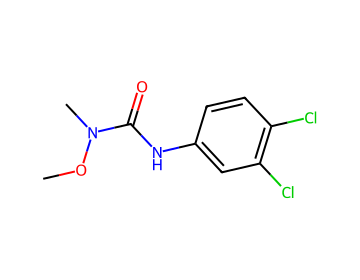
IDENTITY
COMPUTED
PROPERTIES
log Kow=3.20
3.2
ODORLESS
1.49 @ 20 °C
White crystalline solid
Colorless crystals
Fine flakes or coarse powder
PARTIALLY SOL IN TOLUENE
SPARINGLY SOL IN ALIPHATIC HYDROCARBONS
In acetone 500, benzene 150, ethanol 150, xylene 130, n-heptane 15 (all in g/kg at 25 °C). Readily soluble in dimethylformamide, chloroform, and diethyl ether. Moderately soluble in aromatic hydrocarbons. Sparingly soluble in aliphatic hydrocarbons.
In water, 75 mg/l @ 25 °C
Solubility in water, g/100ml:
Non-corrosive
When heated to decomposition it emits very toxic fumes of /hydrogen chloride and nitrogen oxides/.
93-94 °C
93-94 °C
0.00000143 [mmHg]
1.43X10⁻⁶ mm Hg @ 25 °C
Vapor pressure, Pa at 24 °C: 0.002
Henry's Law constant= 1.97X10⁻⁹ atm-cu m/mol @ 25 °C
Linuron appears as colorless crystals. Non corrosive. Used as an herbicide.
Colorless or white odorless solid; [HSDB] Colorless odorless fine crystalline powder; [MSDSonline]
COLOURLESS CRYSTALS.
It is stable at its melting point & in neutral aqueous media.
DRY FORMULATIONS ARE STABLE UNDER NORMAL STORAGE CONDITIONS.
Hydrolyzed slowly by acids and alkalis at normal temperatures, and more rapidly at higher temperatures.
GHS
Danger
H302: Harmful if swallowed [Warning Acute toxicity, oral];H351: Suspected of causing cancer [Warning Carcinogenicity];H360Df: May damage the unborn child; Suspected of damaging fertility [Danger Reproductive toxicity];H373 **: May causes damage to organs through prolonged or repeated exposure [Warning Specific target organ toxicity, repeated exposure];H400: Very toxic to aquatic life [Warning Hazardous to the aquatic environment, acute hazard];H410: Very toxic to aquatic life with long lasting effects [Warning Hazardous to the aquatic environment, long-term hazard]
P203, P260, P264, P270, P273, P280, P301+P317, P318, P319, P330, P391, P405, and P501 (click each P-code to see the statement)
Danger
HAZARDS
Hazard Traits - Developmental Toxicity; Reproductive Toxicity;Authoritative List - EC Annex VI CMRs - Cat. 1B; Prop 65;Report - regardless of intended function of ingredient in the product
Commission Regulation No 844/2012
Linuron is listed in the dataset of EPA Human Health Benchmarks for Pesticides under the Safe Drinking Water Act (40 eCFR 141)
03/31/EC, Reg (EU) 2015/408, Reg. (EU) 2016/950, Reg. (EU) 2017/244, Reg. (EU) No 540/2011, Reg. (EU) No 823/2012
Linuron: Does not have an individual approval but may be used under an appropriate group standard
The New Jersey Worker and Community Right to Know Act requires public and private employers to provide information about hazardous substances at their workplaces. (N.J.S.A. 34:5A-1 et. seq.)
IMAP assessments - Urea, N'-(3,4-dichlorophenyl)-N-methoxy-N-methyl-: Environment tier I assessment;IMAP assessments - Urea, N'-(3,4-dichlorophenyl)-N-methoxy-N-methyl-: Human health tier I assessment
Class 9
Excerpt from ERG Guide 171 [Substances (Low to Moderate Hazard)]:;Some may burn but none ignite readily. Containers may explode when heated. Some may be transported hot. For UN3508, Capacitor, asymmetric, be aware of possible short circuiting as this product is transported in a charged state. Polymeric beads, expandable (UN2211) may evolve flammable vapours. (ERG, 2024)
Combustible. Liquid formulations containing organic solvents may be flammable. Gives off irritating or toxic fumes (or gases) in a fire.
Excerpt from ERG Guide 171 [Substances (Low to Moderate Hazard)]:;Inhalation of material may be harmful. Contact may cause burns to skin and eyes. Inhalation of Asbestos dust may have a damaging effect on the lungs. Fire may produce irritating, corrosive and/or toxic gases. Some liquids produce vapors that may cause dizziness or asphyxiation. Runoff from fire control or dilution water may cause environmental contamination. (ERG, 2024)
May cause skin, eye, nose, and throat irritation; Urea-derived herbicides have low toxicity in animal feeding studies; May induce methemoglobinemia; [HSDB] Systemic toxicity unlikely unless large amounts ingested; [EPA Pesticides, p. 122] May effect blood causing anemia; [ICSC] May cause irritation; [MSDSonline] May interfere with fertility in rats because of its antiandrogenic effects; [REPROTOX]
Amides and Imides;Aryl Halides;Amines, Aromatic
Symbol: T, N; R: 61-22-40-48/22-62-50/53; S: 53-45-60-61
As the federal pesticide law FIFRA directs, EPA is conducting a comprehensive review of older pesticides to consider their health and environmental effects and make decisions about their future use. Under this pesticide reregistration program, EPA examines health and safety data for pesticide active ingredients initially registered before November 1, 1984, and determines whether they are eligible for reregistration. In addition, all pesticides must meet the new safety standard of the Food Quality Protection Act of 1996. Linuron is found on List A, which contains most food use pesticides and consists of the 194 chemical cases (or 350 individual active ingredients) for which EPA issued registration standards prior to FIFRA, as amended in 1988. Case No: 0047; Pesticide type: herbicide; Registration Standard Date: 06/29/84; Case Status: RED Approved 12/94; OPP has made a decision that some/all uses of the pesticide are eligible for reregistration, as reflected in a Reregistration Eligibility Decision (RED) document.; Active ingredient (AI):Linuron; Data Call-in (DCI) Date(s): 09/04/90, 11/08/93, 04/28/95; AI Status: OPP has completed a Reregistration Eligibility Decision (RED) document for the case/AI.
Tolerances are established for residues of the herbicide linuron (3-(3,4-dichlorophenyl)-1-methoxy-1-methylurea) in or on the following food commodities: asparagus; carrots; cattle, fat; cattle, mbyp; cattle, meat; celery; corn, field, fodder; corn, field, forage; corn, fresh (inc. sweet K+CWHR); corn, grain (inc. pop); corn, sweet, fodder; corn, sweet, forage; cottonseed; goats, fat; goats, mbyp; goats, meat; hogs, fat; hogs, mbyp; hogs, meat; horses, fat; horses, mbyp; horses, meat; parsnips (with or without tops); potatoes; sheep, fat; sheep, mbyp; sheep, meat; sorghum, fodder; sorghum, forage; sorghum, grain (milo); soybeans (dry and succulent); soybeans, forage; soybeans, hay; wheat, forage; wheat, grain; wheat, hay; and wheat, straw.
Tolerances with regional registration, as defined in 180.1(n), are established for residues of the herbicide linuron 3-(3,4- dichlorophenyl)-1-methoxy-1-methylurea in or on the following food commodity: parsley.
A urea derivative.
Decomposes on heating. This produces toxic fumes including hydrogen chloride and nitrogen oxides.
Do not transport with food and feedstuffs.
SAFETY
Excerpt from ERG Guide 171 [Substances (Low to Moderate Hazard)]:;CAUTION: Fire involving Safety devices (UN3268) and Fire suppressant dispersing devices (UN3559) may have a delayed activation and a risk of hazardous projectiles. Extinguish the fire at a safe distance.;SMALL FIRE: Dry chemical, CO2, water spray or regular foam.;LARGE FIRE: Water spray, fog or regular foam. Do not scatter spilled material with high-pressure water streams. If it can be done safely, move undamaged containers away from the area around the fire. Dike runoff from fire control for later disposal.;FIRE INVOLVING TANKS: Cool containers with flooding quantities of water until well after fire is out. Withdraw immediately in case of rising sound from venting safety devices or discoloration of tank. ALWAYS stay away from tanks in direct contact with flames. (ERG, 2024)
Use water spray, powder, foam, carbon dioxide.
Fresh air, rest.
Rinse skin with plenty of water or shower.
First rinse with plenty of water for several minutes (remove contact lenses if easily possible), then refer for medical attention.
Rinse mouth. Rest. Refer for medical attention .
Excerpt from ERG Guide 171 [Substances (Low to Moderate Hazard)]:;Refer to the "General First Aid" section. (ERG, 2024)
Provision to contain effluent from fire extinguishing. Separated from food and feedstuffs.
Store in cool, dry place ... .
Excerpt from ERG Guide 171 [Substances (Low to Moderate Hazard)]:;Do not touch or walk through spilled material. Stop leak if you can do it without risk. Prevent dust cloud. For Asbestos, avoid inhalation of dust. Cover spill with plastic sheet or tarp to minimize spreading. Do not clean up or dispose of, except under supervision of a specialist.;SMALL DRY SPILL: With clean shovel, place material into clean, dry container and cover loosely; move containers from spill area.;SMALL SPILL: Pick up with sand or other non-combustible absorbent material and place into containers for later disposal.;LARGE SPILL: Dike far ahead of liquid spill for later disposal. Cover powder spill with plastic sheet or tarp to minimize spreading. Prevent entry into waterways, sewers, basements or confined areas. (ERG, 2024)
SRP: At the time of review, criteria for land treatment or burial (sanitary landfill) disposal practices are subject to significant revision. Prior to implementing land disposal of waste residue (including waste sludge), consult with environmental regulatory agencies for guidance on acceptable disposal practices.
Linuron should be incinerated in a unit operating at 850 °C equipped with offgas scrubbing equipment. ... Recommendable methods: Incineration.
Do NOT wash away into sewer. Sweep spilled substance into covered containers. If appropriate, moisten first to prevent dusting. Carefully collect remainder. Then store and dispose of according to local regulations. Personal protection: self-contained breathing apparatus.
AVOID BREATHING DUST OR SPRAY MIST. AVOID CONTACT WITH SKIN, EYES, & CLOTHING.
Wash contaminated clothing with soap & hot water before re-use.
Avoid contact with skin, eyes, and clothing. ... Keep out of lakes, streams, or ponds.
SRP: The scientific literature for the use of contact lenses in industry is conflicting. The benefit or detrimental effects of wearing contact lenses depend not only upon the substance, but also on factors including the form of the substance, characteristics and duration of the exposure, the uses of other eye protection equipment, and the hygiene of the lenses. However, there may be individual substances whose irritating or corrosive properties are such that the wearing of contact lenses would be harmful to the eye. In those specific cases, contact lenses should not be worn. In any event, the usual eye protection equipment should be worn even when contact lenses are in place.
Excerpt from ERG Guide 171 [Substances (Low to Moderate Hazard)]:;IMMEDIATE PRECAUTIONARY MEASURE: Isolate spill or leak area in all directions for at least 50 meters (150 feet) for liquids and at least 25 meters (75 feet) for solids.;SPILL: Increase the immediate precautionary measure distance, in the downwind direction, as necessary.;FIRE: If tank, rail tank car or highway tank is involved in a fire, ISOLATE for 800 meters (1/2 mile) in all directions; also, consider initial evacuation for 800 meters (1/2 mile) in all directions. (ERG, 2024)
Wear safety spectacles.
NO open flames.
TOXICITY
Hematologic
Linuron affects the male reproductive system of the offspring after maternal exposure during mid and late pregnancy.
LC50 RAINBOW TROUT 16 PPM/96 HR
LC50 BLUEGILL 16 PPM/96 HR
LC50 RING NECKED PHEASANT ORAL 3438 PPM, AGE 10 DAYS (95% CONFIDENCE LIMIT 2874-4139 MG/L) /50% PURE/
LC50 MALLARD ORAL 3083 PPM, AGE 5 DAYS (95% CONFIDENCE LIMIT 2419-3990 MG/L) /50% PURE/
For more Ecotoxicity Values (Complete) data for LINURON (6 total), please visit the HSDB record page.
TERRESTRIAL FATE: Based on a classification scheme(1), a Koc value ranging from 555 to 987(2), indicates that linuron is expected to have low mobility in soil(SRC). Volatilization of linuron from moist soil surfaces is not expected to be an important fate process(SRC) given an experimental Henry's Law constant of 1.97X10⁻⁹ atm-cu m/mol(3). Linuron is not expected to volatilize from dry soil surfaces(SRC) based upon its vapor pressure of 1.43X10⁻⁶ mmHg(4). The dissipation of linuron was followed in field plots planted with potatoes and treated at 1 and 2 kg/ha(5). The disappearance of linuron was very fast and followed first-order kinetics with a half-life of 25 and 22 days, respectively, at the two application rates. After about 75 days, the residual concentration of linuron in the soil was constant, suggesting that a small amount of linuron is strongly absorbed to soil colloids and not available to microbial attack(5). Most evidence indicates that linuron's loss in soil is due to biodegradation(6). For example linuron, at 4 ppm, degraded with half-lives of 22-86 days when incubated at 25 °C in 18 mineral soils(7). Photolysis of linuron on surface soils may also be an important degradation pathway. Phenyl-labeled C-14 linuron degraded with a half-life >15 days on silt loam soil irradiated continuously with a Pyrex glass filtered xenon arc light at 25 deg(8). After 15 days of irradiation, the soil contained 78.8% of the recovered radioactivity as parent linuron.
TERRESTRIAL FATE: The half-life of linuron in cropped fields was 8-25 weeks; residues were undetectable after 6 mo(1-2). No progressive buildup was observed after repeated treatment(1-2). Four weeks after a half normal, normal, and double normal spray of linuron in May on corn, carrots, bean and potato crops planted in loamy soil, an average of 40% of the applied dose was recovered(3). After 3 months, only 25% of the linuron was recovered(3). At the end of the winter months, <0.4% of the linuron was recovered(3). In Greenhouse experiments linuron's persistence was 25-60 weeks(3). In test field plots in a vegetable growing area of Ontario, 64% of linuron had dissipated in 5 months from the organic soil (92% organic matter)(4). It was concluded that linuron residues did not accumulate in soil in vegetable farms of area growers(4).
AQUATIC FATE: Based on a classification scheme(1), an experimental Koc value ranging from 555 to 987(2), indicates that linuron is expected to adsorb to suspended solids and sediment(SRC). Volatilization from water surfaces is not expected(3) based upon a Henry's Law constant of 1.97X10⁻⁹ atm-cu m/mole(4). According to a classification scheme(5), a BCF ranging from 13 to 49(6,7), suggests the potential for bioconcentration in aquatic organisms is low to moderate. Hydrolysis of linuron is not expected to occur in water except at high alkaline conditions (pH> 9)(8). There was no evidence of hydrolysis products after 4 months in buffered solutions at pH 5, 7, and 9(8). Biodegradation of linuron in surface waters appears to be site specific. Although linuron did not biodegrade when incubated with river water and sewage for 4 months(8), when it was applied as an emulsifiable formulation to ditch water, it degraded with half-lives ranging from 7.2 to 11.8 days during the stagnant period (1 week), and an average half-life of 3.8 days during the flow period (3 weeks)(9). Disappearance of linuron was slower in the higher treatment rate ditches, and in those studied during lower temperature periods(9). Photolysis of linuron is expected to occur in surface waters. In one experiment, 43% of linuron exposed to sunlight outdoors was photolyzed in 24 days(8). After 1 ppm of linuron was added to each of three 1 cu m outdoor ecosystems, linuron concns in the water columns declined exponentially over the 42-day experiment; the calculated half-lives ranged from 16 to 42 days(10). The half-life of linuron in Lake Balatan (Hungary) water was 10 weeks(11).
ATMOSPHERIC FATE: According to a model of gas/particle partitioning of semi-volatile organic compounds in the atmosphere(1), linuron, which has a vapor pressure of 1.43X10⁻⁶ mm Hg at 25 °C(2), is expected to exist in both the vapor and particulate phase in the ambient atmosphere. Vapor-phase linuron is degraded in the atmosphere by reaction with photochemically-produced hydroxyl radicals(SRC); the half-life for this reaction in air is estimated to be 12 hours(SRC), calculated from its rate constant of 1.0X10⁻¹¹ cu cm/molecule-sec at 25 °C determined using a structure estimation method(3). Particulate-phase linuron may be removed from the air by wet and dry deposition(SRC). Linuron may undergo photolysis in air based upon its absorption maximas at 210, 245, and 280 nm with some overlap at > 290 nm(4). The rate of photolysis in the environment appears to be slow. Phenyl-labeled C-14 linuron degraded with a half-life > 30 days in sterile aqueous pH 5 buffer solution irradiated with natural sunlight at 25 °C(4).
Of the 1044 composites analyzed in the FDA Adult Total Diet Study in FY1978-82, 19 contained linuron(1). In the FY1978-82 FDA'S Adult Total Diet Study Survey, the mean concn of linuron in root vegetable composites was 0.0089 ppm(2). Linuron dietary intakes estimated from the July 1986-April 1991 FDA Total Diet Study were 0.0018 ug/kg body wgt/day for a 6-11 month old; 0.0024 ug/kg body wgt/day for 2 yr old; and ranged from 0.0005 to 0.0008 ug/kg body wgt/day for respective groups of 14-16 yr, 25-30 yr, and 60-65 yr males and females (3). In a pesticide screening survey of 6970 produce samples, linuron was detected in 226 carrot samples (detection limit = 0.2 ppm); all of the samples containing linuron were carrots(4). Of the 6,568 samples of domestic food and feed the FDA analyzed between 1982 and 1986, 30 (29 of them carrots) contained linuron with levels up to 0.5 ppm(5). None of the 13,283 imported agricultural commodities tested contained linuron(5). No linuron residues (detection limit = 0.1 ppm) were found in 13 potatoes from farms in NJ, 9 from FL, and 3 from CA(6). In a 1994 surveillance study of domestic food samples collected from the U.S. and Puerto Rico, and import food samples from 101 countries, in which 329 pesticides were monitored and only 94 were found, linuron was detected in an unspecified number of samples(7).
Methemoglobinemia - The presence of increased methemoglobin in the blood; the compound is classified as secondary toxic effect
The substance can be absorbed into the body by inhalation of its aerosol and by ingestion.
Linuron is a weak competitive inhibitor of androgen receptor binding and it inhibits androgen-induced gene expression in vitro. This may partially contribute to the malformations of androgen-dependent tissues in male rats. (A9961)
FOOD INTAKE: Assumed 0.0010 ug/kg/d for a 70 kg 14-16 yr male(1). The intake of linuron from the FY1981/82 FDA's Adult Total Diet Study, in which the typical 14-day diet of a 16-19 yr male is collected throughout the US from market basket composite samples in 12 food groups, was 0.004 ug/kg body wt/day(2). An analogous FY 81/82 study for infants and toddlers determined the daily intake of linuron to be 0 and 0.001 ug/kg body wt/day for infants and toddlers, respectively(3). The daily intake of linuron for 6-11 month infants, 2-yr toddlers, 14-16 yr males and 60-65 yr females according to the 1982-1984 FDA Total Diet Study was 0.0010, 0.0014, 0.0004, 0.0005 ug/kg body wt/day, respectively(4). The major source of linuron was carrots(4). Linuron intakes estimated from the 1990 FDA Total Diet Study were 0.0027, 0.0010, and 0.0012 ug/kg/day for a 6-11 month old, a 14-16 yr male, and a 60-65 yr female, respectively(1). Linuron dietary intakes estimated from the July 1986-April 1991 FDA Total Diet Study were 0.0018 ug/kg body wgt/day for a 6-11 month old; 0.0024 ug/kg body wgt/day for 2 yr old; and ranged from 0.0005 to 0.0008 ug/kg body wgt/day for respective groups of 14-16 yr, 25-30 yr, and 60-65 yr males and females (5).
Chemical: LINURON
Runoff was collected after each rainfall or series of rainfalls from test plots (silty clay loam graded to a slope of 0.2%) planted with soybeans in the 2 to 4 month period following treatment with linuron as a preemergence herbicide. Concns of linuron in runoff in three years were: trace - 28 ppb, trace - 14 ppb, and trace - 124 ppb (trace = <10 ppb), respectively(1).
The substance is toxic to aquatic organisms. This substance may be hazardous to the environment. Special attention should be given to algae and aquatic plants. This substance does enter the environment under normal use. Great care, however, should be taken to avoid any additional release, for example through inappropriate disposal.
REGULATORY
Hazard Traits - Developmental Toxicity; Reproductive Toxicity;Authoritative List - EC Annex VI CMRs - Cat. 1B; Prop 65;Report - regardless of intended function of ingredient in the product
Commission Regulation No 844/2012
Linuron is listed in the dataset of EPA Human Health Benchmarks for Pesticides under the Safe Drinking Water Act (40 eCFR 141)
03/31/EC, Reg (EU) 2015/408, Reg. (EU) 2016/950, Reg. (EU) 2017/244, Reg. (EU) No 540/2011, Reg. (EU) No 823/2012
Linuron: Does not have an individual approval but may be used under an appropriate group standard
The New Jersey Worker and Community Right to Know Act requires public and private employers to provide information about hazardous substances at their workplaces. (N.J.S.A. 34:5A-1 et. seq.)
As the federal pesticide law FIFRA directs, EPA is conducting a comprehensive review of older pesticides to consider their health and environmental effects and make decisions about their future use. Under this pesticide reregistration program, EPA examines health and safety data for pesticide active ingredients initially registered before November 1, 1984, and determines whether they are eligible for reregistration. In addition, all pesticides must meet the new safety standard of the Food Quality Protection Act of 1996. Linuron is found on List A, which contains most food use pesticides and consists of the 194 chemical cases (or 350 individual active ingredients) for which EPA issued registration standards prior to FIFRA, as amended in 1988. Case No: 0047; Pesticide type: herbicide; Registration Standard Date: 06/29/84; Case Status: RED Approved 12/94; OPP has made a decision that some/all uses of the pesticide are eligible for reregistration, as reflected in a Reregistration Eligibility Decision (RED) document.; Active ingredient (AI):Linuron; Data Call-in (DCI) Date(s): 09/04/90, 11/08/93, 04/28/95; AI Status: OPP has completed a Reregistration Eligibility Decision (RED) document for the case/AI.
Tolerances are established for residues of the herbicide linuron (3-(3,4-dichlorophenyl)-1-methoxy-1-methylurea) in or on the following food commodities: asparagus; carrots; cattle, fat; cattle, mbyp; cattle, meat; celery; corn, field, fodder; corn, field, forage; corn, fresh (inc. sweet K+CWHR); corn, grain (inc. pop); corn, sweet, fodder; corn, sweet, forage; cottonseed; goats, fat; goats, mbyp; goats, meat; hogs, fat; hogs, mbyp; hogs, meat; horses, fat; horses, mbyp; horses, meat; parsnips (with or without tops); potatoes; sheep, fat; sheep, mbyp; sheep, meat; sorghum, fodder; sorghum, forage; sorghum, grain (milo); soybeans (dry and succulent); soybeans, forage; soybeans, hay; wheat, forage; wheat, grain; wheat, hay; and wheat, straw.
Tolerances with regional registration, as defined in 180.1(n), are established for residues of the herbicide linuron 3-(3,4- dichlorophenyl)-1-methoxy-1-methylurea in or on the following food commodity: parsley.
(MN) MINNESOTA 1 ug/l
(FL) FLORIDA 14 ug/l
(FL) FLORIDA 14 ug/l
PHARMACOLOGY
Inhibits photosynthesis.
... LINURON-INDUCIBLE ENZYME WAS OBTAINED FROM BACILLUS SPHAERICUS. THIS ACYLAMIDASE DEGRADED LINURON BY HYDROLYSIS OF AMIDE BOND WITH ... RELEASE OF CARBON DIOXIDE & N,O-DIMETHYL HYDROXYLAMINE. ... ENZYME WAS SPECIFIC FOR METHOXY-SUBSTITUTED PHENYLUREAS & DID NOT HYDROLYZE 1,1-DIMETHYL PHENYLUREAS ... .
IN GREENHOUSE STUDIES, LINURON ENTERED CORN (ZEA MAYS L), SOYBEAN (GLYCINE MAX L) & CRABGRASS (DIGITARIA SANGUINALIS L) WITH ABSORBED WATER. DEMETHYL LINURON & 3,4-DICHLORO-ANILINE WERE FOUND IN TISSUES. ... SOME LINURON BOUND WITHIN PLANT ... .
LINURON ... FED TO ALBINO RATS. URINE ... ANALYZED FOR METABOLITES /&/ N-(3,4-DICHLOROPHENYL)UREA, N-(3,4-DICHLOROPHENYL)-N'-METHYLUREA & 3,4-DICHLOROANILINE WERE FOUND FREE. N-(2-HYDROXY-4,5-DICHLOROPHENYL)-N'-METHYLUREA, N-(5-HYDROXY-3,4-DICHLOROPHENYL)UREA & 6-ACETAMIDO-2,3-DICHLOROPHENOL ... /WERE IDENTIFIED/ AS GLUCURONIDES OR SULFATES.
In rats linuron is metabolized by demethoxylation followed by hydroxylation of the benzene ring. Major urinary metabolites are urea derivatives; no unchanged linuron could be demonstrated. Only trace amounts of 3,4-dichloroaniline were found. If metabolism to dichloroaniline is major pathway in humans, ... methemoglobinemia should be anticipated after toxic doses.
For more Metabolism/Metabolites (Complete) data for LINURON (9 total), please visit the HSDB record page.
Pesticides used to destroy unwanted vegetation, especially various types of weeds, grasses (POACEAE), and woody plants. Some plants develop HERBICIDE RESISTANCE.
IN CHRONIC TOXICITY STUDIES ... LINURON ... CONTINUOUSLY FED TO RATS & DOGS FOR ... TWO YR AT DIETARY LEVELS ... FROM 25 TO 2500 PPM ... TOTAL ANILINE-CONTAINING RESIDUES IN BLOOD & ... (MUSCLE, FAT, LIVER, KIDNEY, SPLEEN) WERE A FEW TO 100 PPM. ... RESIDUES REPRESENTED ONLY MINUTE FRACTION OF ... HERBICIDE INGESTED BY ANIMALS.
LINURON IS MOST READILY ABSORBED THROUGH THE ROOT SYSTEM; LESS SO THROUGH FOLIAGE & STEMS. HOWEVER, FOLIAR ABSORPTION ... IS SIGNIFICANTLY GREATER THAN THAT OF DIURON, MONURON, OR FENURON. ... TRANSLOCATION IS PRIMARILY UPWARD IN THE XYLEM.
... RESIDUE DATA ... OBTAINED IN SHORT TERM ELIMINATION EXPERIMENTS ... . AMT OFRADIOACTIVITY WHICH PERSISTED IN BLOOD & DIFFERENT TISSUES AT END OF 72 HR ... PERIODS WERE NO MORE & USUALLY MUCH LESS THAN 1% OF DOSE APPLIED.
USES
Used as selective pre- and post-emergence herbicide; [Merck Index]
Farming (Pesticides) [Category: Industry]
For Linuron (USEPA/OPP Pesticide Code: 035506) ACTIVE products with label matches. /SRP: Registered for use in the U.S. but approved pesticide uses may change periodically and so federal, state and local authorities must be consulted for currently approved uses./
Controls germinating and newly established broadleaf weeds in crops
Herbicide .. Pre- and post emergence control of annual grass and broad-leaved weeds, and some seedling perrenial weeds...
This is a man-made compound that is used as a pesticide.
In 1992, 1,974,832 pounds of linuron were applied to soybeans, cotton, potatoes, carrots, asparagus, and celery. Approximately 80% of linuron was used on soybeans, 11% on cotton, 4% on potatoes, 4% on carrots, < 1% on asparagus, and < 1% on celery.
N,O-dimethylhydroxylamine + 3,4-dichlorophenyl isocyanate (isocycanate addition)
USEPA/OPP Pesticide Code 035506; Trade Names: Lorox; Afalon; Linorox; h 326; Linex 4L; Linex 50% DF; Cephalon; Dupont 326; lorox L; Garnitan; Hoe 2810; Linurex; lorox DF; Premalin; Sarclex.
Dry flowable, flowable, water dispersible granule, wettable powder. Trifluron* Twin Pack: emulsifiable concentrate and suspension concentrate
LIQ FORMULATIONS & MIXTURES WITH OTHER HERBICIDES, EG LENACIL, MONOLINURON ... METOXURON, /CHLORPROPHAM, CYANAZINE, POTABLAN S (200 G MONALIDE + 50 G LINURON/L), TRIETAZINE (A WETTABLE POWDER), & TRINULAN OR CHANDOR (240 G TRIFLURALIN + 120 G LINURON/L)/ ARE ALSO AVAIL.
Mixtures include: (linuron +) alachlor; atrazine; chlorpropham; cyanazine; ioxynil; lenacil; metribuzin; monolinuron; propachlor; trietazine; trifluralin; terbutryn; terbacil; amitrole; nitralin; metoxuron; monalide; bromoxynil + ioxynil + mecoprop; bromoxynil + ioxynil + dichlorprop; trietazine + trifluralin; butralin; pendimethalin; simazine.
For more Formulations/Preparations (Complete) data for LINURON (8 total), please visit the HSDB record page.
Environmental transformation -> Pesticides (parent, predecessor)
Herbicides
HERBICIDES
Urea, N'-(3,4-dichlorophenyl)-N-methoxy-N-methyl-: ACTIVE
... Compatible with most other herbicides with which they might be mixed. Certain ester formulations of hormone weed killers may create a physical problem in the spray tank.
... RECOMMENDED FOR PRE-EMERGENCE USE ON SOYBEANS AT 0.5 TO 2.5 KG AI/HA, COTTON(LAY-BY) AT 0.5 TO 1.5 KG AI/HA, ON POTATOES AT 0.5 TO 2.0 KG AI/HA, ON MAIZE, BEANS & PEAS AT 0.75 TO 1.0 KG AI/HA, ON ASPARAGUS AT 1.0 TO 1.5 KG AI/HA; FOR PRE- & POST-EMERGENCE USE ON CARROTS & WINTER WHEAT AT 0.5 TO 1.0 KG AI/HA.
... USED FOR SHORT TERM CONTROL OF ANNUAL WEEDS IN NONCROP AREAS SUCH AS ROADSIDES & FENCE ROWS.
ALIASES
REACTIONS
Training data from https://doi.org/10.1039/C8SC04228D (9/10) · 10.1039/C8SC04228D
查看
uspto-grants-1987_11 · 10.6084/m9.figshare.5104873.v1 · US04708734
查看
uspto-grants-1987_10 · 10.6084/m9.figshare.5104873.v1 · US04698094
查看
uspto-grants-1990_10 · 10.6084/m9.figshare.5104873.v1 · US04964905
查看
uspto-grants-2011_08 · 10.6084/m9.figshare.5104873.v1 · US08003569B2
查看
uspto-grants-2011_08 · 10.6084/m9.figshare.5104873.v1 · US08003569B2
查看